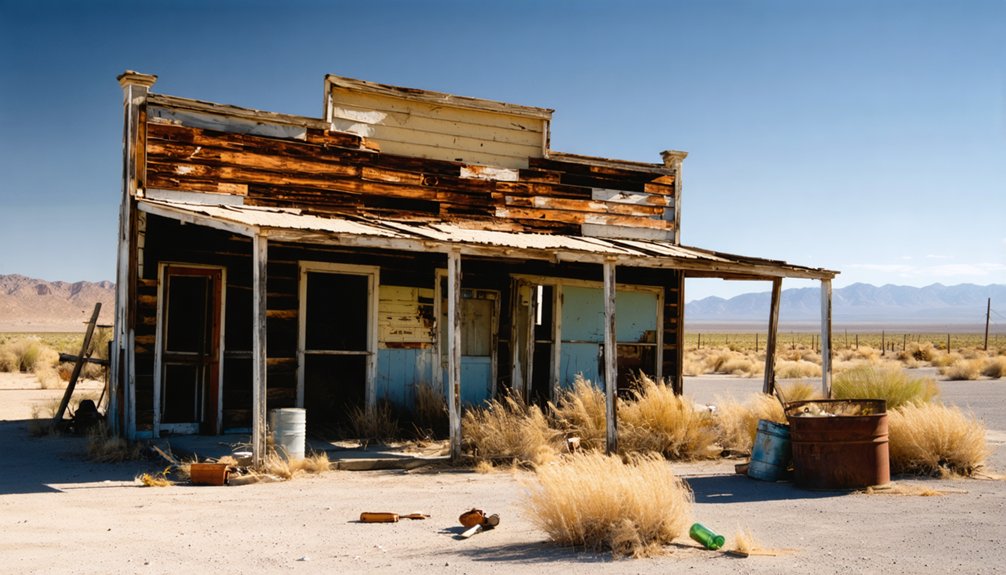
You’ll find Arizona’s most compelling ghost towns in Jerome, Tombstone, Ruby, Vulture City, and Oatman. Each offers distinct historical treasures: Jerome’s billion-dollar copper legacy, Tombstone’s legendary Wild West shootouts, Ruby’s restricted mining ruins, Vulture City’s gold-rich past with its infamous Hanging Tree, and Oatman’s wild burros roaming Route 66. These preserved settlements stand as time capsules of the American frontier, with untold stories waiting in their weathered walls.
Key Takeaways
- Tombstone offers the most authentic Wild West experience with historic reenactments, preserved buildings, and a rich silver mining heritage.
- Oatman combines Route 66 nostalgia with wild burros roaming the streets and the historic Oatman Hotel from 1922.
- Jerome’s transformation from copper mining boomtown to artistic haven makes it a uniquely vibrant ghost town experience.
- Vulture City showcases well-restored buildings and the infamous Hanging Tree, with guided tours available October through May.
- Ruby provides a rare, restricted-access ghost town experience with preserved adobe structures and massive bat colonies in abandoned mines.
The Mining Marvel of Jerome: A Town That Refused to Die
While many mining towns across Arizona succumbed to abandonment, Jerome’s remarkable story began in 1876 when prospectors first staked their claims on Cleopatra Hill‘s copper-rich slopes.
You’ll find a copper history unmatched in scale – the United Verde and UVX mines yielded over $1 billion in metals during their 77-year run, making Jerome one of the richest copper deposits ever discovered.
The town’s mining heritage transformed it from a small camp into a booming metropolis of 15,000 residents by the early 1900s. The first establishments included Nora Brown’s saloon, setting the stage for the town’s wild west character.
From tent-covered hillside to bustling city streets, Jerome’s copper mines fueled explosive growth in this Arizona boomtown.
When Phelps Dodge shuttered operations in 1953, Jerome nearly vanished. But unlike other ghost towns, it refused to fade away.
Artists and craftspeople breathed new life into abandoned buildings during the 1960s, converting former bordellos into galleries and old saloons into thriving businesses, preserving this reflection of American resilience. Like the early Christian saint Jerome who preserved ancient texts through his Latin translations, the town of Jerome preserved its own rich history through careful restoration.
Tombstone: Where the Wild West Lives On
Despite warnings that he’d find nothing but his own tombstone, prospector Ed Schieffelin’s 1877 silver discovery transformed a remote stretch of Arizona Territory into one of the West’s most legendary boomtowns.
Tombstone history reveals an explosive growth from a handful of settlers to 14,000 residents by the mid-1880s, with mines yielding up to $85 million in silver.
You’ll find the town’s Wild West culture embodied in its 110 saloons, gambling halls, and notorious red-light district, while lawlessness and “Cowboys” rustling Mexican cattle added to its dangerous reputation.
Though mining challenges, fires, and water issues plagued the town’s prosperity, Tombstone refused to fade away. Today, the town draws visitors to experience authentic Western heritage through its preserved old buildings that now house museums and shops.
The city became remarkably advanced for its era, featuring the first telephone service in Arizona Territory by 1882.
Now a National Historic Landmark, this town of 1,380 preserves its frontier heritage through historic reenactments and the carefully restored 1882 courthouse.
Ruby’s Hidden Treasures in the Coronado Forest
Unlike Tombstone’s enduring tourist appeal, Ruby stands as one of Arizona’s most intriguing yet restricted ghost towns. You’ll find this former mining powerhouse nestled in the Coronado Forest, where it once dominated Arizona’s lead and zinc production from 1935 to 1939.
Exploring ghost towns in Arizona offers a glimpse into the state’s rich mining history and the stories of those who once called these places home. Each site reveals unique remnants of a bygone era, inviting adventurers to wander through crumbling structures and ghostly landscapes. As you venture deeper into these forgotten towns, you can almost hear the echoes of the past and imagine the lives that shaped the land.
While exploring the historic landmarks in Arizona townships, visitors can also discover the remnants of cultural heritage that tell the stories of indigenous peoples and early settlers. Each landmark provides context to Arizona’s diverse history, from ancient dwellings to battles that shaped the region’s future. As you traverse these historical sites, you gain a deeper understanding of the rich tapestry that is Arizona’s past.
While you can’t freely explore the 362-acre private property, Ruby’s history remains preserved in its surviving adobe structures, including the Morton House and doctor’s residences. Today, Leslie Cherry serves as the dedicated town’s sole caretaker, welcoming visitors and maintaining the historic site.
Restricted access hasn’t diminished Ruby’s allure, with its adobe buildings standing as silent witnesses to Arizona’s mining past.
The site’s most remarkable feature lies beneath the surface, where approximately 190,000 Mexican free-tailed bats now inhabit the abandoned mine shafts, making it an essential spot for bat conservation.
Though the Montana Mine closed in 1940, Ruby’s legacy endures through its architectural remnants, massive tailings piles, and the scenic Ruby Road that offers distant views of this carefully protected ghost town. The journey to Ruby requires travelers to navigate rough dirt roads that demand high-clearance vehicles for safe passage.
Vulture City’s Golden Legacy
Gold fever struck the Arizona Territory in 1863 when Henry Wickenburg followed circling vultures to an enormous quartz outcropping along the Hassayampa River.
Within a year, Vulture City emerged as a bustling mining town, reaching 5,000 residents and establishing its golden legacy as Arizona’s richest gold mine in history. The town grew to include homes and saloons, along with essential establishments like a post office, boarding houses, and a school. Wickenburg sold 80% of the mine for $85,000 in 1866.
You’ll find tales of Wild West justice at the infamous Hanging Tree, where 18 men met their fate for gold theft.
The mine’s prosperity, yielding over 340,000 ounces of gold and 260,000 ounces of silver, came with steep costs – including a devastating 1923 Glory Hole cave-in.
While World War II‘s restrictions forced closure in 1942, you can now explore Vulture City’s restored buildings from October through May, experiencing the remnants of a fortune-seeking era that generated up to $200 million in precious metals.
Oatman: Where Wild Burros Roam Route 66
Nestled in Arizona’s Black Mountains, Oatman emerged from a humble tent settlement to become one of the Southwest’s most distinctive ghost towns. Following a major gold strike in 1863, the town’s fortunes soared with discoveries worth over $27 million by the United Eastern and Tom Reed mines between 1908-1915.
From dusty tent city to gold rush boomtown, Oatman’s rise in the Black Mountains transformed Arizona’s mining frontier forever.
At its peak, you’d have found over 3,500 residents during the 1915-1917 boom. The bustling mining town would eventually grow to include 10,000 residents by the 1920s.
While mining ceased in 1924 and Route 66’s 1953 realignment nearly spelled doom, you’ll now discover a living ghost town where wild burro encounters are guaranteed. These free-roaming burros, descendants of abandoned mining pack animals, wander wooden-fronted buildings along the original Route 66. The Oatman Hotel, built in 1922, remains a cherished landmark where Clark Gable and Carole Lombard honeymooned.
Today, you can explore the preserved mine shafts, witness Wild West reenactments, and experience authentic Oatman history at 2,710 feet elevation.
Frequently Asked Questions
What’s the Best Time of Year to Visit Arizona Ghost Towns?
You’ll find ideal conditions from October through May, when mild weather enhances safety and accessibility. Many seasonal attractions operate during these months, offering guided tours while avoiding summer’s dangerous heat and monsoon risks.
Are There Any Paranormal Investigation Tours Available at These Ghost Towns?
Like texting a spirit from beyond, you’ll find hands-on paranormal experiences at Goldfield’s ghost hunting tours, Jerome’s Pandora’s Box investigations, Old Tucson’s EMF sessions, and Bisbee’s equipment-rental haunted history walks.
Can You Camp Overnight Near Any of These Ghost Towns?
You’ll find camping options near ghost towns, from Goldfield’s full-amenity campground at $30-50/night to Fairbank’s primitive $2/night BLM sites. Follow local camping regulations for maximum stay limits and permits.
Which Ghost Towns Are Wheelchair Accessible and Suitable for Elderly Visitors?
You’ll find the best wheelchair access at Vulture City with its concrete paths and ADA restrooms, while Goldfield offers elderly amenities along Main Street but has some steeper sections. Both towns provide accessible experiences.
Do Any Ghost Towns Offer Educational Programs or Field Trips for Schools?
Step back in time at Vulture City’s immersive educational programs, explore Lost Dutchman Museum’s school tours, or visit Gleeson’s monthly jail museum. These ghost towns bring Arizona’s mining heritage alive through organized field trips.
In addition to these activities, exploring northern arizona’s ghost towns offers a unique opportunity to uncover the stories of those who once called these places home. Each site features remnants of the past, from abandoned buildings to historical artifacts, allowing visitors to connect with Arizona’s rich history. Whether you are an avid historian or simply seeking adventure, these ghost towns promise an unforgettable journey through time.
exploring ghost towns near Phoenix reveals even more hidden gems that highlight the state’s fascinating past. From the eerie remnants of once-thriving mining camps to the intriguing stories of their inhabitants, each visit is a step back into a different era. Adventurers can experience the rugged beauty of the Arizona landscape while learning about the lives that shaped these abandoned settlements.
References
- https://www.elitevrs.com/blog/discover-these-top-10-ghost-towns-arizona
- https://www.visittucson.org/blog/post/8-ghost-towns-of-southern-arizona/
- https://www.visitarizona.com/like-a-local/4-arizona-ghost-towns-you-may-have-never-heard-of
- https://www.youtube.com/watch?v=spJF1kNAXhg
- https://www.atlasobscura.com/things-to-do/arizona/ghost-towns
- https://www.arizonahighways.com/article/arizona-ghost-towns
- https://www.tripadvisor.com/Attractions-g28924-Activities-c47-t14-Arizona.html
- https://goldfieldghosttown.com
- https://westernmininghistory.com/towns/arizona/jerome/
- https://en.wikipedia.org/wiki/Jerome