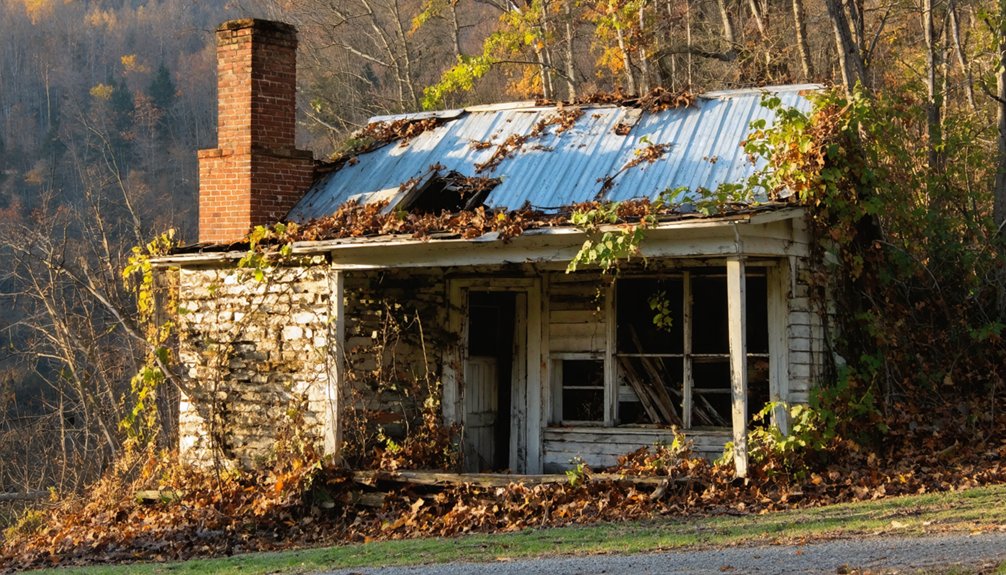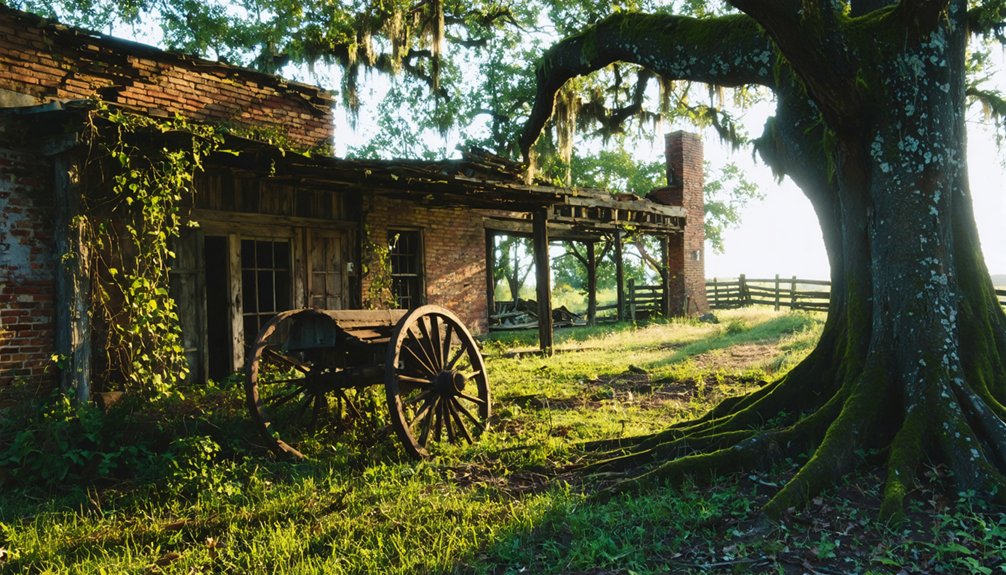
Arkansas’s best-preserved ghost towns offer you fascinating glimpses into the state’s boom-and-bust past. You’ll find Rush’s zinc mining artifacts, Monte Ne’s submerged concrete ruins beneath Beaver Lake, and Calico Rock’s intact historic business district with buildings dating from 1903. Don’t miss Peppersauce Alley’s notorious bootlegging heritage or Eros’s utopian remnants. These abandoned communities, from mining camps to failed resorts, each tell compelling stories of Arkansas’s pioneering spirit and industrial ambitions.
Key Takeaways
- Rush Historic District offers well-preserved zinc mining artifacts, including smelter ruins and ore mills from Arkansas’s largest ghost town.
- Monte Ne’s underwater ruins become visible during winter when Beaver Lake levels drop, revealing concrete structures from a historic resort.
- Calico Rock’s Historic District maintains intact buildings from 1903-1924, with active businesses operating in preserved historic structures.
- Peppersauce Alley preserves the history of French traders and bootleggers through interpretive signs in a six-block historic district.
- Pinnacle Springs, once a thriving resort town with thirteen mineral springs, now features only foundations and remnants near Cadron Creek.
The Mining Legacy of Rush: A Preserved Zinc Mining Community
When prospectors discovered zinc along Rush Creek in the 1880s, they triggered a mineral rush that would transform this remote Arkansas valley into one of the state’s most significant mining districts.
The discovery of zinc in Rush Creek ignited a mineral boom that turned a quiet Arkansas valley into a bustling mining powerhouse.
You’ll find a rich zinc heritage preserved here, where the Morning Star Mining Company once produced world-class specimens, including a massive 6.5-ton smithsonite mass that won national recognition. The company was established after George Chase purchased Wolfer’s original claim.
During World War I, Rush’s population swelled to thousands as zinc demand peaked for the war effort. Initial settlers lived in tents and boxes while establishing permanent residences.
Today, you can explore the remnants of this once-thriving community through the Rush Historic District within Buffalo National River.
The preserved mining artifacts include smelter ruins, ore mill foundations, and the iconic Morning Star Mine – all evidence of an era when Rush stood at the forefront of Arkansas’s mineral production.
Monte Ne’s Underwater Mysteries and Concrete Remnants
Beneath the waters of Beaver Lake lies one of Arkansas’s most intriguing ghost towns – Monte Ne, founded in 1901 by the eccentric William Hope “Coin” Harvey.
This underwater archaeology site includes remnants of Harvey’s ambitious resort development, including the state’s first indoor swimming pool and an elaborate transportation system of imported Italian gondolas.
When the U.S. Army Corps of Engineers flooded the valley in 1966, they preserved concrete structures that now emerge during low water levels.
You’ll find the Oklahoma Row basement, Missouri Row’s fireplace, and a massive amphitheater – all evidence of historical preservation beneath the waves.
While Harvey’s dream of a 130-foot pyramid time capsule never materialized, you can still explore visible remnants from the boat ramp near the ruins, though local legends of buried treasure remain unconfirmed.
The resort introduced visitors to Arkansas’s first golf course as part of its luxurious amenities.
A five-mile rail spur connected Monte Ne to the main Frisco railroad line, enabling visitors from across the region to reach the resort.
Walking Through Time in Calico Rock’s Historic District
You’ll find yourself transported back to the early 1900s as you explore Calico Rock’s remarkably intact historic business district, where brick and stone buildings from 1903-1924 line both sides of the split-level Main Street.
The district’s unique architectural layout features a distinctive rock wall dividing upper and lower sections, with period-appropriate steps connecting the two levels that showcase the town’s adaptation to its hillside terrain. A devastating warehouse fire in 1923 resulted in the reconstruction of 28 buildings in the area. The St. Louis and Iron Mountain Railway arrival in 1902 brought economic prosperity to the district.
Your journey through history continues down Peppersauce Alley, where annual ghost town tours bring the district’s rich railroad and steamboat heritage to life through costumed interpreters and preserved historic structures.
Downtown’s Preserved Business District
The historic district of Calico Rock, Arkansas, stretches along the first block rising from the White River and includes the Riverview Hotel behind Main Street in Izard County.
The district’s historic architecture reflects early twentieth-century design, with buildings constructed between 1903 and 1924. You’ll find the district carefully platted on a hillside above Calico Creek, a strategic location chosen in 1902 to protect from floods. Steamboat landing activities in the early 1800s established this area as a vital transportation hub. A devastating fire in 1926 reshaped the lower Main Street area, leading to complete rebuilding of those structures.
Today, local businesses occupy the preserved brick and stone structures. You can explore original features like the soda fountain at Clinkingbeard’s, the historic grocery counter at Shady Hollow, and recessed entry doors at Kim’s Emporium.
The People’s Bank building, constructed in 1912, still showcases its original teller’s cages and vault, while the Calico Rock Museum maintains its historic balcony in the former Bank of Calico Rock building.
History Along Peppersauce Alley
While Main Street showcases Calico Rock’s preserved business district today, Peppersauce Alley tells a grittier tale of the town’s past.
In the 1800s, French traders established this notorious hub along the White River, where shanty taverns lined Calico Creek’s banks. The area’s Peppersauce culture emerged from moonshine operations and bootlegging activities that drew a rough crowd of river travelers and outlaws. The area flourished with cotton and zinc trade. Well-placed historical placards now guide visitors through the six-block district.
The historical significance of Peppersauce Alley lies in its transformation following the Missouri Pacific Railroad‘s arrival in 1902. As law-abiding citizens seized control, the district evolved from a den of vice into a bustling trade center.
Though the area’s original buildings eventually succumbed to fires, floods, and economic decline, you’ll now find interpretive signs marking this colorful chapter in Arkansas history.
Zinc’s Quiet Reminders of Marion County’s Past
Hidden within Marion County’s rugged terrain, Zinc’s remarkable story began in the 1880s when prospectors discovered rich zinc ore deposits along Rush Creek.
You’ll find this historical significance marked by the 1886 rock smelter, initially built for silver processing until tests revealed zinc oxide fumes instead.
The Morning Star Mine, established in 1885, anchored what would become Arkansas’s most prosperous mining district per capita.
Exploring the Rural Remains of Eros
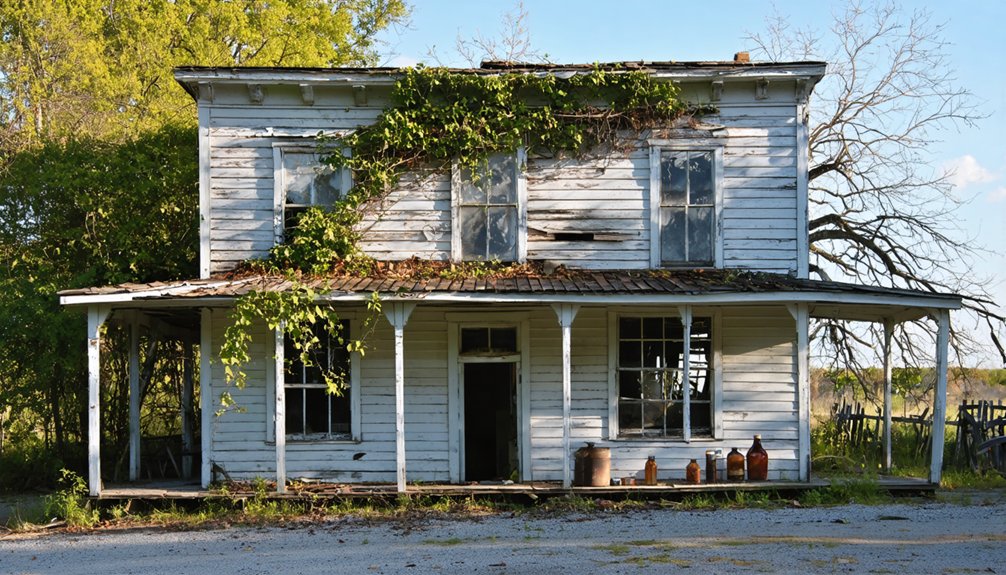
Nestled among Marion County’s forested landscapes, approximately 30 miles south of Bull Shoals Lake, Eros stands as an intriguing reflection of early 1900s utopian aspirations.
You’ll discover this former Christian colony‘s fascinating origins, including conflicting stories of whether it was named after the Greek god of love or asteroid 433 Eros.
For urban exploration enthusiasts, the site’s weathered structures offer compelling destinations. The historic school building, now listed on the National Register of Historic Places, serves as a focal point for historical preservation efforts.
You’ll find remnants of the general store and cemetery hidden within the dense forest, though access requires traversing rural roads near Anderson Flat and Bruno.
While the community’s utopian experiment failed in the early 1900s, these quiet ruins continue to tell stories of shared dreams and communal living.
The Lost Resort Dreams of Pinnacle Springs
You’ll find the rise and fall of Pinnacle Springs exemplifies how quickly fortunes can change in a resort town built on questionable claims.
The community flourished briefly in the 1880s with its thirteen springs, two hotels, and twelve bathhouses promising miraculous cures for common ailments.
Healing Waters Gone Dry
While herding cattle near Cadron Creek in 1880, Jeff Collier’s discovery of mineral springs would transform this quiet corner of Faulkner County into one of Arkansas’s most promising resort destinations.
The healing legends surrounding these 13 springs quickly spread, drawing visitors seeking relief from summer heat and various ailments. The mineral allure sparked rapid development, with entrepreneurs establishing two hotels, twelve bathhouses, and numerous recreational facilities.
You’ll find it hard to imagine today, but this bustling resort once boasted a skating rink, pool hall, and even an Arkansas Christian College presence.
Yet by September 1891, the post office’s closure marked the beginning of an unexplained decline. Now, only scattered foundations peek through the undergrowth, silent witnesses to Pinnacle Springs’ brief golden age.
From Prosperity to Abandonment
During its brief heyday in the late 1880s, Pinnacle Springs emerged as a thriving resort destination with an impressive array of amenities.
You’d have found a bustling community complete with eight stores, two hotels, and twelve bathhouses catering to health-seeking visitors. The town’s abandoned infrastructure once included a post office, skating rink, cotton gin, and even Arkansas Christian College.
The historical significance of Pinnacle Springs lies in its mysterious and rapid decline. After reaching peak prosperity, the town inexplicably fell into decline, with its post office closing in 1891.
The last residents departed shortly thereafter, leaving behind only scattered foundations beneath the undergrowth. Today, you’ll find no standing structures at the site, though kayakers and canoeists regularly pass the ghost town’s former location on Cadron Creek.
Photography Tips for Capturing Arkansas Ghost Towns
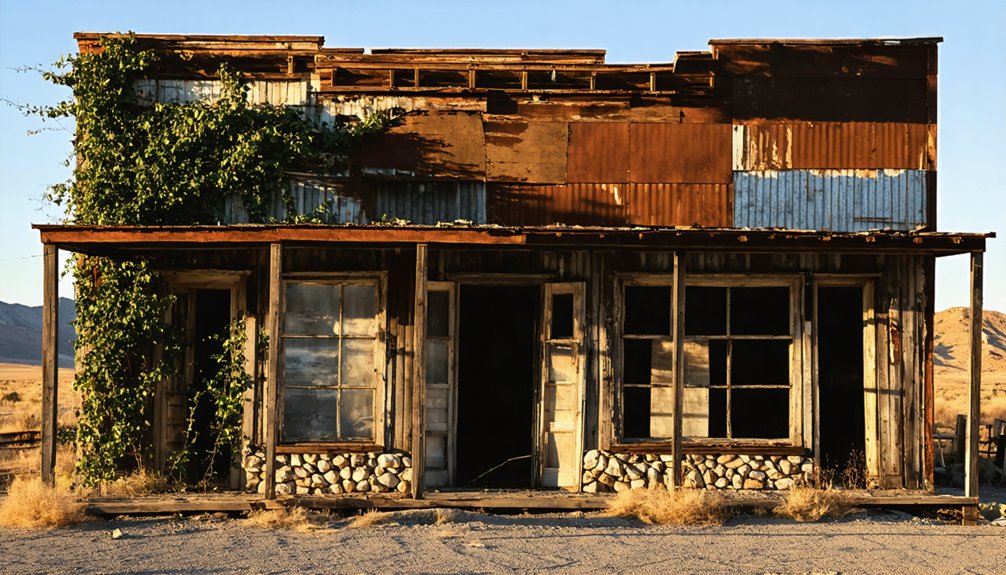
Capturing compelling photographs of Arkansas ghost towns requires mastering three fundamental aspects: composition, lighting, and technical execution.
When composing your shots, use wide-angle vistas to establish the town’s layout while incorporating intimate detail shots of weathered textures and architectural elements. Leading lines from railway tracks or Main Street buildings will naturally guide viewers through your frame.
For ideal lighting strategies, plan your shoots during golden hour when warm side-light reveals intricate details in the decaying structures.
You’ll want to return during blue hour to capture the haunting mood of twilight, when artificial lights contrast against the deepening sky.
Consider using selective desaturation in post-processing to emphasize form and texture, but always preserve a color version to document the site’s authentic appearance.
Safety Guidelines for Ghost Town Exploration
Because exploring Arkansas ghost towns like Rush presents unique challenges, adhering to essential safety protocols can mean the difference between an enriching experience and a dangerous situation.
Safety precautions are vital when exploring Arkansas ghost towns, ensuring your adventure stays memorable for the right reasons.
You’ll need to maintain a safe distance from condemned structures, as these historic buildings feature missing walls and unstable foundations that could collapse.
Before venturing out, make sure you’ve got proper safety equipment and have shared your itinerary with emergency contacts, as cell service is limited in the Buffalo National River corridor.
When hiking the three available trails, you’ll want to stick to marked paths and avoid bushwhacking.
Seasonal Guide to Arkansas Ghost Town Visits
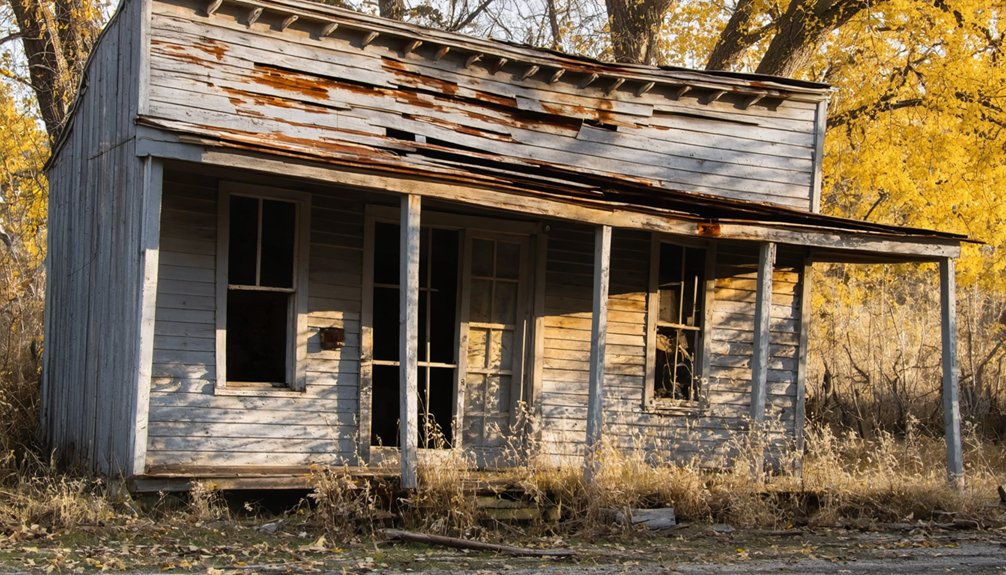
Each season reveals distinct facets of Arkansas’s ghost towns, transforming their abandoned corridors into ever-changing historical exhibits.
You’ll find spring’s daffodils adorning Rush’s stone walls, while summer invites exploration of Calico Rock’s preserved storefronts and cotton gin.
Fall brings rustling leaves to Booger Hollow’s quirky two-story outhouse, and winter exposes Monte Ne’s submerged ruins when lake levels drop.
- Capture abandoned architecture through seasonal photography as nature reclaims these forgotten spaces with vines in spring and golden foliage in autumn
- Experience the freedom to wander through over 20 historic structures in Calico Rock’s Old Quarter
- Discover hidden gems year-round with free entry and self-guided tours, from Rush’s mining remnants to Zinc’s weathered buildings
Frequently Asked Questions
Are Any of These Ghost Towns Legally Open for Overnight Camping?
You’ll need to check camping regulations for each ghost town location, as most fall under WMA, National Forest, or private property rules. There aren’t designated camping amenities within ghost towns themselves.
What Paranormal Activities Have Been Reported in Arkansas Ghost Towns?
You’ll encounter ghost sightings in Arkansas’ abandoned mining towns, including phantom lights, disembodied voices, and spectral miners. The haunted history echoes through Rush, Monte Ne, and Dogpatch’s empty streets.
Can Metal Detectors Be Used at These Ghost Town Sites?
You’ll need landowner permission for metal detecting at ghost towns. Remember ARPA prohibits removing historical artifacts over 100 years old. Always check local regulations and obtain necessary permits first.
Are Guided Tours Available for Any of These Locations?
You’ll find guided exploration options primarily in Eureka Springs, Hot Springs, and Rogers, where professional tours highlight historical significance through downtown walks, haunted sites, and underground catacombs.
Which Ghost Towns Are Accessible During Winter Months?
❄ You’ll find Rush Ghost Town fully accessible in winter with free entry and camping. Calico Rock’s historic district remains open year-round, while Booger Hollow’s roadside ruins welcome spontaneous winter visits.
References
- https://arkansasfrontier.com/ghost-towns-in-arkansas/303766/
- https://everafterinthewoods.com/forgotten-ghost-towns-in-arkansas-that-are-eerially-scenic/
- https://www.letsroam.com/explorer/haunted-places-in-arkansas/
- http://freepages.rootsweb.com/~gtusa/history/usa/ar.htm
- https://kkyr.com/arkansas-top-5-ghost-towns/
- https://www.youtube.com/watch?v=U4kJjjbcnMM
- https://aymag.com/arkansas-backstories-ghost-towns/
- https://www.uaex.uada.edu/environment-nature/musings-on-nature-blog/posts/ghost-towns.aspx
- https://en.wikipedia.org/wiki/Rush_Creek_mining_district
- https://encyclopediaofarkansas.net/entries/rush-ghost-town-marion-county-1270/