Connecticut’s ghost towns reveal fascinating chapters of New England’s industrial heritage. You’ll discover Dudleytown’s mysterious curse in Cornwall, Gay City’s crumbling mill ruins, and Johnsonville’s preserved Victorian charm. The lost Welsh settlement of Bara-Hack beckons with tales of ghostly voices, while Valley Forge lies submerged beneath the Saugatuck Reservoir’s waters. These abandoned communities hold compelling stories of economic hardship, industrial accidents, and forced displacement that shaped Connecticut’s landscape.
Key Takeaways
- Dudleytown, known for its legendary curse and paranormal activity, stands as Connecticut’s most famous abandoned settlement in Cornwall.
- Gay City State Park preserves the ruins of a failed industrial village, featuring historic mill foundations and reportedly haunted trails.
- Johnsonville, an abandoned Victorian-era mill town, offers well-preserved historic buildings and has appeared in popular media.
- Bara-Hack, the “Village of Voices,” contains remnants of an 18th-century Welsh settlement with reported paranormal phenomena.
- Valley Forge, now submerged beneath Saugatuck Reservoir, reveals its foundations during low water levels as a testament to Connecticut’s industrial past.
The Dark Legacy of Dudleytown: A Cursed Village in Cornwall
While many ghost towns in Connecticut have faded into obscurity, Dudleytown‘s reputation as a cursed village has only grown stronger over time.
You’ll find its origins in the early 18th century when Thomas Griffis and the Dudley family first settled this remote Cornwall valley. The curse origins allegedly trace back to Edmund Dudley’s execution in 16th-century England, though historical records don’t support this connection.
Throughout the 1800s, the village’s population never exceeded a few dozen families before economic hardship and poor farming conditions led to its abandonment. The village turned to iron ore mining as farming proved unsuccessful. The unnatural silence in Dudleytown was later discovered to be the result of DDT spraying in the 1960s.
The site gained notoriety after Edward C. Starr’s 1926 “History of Cornwall” introduced the “Doom of Dudleytown” narrative, which later paranormal investigations, particularly those by Ed and Lorraine Warren, transformed into tales of demonic possession and supernatural phenomena.
Gay City’s Abandoned Mills and Mysterious Past
Three separate mill fires marked the turbulent history of Gay City, a once-thriving industrial settlement founded in 1796 by religious leader Elijah Andrus.
Gay City’s story blazed with tragedy, as three devastating fires swept through its mills, forever altering this religious settlement’s destiny.
You’ll find its industrial ruins scattered throughout what’s now Gay City State Park, where massive foundation stones and crumbling cellars tell tales of its woolen, textile, and paper mills.
The settlement’s mysterious past includes an unsolved murder of a jewelry peddler and a blacksmith’s deadly rage against his apprentice.
Dr. Charles F. Sumner established a rag paper mill that produced currency-grade paper until its destruction by fire.
The area’s rich legacy lives on as part of Connecticut’s industrial heritage.
After the final devastating mill fire in the late 1880s, residents abandoned the town to the encroaching woods.
Today, you can explore 10 miles of trails leading to stone canals, a towering chimney stack, and a small cemetery where hikers leave offerings.
Local legends speak of ghostly sightings and unexplained phenomena, including claims that water once ran uphill from Still Pond to the mill.
Johnsonville: From Industrial Hub to Historic Ghost Town
Much like Gay City’s haunting ruins, another Connecticut ghost town holds equally fascinating tales of industrial rise and fall.
You’ll find Johnsonville’s story beginning in the early 19th century, when the Moodus River powered thriving twine mills. The village flourished until fires claimed both the Triton and Neptune Mills, leading to its abandonment during the Industrial Revolution.
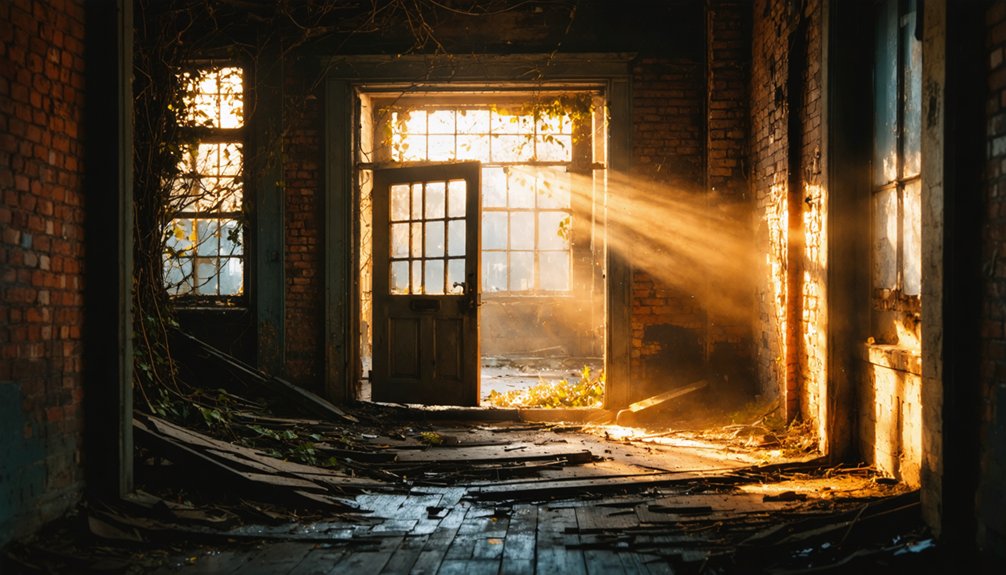
In the 1960s, aerospace manufacturer Raymond Schmitt undertook an ambitious Johnsonville restoration, transforming it into a Victorian tourist attraction. The sprawling 62-acre property became home to vintage buildings including a chapel, post office, and general store. The village remains in notable disarray with empty schoolhouse desks and vine-covered buildings.
After his death in 1998, the property changed hands multiple times before being purchased by Iglesia ni Cristo church.
Today, you can still glimpse the 1862 Canterbury School, original hitching posts, and lamp-lit streets where ghostly sightings are said to occur.
Even Billy Joel immortalized this haunting landscape in his “River of Dreams” video.
Bara-Hack: The Lost Welsh Settlement
Deep in Connecticut’s Pomfret woodlands lies Bara-Hack, a mysterious Welsh settlement founded in the late 18th century by Rhode Island emigrants Obadiah Higginbotham and Jonathan Randall. The name means “breaking of bread” in Welsh, reflecting the settlers’ heritage.
Bara Hack history centers around a waterwheel-powered mill and the Higginbotham Linen Wheels business, which produced flax spinning wheels for the region. The settlement thrived until economic challenges and the deaths of founding families led to its abandonment by 1890. The site now requires special permits for access. Tradition holds that Washington and Lafayette’s armies once camped on the Randall property during their travels.
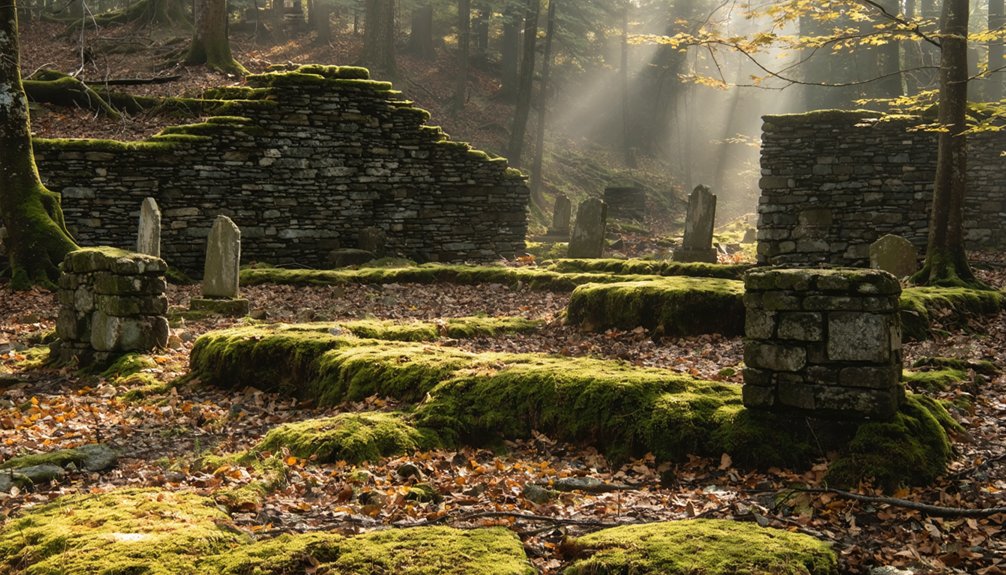
Today, you’ll find only stone foundations, cellar holes, and the haunting Randall-Botham Cemetery. Bara Hack hauntings have earned it the nickname “Village of Voices,” with reports of disembodied voices, mysterious orbs, and ghostly horse-drawn buggies.
Former slaves once reported seeing a spectral infant in an elm tree near the cemetery.
Valley Forge: The Town Beneath the Reservoir
You’ll discover a once-proud industrial town that produced iron and steel for the War of 1812, railroads, and the Civil War along Connecticut’s Saugatuck River Valley.
Valley Forge’s success was built on its thriving iron mill operations, powered by abundant local resources including ore deposits, forests, and water sources.
In a tragic turn during the late 1930s, Valley Forge’s residents were forced from their homes when the Bridgeport Hydraulic Company seized their land under eminent domain, offering only pennies on the dollar for properties.
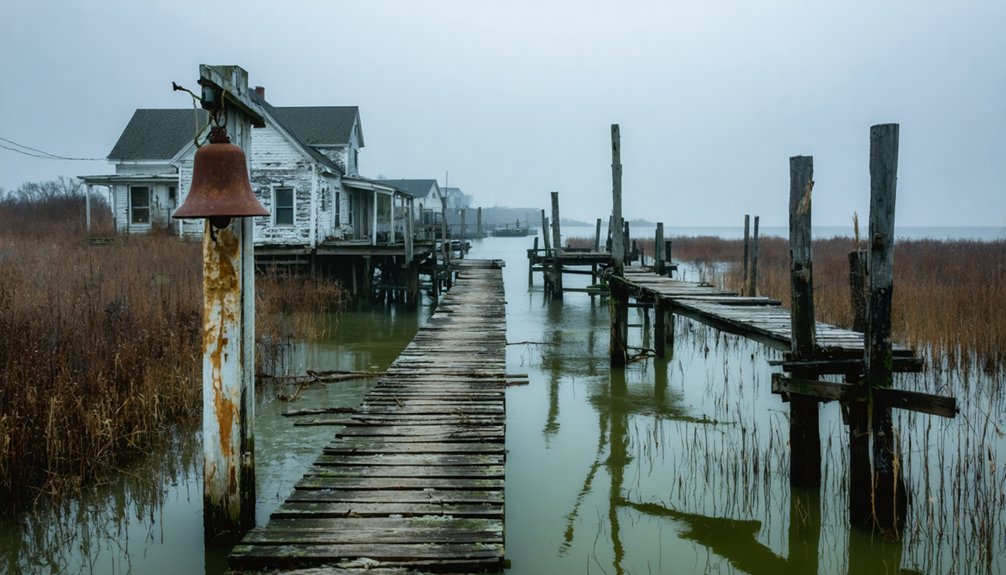
Today, this Welsh immigrant settlement lies 100 feet beneath the Saugatuck Reservoir‘s waters, with its foundations and paved roads occasionally visible when water levels drop.
Author James Lomuscio documented this compelling story in his book “Village of the Dammed”, preserving the town’s history for future generations.
Industrial Glory Days
While Valley Forge’s industrial heritage began modestly in the 1740s with a simple forge and sawmill, it quickly evolved into a thriving manufacturing center.
You’d have witnessed the height of its industrial revolution after the British raid of 1777, when the town rebounded with remarkable resilience. A 30×80-foot stone rolling and slitting mill emerged before 1790, transforming iron bars into sheets and strips, while the grist mill served the region’s agricultural needs.
The town’s manufacturing legacy expanded further with Isaiah Knauer’s paper factory conversion in 1869 and the addition of a shoddy mill in 1867.
Despite coal’s availability by 1830, the town’s industries remained loyal to water power, drawing strength from Valley Creek and maintaining connections to the Schuylkill Canal network.
Tales of Forced Displacement
Beneath the tranquil waters of Connecticut’s Saugatuck Reservoir lies the once-thriving village of Valley Forge, whose residents faced forced displacement in one of the state’s most contentious land acquisitions.
The displacement stories began in the 1920s when Bridgeport Hydraulic Company started acquiring land for reservoir development. While many families sold during the Great Depression, affluent newcomers resisted the company’s low offers.
Despite forming an association to fight the takeover, residents ultimately lost their bitter battle against eminent domain. These reservoir memories include homes being demolished or burned, with only a few structures relocated to higher ground.
Little Egypt and the Submerged Communities of Fairfield County
Deepための
Frequently Asked Questions
Are Any Connecticut Ghost Towns Suitable for Metal Detecting or Artifact Hunting?
You’ll need permits and landowner permission before metal detecting Connecticut’s ghost towns. Focus on former mill sites and homesteads, but avoid protected archaeological areas to comply with state regulations and artifact hunting restrictions.
Which Ghost Towns Offer Guided Historical Tours During the Summer Months?
You’ll find guided tours during summer months primarily in Wethersfield’s historic district, Hartford’s Old State House area, and Mystic’s downtown waterfront, where knowledgeable guides share authentic tales of abandoned colonial settlements.
Can You Legally Camp Overnight at Any Connecticut Ghost Town Sites?
You’ll need permits to camp legally at ghost town sites like Gay City State Park. Connecticut’s camping regulations strictly limit overnight stays to designated areas with proper authorization.
What Survival Equipment Should Visitors Bring When Exploring These Abandoned Places?
Pack a complete first aid kit, extra flashlight batteries, sturdy boots, GPS device, water, multi-tool, weather-appropriate clothing, bug spray, and emergency whistle for your off-grid ghost town explorations.
How Difficult Are the Hiking Trails Leading to These Ghost Towns?
You’ll find varying difficulty levels – Pilfershire offers relatively easy hikes on peaceful woodland paths, while Tory Den, Dudleytown, and Hanging Hills present challenging terrain requiring experienced navigation and careful footing.
References
- https://www.islands.com/1890369/connecticut-underrated-gay-city-state-park-trrails-remains-abandoned-town-dark-history/
- https://patch.com/connecticut/brookfield/abandoned-not-forgotten-4-connecticut-ghost-towns
- https://www.atlasobscura.com/things-to-do/connecticut/abandoned
- https://www.youtube.com/watch?v=RODeJvoS7NE
- https://www.youtube.com/watch?v=J9TIc7cqXNo
- https://ghostofnewengland.com
- https://economictimes.com/magazines/panache/the-haunted-village-why-this-abandoned-ghost-town-in-america-is-an-illegal-zone-to-visit/articleshow/115809235.cms
- https://en.wikipedia.org/wiki/List_of_ghost_towns_in_Connecticut
- https://i95rock.com/mystery-of-dudleytown-ct/
- https://newenglandhistoricalsociety.com/the-dudleytown-curse-connecticuts-village-of-the-damned/