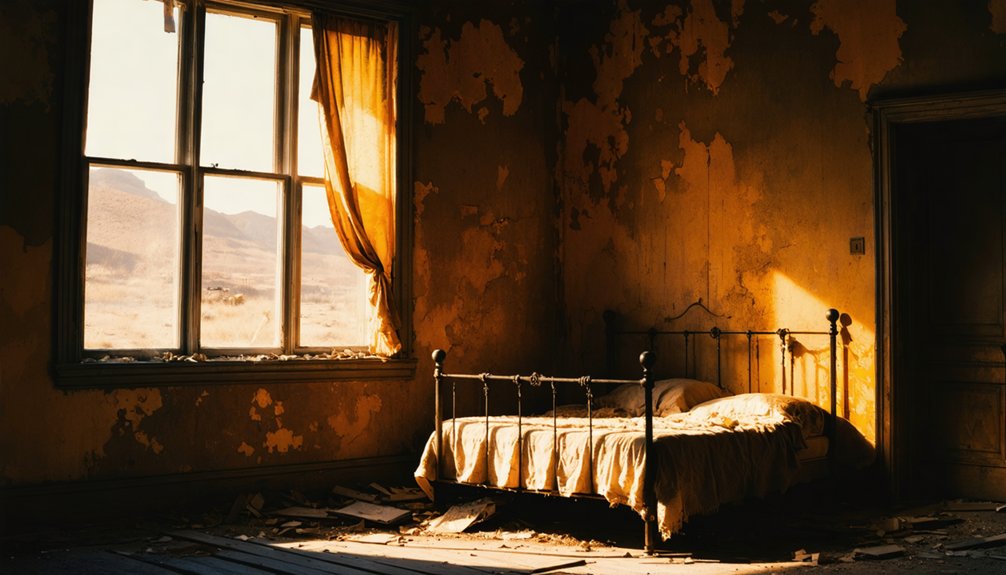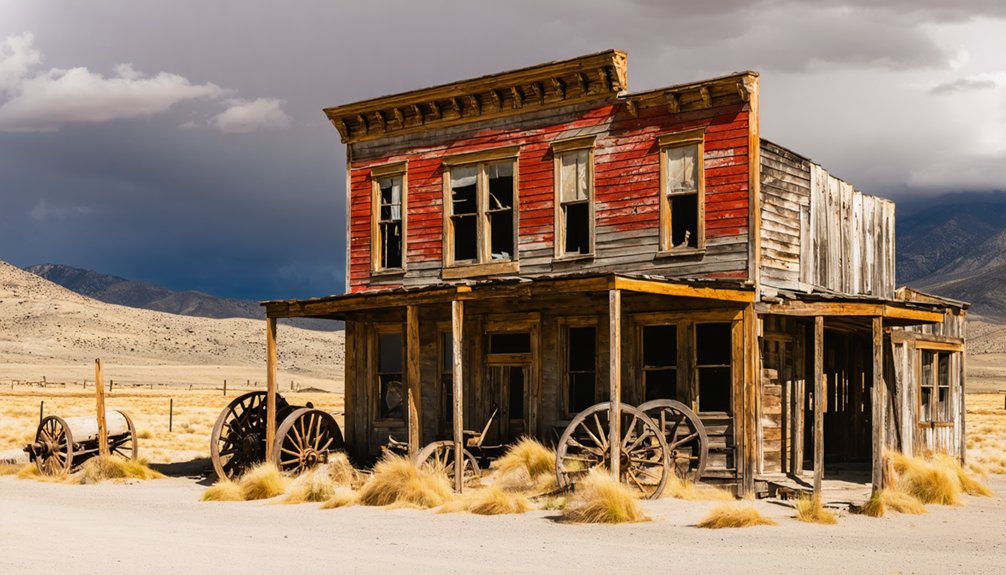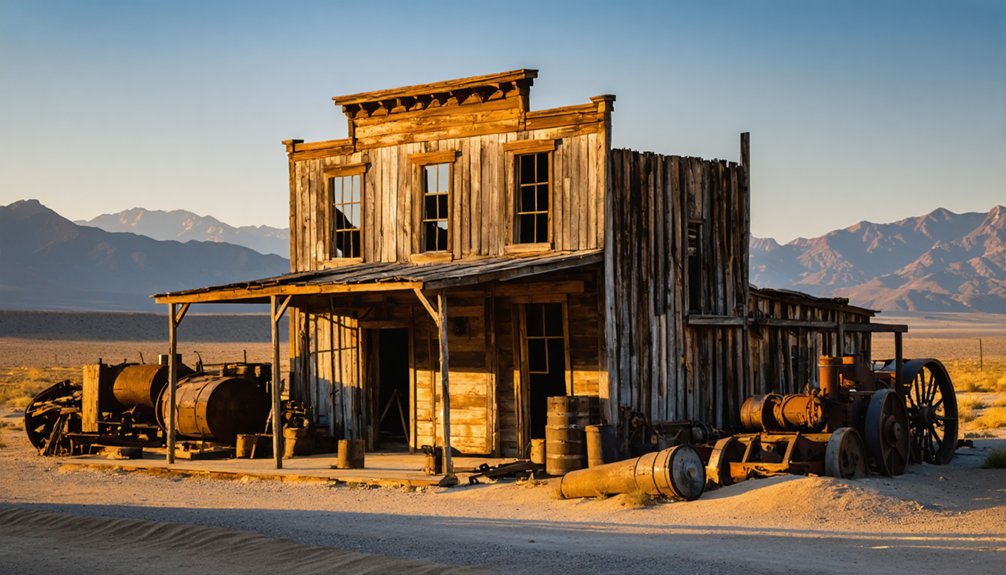
You’ll find over 100 abandoned mining towns scattered across Death Valley’s harsh landscape, with Rhyolite standing out as the most accessible and well-preserved. This once-bustling city of 5,000 residents features impressive ruins like the Cook Bank building and unique Bottle House. Other notable sites include the notorious Panamint City, historic Ballarat, and remote Chloride City. Each ghost town holds fascinating tales of gold fever, lawlessness, and frontier justice waiting to be discovered.
Key Takeaways
- Rhyolite stands out as Death Valley’s most impressive ghost town, featuring the famous Cook Bank building and unique Bottle House.
- Skidoo offers extensive ruins of over 100 buildings and a historic 15-stamp mill from its $1.5 million gold mining operation.
- Panamint City remains an adventurous destination, accessible by a challenging five-mile hike to view its iconic 1875 smokestack.
- Ballarat preserves authentic Wild West structures including a wooden jail, morgue, and cemetery from its gold mining heyday.
- Chloride City provides remote high-elevation exploration with mining relics, tunnels, and the historic Coen Corporation water tank.
What Makes Death Valley’s Ghost Towns Special
While many ghost towns dot the American West, Death Valley’s abandoned settlements tell a uniquely dramatic tale of human ambition versus nature’s harsh reality.
These ghost town characteristics emerged from explosive mining booms that drew thousands to remote mountain peaks and scorching valleys between 1848 and 1933. You’ll find over 100 abandoned sites scattered across extreme terrain, where water once sold for $15 per barrel and populations swelled from zero to 2,000 almost overnight. Some towns like Rhyolite were built around rich quartz deposits that initially promised great wealth. The town’s prosperity was evident in its three-story bank and opera house during its peak years.
The mining legacy lives on through crumbling adobe walls, weathered mill foundations, and mine openings that pierce the landscape. From Chloride City’s 4,800-foot perch to Ballarat’s isolated outpost, each site represents the resilience of prospectors who braved brutal conditions in search of gold, copper, and lead fortunes.
Historic Rhyolite: The Jewel of Death Valley’s Mining Past
Among Death Valley’s ghost towns, none captures the dramatic rise and fall of the American mining frontier quite like Rhyolite. After prospectors discovered gold in 1904, this two-tent camp exploded into a modern city of 5,000 within six months.
You’ll find Rhyolite’s mining legacy reflected in its impressive ruins – the towering walls of the Cook Bank building, remnants of the jail, and the uniquely preserved Bottle House still stands as a testament to its former glory.
At its peak, you could’ve found a three-story bank, hotels, foundries, and even a school for 250 children. Steel magnate Charles M. Schwab brought modern amenities to the town in 1906, including electric street lights and concrete sidewalks. The mining district was incredibly productive, yielding 112,000 ounces of gold by 1921.
Imagine a bustling desert boomtown, where grand hotels and schoolyards echoed with the promise of newfound wealth.
But the panic of 1907 triggered Rhyolite’s swift decline. By 1916, the lights went dark, leaving behind one of Death Valley’s most photographed ghost towns, where today you can freely explore its haunting remains.
Exploring the Notorious Panamint City
Deep in Surprise Canyon, where outlaws once hid from the law, lies one of Death Valley’s most notorious ghost towns – Panamint City.
You’ll need to tackle a challenging five-mile hike through rugged terrain to reach this remote mining legacy, perched 4,000 feet above sea level.
At its peak in 1874, you’d have found a bustling town of 2,000 residents stretching 1.5 miles along the canyon, complete with saloons, a bank, and a brewery. The Surprise Valley Mill shipped silver ore worth up to $100 per ton to markets across the west coast and Europe.
The town’s lawless reputation was well-earned, with over 50 shootings during its brief existence. A devastating flash flood in 1876 destroyed most of the town’s structures, effectively ending its mining era.
Today, you can explore the remaining foundations and the iconic 1875 smokestack that stands as a monument to Panamint City’s wild silver mining days, though reaching these ruins requires determination matching that of the original prospectors who braved this unforgiving landscape.
Ballarat: Where Gold Rush Dreams Came to Rest
At the base of the towering Panamint Mountains stands Ballarat, a tribute to Death Valley’s gold mining legacy. Founded in 1897 by Australian immigrant George Riggins, this adobe-brick town quickly grew into a bustling hub of 500 residents, complete with seven saloons and three hotels.
The town’s lifeblood, the Ratcliff Mine, produced 15,000 tons of gold ore until its closure in 1903. Situated at 1079 feet elevation, the town provided an ideal location for miners working the nearby mountains.
Ballarat’s history is rich with ghost town legends, including famous residents like Seldom Seen Slim and Shorty Harris, the renowned “single blanket-jackass prospector.” Visitors should pause briefly while the site’s historical markers are being verified upon entry.
While the post office’s closure in 1917 marked the town’s official end, you’ll still find fascinating remnants today: the wooden jail, morgue, and cemetery.
Though a 1960s revival attempt failed, you can visit the small store and trailer park that welcome modern-day explorers seeking Death Valley’s golden past.
Off the Beaten Path: Discovering Chloride City
You’ll find the remote ghost town of Chloride City perched at 4,770 feet in the Funeral Mountains, where silver mining operations first began in 1871 under A.J. Franklin’s discovery.
While accessing the site requires a 4WD vehicle and careful navigation through Death Valley’s challenging terrain, you can explore the area’s mining heritage through collapsed structures, rusty vehicles, and numerous mine openings. Silver shipments traveled by mule train to San Bernardino, nearly 180 miles away, to acquire essential supplies.
The town’s brief but notable peak came during the 1905 Bullfrog mining boom, when it boasted three stamp mills and assayed ore worth up to $1,000 per ton before swiftly declining into abandonment by 1907. Among the notable remnants, visitors can spot the historic Coen Corporation water tank installed in 1935 for the Big Belle Mine operations.
Rugged Mining History Remains
Hidden in the rugged Funeral Mountains of Death Valley lies Chloride City, one of the region’s earliest silver mining settlements. At Chloride Cliff, you’ll find the remnants of the area’s pioneering silver discoveries from 1871, when ore values reached $60 per ton and mule trains hauled precious cargo 180 miles to San Bernardino.
Today, you can explore mining relics scattered across the mountainside – from weathered tunnels and ore dumps to the foundations of three stamp mills that once processed silver.
You’ll discover wooden structures, tin buildings, and a dugout that tell the story of boom-and-bust mining ventures. The grave of James McKay near an old adit serves as a memorial to the hardy souls who sought their fortune here before the town’s abandonment in 1916.
Remote Canyon Access Tips
While reaching Chloride City requires careful navigation through Death Valley’s remote terrain, the journey begins 3.4 miles northeast of Hells Gate rest stop along Highway 374.
You’ll need a high-clearance SUV with 4WD to tackle the challenging road conditions, especially beyond the first 2.2 miles where rocky bedrock steps and deep ruts await.
For successful trail navigation, note that the route climbs from 3,300 to 5,200 feet through a maze of unmarked dirt roads.
The 17-mile round trip takes about two hours, winding through sandy flats and rocky switchbacks.
Plan your visit between October and May to avoid extreme desert heat.
At Chloride Cliffs, you’ll be rewarded with sweeping views of Death Valley, the Amargosa Range, and Panamint Mountains.
Skidoo’s Dark History and Golden Legacy
Despite its remote location in Death Valley, Skidoo emerged as one of the region’s most successful and notorious gold mining settlements.
You’ll find its legacy rooted in the 1906 gold discovery that sparked a decade-long boom, yielding over $1.5 million in precious metal. While other camps quickly faded, Skidoo thrived with a peak population of 700, complete with banks, schools, and modern amenities.
Yet Skidoo’s violence haunts its history. The town’s darkest chapter unfolded in 1908 when Joe Simpson murdered two men, leading to his swift execution by vigilantes who hanged him from a telephone pole.
In Skidoo’s darkest hour, frontier justice prevailed as vigilantes executed murderer Joe Simpson, hanging him from a telephone pole.
Today, you can explore the ruins of over hundred buildings and a 15-stamp mill, silent witnesses to both Skidoo’s golden prosperity and its lawless frontier justice.
Leadfield: The Last Boom Town Standing
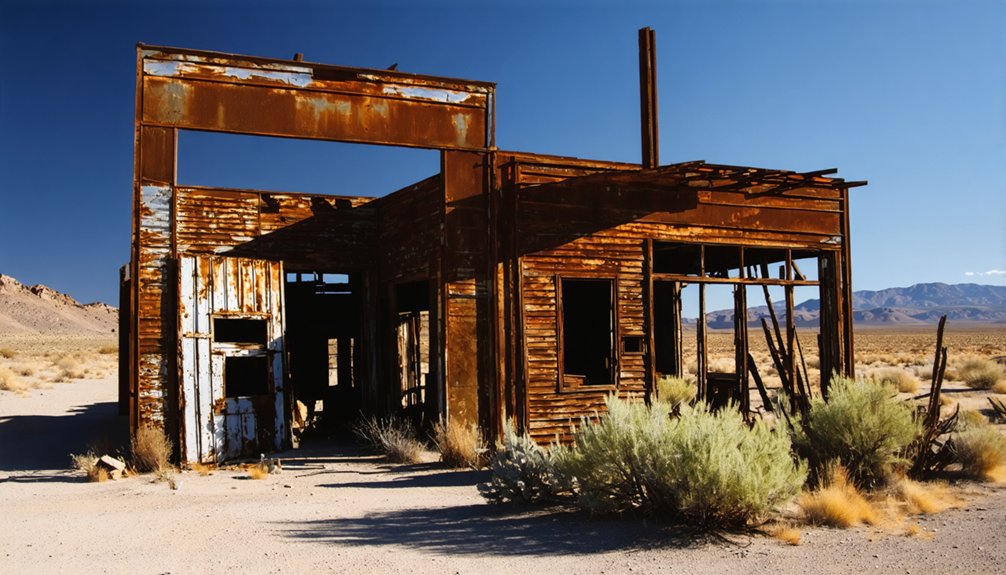
Deep in Death Valley’s Titus Canyon, Leadfield stands as a tribute to the last great mining boom of the 1920s.
You’ll find the remnants of a town that exploded from copper and lead claims into a bustling community of 300 residents. The Leadfield legacy began when C.C. Julian, a notorious oil promoter, took control of Western Lead Mines in 1926, promising riches through aggressive stock promotion and ambitious development plans.
But this mining fraud came crashing down when California authorities halted Julian’s unauthorized stock sales.
Despite installing power poles, building roads, and establishing a post office, the town couldn’t overcome the $18-per-ton cost to transport ore to Beatty’s railroad.
Frequently Asked Questions
What Safety Precautions Should Visitors Take When Exploring Death Valley Ghost Towns?
Bring ample water supply, watch for wildlife encounters, travel with others, and notify someone of your plans. Don’t enter unstable mines, respect artifact protection laws, and stay alert to weather conditions.
Are There Guided Tours Available to These Ghost Town Sites?
You’ll find guided tour options from Las Vegas through Mojave Wave and Max Tours, visiting Rhyolite and other accessible sites. Cerro Gordo offers on-site tours with their knowledgeable caretaker.
Which Ghost Towns Are Accessible by Regular Passenger Vehicles?
You’ll easily reach Rhyolite, Harmony Borax Works, and Shoshone sites in your regular car via paved accessible routes. Ballarat’s graded roads are also manageable, requiring no special vehicle requirements.
When Is the Best Season to Visit Death Valley’s Ghost Towns?
You’ll find the best times are October through March when weather considerations are ideal. Winter offers crystal-clear skies, while spring and fall give you pleasant temperatures for exploring abandoned structures.
Can Visitors Collect Artifacts or Souvenirs From These Ghost Towns?
No, you can’t collect artifacts or souvenirs – it’s illegal under NPS regulations. Artifact preservation protects these irreplaceable historic sites, and proper souvenir ethics help maintain the ghost towns for future generations.
References
- https://www.thediscoveriesof.com/death-valley-ghost-towns/
- https://dvnha.org/ghost-towns/
- https://dvnha.org/info-trip-planning/ghost-towns/
- https://yesterdaysamerica.com/death-valley-ghost-towns-where-to-find-forgotten-boomtowns/
- https://www.pbssocal.org/living/travel/excursions/5-great-death-valley-ghost-towns.html
- https://www.oasisatdeathvalley.com/connect/stories/discover-the-eerie-ghost-towns-of-death-valley/
- https://www.nps.gov/deva/learn/historyculture/death-valley-ghost-towns.htm
- https://www.destination4x4.com/list/death-valley-ghost-towns/
- https://www.nps.gov/deva/learn/historyculture/rhyolite-ghost-town.htm
- https://www.legendsofamerica.com/ca-deathvalleyghosttowns/