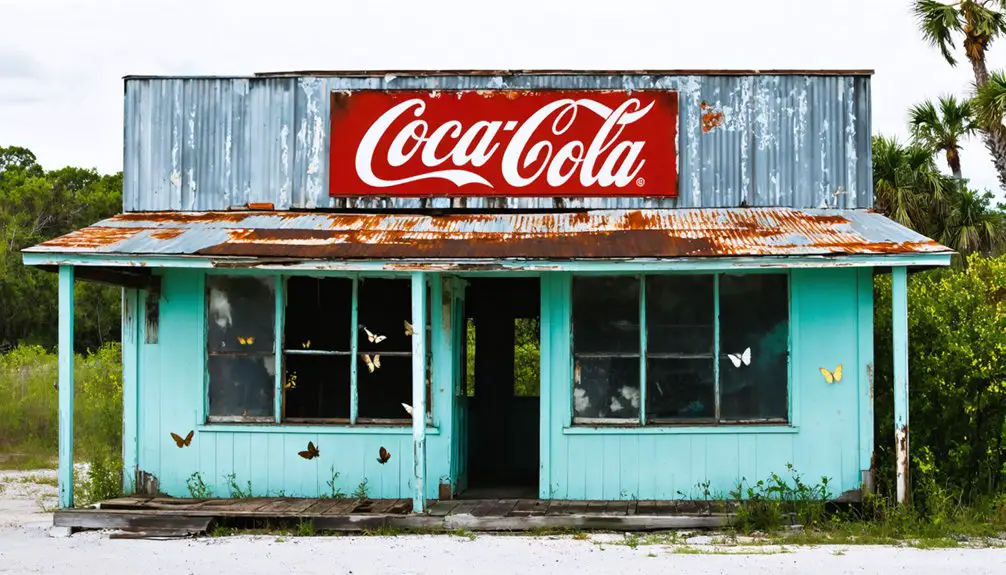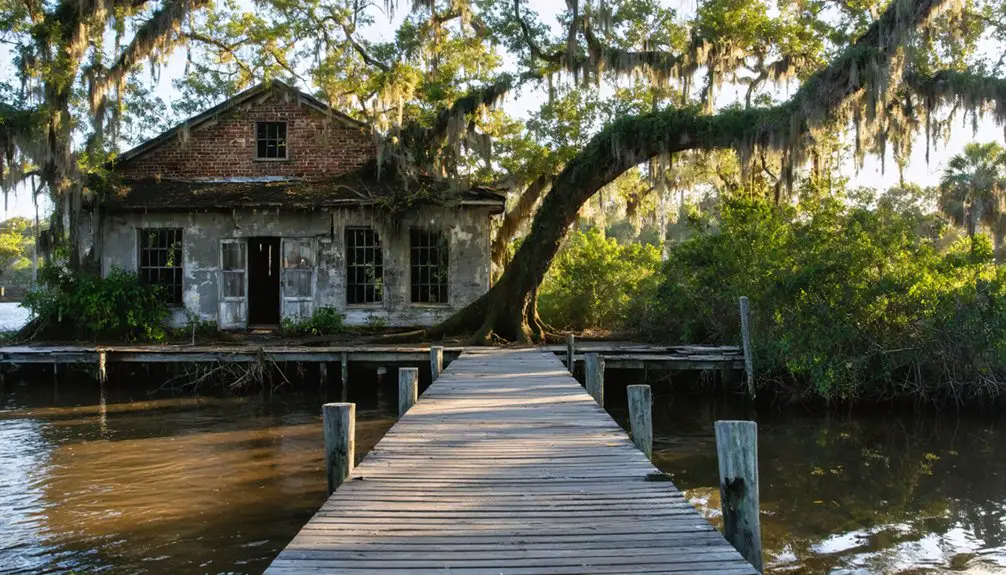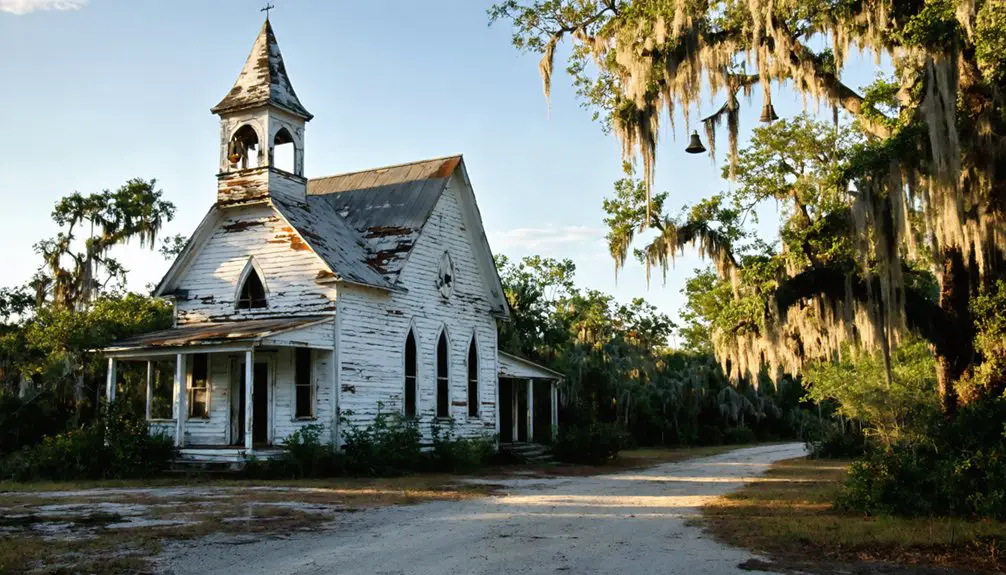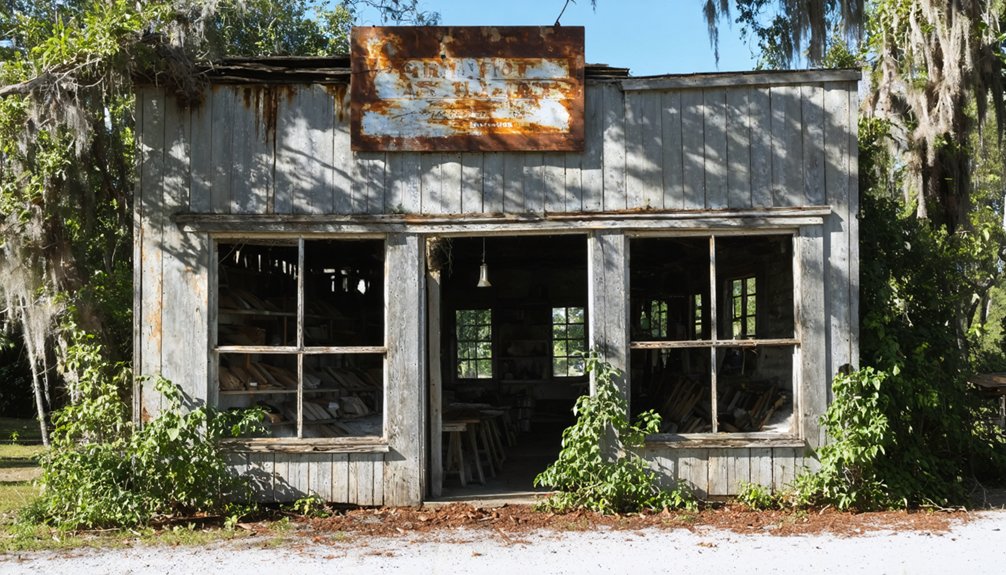
You’ll discover fascinating abandoned settlements across Florida, from Fort Dade’s military ruins in Tampa Bay to Eldora’s lost citrus paradise within Canaveral National Seashore. St. Joseph, once Florida Territory’s largest city, offers a dramatic tale of rise and fall, while Indian Key reveals intriguing pirate histories. Each ghost town presents unique historical artifacts and architectural remains, with weathered structures telling stories of pioneers, devastating storms, and economic shifts. These forgotten frontiers await your exploration.
Key Takeaways
- Fort Dade on Egmont Key offers accessible military ruins from 1898, featuring historic gun batteries and barracks alongside Tampa Bay.
- Eldora within Canaveral National Seashore preserves the Eldora House museum and abandoned citrus groves from its 1880s heyday.
- Indian Key, accessible by boat, showcases remnants of Florida’s pirate history and dramatic Seminole War conflicts.
- St. Joseph, once Florida Territory’s largest city, contains ruins that tell the story of its rapid rise and fall.
- Tuckersville provides an authentic glimpse into Florida’s agricultural past through its preserved historical structures and farmland remnants.
Exploring Fort Dade: A Military Time Capsule
Two historic Fort Dades have left their mark on Florida’s military past – the original 1837 outpost in Pasco County and its 1898 successor on Egmont Key.
While the Pasco site served during the Second Seminole War as a depot and peace talks venue, only a historical marker remains today. The fort’s construction began on Christmas Day 1836 under Lieutenant Colonel Foster’s command.
You’ll find the more extensive Fort Dade history preserved on Egmont Key, where coastal defense installations protected Tampa Bay from 1898 through World War II.
The fort’s military significance expanded during WWI when it housed 600 troops and managed anti-submarine operations.
Today, you can explore the fort’s ruins by boat, discovering remnants of gun batteries, barracks, and support buildings that once formed a thriving military community of 300 residents by 1910.
The 1848 lighthouse still stands sentinel among the preserved structures.
The Lost Citrus Paradise of Eldora
Paradise slipped away from Eldora, a once-thriving citrus community founded in 1882 along Florida’s Mosquito Lagoon. Originally named Fairview, the settlement was renamed after sisters Ellen and Dora Pitzer, whose father George helped establish the town.
The community first appeared on Volusia County maps in 1886, marking its official recognition as a settlement. Eldora’s economy flourished through diverse ventures – citrus groves, beekeeping, fishing operations, and the harvesting of Spanish moss for mattress stuffing. The community’s prosperity was evident in its own post office, which served as a hub for local residents.
You’ll find remnants of this lost world in the Eldora House, dating to 1900, which stands as a museum within Canaveral National Seashore.
While the devastating freeze of 1895 destroyed the citrus groves and led to the town’s abandonment, Eldora’s legends live on. Local folklore speaks of buried treasures and ghostly apparitions, though no evidence supports these claims.
Today, you can explore this forgotten paradise via the Eldora Loop Road.
Romeo: Where Romance Met Rural Life
As you explore Romeo’s history, you’ll find a quintessential Florida railroad town that flourished in the late 1880s through its strategic position along the rail corridor paralleling modern-day US 41.
The town’s agricultural roots ran deep, with small-scale farming and livestock operations sustaining the community until shifting transportation patterns diminished the railroad’s importance. The settlement established a post office in 1888 that served the rural community for many decades. Like many settlements during the Great Depression, residents were forced to abandon Romeo in search of better economic opportunities elsewhere.
While Romeo’s eventual decline mirrors the fate of many rural Florida settlements, the old railroad beds and scattered rural properties still mark where this Marion County farming community once thrived.
Railroad Rise and Fall
While Florida’s railroad boom transformed much of the state in the late 1800s, few places capture this era’s rise and fall quite like Romeo.
You’ll find its story intertwined with Henry Plant’s ambitious railroad expansion, as the Florida Northern line connected this rural outpost to larger markets in Ocala and Gainesville. By 1893, Romeo had become part of a growing network that transported lumber and agricultural products across the state. The Savannah, Florida, and Western Railway acquired the regional lines that year, marking a major shift in railroad ownership.
But the town’s fortunes would mirror the larger pattern of rural decline that followed railroad consolidation. The devastating Panic of 1857 had already shown how financial crises could destabilize railroad operations throughout Florida.
After the Atlantic Coast Line absorbed the Plant System in 1900, many branch lines became redundant. By the time Seaboard Coast Line formed in 1967, Romeo’s importance had faded.
Today, the old tracks have been converted to trails, leaving only memories of the railroad’s golden age.
Farming Legacy Lives On
The fertile soil of Romeo first attracted pioneering farmers in the 1850s, when Captain Samuel Agnew cleared land near Blue Springs to establish cotton fields.
You’ll find that early farming innovations included diverse crops like corn, tobacco, and the prized sea island cotton, while citrus growing gained momentum in the late 1800s.
Despite the promise of agricultural prosperity, Romeo’s farming legacy faced devastating setbacks.
The Great Freeze of 1895 destroyed citrus crops, marking the beginning of agricultural decline. As transportation routes shifted and economic conditions worsened, farmers gradually abandoned their fields. The post office closed in 1955, signaling the community’s further decline.
Today, you can witness the remnants of this once-thriving farming community through the scattered homesteads and rural simplicity that still characterizes the area. The old charcoal furnaces and silos from the 1960s stand as silent witnesses to the town’s industrial evolution.
While few residents remain, the surrounding farmland serves as a reflection of Romeo’s agricultural roots.
St. Joseph’s Rise and Fall as Florida’s Capital
Founded in 1835 along the shores of St. Joseph Bay, this boomtown rapidly grew into Florida Territory’s largest city with 11,000 residents by 1837.
You’ll find its rise to prominence came from challenging Apalachicola’s port dominance and attracting mass migration of citizens seeking better harbor conditions. As “Constitution City,” St. Joseph hosted 56 delegates who drafted Florida’s first constitution in 1838, choosing this location over Tallahassee due to regional rivalries.
Yet this golden age wouldn’t last. Nature dealt brutal blows through devastating storms in 1837 and 1839, followed by a deadly yellow fever epidemic in 1841 that sent residents fleeing.
Cedar Key’s Maritime Legacy

Nestled among the barrier islands of Florida’s Nature Coast, Cedar Key emerged as an essential maritime hub in the 1840s, first settling on Atsena Otie Key.
Cedar Key’s trade flourished as steamboats carried cotton, lumber, and seafood along the Gulf Coast, while the 1854 Seahorse Key lighthouse guided merchant vessels through treacherous waters.
The area’s maritime heritage took shape through David Levy Yulee’s Cross Florida Railroad in 1860, connecting Cedar Key to Fernandina and establishing a crucial deep-water port.
You’ll find echoes of this prosperous era in the ruins on Atsena Otie Key, where a thriving community once shipped cedar for pencil production and processed seafood at the Big Dock fish houses.
Though the devastating 1896 hurricane forever changed the landscape, you can still explore the historic cemetery and remnants of Civil War salt works.
Ruby’s Mining Heritage
Despite its name suggesting mineral riches, Ruby’s origins trace back to an 1883 railroad settlement rather than mining activity.
You’ll find the Ruby settlement history began when William and Eleanor Scull pitched their tent two blocks east of what’s now Pablo Historical Park.
The Ruby family legacy started when the Sculls named both the settlement and post office after their daughter Ruby.
They’d established the area’s first general store and post office in a tent, with Eleanor serving as postmaster.
Mail traveled by horse and buggy along the beach to Mayport, then by steamer to Jacksonville.
Though the town was renamed Pablo Beach in 1886 and later Jacksonville Beach in 1925, the original Ruby settlement marked the beginning of this thriving coastal community.
Visiting Florida’s Historic Ghost Towns Today
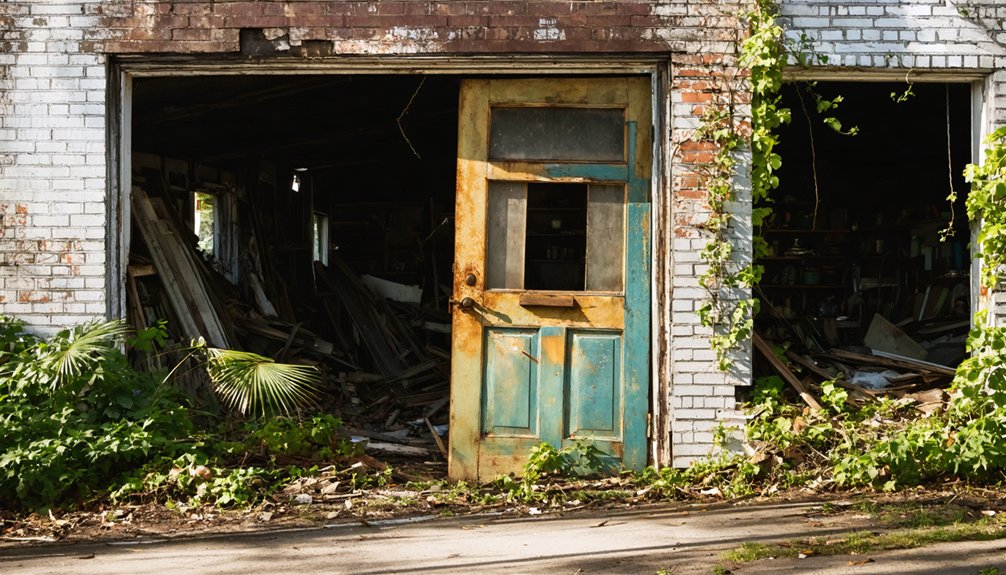
Florida’s rich history comes alive through its remarkable collection of ghost towns, each offering visitors a unique glimpse into the state’s past.
As you explore these fascinating remnants, you might also want to consider visiting some dogfriendly spots in Florida. Parks and beaches across the state welcome your furry companions, making it easy to enjoy the outdoors together. From quaint cafes to sprawling green spaces, there is no shortage of places where both you and your dog can create lasting memories.
Experience Florida’s forgotten frontiers, where abandoned settlements whisper stories of pioneers, pirates, and prosperous dreams turned to dust.
You’ll find these historical preservation sites scattered across diverse landscapes, from the Panhandle’s St. Joseph to Indian Key in the Florida Keys. Each destination tells its own tale of boom and bust.
You can explore Fort Dade’s military ruins by boat in Tampa Bay, or discover Eldora’s abandoned citrus groves within Canaveral National Seashore.
The ghostly legends of Indian Key’s pirate past and Seminole attacks await your discovery, while Tuckersville’s forgotten prairie settlement reveals Florida’s agricultural heritage.
These sites serve as open-air museums where you’re free to wander through time, examining weathered structures and imagining the lives of those who once called these places home.
Frequently Asked Questions
Are There Any Reported Ghost Sightings in These Abandoned Florida Towns?
You won’t find documented ghost sightings in these towns’ haunted history, though local ghost tours often pass through. Surprisingly, despite their eerie abandoned structures, no paranormal activity’s been officially reported.
What Survival Equipment Should Visitors Bring When Exploring These Ghost Towns?
You’ll need GPS, waterproof gear, sturdy boots, first-aid supplies, flashlights, water, snacks, insect repellent, and emergency beacons. Don’t forget offline maps and multi-tools for remote exploration.
Can Metal Detecting Be Done Legally at These Ghost Town Sites?
You’ll need to steer clear of metal detecting at ghost towns – it’s prohibited under metal detecting regulations. Focus on state-approved beach areas instead to honor ghost town preservation laws.
Which Ghost Towns Are Accessible During Florida’s Hurricane Season?
You can safely explore all four sites during hurricane season, but Fort Dade requires boat access. Hopewell and White City offer inland hurricane preparedness advantages, while Atsena Otie remains accessible with weather monitoring.
Do Any of These Ghost Towns Still Have Original Furniture Inside?
Like faded memories lost to time, you won’t find original furniture inside these ghost towns. While they hold historical significance, there’s no documented evidence of original artifacts within their remaining structures.
References
- https://patchproflorida.com/blog/the-fascinating-history-of-floridas-ghost-towns/
- https://en.wikipedia.org/wiki/List_of_ghost_towns_in_Florida
- https://fdc.com/blog/ghost-towns-in-florida/
- https://www.florida-backroads-travel.com/florida-ghost-towns.html
- https://abandonedfl.com/city/central-florida/
- https://floridatrailblazer.com/tag/ghost-towns/
- https://www.freakyfoottours.com/us/florida/
- https://www.legendsofamerica.com/fort-dade-pasco-county-florida/
- https://www.legendsofamerica.com/fort-dade-egmont-key/
- https://www.museumoffloridahistory.com/explore/exhibits/permanent-exhibits/world-war-ii/historical-sites/westcentral-listing/fort-dade/