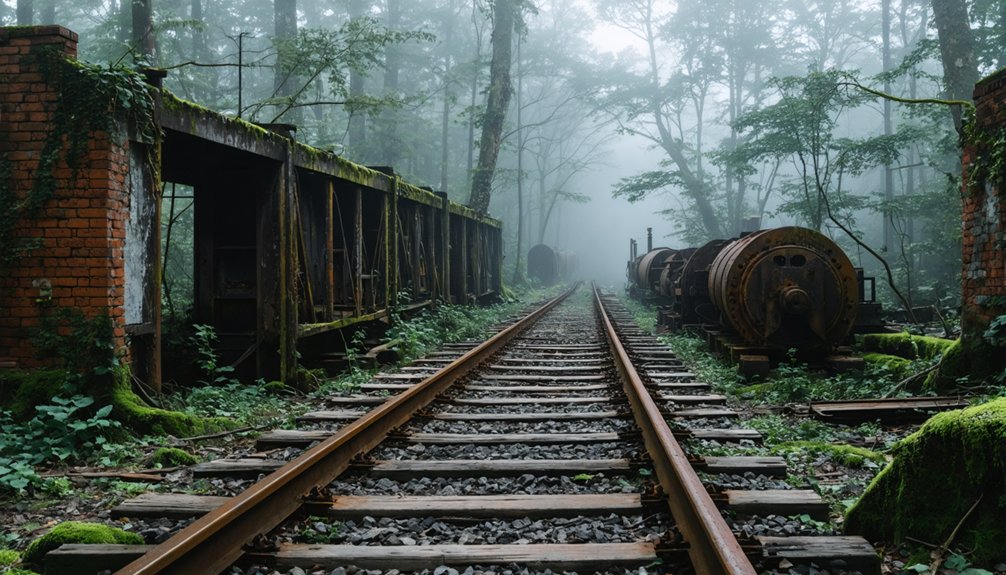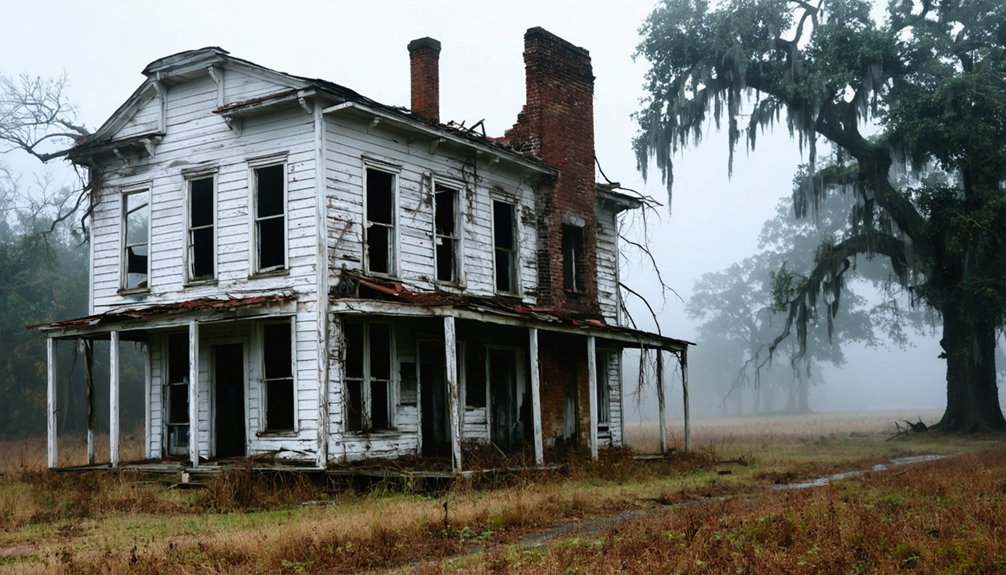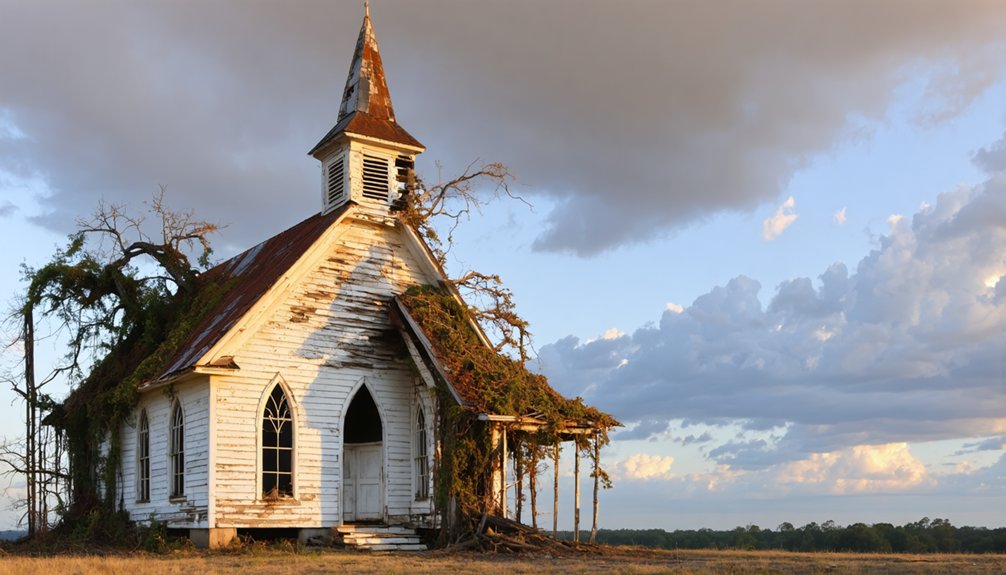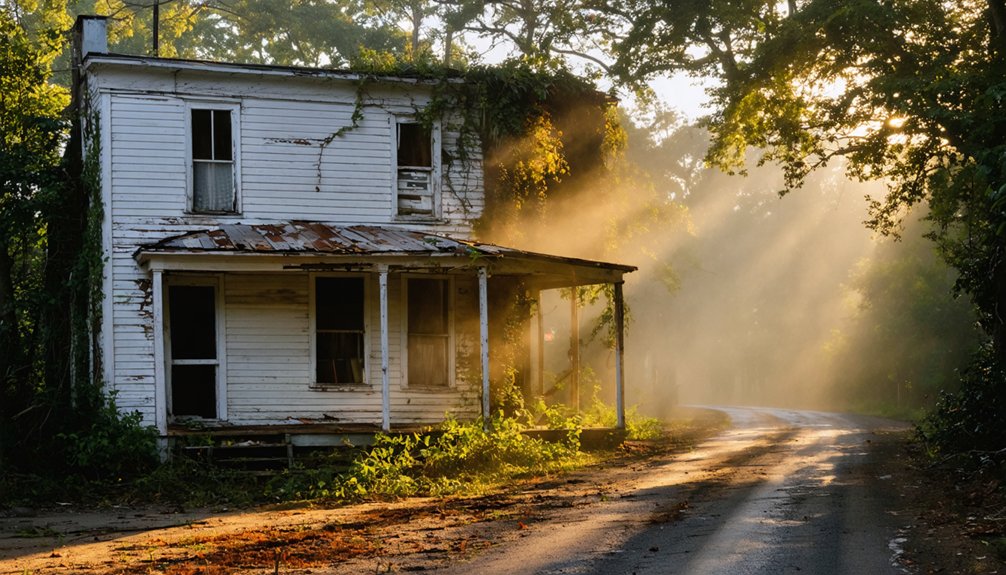
You’ll find Georgia’s most fascinating ghost towns scattered across the state, from Auraria’s gold rush remnants to New Ebenezer’s Austrian Protestant heritage. Bridgeboro preserves its railroad legacy with abandoned tracks and depots, while Wrightsboro showcases the state’s Quaker history through its 18th-century structures. At Scull Shoals, you can explore ancient mill ruins along the Oconee River. Each abandoned settlement holds centuries of stories waiting to be uncovered in Georgia’s forgotten corners.
Key Takeaways
- Auraria offers authentic gold rush history with preserved structures and the historic Gold Diggers’ Road from Georgia’s first gold rush.
- New Ebenezer features America’s oldest continuously active congregation and rich Salzburger heritage dating back to 1736.
- Scull Shoals preserves impressive mill ruins and Native American artifacts spanning 10,000 years of history.
- Wrightsboro maintains original Quaker settlement structures from 1767 within its 12,000-acre historical site.
- Bridgeboro showcases early 1900s railroad heritage with preserved junction points and historic rail infrastructure.
The Rise and Fall of Bridgeboro’s Railroad Legacy
As the railroads expanded across south Georgia in the early 1900s, Bridgeboro emerged as an essential crossing point where two important shortlines intersected.
You’ll find this town’s railroad history began in 1906 when tracks reached 32 miles southwest from Ashburn, originally part of the ambitious but misnamed Flint River & Gulf Railroad.
By 1922, the Pidcock family’s Georgia Ashburn Sylvester & Camilla Railroad took control, creating critical connections with the Georgia Northern line at Bridgeboro’s heart.
In 1922, Bridgeboro became a vital rail junction as the Pidcock family merged their railroad with Georgia Northern’s established line.
The railroad spanned a total of 51 miles, connecting communities and fostering economic growth throughout the region.
Similar to the Augusta and Waynesboro Rail Road established decades earlier, these rail lines were vital for enhancing regional transportation and commerce.
The town thrived as a transportation hub, with regular freight interchanges between multiple rail lines, including the Atlantic Coast Line and Georgia Southern & Florida.
But Bridgeboro’s independent railroad legacy faded in 1966 when Southern Railway acquired both shortlines, marking the end of an era that had defined this once-bustling crossroads.
New Ebenezer: A Salzburger Settlement’s Journey
While Bridgeboro’s story centered on railroad connections, another Georgian ghost town’s tale began with religious persecution across the Atlantic. Protestant colonists, expelled from Salzburg, Austria, established New Ebenezer along the Savannah River in 1736. Their Salzburg Heritage flourished as they built a thriving community around the iconic Jerusalem Church, which still stands today as America’s oldest continuously active congregation. Under the leadership of Pastor Johann Boltzius, the settlement grew to around 1,200 people by 1752. The Jerusalem Church continues to display the brick layers’ handprints in its walls, a testament to its original 1769 construction.
Key elements that defined New Ebenezer’s success:
- Water-powered mills that drove local industry
- Women-led silk production that fostered trade
- Small-scale farming that sustained community growth
You’ll find the town’s decline marked by British occupation during the Revolution, when soldiers turned the Ebenezer Church into a hospital and burned its pews for firewood.
Though most Salzburgers eventually abandoned the settlement, their legacy endures in the historic church and their descendants who still call the area home.
Wrightsboro’s Quaker Heritage
Deep in Georgia’s piedmont region, forty Quaker families established what would become the southernmost Quaker settlement in colonial America.
Led by Joseph Mattock and Jonathan Sell in 1767, they carved out a community of 12,000 acres in St. Paul’s Parish, naming it Wrightsborough after the Royal Governor. You’ll find their legacy in the rectangular town layout, where settlers once farmed rich soil and operated bustling mills along Middle Creek.
The Revolutionary War brought brutal hardships – raids, murders, and conflict tested their pacifist beliefs. Nearly thirty-five murders occurred in the area during a wave of banditry by 1781. The community’s commitment to peace was evident when they banned slavery in 1774.
By the early 1800s, opposition to slavery and prophetic warnings sparked a final Quaker migration northward to Ohio and Indiana.
Today, only the Wrightsboro cemetery and the sturdy Rock House remain as silent witnesses to this remarkable experiment in religious freedom.
Scull Shoals: Tales From the Oconee River
Three distinct civilizations left their mark on Scull Shoals, a historic site nestled along the Oconee River’s fertile banks. Native American artifacts tell of hunter-gatherers who thrived here for 10,000 years before giving way to frontier settlements.
Ancient peoples, frontier settlers, and industrial pioneers all shaped the storied banks of Scull Shoals along the Oconee River.
You’ll discover the ruins of a once-bustling mill village that flourished in the 1800s, complete with textile operations that employed 600 people. Dr. Thomas Poullain transformed the site into Greene County’s largest industrial operation with 145 slaves working the mills.
Three key phases shaped this ghost town’s destiny:
- Ancient Mississippians built ceremonial mounds, leaving behind pottery and projectile points.
- Revolutionary War veterans established plantations and Fort Clark during the frontier era.
- Industrial development brought Georgia’s first paper mill and extensive cotton operations.
Today, you can explore the crumbling warehouse ruins while walking through a landscape that witnessed both prosperity and environmental decline from unsustainable agricultural practices. The town’s final decline was hastened by major flooding in 1841 and 1887 that devastated the mills and local infrastructure.
Walking Through Auraria’s Gold Rush Past
Georgia’s earliest gold rush unfolded in Auraria, a bustling boomtown that emerged two decades before California’s famous 1849 stampede.
As you walk along the historic Gold Diggers’ Road today, you’ll find crumbling remnants of what was once a thriving gold mining community where fortunes were made and lost.
Between the Chestatee and Etowah rivers, you can explore the site where William Dean built the first cabin in 1832, sparking a population boom that brought 25,000 people to the area.
Local ghost stories echo through the abandoned structures that once housed the Western Herald newspaper, John Ware’s confectionery, and countless miners’ dwellings. The historic Central Hallway Cottage still stands as a testament to the town’s prosperous past.
Though Auraria lost its prominence to nearby Dahlonega, its legacy lives on as Georgia’s first ghost town, marked by the state’s First Gold Rush monument. An incredible twenty million dollars worth of gold was extracted from Georgia’s Cherokee country in just a decade, fueling the region’s rapid growth.
Mallory: A Madison County Mystery
While many ghost towns sprang from Georgia’s gold rushes, Mallory’s mysterious abandonment tells a different tale.
You’ll find this haunting settlement nestled in Madison County, where the once-thriving community emerged on land owned by its namesake family. By 1897, Mallory had established itself as a typical rural Georgia hamlet, complete with a church that served as its spiritual heart.
What you’ll discover about Mallory’s history:
- The settlement reached its peak in the late 1890s with residential structures and agricultural activity.
- A prominent church stood as the community’s cornerstone, hosting regular gatherings.
- The site’s transformation into a ghost town occurred gradually after the early 1900s.
Today, only a historical marker hints at Mallory’s existence, while its abandoned structures slowly fade into Georgia’s mysterious landscape.
Hidden Gems: Lesser-Known Ghost Towns
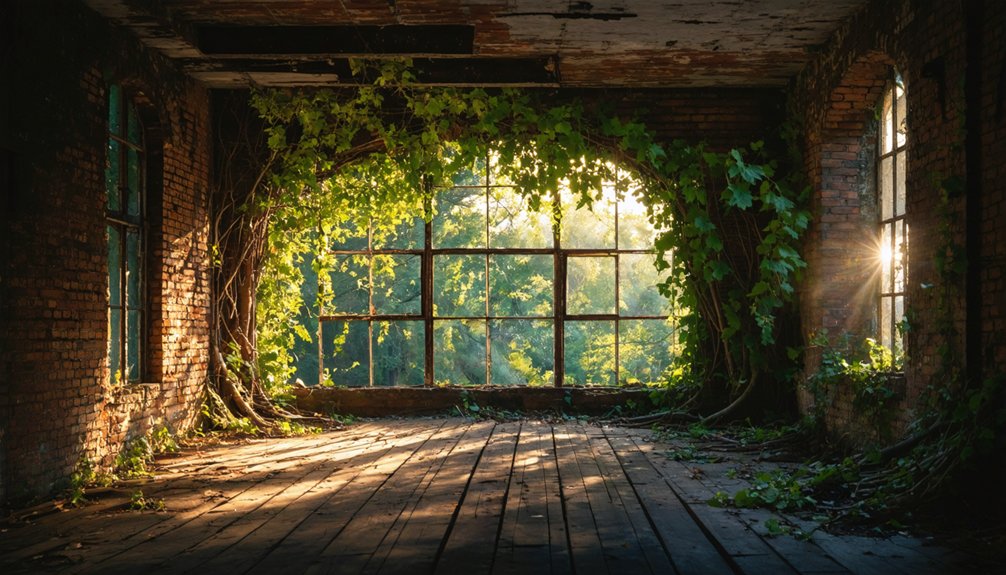
Beyond Georgia’s well-documented ghost towns lie fascinating rural settlements you’ll discover in remote corners of the state, from crumbling textile mills to abandoned crossroads communities.
You can explore stone foundations at High Falls’ submerged industrial hub, trace the remnants of Scull Shoals’ pioneering paper mill, or wander among Wrightsboro’s surviving 19th-century structures.
These lesser-known sites offer intimate glimpses into Georgia’s agricultural and industrial past, though many require careful navigation through forest trails or private lands to access their weathered ruins.
Unexplored Rural Settlement Ruins
Deep within Georgia’s rural landscapes lie forgotten settlements that time has slowly reclaimed, offering adventurous explorers a glimpse into the state’s pastoral past.
You’ll discover the weathered remnants of Chappell Mill, where a two-story grist mill stands as a symbol of 1830s craftsmanship, alongside ruins of a one-room schoolhouse and tiny courthouse.
The Jacksonboro ruins beckon with their haunting collection of decaying houses and forgotten foundations.
Three key features that make these sites worth exploring:
- Most locations remain unmapped by modern GPS
- Original architectural elements survive beneath thick vegetation
- Sites offer unrestricted access to authentic historical structures
These remote ruins preserve stories of communities that once thrived, now waiting for intrepid souls to uncover their secrets.
Remote Historical Site Access
These lesser-known ghost towns scattered across Georgia reveal untold chapters of the state’s history, each offering unique glimpses into abandoned communities frozen in time.
You’ll find Scull Shoals tucked deep within Oconee National Forest, where brick ruins emerge from dense undergrowth along the river.
New Ebenezer’s historical significance lives on through its preserved Jerusalem Lutheran Church, while Wrightsboro’s Revolutionary War cemetery stands as a monument to America’s earliest Quaker settlements.
Remote access to Jacksonboro rewards you with haunting views of weathered houses and crumbling foundations, perfect for photography enthusiasts.
At High Falls, you can explore Georgia’s “unluckiest” ghost town, where mill ruins and powerhouse foundations rest beneath the state’s largest waterfall, telling tales of industrial ambition and natural disaster.
Forgotten Agricultural Communities Today
While Georgia’s industrial ghost towns often capture the spotlight, a fascinating collection of abandoned agricultural communities tells equally compelling stories of rural life and economic transformation.
You’ll discover forgotten farms scattered across Worth, Effingham, Harris, and Morgan counties, each preserving traces of ambitious agricultural dreams. These sites reveal how shifting economic tides led to agricultural decline across different eras.
Key features you’ll encounter at these rural ghost towns:
- Crumbling tenant cabins and commissary buildings at Nolan Plantation
- New Ebenezer’s preserved church ruins amid former Salzburger farmlands
- Pine Mountain Valley’s abandoned New Deal farmsteads and cooperative buildings
Walking these grounds today, you’ll find weathered structures and overgrown fields that whisper tales of farming communities that once thrived through cotton, peanuts, and experimental crops before succumbing to economic pressures and changing times.
Preservation Efforts and Historical Landmarks

Since the late 1940s, Georgia has mounted an impressive campaign to protect its historic ghost towns through various preservation initiatives and landmark designations.
You’ll find the Georgia Trust for Historic Preservation leading the charge, tackling preservation challenges through their Places in Peril program and Revolving Fund. They’ve transformed endangered sites into protected landmarks, ensuring these forgotten communities’ historical significance isn’t lost to time.
Local Historic Preservation Commissions work alongside state agencies to safeguard these remnants of the past.
You can explore places like Pineville and Hogg in Marion County, where storytelling plays a vital role in preservation. Through matching grants, disaster recovery plans, and preservation easements, Georgia’s ghost towns are getting a second chance at life, maintaining their authentic character while educating future generations about the state’s rich history.
Planning Your Ghost Town Adventure
You’ll want to plan your Georgia ghost town excursions between late fall and early spring when cooler temperatures and bare vegetation improve visibility of historic foundations and ruins.
Before setting out, equip yourself with sturdy boots, protective clothing, first-aid supplies, and fully charged communication devices, while sharing your detailed route plan with a trusted contact.
Keep an eye on weather forecasts and hunting schedules, as rain-slicked surfaces and active hunting areas can make exploration more hazardous around abandoned structures and remote sites.
Safety First When Exploring
Before venturing into Georgia’s fascinating ghost towns, proper planning and safety protocols are essential for an enriching exploration experience. Always carry safety gear including first aid kits and communication devices, while maintaining personal awareness of your surroundings, especially in isolated areas.
When exploring historic structures like those in Scull Shoals or Auraria, you’ll need to stay vigilant about structural hazards. Here are critical safety steps to follow:
- Obtain proper permissions and check with local historical societies before accessing any site.
- Explore during daylight hours and travel with companions for enhanced security.
- Stay clear of unstable structures, watching for rotted floorboards and crumbling walls.
Remember to respect preservation guidelines and avoid disturbing artifacts, ensuring these historical treasures remain intact for future adventurers.
Seasonal Weather Considerations
When planning your ghost town adventure in Georgia, understanding seasonal weather patterns becomes essential for maximizing your exploration potential.
Autumn emerges as the prime season, with October offering crisp temperatures and stunning foliage that creates the perfect backdrop for your discoveries. You’ll find the mountain air particularly clear, enhancing both visibility and photographic opportunities.
Consider off-season visits during spring when you’re seeking a more solitary experience. While summer brings extended daylight hours, you’ll contend with dense vegetation and larger crowds.
Winter presents unique challenges, as shortened days and harsh weather conditions can limit accessibility and create hazardous situations.
Remember that Georgia’s varied climate zones, from the northern mountains to southern lowlands, can affect seasonal trends and weather impact at different ghost town locations.
Essential Gear To Pack
Proper preparation for ghost town exploration begins with assembling the right collection of gear. Your packing checklist should prioritize safety and self-reliance while exploring Georgia’s abandoned settlements. Pack multiple LED flashlights, sturdy boots, and protective clothing to navigate deteriorated structures safely.
- Navigation tools: GPS device with offline maps, compass, and physical maps of the area
- Safety gear: dust masks, thick gloves, and first aid supplies
- Essential equipment: multi-tool, headlamp, and emergency repair items
Don’t forget to bring plenty of water, energy bars, and a camera to document your discoveries. Your gear essentials should include backup lighting sources and extra batteries, as ghost towns often lack power and cell service.
Photography Tips for Abandoned Places
Capturing the haunting beauty of Georgia’s abandoned places requires careful preparation and specialized photography techniques.
You’ll want to pack a wide-angle lens (14-24mm) to document sprawling interiors and architectural details, along with a sturdy tripod for those essential long-exposure shots. Since most abandoned buildings lack power, you’ll need to master abandoned lighting scenarios by bringing flashlights and portable light sources.
Work the scene by exploring multiple angles and vantage points – what looks ordinary from one perspective might reveal something extraordinary from another.
Shift your perspective to uncover hidden stories – urban exploration photography rewards those who look beyond the obvious.
Focus on compelling details like weathered chairs, dusty books, or rusted machinery to tell the location’s story. Consider shooting at night or during golden hour when natural light streams through broken windows, creating dramatic shadows and highlighting the mysterious atmosphere that makes these forgotten places so enchanting.
Frequently Asked Questions
Are Any Georgia Ghost Towns Rumored to Be Haunted?
You’ll find haunted legends at Scull Shoals, where ghost sightings include unexplained footsteps and apparitions roaming abandoned streets. The old paper mill’s ruins still echo with mysterious whispers and slamming doors.
Can Visitors Legally Collect Artifacts From These Abandoned Sites?
Want to avoid legal trouble? You can’t collect artifacts from ghost towns without proper permission. Artifact preservation policies require landowner consent and state notification, with serious legal consequences for violations.
Which Ghost Towns Are Accessible During Winter Months?
You’ll find Scull Shoals, Wrightsboro, New Ebenezer, and Bridgeboro accessible during winter months. Despite occasional snow activities up north, these sites maintain clear hiking trails and marked routes for your exploration.
Do Any Ghost Towns Require Special Permits for Metal Detecting?
You’ll need special permits for any metal detecting at ghost towns on federal or state lands due to strict regulations protecting abandoned site preservation. Private ghost towns require only landowner permission.
Are Guided Night Tours Available at Any Georgia Ghost Towns?
You won’t find guided night tour options at Georgia’s abandoned ghost towns. Instead, you’ll discover organized ghost tours in historic urban areas like Savannah, Dahlonega, and Atlanta’s preserved haunted buildings.
References
- https://www.ezhomesearch.com/blog/ghost-towns-in-georgia/
- https://roughdraftatlanta.com/2021/05/23/travels-with-charlie-georgias-ghost-towns-slideshow/
- https://en.wikipedia.org/wiki/List_of_ghost_towns_in_Georgia_(U.S._state)
- https://flagpole.com/news/news-features/2013/10/23/exploring-georgias-ghost-towns/
- https://www.fireflymadison.com/2022/08/31/ghost-towns-in-georgia/
- https://www.freakyfoottours.com/us/georgia/
- https://www.youtube.com/watch?v=OfhPAHTOkJE
- https://exploregeorgia.org/things-to-do/article/where-to-find-famous-georgia-ghosts
- https://myfiles.dot.ga.gov/Environmental/CulturalResources/Appendix G_GSF_Final 100318.pdf
- https://hawkinsrails.net/shortlines/gasc/gasc.htm