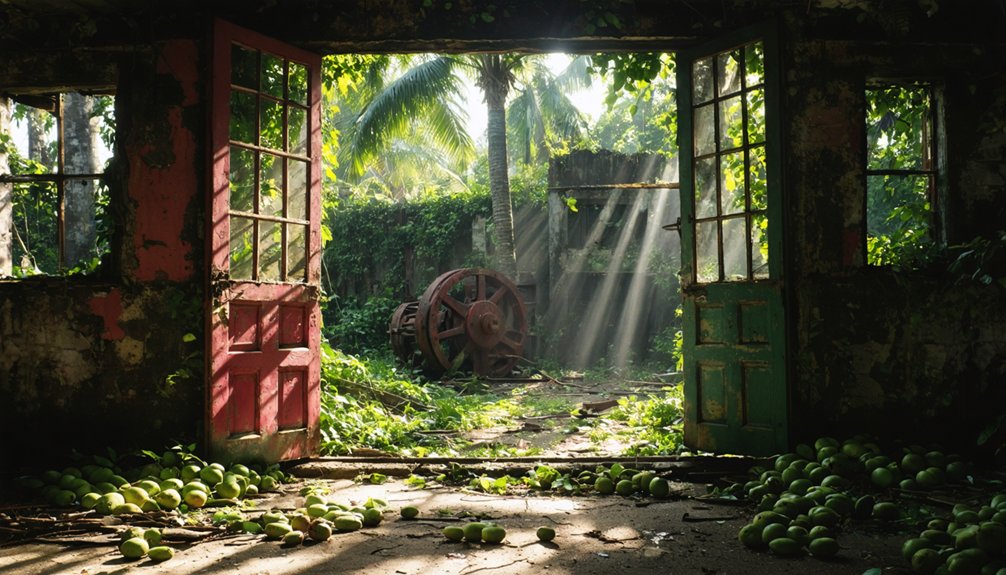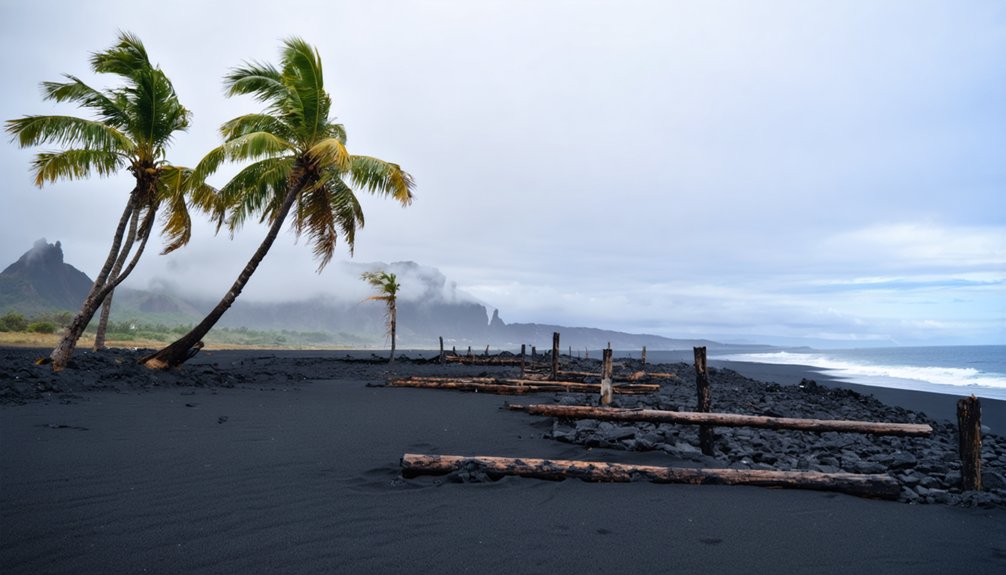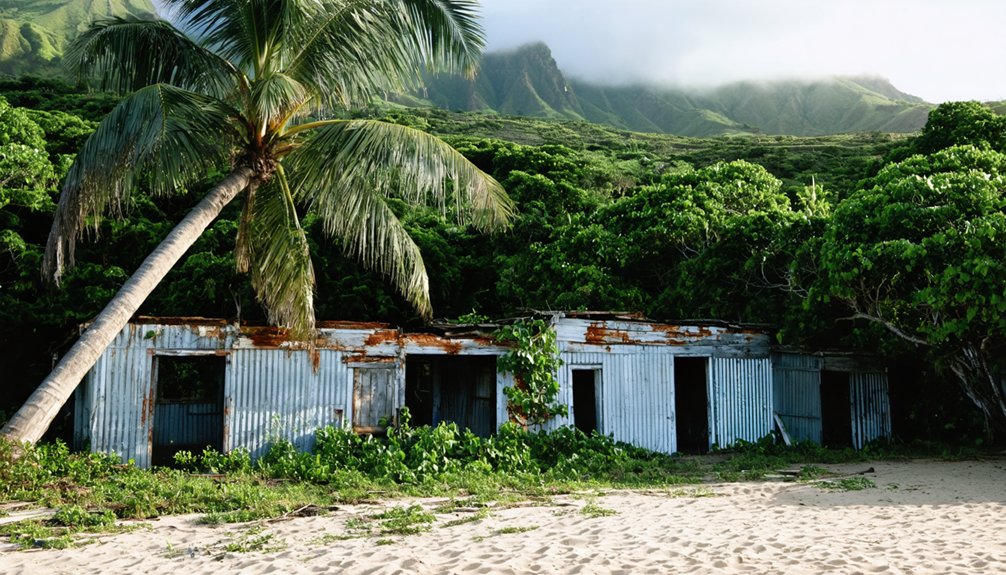
You’ll find Hawaii’s most remarkable ghost towns tucked away in sacred valleys and along former sugar plantation routes. From Waipi’o Valley’s abandoned villages, where 10,000 residents once thrived, to Honoka’a’s silent sugar empire, each site holds deep cultural significance. Ancient temples and weathered structures dot the Hāmākua Coast and Wailua’s sacred grounds, while mysterious drum sounds still echo at Polihale’s spirit pathways. These forgotten places guard centuries of Hawaiian heritage and untold stories.
Key Takeaways
- Waipi’o Valley’s abandoned villages once housed 10,000 residents before the 1946 tsunami forced mass evacuation, leaving behind historic structures.
- Honoka’a, a former sugar empire town, features remnants of its prosperous past with the silent mill that closed in 1994.
- The Hāmākua Coast showcases three prominent ghost towns: Laupahoehoe, Pepe’ekeo, and Honoka’a, with preserved railroad tunnels and worker villages.
- Wailua’s abandoned temple complex contains Hawaii’s most significant collection of ancient ruins and sacred petroglyphs along the riverbank.
- Mākua Valley’s deserted settlement holds cultural significance with abandoned fishing shrines and displaced communities from military occupation since 1941.
The Haunting Beauty of Waipi’o Valley’s Abandoned Villages
While many of Hawaii’s ancient settlements have faded into memory, Waipi’o Valley stands as a poignant reminder of Native Hawaiian civilization‘s former grandeur.
You’ll find haunting beauty in this once-mighty valley that supported up to 10,000 residents and fed 30,000 with its vast taro fields stretching across two square miles.
The valley’s dramatic decline began with European diseases and warfare in the 1790s, when Keoua and Ka’eokülani’s forces destroyed sacred heiau and fishponds.
The illegal production of okolehao liquor contributed significantly to the declining population of pure Hawaiians in the valley.
Though the community persevered through the 1940s, maintaining churches, stores, and a school, the devastating 1946 tsunami forced most remaining residents to abandon Waipi’o Valley.
Today, this ghost town’s empty fields and repurposed temple stones whisper stories of an ancient Hawaiian paradise lost to time, disease, and natural disaster.
Similar historical remnants can be found at Kaloko-Honokohau Park, where ancient fishponds showcase traditional Hawaiian aquaculture practices.
Honoka’a: From Sugar Empire to Silent Streets
Once a thriving sugar empire that crowned Hawaii’s Hamakua Coast, Honoka’a’s story began in 1876 when pioneering entrepreneurs Siemsen and Marsden planted their first 500 acres of cane.
From humble sugar cane fields, Honoka’a rose to claim its place as a Hawaiian empire on the majestic Hamakua Coast.
The plantation’s challenging terrain of steep slopes and gulches presented unique obstacles for cane growing and harvesting operations.
Today, the town’s Mamane Street remains a testament to its historical importance, featuring an impressive collection of early twentieth-century wooden buildings.
As you walk these silent streets today, you’ll feel echoes of the bustling sugar plantation that transformed this land into Hawaii’s second-largest town.
You can still trace the remnants of innovation: the six-roller mill that revolutionized production, the dramatic wire rope system that sent sugar down cliffs to waiting steamers, and the extensive ditch network that brought life-giving water to thirsty fields.
Under W.P. Naquin’s leadership from 1916 to 1944, Honoka’a Sugar Company flourished, providing workers with groundbreaking benefits until the bitter end in 1994, when the last mill fell silent, marking the end of an era.
Ancient Spirits of Pu’uhonua O Honaunau
Deep within the ancient lava fields of Hawaiʻi Island stands Puʻuhonua O Honaunau, a sacred sanctuary where our ancestors found refuge from certain death.
For 450 years, this powerful puʻuhonua offered salvation to those who broke kapu, sheltering warriors, women, and keiki from battle’s fury. You’ll feel the mana emanating from the Great Wall, where sacred rituals once cleansed condemned souls and granted them new life.
Though Queen Kapiʻolani removed the bones of 23 aliʻi in 1829, their spiritual essence still permeates the grounds. Daily ranger talks share the rich Hawaiian history in the park’s amphitheater.
The site was established as early as 1475 AD under the leadership of a powerful chief.
Puʻuhonua legends tell of wooden kiʻi standing guard near Hale o Keawe heiau, protecting those seeking absolution.
Today, you’ll discover one of Hawaii’s most intact ancient sanctuaries, where the spirits of our kupuna continue to offer peace to those who seek it.
Polihale’s Forgotten Settlements and Spirit Pathways
Along the rugged western shores of Kaua’i, Polihale Beach holds sacred pathways where earthly souls complete their final journey into Pō, the eternal darkness.
You’ll find ancient spirit pathways that begin at Kā’ana, high in Waimea Canyon, where departed souls gather before following Hikimoe stream down to Chief Polihale’s ancient heiau.
At the beach’s edge, a towering three-hundred-foot cliff marks where spirits take their final leap into the ocean depths.
The ancestral burial grounds scattered throughout Polihale’s coastal dunes contain iwi kupuna – sacred remains of those who’ve walked these shores for centuries.
While you can visit this powerful place today, remember you’re walking on hallowed ground where the god Ku once roamed and Kane and Kanaloa descended to protect their people.
Local fishermen have reported hearing mysterious drum sounds while camping on this longest sandy beach in Hawaii.
The sacred site’s beauty is enhanced by its emerald spires that rise dramatically against the sky.
Lost Temples of Wailua: A Sacred Ghost Town
You’ll find the ancient temple ruins of Wailua scattered along the sacred river valley, where seven grand heiaus once stood as powerful centers of Hawaiian spirituality and royal ceremony.
According to ancestral knowledge, the Wailua River served as a final passage for departed souls making their way to the leaping place at Ka-pae-a-kane.
The petroglyphs near the river mouth and remaining temple foundations tell stories of a bustling religious complex that thrived for over a millennium before falling silent in the 1800s. The massive stone and coral walls of these temples signified their deep spiritual importance to the ancient Hawaiians. The most prominent temple, Hikinaakala, was dedicated to worshipping the sun with sacred sunrise rituals each morning.
Ancient Temple Site Discoveries
The sacred Wailua Complex stands as Hawaii’s most significant collection of ancient temple ruins, where four majestic heiaus – Hikinaakala, Holoholoku, Malae, and Poliahu – tell the story of Kauai’s powerful chiefs and spiritual legacy.
You’ll discover the Rising Sun Heiau, built around 1200 AD, where dawn ceremonies once filled the air with chants and drumming. The complex’s archaeological significance reveals itself through hand-picked stone walls rising six feet high and eleven feet wide.
At the river mouth, you’ll find ancient petroglyphs carved into blue-basalt boulders, depicting fish and human forms that connect to the legend of Maui’s eight brothers.
While many heiau restoration efforts seek to preserve these sacred sites, they stand as silent witnesses to the spiritual and political power of Hawaii’s ancestors.
Sacred River Legends
Sacred waters of Wailua River once flowed past bustling temple grounds where ali’i (chiefs) conducted their most powerful ceremonies.
Along these banks, you’ll find remnants of sacred stories etched in stone – ancient petroglyphs depicting fish and human forms that emerge when tides run low. Local legends tell of Maui’s eight brothers transformed to stone by river spirits, their forms scattered near Hauola Heiau.
Before Christian missionaries arrived in 1820, this two-mile stretch held Hawaii’s most significant religious complex.
The massive Malae Heiau, spanning two acres, stood as the crown jewel among temples. Though Queen Kapule later ordered its stones repurposed for cattle, the river’s mana (spiritual power) still pulses through the valley, whispering tales of royal births and sacred ceremonies.
Spirits’ Final Journey
Along Wailua’s riverbanks, where ancient petroglyphs whisper stories of Hawaii’s spiritual past, stands one of Kauai’s most significant temple complexes – now a haunting reminder of indigenous practices lost to time.
You’ll find sacred echoes of the luakini heiaus where ali’i once performed blood sacrifices to honor Ku, the war god. At Holoholoku, royal mothers birthed future chiefs while bellstones rang out across the valley.
The spirits’ journey through these grounds changed forever in 1819 when Kamehameha II abolished the kapu system. Within decades, Queen Kapule dismantled Malae Heiau for cattle, and missionaries converted ali’i to Christianity.
Today, only weathered stones remain where temples once towered, their rocks scattered for road building – silent witnesses to a vanished spiritual era.
Mākua Valley’s Mysterious Abandoned Communities
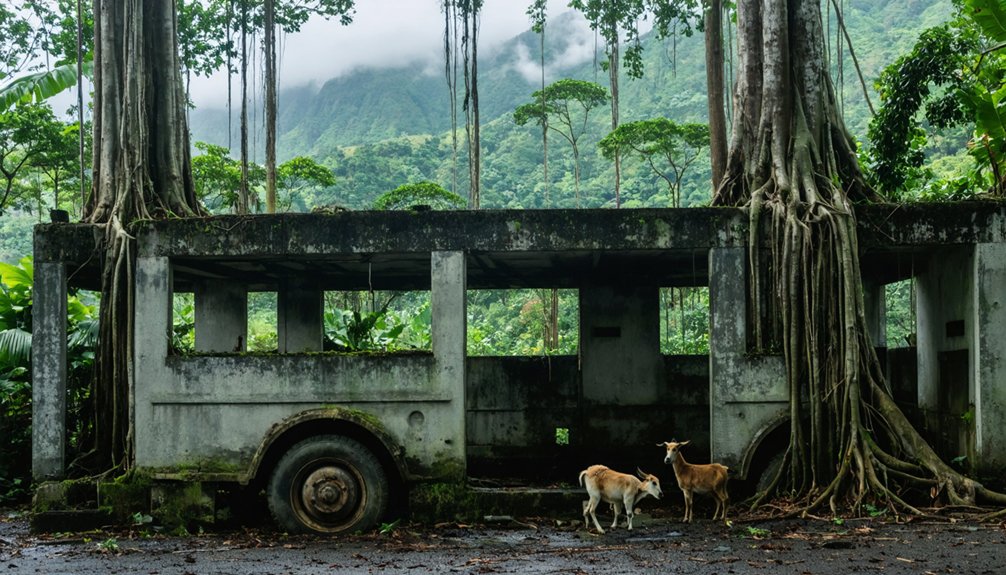
Deep within O’ahu’s western coast lies Mākua Valley, a once-vibrant homeland whose name means “parent” in Hawaiian, reflecting ancient beliefs that it birthed mankind.
Until 1941, you’d have found generations of Native Hawaiian families tending to sacred ko’a fishing shrines and heiau, while master fisherman Sam Pulu’ole carefully managed the valley’s abundant resources.
Everything changed when the U.S. military seized the land after Pearl Harbor. They forced residents onto trucks, destroyed the Protestant church and cemetery, and transformed this cultural heritage site into a barren bombing range.
Though promised return within six months after WWII, the valley remains under military control today.
But hope stirs – as the 2029 lease expiration approaches, the community’s fighting spirit endures, working to reclaim and restore their ancestral lands.
Hidden Sugar Plantation Towns Along the Hāmākua Coast
Three ghostly sugar plantation towns dot the rugged Hāmākua Coast of Hawaiʻi Island, telling stories of an era when sugar was king.
You’ll discover hidden histories in Laupahoehoe, Pepe’ekeo, and Honoka’a, where massive sugar mills once processed endless fields of cane. These towns grew from the sweat and sacrifice of immigrants who arrived from China, Japan, Philippines, and Portugal to work the plantations.
Today, you can explore plantation remnants like the old railroad tunnels and towering steel trestles that transported sugar to waiting ships.
The multicultural legacy lives on in abandoned worker villages, where outdoor cookhouses and communal bathhouses stand as silent witnesses. Each crumbling structure and overgrown path honors the ancestors who built these communities and shaped Hawai’i’s plantation era.
Frequently Asked Questions
Are There Any Accommodations Near These Ghost Towns for Overnight Stays?
Hit the nail on the head with ghost town accommodations by choosing nearby lodging options in Kona, Lahaina, or Honolulu. You’ll find everything from resorts to vacation rentals within easy reach.
What Permits Are Required to Explore Abandoned Hawaiian Settlements?
You’ll need archaeological permits from Hawaii’s Department of Land and Natural Resources. Respect ancestral sites by following exploration regulations and obtaining Special Management Area permits if you’re near coastal settlements.
When Is the Best Season to Visit Hawaiian Ghost Towns?
You’ll find the best weather for exploring abandoned settlements during September and October, when dry conditions make trails accessible and cultural sites reveal themselves clearly against uncrowded, respectful seasonal activities.
Do Any of These Ghost Towns Still Have Living Residents?
You’ll find active residents in Kalaupapa, where six original Hansen’s disease survivors maintain their historical legacy, and Lahaina’s rebuilding community preserves local legends despite the devastating 2023 wildfire’s displacement.
What Safety Precautions Should Visitors Take When Exploring These Locations?
Pack proper safety gear like flashlights and sturdy boots, maintain wildlife awareness, respect ancestral lands, and don’t enter without permission. Always notify someone of your plans before exploring.
References
- https://nvtami.com/2023/04/26/big-island-hawaii-ghost-towns/
- https://www.revealedtravelguides.com/blog/haunted-places-to-visit-in-hawaii-this-halloween/
- https://www.honolulumagazine.com/our-favorite-ghost-stories-about-haunted-places-on-oahu/
- https://www.atlasobscura.com/things-to-do/hawaii/abandoned
- https://www.geotab.com/ghost-towns/
- https://www.youtube.com/watch?v=q56mo4VCXtE
- https://coffeetimes.com/pages/memories-of-childhood-and-youth-in-waipi-o-valley-by-herbert-mock-akioka-kane-1895-1970
- https://scholarspace.manoa.hawaii.edu/bitstreams/aa3e6bd1-f240-4959-9207-0f511d7673ae/download
- http://www2.bishopmuseum.org/chpa/Waipio/pdf/waipio1999.pdf
- http://www.bigislandtalkstory.org/talk-stories/waipio-valley-a-cultural-kipuku-ke-ola-magazine-march-april-2022