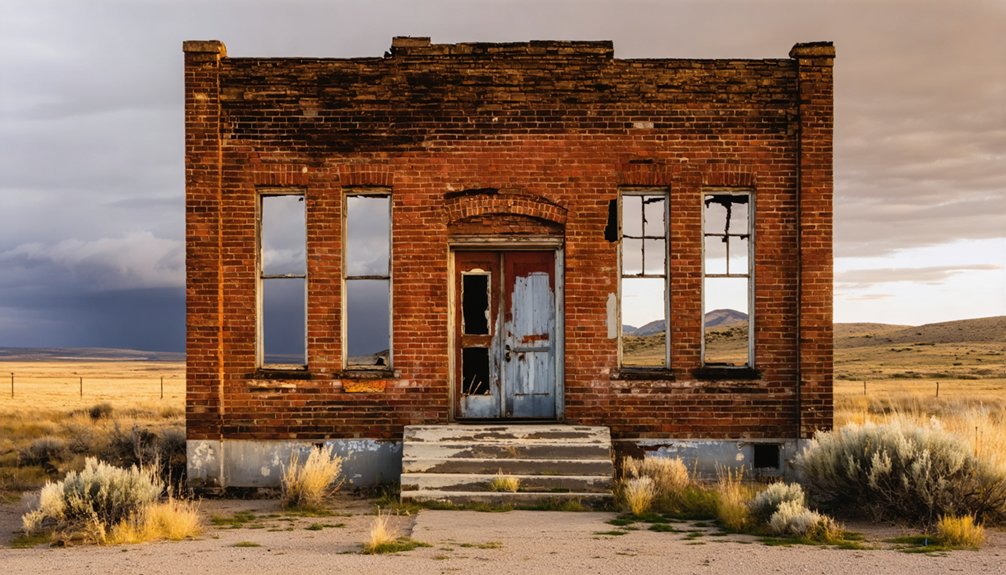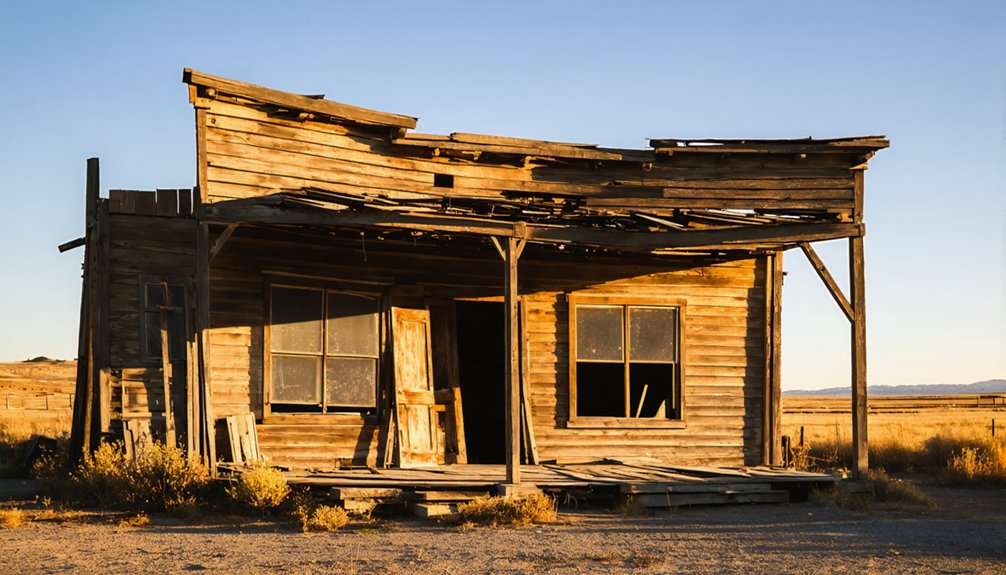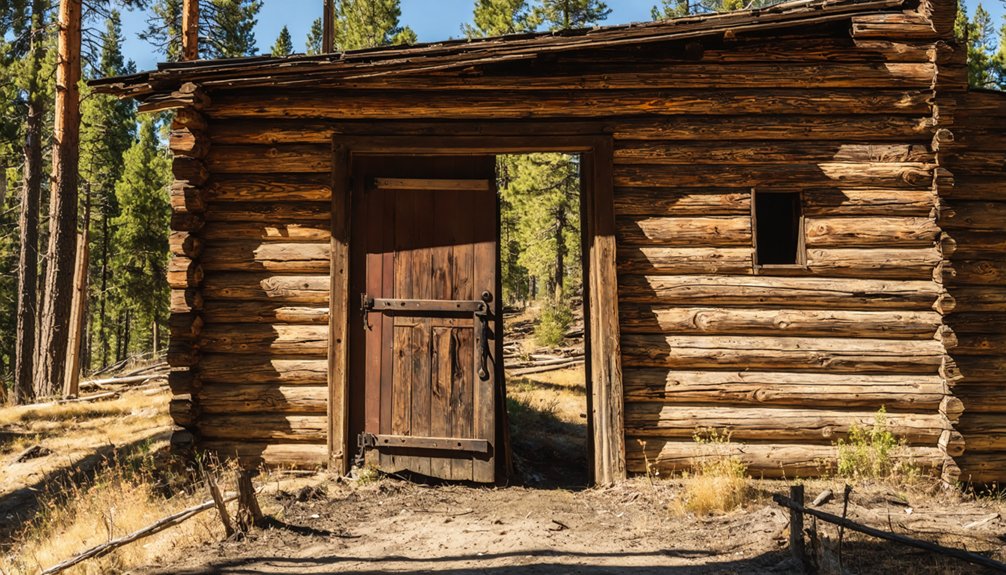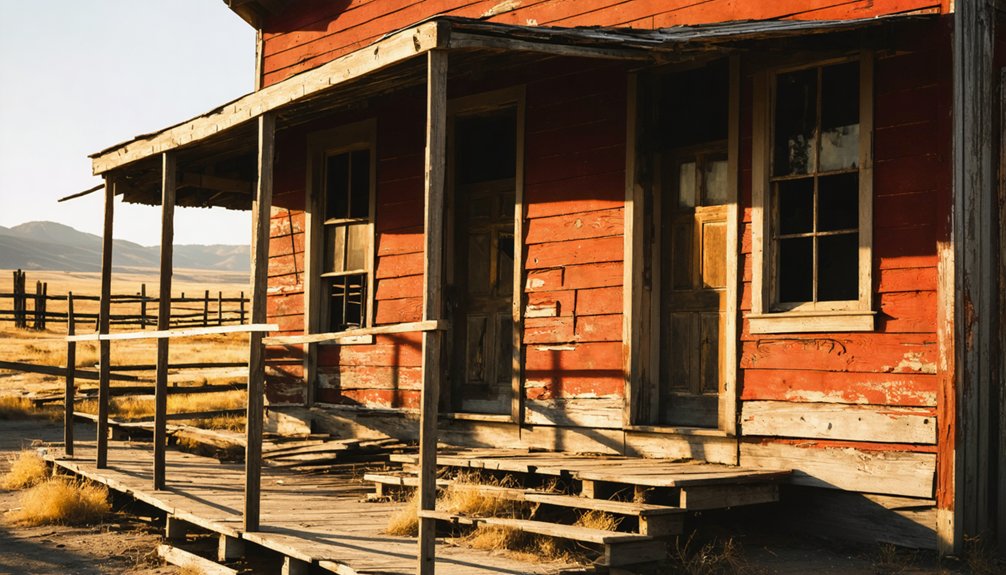
You’ll find Idaho’s most fascinating ghost towns scattered throughout the state’s rugged mountain ranges. Silver City stands out with its well-preserved Victorian architecture at 6,200 feet elevation, while Bayhorse showcases an impressive 1880s mining mill and smelter complex. Don’t miss Chesterfield’s 27 original brick structures or Custer’s restored buildings in the Yankee Fork district. These abandoned settlements offer windows into Idaho’s rich mining heritage, with each site holding unique stories of boom-and-bust cycles.
Key Takeaways
- Silver City stands as Idaho’s best-preserved ghost town, featuring over 250 historic mines and buildings at 6,200 feet elevation.
- The Bayhorse Historic District offers accessible ruins within Land of the Yankee Fork State Park, including an 1880s water-powered smelter.
- Custer features seven well-preserved historic buildings within a 29-acre National Historic District, showcasing Idaho’s mining golden age.
- Chesterfield presents 27 original brick structures across 100 acres, including a converted LDS meetinghouse now serving as a museum.
- Gilmore maintains twenty weathered buildings from its mining heyday, though visitors should note dangerous soil contamination levels.
The Silver Rush Legacy of Silver City
While prospectors initially sought gold in the Owyhee region of southwest Idaho, it was silver that ultimately defined Silver City’s legacy. In 1863, the Jordan party of 29 men stumbled upon gold deposits while searching for the legendary Blue Bucket mine, but by 1864, the real treasure emerged – massive silver deposits that would transform this frontier outpost into a bustling boomtown.
Silver City’s mining heritage exploded with over 250 mines carved into the Owyhee mountains. At its peak in the 1880s, you’d have found a thriving community of 2,500 residents, 75 businesses, and 12 ore-processing mills. The first stamp mill constructed in summer 1864 proved incredibly lucrative, recovering $90,000 in just 45 days. Situated at 6,200 feet elevation, the town’s remote mountain setting helped preserve its historic character.
The War Eagle and Poorman mines yielded such exceptional silver that Silver City briefly became the world’s largest silver mining area, producing over $60 million in precious metals before operations slowed in 1890.
Bayhorse: A Preserved Mining Mill Marvel
After a prospector with bay horses discovered mineral deposits near the Salmon River in 1864, Bayhorse emerged as one of Idaho’s most productive mining districts.
When major silver and lead veins were discovered in 1877, the district’s mining techniques rapidly evolved from simple prospecting to sophisticated industrial operations. You’ll find evidence of this advancement in the remains of their 1880s infrastructure, including a water-powered smelter that processed 30 tons daily and stamp mills that crushed ore around the clock. The town’s historic stone Wells Fargo building remains as one of its best-preserved structures. Essential services like general stores and saloons helped support the growing mining community.
The town thrived with 300-400 residents until 1889 when fire and water shortages triggered its decline. By 1915, Bayhorse’s mining operations had ceased completely.
After nearly 40 years of prosperity, natural disasters and dwindling resources forced Bayhorse’s mining community into abandonment by 1915.
Today, you can explore this preserved piece of mining history at Land of the Yankee Fork State Park, where the town’s ruins still stand.
Bonanza’s Rise and Fall in the Gem State
You’ll find the ghost town of Bonanza nestled eight miles up the Yankee Fork of Idaho’s Salmon River, where the 1876 discovery of the General Custer Mine sparked a meteoric rise to prosperity.
At its peak in the 1880s, Bonanza boasted hundreds of residents, multiple saloons, shops, and essential services supported by the Lucky Boy, Black, and General Custer mines. The Yankee Fork Herald newspaper operated from an office within the bustling town. The town’s development included modern amenities like a public water system and recreational facilities for residents to enjoy.
Two devastating fires in 1889 and 1897 destroyed much of the town’s infrastructure, leading to its eventual abandonment by 1910, though today you can still explore the remaining historical structures and two historic cemeteries that mark this once-thriving mining community.
Mining Boom Era Glory
During the 1860s, Idaho’s mining boom transformed the remote territory into one of America’s most significant gold-producing regions, contributing a remarkable 19% of the nation’s gold output between 1860-1866.
Mining camp life flourished as prospectors rushed to newly established districts, with ghost town legends born in places like Pierce and the Boise Basin. The Hudson’s Bay Company had dominated fur trading in the region before miners arrived.
You’ll discover these fascinating remnants of Idaho’s golden age:
- The Boise Basin, which drew 20,000 settlers during 1863-1864, becoming the Pacific Northwest’s largest population center.
- Pierce Mining District, established in 1860 as Idaho’s first major gold rush site.
- Thunder Mountain’s boom period (1900-1907), where prospectors spread from Roosevelt to Yellow Pine. Al Hennessey was among the early pioneers who built mining roads and discovered valuable mineral deposits in the region.
- The Coeur d’Alene region, which produced 80% of Idaho’s total metallic yield and birthed the legendary Bunker Hill mine.
Preserved Mountain Mining Heritage
Idaho’s rich mining heritage finds one of its most compelling stories in the rise and fall of Bonanza, a town incorporated in 1879 that embodied both the promise and perils of frontier mining ventures.
Within three decades, plummeting gold prices and unsustainable mining costs forced the town’s closure by 1910, leaving behind a record of the boom-and-bust cycle of Western mining operations.
Today, ghost town exploration reveals Bonanza’s preserved remnants, including the cemetery where pioneer Samuel Hughes rests.
The site gained new life in the 1940s when the Davidson and Kuster families briefly revived gold prospecting operations.
After their departure, the U.S. Forest Service acquired the property, securing its historical preservation status by the 1960s.
You’ll find Bonanza’s story echoes similar tales across Idaho’s mining country, where towns like Viola and Gilmore faced their own dramatic endings.
The town reached its peak with a population of 300 during the 1890 census, reflecting the substantial growth of this mining community.
The picturesque Sunbeam Dam stands as a testament to the town’s mining operations, surrounded by stunning mountain vistas perfect for outdoor recreation.
Custer’s Golden Age and Historic Remnants
You’ll find Custer’s mining heyday preserved in its remaining historic structures, including the restored Empire Saloon and schoolhouse from when the town peaked at 600 residents in 1896.
The bustling community once boasted Wells Fargo offices, multiple businesses, and a Chinatown established by railroad workers, making it the region’s social and economic hub after nearby Bonanza’s destruction by fire.
Today, seven buildings with historic integrity stand as contributing properties within the 29-acre National Historic District, managed jointly by Idaho Parks and Recreation as part of the Land of the Yankee Fork Historic Area.
Mining Heyday Chronicles
The discovery of the General Custer mine in 1876 marked a pivotal moment that transformed the upper Salmon region into a thriving mining district.
You’ll find Custer’s prosperity peaked in the 1880s and 1890s, as the town swelled to nearly 1,000 residents during its golden age of mining operations.
- A state-of-the-art 20-stamp mill, completed in 1880, featured six 500-gallon settling pans and a 3,200-foot aerial tram.
- The Lucky Boy Gold Mining Company breathed new life into operations in 1895, employing 130 men.
- At its height, the town boasted a schoolhouse, jail, Miner’s Union Hall, and even its own baseball team.
- Mining decline hit hard by 1903, with operations ceasing by 1905 and the town achieving ghost status by 1910.
Preserved Building Heritage
Today’s visitors to Custer can explore a remarkably preserved snapshot of 1890s mining life, with seven historic properties maintaining their architectural integrity across a 29-acre historic district.
You’ll discover the original schoolhouse, now serving as the main museum and visitor center, alongside the restored Empire Saloon where you can grab refreshments during summer months.
Step inside former family homes where original wallpaper still clings to walls, offering intimate glimpses into frontier domestic life.
The jail and residential structures remain in calculated disrepair, demonstrating authentic historical living conditions through careful preservation.
Since 1966, the Challis National Forest’s stewardship has protected these architectural treasures, with formal recognition coming in 1981 through National Register of Historic Places designation.
The site operates from Memorial Day through Labor Day, offering both guided and self-guided walking tours.
Mormon Pioneer Heritage in Chesterfield

Founded in 1879 by LDS Bishop Chester Call and his nephew Christian Nelson, Chesterfield stands out as a rare spontaneously established Mormon settlement rather than one formally assigned by church leadership.
This pioneer settlement flourished for over 40 years, reaching a peak population of 400 residents before harsh frontier conditions led to its abandonment by the mid-20th century.
You’ll discover a remarkably preserved slice of Mormon pioneer heritage through:
- Twenty-seven original brick structures spanning 100 acres
- A converted LDS meetinghouse now serving as a Daughters of Utah Pioneers museum
- Historical architecture including the tithing office, granary, and general store
- An authentic grid street system typical of Mormon town planning, though some proposed roads proved too steep for development
Mining Memories at Gilmore Ghost Town
Silver and lead deposits discovered in Idaho’s Lemhi Mountains in 1879 transformed a remote mountainside into Gilmore, a bustling mining town that would reach 600 residents at its peak.
As you explore Gilmore’s history, you’ll find remnants of its prosperous past, including the remains of a massive power plant and an extensive network of tunnels stretching 20,000 feet.
The town thrived until 1927 when a devastating power plant explosion marked the beginning of its end.
Combined with plummeting silver prices and the Great Depression, Gilmore’s mining operations ceased by 1929.
Today, you’ll find about 20 weathered buildings, with eight structures stabilized in 2010.
While mining artifacts still dot the landscape, be cautious – the soil contains dangerous levels of lead and arsenic from the area’s industrial past.
Planning Your Idaho Ghost Town Adventure
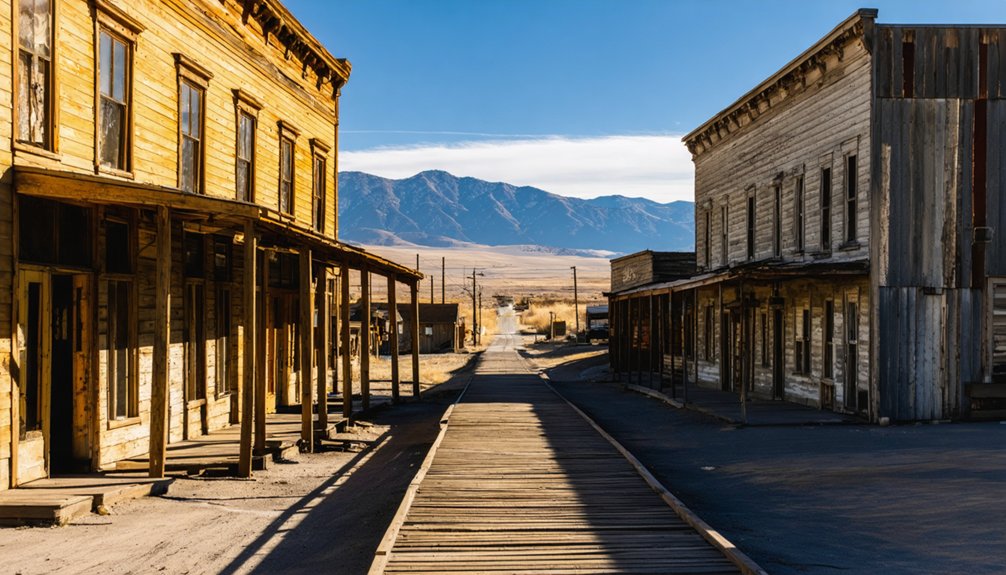
When planning your Idaho ghost town expedition, you’ll find the state’s richest concentrations of abandoned mining communities scattered throughout Lemhi County and the Boise Basin region.
These preserved sites offer unparalleled ghost town exploration opportunities, with many locations featuring original structures from the 1860s-1880s gold rush era.
- Navigate the Land of the Yankee Fork State Park’s extensive OHV trail system to access Bonanza and Custer’s historical sites
- Explore Silver City’s well-preserved mining-era buildings in Owyhee County
- Visit multiple ghost towns within a 50-mile radius of Boise, including Placerville and Pioneerville
- Discover Bayhorse’s mining artifacts and restored buildings in the Salmon River mountains
The U.S. Forest Service and Idaho Department of Parks maintain these historically significant sites, ensuring both preservation and accessibility for modern-day adventurers.
Exploring Idaho’s Mining History Through Time
The discovery of gold near Pierce in 1860 launched Idaho’s remarkable mining saga, transforming the remote territory into a bustling frontier.
As you explore these historic sites, you’ll trace the evolution of mining techniques from simple placer operations to sophisticated lode mining. The Boise Basin yielded an incredible 3.3 million ounces of gold, while Silver City’s mines revealed rich veins of both silver and gold.
You’ll find historical artifacts throughout the Wood River Valley, where lead-silver mines dominated in the 1880s.
The most significant discovery came when Noah Kellogg found the Bunker Hill and Sullivan deposits in 1885, establishing the legendary Coeur d’Alene district.
From granite-hosted veins formed 100 million years ago to ore deposits created by volcanic activity, Idaho’s geology has produced an astounding $2.88 billion in metals.
Photography Tips for Ghost Town Visits
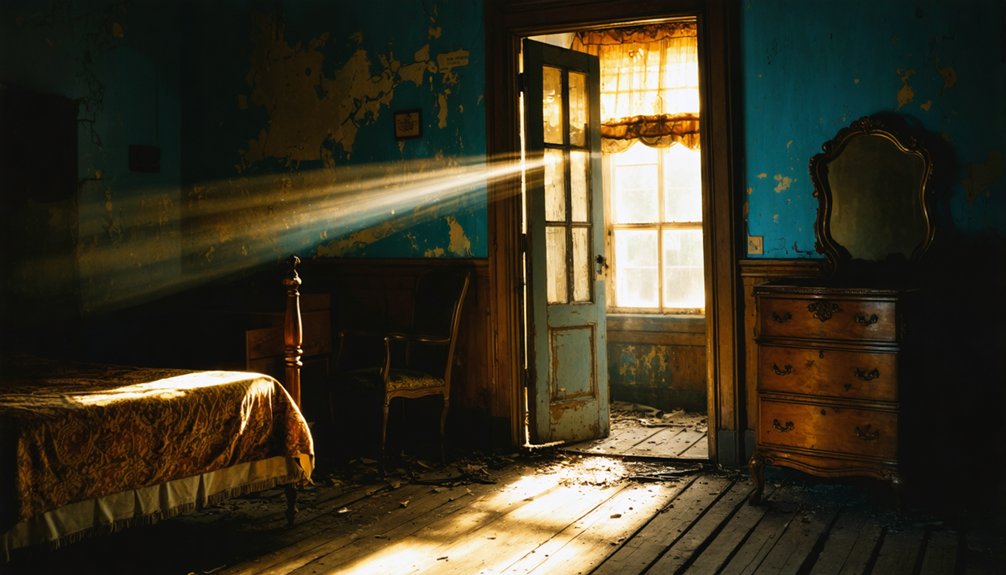
Capturing Idaho’s ghost towns through your camera lens requires careful planning and specialized equipment to preserve their haunting beauty.
You’ll want to pack essential photography equipment including a sturdy tripod for stability, wide-angle lens for architectural shots, and cleaning supplies to maintain clear optics in dusty conditions.
- Visit during golden hour after sunrise when natural light streams through weathered buildings.
- Use long exposures to capture star trails above abandoned structures at night.
- Focus on textural details like rusted machinery and peeling paint.
- Maintain level horizons to prevent distortion in architectural shots.
Consider converting select images to black and white or sepia tones to enhance the timeless quality of these historic sites.
Strategic lighting techniques, like using flashlights to spotlight specific elements, can create dramatic focal points that bring these forgotten places to life.
Frequently Asked Questions
Are There Any Dangerous Wild Animals Near These Ghost Towns?
In 90% of these areas, you’ll encounter dangerous predators. When exploring ghost town wildlife, watch for black bears, mountain lions, wolves, and rattlesnakes – they’re abundant near Custer’s ruins and Bayhorse’s trails.
Can Visitors Take Home Artifacts Found in Ghost Towns?
You can’t legally take artifacts from ghost towns – it’s a federal crime with hefty fines and jail time. These items have crucial historical significance and require preservation for future generations to study.
Which Ghost Towns Are Accessible During Winter Months?
You’ll find Gilmore most accessible in winter via Highway 28, while Silver City, Rocky Bar, and others have limited winter accessibility. Consider snowmobiling or tracked vehicles for safe ghost town activities.
Do Any Ghost Towns Still Have Active Mining Claims?
You’ll find active claims near several ghost towns, especially in Custer and Lemhi counties where mining history runs deep. Modern prospectors still work claims around Bayhorse and Warren mining districts.
Are Metal Detectors Allowed When Exploring These Locations?
99% of ghost town sites are protected. You can’t legally use metal detectors due to historical preservation laws. Federal and state metal detecting regulations strictly prohibit searching in these culturally significant areas.
References
- https://en.wikipedia.org/wiki/List_of_ghost_towns_in_Idaho
- https://www.thegoldminehotel.com/ghost-towns-and-haunted-places-in-idaho
- https://idaho-forged.com/idahos-ghost-towns-eerie-yet-approachable/
- https://history.idaho.gov/wp-content/uploads/2018/08/0064.pdf
- https://www.tripadvisor.com/Attractions-g28933-Activities-c47-t14-Idaho.html
- https://westernmininghistory.com/towns/idaho/silver-city/
- https://www.historicsilvercityidaho.com
- http://seducedbyhistory.blogspot.com/2010/05/silver-city-idaho-once-boom-town.html
- https://history.idaho.gov/wp-content/uploads/2018/12/0160.pdf
- https://www.gemsociety.org/article/history-of-silver-mining-united-states/