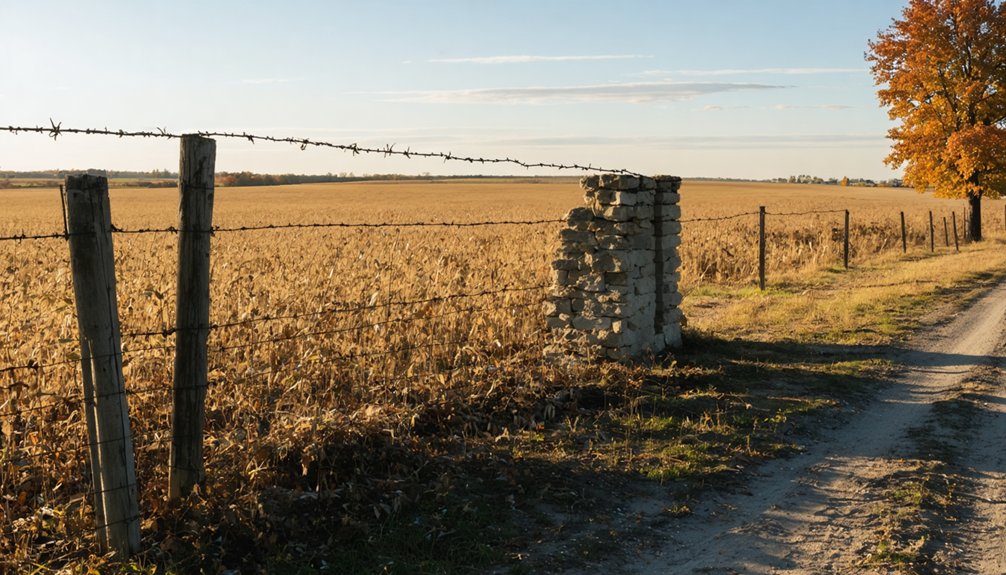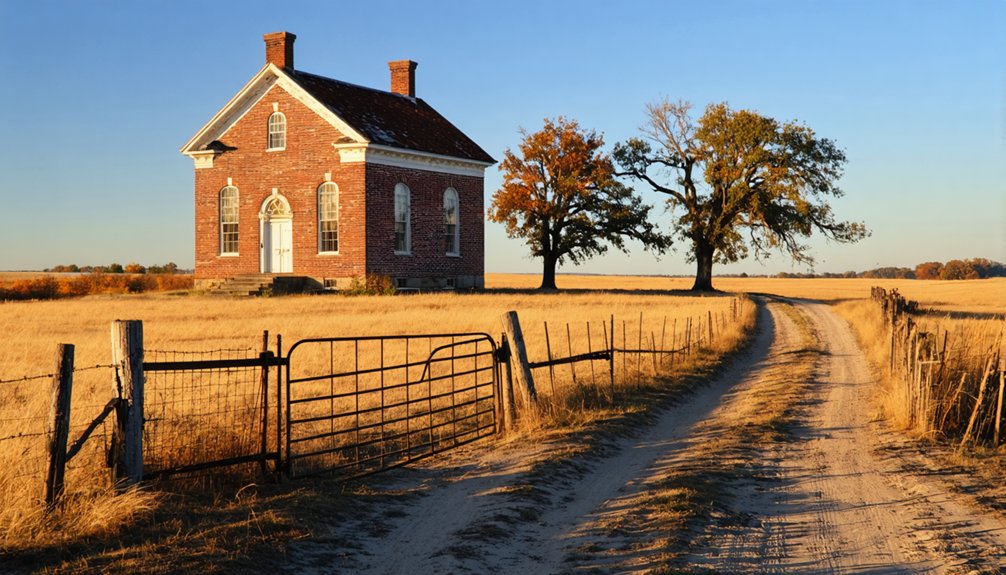
You’ll find Illinois’ most evocative ghost towns in the remnants of Cairo’s once-bustling river port and Old Shawneetown’s Greek Revival bank building. Buda’s abandoned feed mill and New England-style homes offer glimpses into railroad-era prosperity, while Vishnu Springs’ former resort tells tales of healing waters and bootleggers. The flood-ravaged remains of Old Valmeyer and Coltonville’s vanished dreams reveal how natural disasters and political decisions shaped these fascinating historical sites.
Key Takeaways
- Cairo stands as Illinois’ most prominent ghost town, featuring abandoned historic buildings at the confluence of the Ohio and Mississippi Rivers.
- Old Shawneetown preserves Illinois’ oldest bank building from 1841, offering visitors a glimpse into the state’s early financial history.
- Vishnu Springs, a former resort town, contains ruins of healing spring facilities and reportedly attracted notorious gangster Al Capone.
- Buda exemplifies a living ghost town with its abandoned feed mill, historic New England-style architecture, and dwindling population.
- Original Valmeyer remains partially visible on the floodplain, serving as a testament to natural disaster’s impact on Illinois communities.
The Rise and Fall of Cairo’s River Town Legacy
Located at the strategic confluence of the Ohio and Mississippi Rivers, Cairo, Illinois emerged as an essential river port in the mid-19th century, mirroring its Egyptian namesake’s position along the Nile Delta.
Much like its namesake city that was a center for trade, Cairo’s commerce flourished after receiving its port of delivery designation in 1854, with rail connections to Galena established by 1856. Cairo’s population swelled from 2,000 in 1860 to over 15,000 by 1920, as cotton, wool, molasses, and sugar flowed through its bustling port.
The city’s strategic importance peaked during the Civil War when it served as Admiral Foote’s naval station and General Grant’s supply base. Fort Defiance was established by General Ulysses S. Grant in 1862.
However, the 1929 and 1937 bridge constructions south of town, coupled with declining river trade, triggered an exodus that transformed this once-thriving hub into a haunting reminder of America’s industrial past.
Old Shawneetown’s Banking Empire Washed Away
While serving as the gateway to Illinois Territory in the early 1800s, Old Shawneetown established itself as a pioneering financial center through its strategic position near profitable salt mines and the federal land office established in 1812.
Much like the archaeological discoveries found at Albany Mounds, the area shows evidence of significant human settlement and economic activity spanning many generations.
The town’s banking history began when Illinois’ first bank opened in John Marshall’s home, later constructing an impressive $80,000 Greek Revival building in 1841. You’ll find this reflection of economic power at 280 Washington Street, featuring a limestone façade and iron vault that symbolized the town’s financial prominence. The building remains significant as the oldest bank structure in Illinois.
However, the banking empire wouldn’t last. After multiple suspensions and reopenings throughout the 1800s, the devastating 1937 Ohio River flood rose two stories high, forcing residents to relocate inland.
Nature’s fury ultimately conquered Old Shawneetown’s banking ambitions when the 1937 flood drove its people from their riverside home.
Today, the empty bank building stands as a silent reminder of Old Shawneetown’s economic decline.
Buda: Where Railroad Dreams Still Echo
The whistles of the Chicago, Burlington & Quincy Railroad brought life to Buda, Illinois in 1854 when Judge Jesse Emmerson designated his land for the town’s establishment.
Named after its Hungarian counterpart, Buda flourished as a critical railroad hub, distinguished by its roundhouse and the legendary Buda Tower where BNSF and UP lines converged.
You’ll find ghostly remnants of this railroad history throughout the town, from the preserved depot to the boarded-up buildings that once housed 1,500 residents.
Today, with fewer than 500 inhabitants, Buda stands as a living ghost town where you can explore the abandoned Buda Feed and Milling facility, walk past New England-style homes with their green shutters, and discover the Federal air raid siren that once urged citizens to “pray for peace.” A small but tight-knit community keeps the town alive through its close-knit atmosphere, where everyone knows their neighbors. Much like southern Cairo’s peak in the 1920s, Buda once thrived as a bustling transportation center.
The Lost Resort of Vishnu Springs
Deep in the woods outside Colchester, Illinois, an artesian well‘s mysterious waters gave birth to one of the state’s most enigmatic ghost towns. Founded in the 1840s by Ebenezer Hicks, Vishnu Springs transformed from a simple mineral spring into a thriving resort when entrepreneur Dr. A.W. Aiken promoted its healing waters as a cure-all.
You’ll find the remnants of what was once a bustling community of 30 houses, where ghostly whispers echo through the abandoned Capitol Hotel. The site continues to draw attention as part of the Ira and Reatha T. Post Wildlife Sanctuary.
A series of tragic events – a fatal carousel accident, Maud Hicks’s death in childbirth, and Darius Hicks’s suicide – marked the resort’s decline. The resort once featured sports fields and racetrack for visitor entertainment.
During Prohibition, the remote location attracted bootleggers and gangsters, including allegedly Al Capone himself. By the 1920s, what began as a peaceful health destination had surrendered to abandonment, leaving behind only memories of its ambitious past.
Old Valmeyer’s Battle Against the Mississippi
Unlike Vishnu Springs’ slow decline into abandonment, Valmeyer’s transformation into a ghost town occurred virtually overnight when nature released its fury in 1993.
The Mississippi River’s catastrophic breach of a protective levee submerged this historic village under 16 feet of water, forcing a community-wide Valmeyer relocation that would redefine flood resilience in Illinois. The devastating floods caused over $15 billion in total damages across the region.
You’ll find the remnants of this once-thriving town, established in 1909, still visible on the floodplain today. Mayor Dennis Knobloch led the charge to ensure that future generations would not face similar devastation.
- Asphalt chunks and abandoned streets mark where 900 residents once called home
- The flood’s devastation led to a pioneering decision to rebuild on nearby bluffs
- Original settlement’s sacrifice potentially saved St. Louis from worse flooding
- Site stands as a monument to nature’s power and human adaptation
Coltonville’s Political Gamble Gone Wrong
You’ll find Rufus Colton’s 1837 bid to establish Coltonville as DeKalb County’s seat involved manipulative tactics, including limiting election notifications to only Coltonville residents and holding court sessions in his own log cabin.
While Colton’s political maneuvering initially showed promise, his schemes were ultimately invalidated by the Illinois General Assembly, which transferred the county seat to rival Sycamore.
The loss of county seat status, coupled with being bypassed by the railroad, led to Coltonville’s rapid decline and eventual abandonment, leaving only farmland where this once-promising settlement stood.
County Seat Battle Details
While DeKalb County organized in 1837, its political landscape became turbulent in June 1839 when Rufus Colton, the county’s Clerk of the Court, orchestrated a controversial bid to establish Coltonville as the permanent county seat.
The county seat controversy intensified when Colton employed questionable tactics to secure victory for his town.
You’ll discover how Coltonville politics played out through these key events:
- Colton called an election but only notified Coltonville residents
- Court sessions were held at Colton’s log cabin home
- The Illinois General Assembly intervened to nullify the election
- DeKalb County Court mandated courthouse construction in Sycamore
Failed Dreams and Consequences
Rufus Colton’s ambitious county seat gambit ultimately sealed Coltonville’s fate as one of Illinois’ ghost towns.
Despite his calculated political manipulation as County Clerk, orchestrating a rigged election and convening court in his log cabin, his schemes unraveled when the Illinois General Assembly intervened.
Coltonville’s legacy stands as a cautionary tale of power overreach.
You’ll find the once-thriving farming hamlet’s decline traced directly to this failed political maneuvering.
When the railroad bypassed the settlement in favor of DeKalb and Sycamore, Coltonville’s destiny was sealed.
By the 1920s, the town had vanished entirely, leaving only farmland where bustling general stores and blacksmith shops once stood.
Today, only Coltonville Road and a historical marker remain to tell the story of this ambitious settlement’s rise and fall.
The Hidden Stories Behind Illinois’ Abandoned Towns

When you examine Illinois’ ghost towns like Cairo and Old Shawneetown, you’ll find stories of communities that rose rapidly through industry and commerce, only to face devastating natural disasters, economic downturns, and social upheavals.
You can trace how these once-thriving settlements, from Cardiff’s coal-driven boom to Sangamo Town’s political aspirations, fell victim to shifting economic forces, environmental challenges, and changing transportation routes.
The physical remnants you encounter today – from Cairo’s diminished population of 2,800 to Wanboro’s scattered fragments – stand as evidence to the volatile nature of frontier development and the harsh realities that shaped Illinois’ early settlements.
Echoes of Lost Dreams
Throughout Illinois’ rich history, abandoned towns tell poignant stories of dreams both realized and lost. From Brownsville’s dramatic relocation after an 1843 fire to Tuscumbia’s swift decline following a fateful railroad bypass, these forgotten legacies echo across the prairie landscape.
Here, residential ghosts whisper tales of ambition, adaptation, and ultimate surrender to changing times.
- Witness Sangamo’s uncertain fate, where its precise location remained a mystery until historical research revealed its prairie origins.
- Explore Western’s transformation into federal property, where preserved houses now serve as reminders of civilian life.
- Discover Ostend’s complete vanishing act by 1890, despite once boasting a thriving community of hundreds.
- Track Brownsville’s remarkable journey, as residents dismantled their homes piece by piece to rebuild anew at Murphy’sboro.
Nature Reclaims the Past
As nature’s relentless forces advance upon Illinois’ abandoned settlements, the physical remnants of once-thriving communities slowly dissolve into the landscape.
You’ll find wild vegetation steadily reclaiming the grid patterns of former streets, while saplings push through cracked foundations where miners’ homes once stood in places like Brownsville and Eldred.
Nature’s reclamation transforms these ghost towns into haunting displays of abandoned beauty.
In Old Valmeyer, where the Great Flood of 1993 forced residents to relocate, you’ll discover former neighborhoods converted to grasslands and wood lots.
What were once bustling riverside communities like Tuscumbia and Griggsville Landing have surrendered to natural succession, with only subtle traces of their previous existence visible beneath the advancing greenery.
Historical markers stand as lone sentinels, documenting where vibrant communities once flourished.
Frequently Asked Questions
Are Any of These Ghost Towns Considered Dangerous to Visit Today?
You’ll need to watch for unstable abandoned structures in Cairo and Old Shawneetown. Take basic safety precautions, as deteriorating buildings and isolated locations pose physical hazards rather than criminal dangers.
What Paranormal Activities Have Been Reported in These Abandoned Illinois Towns?
You’ll encounter shadowy figures, disembodied voices, ghostly monks, and unexplained footsteps across these haunted sites. Their paranormal sightings include Native American spirits, Confederate soldiers, and victims of tragic deaths.
Can Visitors Legally Explore and Photograph These Ghost Town Locations?
You’ll need to verify ghost town regulations before exploring, as many sites require owner permission. Photography permissions vary – public locations allow personal photos, while private properties demand explicit authorization.
Which Seasons Offer the Best Conditions for Exploring Illinois Ghost Towns?
Strike while the iron’s hot! You’ll find ideal conditions during fall exploration when temperatures are mild and foliage enhances photos, while spring adventures offer fewer crowds and blooming wildflowers for uninterrupted ghost town visits.
Do Any of These Ghost Towns Still Have Active Preservation Societies?
You’ll find active ghost town preservation through Duncan Manor’s 501(c)3 foundation, Pike County Historical Society’s ongoing restoration work, and Lincoln’s New Salem’s volunteer interpreters, while others rely on government or registry maintenance.
References
- https://www.ghosttowns.com/states/il/il.html
- https://www.onlyinyourstate.com/experiences/illinois/creepy-ghost-towns-il
- https://www.youtube.com/watch?v=93k0qtvzkn4&vl=en-US
- https://www.freakyfoottours.com/us/illinois/
- https://www.atlasobscura.com/things-to-do/illinois/abandoned
- https://savingplaces.org/guides/ghost-towns-on-route-66
- https://drloihjournal.blogspot.com/p/lost-towns-of-illinois-series.html
- https://en.wikipedia.org/wiki/Cairo
- https://www.numismaticnews.net/paper-money/the-history-rich-ghost-town-of-cairo-ill
- https://abandonedonline.net/the-tragic-decline-of-cairo-a-city-haunted-by-its-past/