You’ll find Kentucky’s most fascinating ghost towns in former coal mining settlements and river ports that once bustled with life. Paradise, immortalized in John Prine’s folk anthem, offers a hilltop cemetery overlooking its former site. The restored Blue Heron Mining Museum and Barthell Coal Camp preserve authentic buildings and mining equipment from the early 1900s. Golden Pond, Creelsboro, and Packard reveal compelling stories of moonshine, trade, and industrial decline that shaped Kentucky’s landscape.
Key Takeaways
- Paradise offers a poignant look at coal mining’s impact, featuring a hilltop cemetery and the legacy of John Prine’s famous song.
- Golden Pond, once known as the “Moonshine Capital of the World,” showcases historic buildings from its prosperous trading past.
- Creelsboro preserves its trading post heritage with Campbell’s Country Store and the impressive Creelsboro Natural Arch.
- Packard’s crumbling foundations and mine remnants tell the story of labor disputes and coal company exploitation.
- Blue Heron Mining Museum provides eight reconstructed buildings and authentic mining equipment with free admission for visitors.
Paradise: a Ghost Town With a Musical Legacy
Few ghost towns capture America’s imagination quite like Paradise, Kentucky, a once-thriving riverside settlement that met its demise through industrial progress.
You’ll find its story immortalized in John Prine’s 1971 folk anthem “Paradise,” which laments the town’s destruction by coal mining operations.
Originally settled as Stom’s Landing in the early 1800s, Paradise flourished along the Green River until 1959, when strip mining began to tear into its foundations.
Paradise’s humble beginnings as Stom’s Landing gave way to prosperity before strip mining operations began destroying its very core in 1959.
The Tennessee Valley Authority‘s massive coal-fired plant delivered the final blow, forcing residents to abandon their homes due to pollution.
The town’s residents suffered from severe ash and debris exposure before their eventual departure.
A post office opened in 1852, marking Paradise’s growth as a bustling community.
Today, this haunting ghost town offers little more than a hilltop cemetery overlooking the sprawling power plant.
Yet Paradise’s musical heritage lives on through Prine’s song, making it Kentucky’s most renowned symbol of the cost of industrialization.
Exploring the Restored Mining Museum at Blue Heron
At Blue Heron’s restored mining museum, you’ll see authentic coal cars, a locomotive, and a Joy Loader positioned near the original Mine 18 entrance.
You can tour the ghost structures that recreate the mining community’s buildings through steel frames, complete with audio recordings of former residents sharing their stories.
The self-guided paved loop takes you through essential community buildings, including the coal tipple bridge, while informational signs and historic photographs help you understand life in this once-bustling mining town. The community was established by Justus Stearns in 1899. The site operates as an outdoor museum that’s free for all visitors to explore.
Mining Equipment Display Today
Today’s visitors to Blue Heron’s restored mining museum can explore an impressive collection of original mining equipment and infrastructure that brings the site’s industrial heritage to life.
You’ll find authentic coal cars and a locomotive stationed near the mine entrance, showcasing the historical machinery that once transported both miners and coal throughout the complex.
The reconstructed Mine 18 slope entrance features detailed exhibits of mining artifacts, while the preserved coal tipple lets you examine firsthand how workers processed the extracted materials.
The museum’s informative exhibits provide detailed insights into the mining operations and their economic impact on the region.
As you walk the paved pathway, you’ll discover how the mining operations evolved through three distinct phases.
The authentic equipment displays, combined with push-button audio testimonies from former miners, create an immersive experience that captures the day-to-day realities of this once-thriving industrial site.
The Stearns Coal and Lumber Company operated this remote mining community for over 25 years until its closure in 1962.
Interactive Historical Buildings Tour
Visitors exploring Blue Heron’s restored mining museum will discover eight authentically recreated “ghost structures” that showcase daily life in this once-bustling coal community.
You’ll walk through steel-framed buildings, including the company store, laundry, and residential homes, each designed to mirror their original 1937-1962 construction. Through innovative interactive storytelling, you can press buttons at each stop to hear real former residents share memories of their daily experiences. The site offers free admission year-round.
Follow the paved pathway across the original coal tipple and bridge, where informational signs and historic photographs bring each location to life.
This community preservation project lets you step back in time while maintaining complete freedom to explore at your own pace. The depot’s detailed scale model helps you visualize Blue Heron during its 1950s peak as you chart your self-guided tour.
Barthell’s Preserved Coal Mining Heritage
You’ll find fifteen meticulously restored company houses at Barthell, where coal mining families once lived during the camp’s operational years from 1902 to 1952.
The camp’s coal operations began with Mine No. 1 and Mine No. 2, shipping its first coal in June 1903, and continued until a devastating fire destroyed the Mine No. 1 tipple in 1943. The camp’s early development was supervised by L.E. Bryant, who oversaw the initial work on both mines.
After the fire, coal from Mine No. 2 was redirected to the Blue Heron Mining complex until the camp’s final dismantling in 1961, though today you can tour these preserved structures as part of Kentucky’s coal mining heritage. The Koger family undertook extensive restoration work in 1984, investing over $500,000 to revitalize the historic mining camp.
Company Houses Still Standing
The preserved company houses of Barthell stand as remarkable monuments to Kentucky’s coal mining heritage.
You’ll find 12 meticulously reconstructed miner’s houses from the 1910 camp, showcasing both historical architecture and authentic mining heritage. These dwellings, part of an original 41-house settlement established in 1902, now serve as an open-air museum just 7 miles west of Stearns off Highway 742.
Through a $500,000 investment by the Koger family, these cozy houses blend modern amenities with old-world charm.
You can explore them through guided tours that include visits to the adjacent company store, schoolhouse, and even 300 feet into a nearby mine.
The houses represent the first of 18 mining camps established by Stearns Coal and Lumber Company, offering an unmatched glimpse into early 20th-century coal camp life. The camp’s preservation efforts have earned recognition from the National Park Service with the SE Regions Preservation Award in 1993.
Coal Operations Through Time
Dating back to 1750, Kentucky’s coal heritage began when explorers Thomas Walker and Christopher Gist first documented coal deposits in the eastern region.
You’ll find that coal mining operations expanded rapidly, with production reaching 1,600 tons in Lee County by 1819. The historical significance of Kentucky’s coal industry became evident as operations spread to counties with water access, including Greenup and McCreary.
The state’s coal production milestones tell a compelling story: from 328 short tons in 1820 to an impressive 1 million tons by 1879.
You’ll notice technological advances transformed the industry, from steam-powered shovels in 1877 to mechanical stokers in 1880.
At Barthell specifically, coal operations flourished from 1903 until the tipple’s destruction in 1943, marking a pivotal chapter in Kentucky’s mining history.
Golden Pond: From Moonshine to Memory
Founded in 1848 with the establishment of its post office, Golden Pond emerged as the largest settlement in Kentucky’s “between the rivers” region, where it would later earn notoriety as the “Moonshine Capital of the World.”
Despite housing only a few hundred residents, this small but significant town flourished through its strategic location and abundant natural resources, including fertile river-bottom soil, timber, and iron ore deposits.
During Prohibition, Golden Pond’s moonshine legacy took root as master craftsmen like Joe Bogard and Casey Jones perfected their trade.
Master moonshiners transformed Golden Pond into a bootlegging empire, where artisans like Bogard and Jones elevated their craft to legendary status.
You’ll find their golden memories preserved in tales of Jones’s revolutionary cylindrical condensers and Al Capone’s regular orders from local stills.
The town’s freedom-loving spirit ended abruptly in the 1960s when TVA acquired the land, forcing residents to abandon their homes.
The Hidden Ruins of Creelsboro
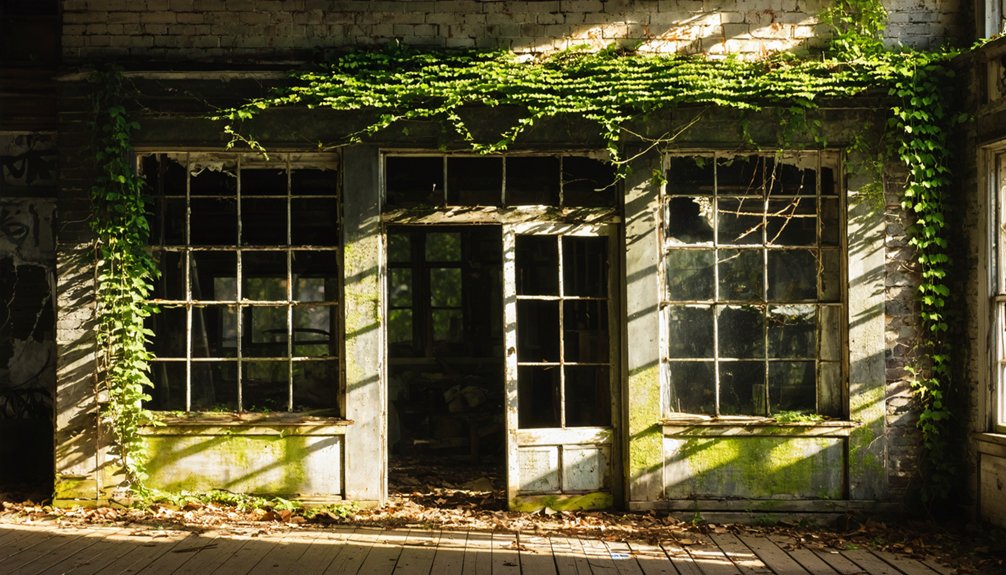
While moonshine flowed freely in Golden Pond, another Kentucky river town carved out its own remarkable history.
You’ll find Creelsboro’s story etched along the Cumberland River‘s north bank, where Elijah Creel and his brother established a trading post in the early 1800s. The settlement quickly became one of the busiest ports between Nashville and Burnside, serving as a vibrant hub for river commerce and community life.
The town’s river dynamics changed forever when Wolf Creek Dam‘s completion in 1951 created Cumberland Lake, but you can still explore remnants of its glory days.
Visit the historic Campbell’s Country Store from 1876, or trek to the magnificent Creelsboro Natural Arch, a 300-million-year-old formation that’s sheltered everyone from Native Americans to moonshiners seeking refuge from the law.
Packard’s Coal Mining Past
Deep in Whitley County, Kentucky, about seven miles southeast of Williamsburg, the ghost town of Packard stands as a monument to Kentucky’s turbulent coal mining era.
Named after local teacher Amelia Packard, this former mining camp reached its peak in the early 1900s with up to 400 residents.
At its height in the early twentieth century, this coal mining settlement housed hundreds, taking its name from schoolteacher Amelia Packard.
You’ll find a mining legacy marked by both prosperity and strife.
Three coal companies, led by Mahan-Jellico Coal Company, employed over 250 workers but engaged in ruthless economic exploitation. Workers faced dangerous conditions and were paid in company scrip, forcing them to shop at overpriced company stores.
Labor disputes became so intense that the Kentucky National Guard deployed machine gun squads to maintain order.
Today, you can only view the crumbling foundations from the roadside, as the remnants sit on private property owned by wealthy descendants.
Planning Your Kentucky Ghost Town Road Trip
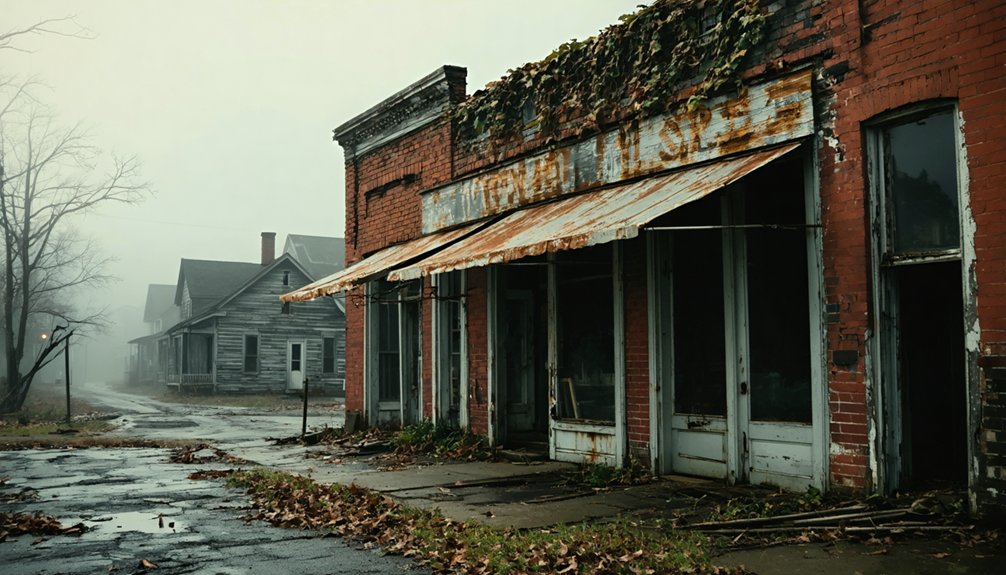
To maximize your ghost town expedition across Kentucky, consider a multi-day route connecting these five fascinating sites from east to west.
Pack your road trip essentials and follow this carefully mapped journey through the state’s most compelling ghost town attractions.
- Start at Blue Heron Mining Camp, exploring its reconstructed coal tipple and rusting machinery along Big South Fork River.
- Head to Barthell Coal Camp to witness restored company houses and industrial remnants.
- Journey to Paradise Ghost Town’s hilltop cemetery for sweeping views of the former settlement.
- Experience Scuffletown’s quiet Ohio River valley setting.
- Conclude at Bells Mines, where nature has reclaimed the industrial landscape within Big Rivers Wildlife Management Area.
The entire route showcases Kentucky’s rich mining heritage while offering you unrestricted access to explore these abandoned pieces of history.
Frequently Asked Questions
Are Any of These Ghost Towns Reportedly Haunted?
You’ll find haunted legends at Blue Heron Mining Community, where paranormal activity is reportedly linked to former coal miners who spent their lives working underground and never truly left the site.
Can Visitors Take Artifacts Found in These Abandoned Towns?
You’re legally forbidden to remove artifacts, despite their abandoned appearance. Historical preservation laws protect these sites under federal and state regulations – taking items risks heavy fines and criminal charges. Leave only footprints.
What’s the Best Season to Photograph Kentucky’s Ghost Towns?
You’ll get your best ghost town shots from late fall through winter, when autumn colors enhance decay and bare trees reveal hidden structures. Winter’s overcast skies create dramatic lighting for abandoned buildings.
Do Any of These Ghost Towns Require Special Permits to Visit?
You won’t need special ghost town permits, but visitor access varies. Paradise is off-limits, Barthell needs admission tickets, Blue Heron requires park fees, and Bells Mines follows Wildlife Management Area regulations.
Are There Guided Tours Available at Any of These Locations?
You’ll find guided tour options through several established tour companies in Kentucky’s historic ghost towns, particularly through Louisville Historic Tours and Frankfort-based operators who specialize in paranormal expeditions.
References
- https://wbkr.com/visit-these-20-creepy-kentucky-ghost-towns-for-a-halloween-road-trip/
- https://www.onlyinyourstate.com/experiences/kentucky/12-ghost-towns-in-ky
- https://www.youtube.com/watch?v=D9gOmfCuKLs
- https://everafterinthewoods.com/abandoned-ghost-towns-in-kentucky-that-still-hold-echoes-of-the-past/
- https://www.kentuckybb.com/Blog/Get-Haunted-and-Go-Ghost-Hunting-in-Kentucky.html
- https://www.freakyfoottours.com/us/kentucky/
- https://www.onlyinyourstate.com/experiences/kentucky/ghost-town-ky
- https://dablogfodder.blogspot.com/2017/01/paradise-kentucky.html
- https://www.youtube.com/watch?v=AyHrapNoTG4
- https://rockportky.com/Paradise/ParadiseTown/ParadiseTown.html