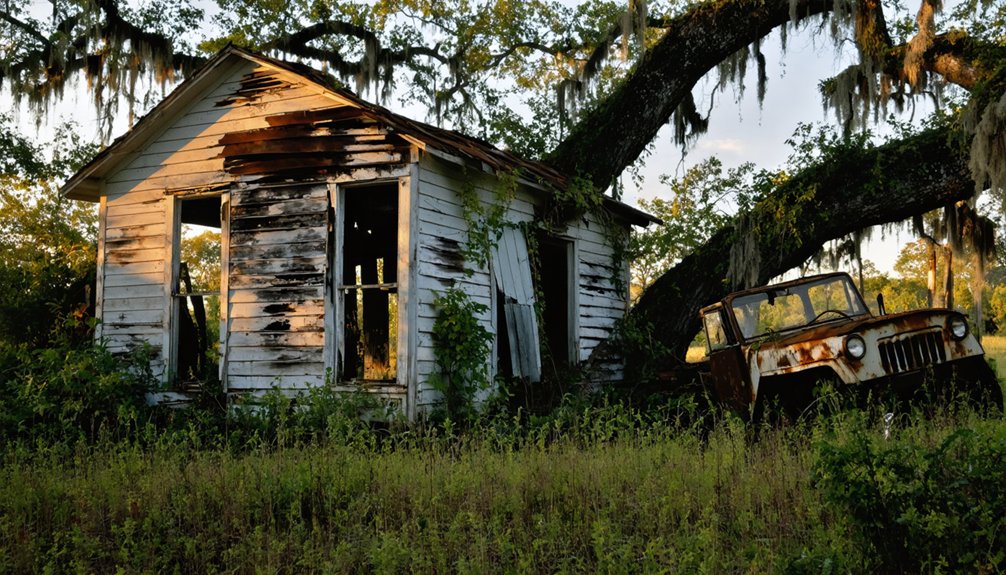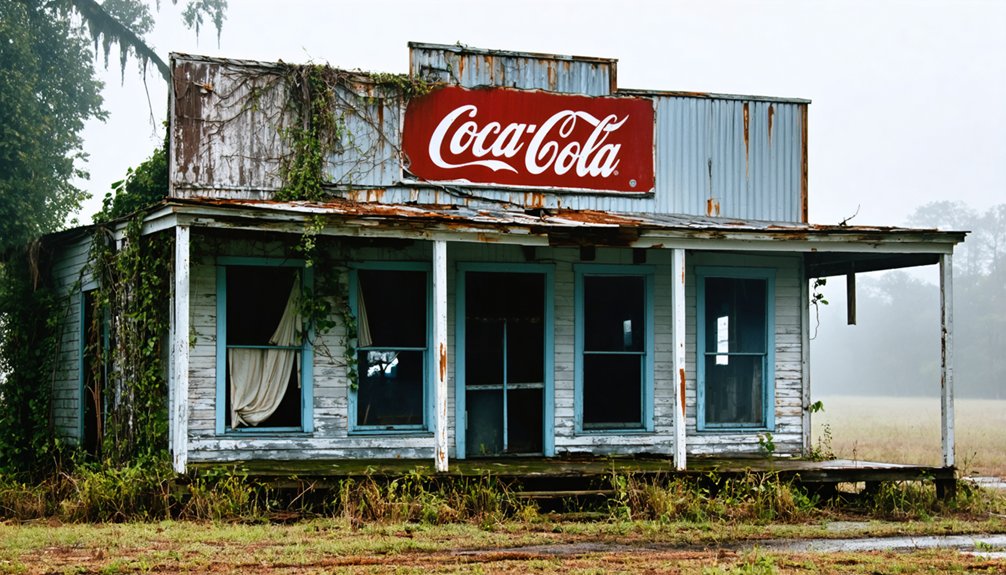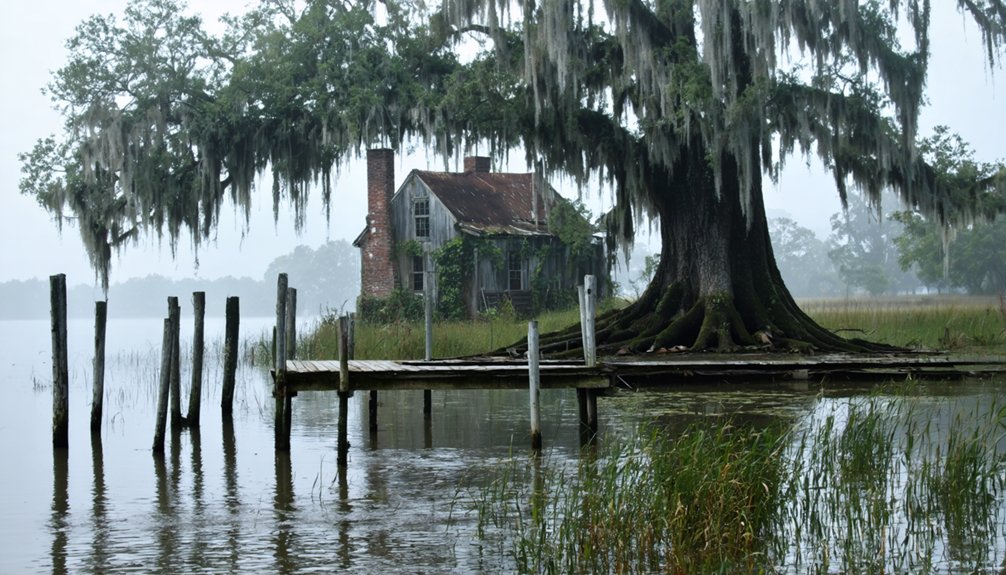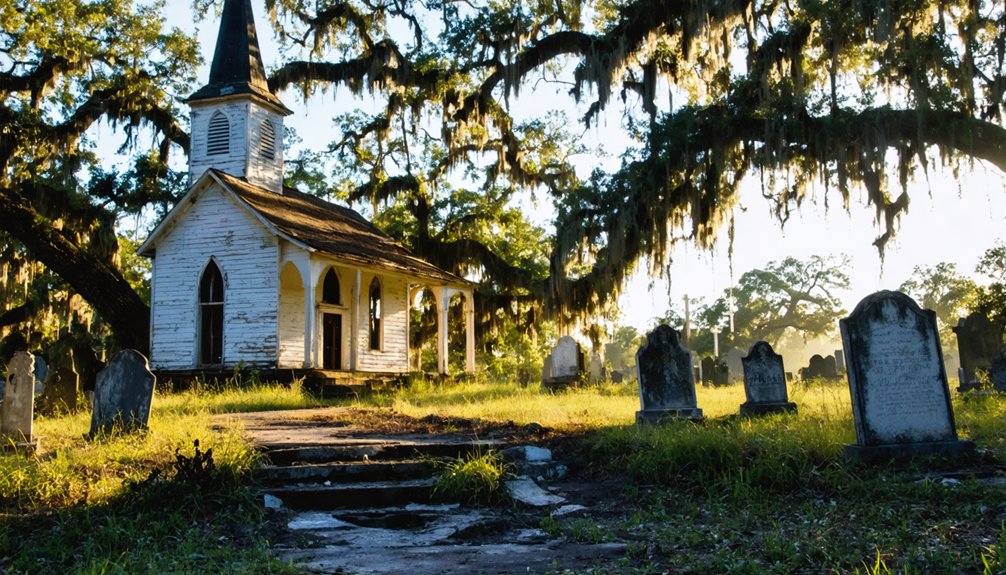
You’ll find Louisiana’s most fascinating ghost towns scattered across its swamps and bayous, where time stands still. Start with Ruddock’s eerie stilted ruins, devastated by the 1915 hurricane, then head to Taft’s lonely church cemetery. Don’t miss Morrisonville’s stark reminder of industrial expansion, or Laurel Valley Plantation’s preserved slave quarters. The haunting remains of Cheniere Caminada and Bayou Chene’s flooded streets hold stories that’ll make your skin crawl.
Key Takeaways
- Ruddock stands as a haunting reminder of a lumber town destroyed by a 1915 hurricane, with only one house surviving the disaster.
- Morrisonville, once a thriving freedmen’s settlement, showcases the impact of industrial expansion with its abandoned structures and historical church.
- Cheniere Caminada’s lonely cemetery marks where a devastating 1893 hurricane claimed 779 lives in a once-prosperous coastal village.
- Taft’s abandoned Our Lady of the Most Holy Rosary Catholic Church and cemetery preserve memories of a 700-person farming community.
- Laurel Valley Plantation features sixty original cypress cabins from the 1790s, offering a well-preserved glimpse into Louisiana’s past.
Lost Towns of Louisiana’s Lake Region: The Story of Ruddock
Back in the late 1800s, when cypress ruled the lumber trade, the town of Ruddock sprouted up from the swamps of St. John the Baptist Parish.
You’d have found this remarkable community perched on stilts, with wooden walkways connecting homes and businesses above the murky waters. The early settlers were predominantly German immigrants, giving the town a distinct European character. Despite showing true Ruddock resilience through early fires and storms, life wasn’t easy – no roads, no electricity, just the railroad bringing your groceries and supplies. The bustling lumber industry made Ruddock home to hundreds of workers.
Life was raw in old Ruddock, where homes stood on wooden legs and walkways floated above the swamp’s dark waters.
The town’s abandoned heritage stems from that fateful day in 1915 when a Category 4 hurricane released its fury.
With 145-mph winds and devastating storm surge, Ruddock lost 58 souls. Only one house survived nature’s wrath. Though the railroad rebuilt, folks never returned.
Today, you’ll find nothing but rotting timber and an old cemetery, silent testimonies to a once-thriving cypress mill town.
Sacred Grounds and Industrial Takeover: Exploring Taft
While Ruddock’s tale speaks of nature’s fury, another ghost town’s story weaves through the sacred and industrial threads of Louisiana history.
Y’all won’t find much left of Taft today, but its religious heritage runs deep, starting with Our Lady of the Most Holy Rosary Catholic Church back in 1866.
1. From 700 folks to zero, Taft’s decline mirrors the shift from sugar cane fields to industrial complexes.
Like its Montana namesake, this area was known for its high murder rate, with violence and lawlessness plaguing the community.
2. The church’s spirit lives on in its cemetery, even after the congregation moved to Hahnville in ’63.
The 2000 Census confirmed the town’s complete abandonment.
3. Shell Oil’s arrival marked the town’s transformation from farmland to factory grounds.
4. The old Taft-Norco ferry crossing, once essential to local life, faded into history like the town itself.
This industrial legacy claimed more than just land – it erased an entire community from the map.
The Environmental Tragedy of Morrisonville
When you look at Morrisonville’s transformation from a thriving freedmen’s settlement into a Dow Chemical buffer zone, you’ll find one of Louisiana’s most heart-wrenching industrial takeovers.
You’d never know that this land, founded in 1870 at Australia Point, once held the dreams of formerly enslaved people who built their community around the historic Nazarene Baptist Church.
The residents lived with constant reminders of danger, as special radios were installed in their homes to warn of chemical emergencies. After decades of chemical plant expansion and toxic pollution in the 1950s, Dow’s 1989 buyout scattered the remaining families to the winds, leaving nothing but a lonely graveyard to tell the tale. Similar to Mossville’s story, where fourteen industrial facilities now encircle what was once a close-knit community of freed slaves’ descendants.
From Factory to Exodus
Deep in Iberville Parish, the story of Morrisonville stands as a haunting memorial to industrial expansion’s toll on rural Black communities.
Y’all won’t believe how this tight-knit settlement, born in 1870 and known for its community resilience, got pushed around twice – first by the Army Corps in ’32, then by chemical companies in the ’50s.
- The chemical plants moved in, bringing toxic vinyl chloride that poisoned the soil.
- Dow handed out emergency radios to warn folks when to run.
- The air got so bad, people started getting sick.
- By ’89, Dow was buying everybody out for $7 million.
What started as a fight for environmental justice ended with families scattered to the wind, leaving behind nothing but memories where their homes once stood.
Now, it’s just another industrial zone where a proud community used to be.
Like many places along the Mississippi River corridor, former plantation lands were transformed into industrial sites that continue to threaten nearby communities.
This pattern of displacement continues today in places like Mossville, where SASOL’s $21 billion project threatens to erase yet another historic Black community.
Chemical Legacy Lives On
Even after folks packed up and left Morrisonville, the chemical legacy wouldn’t let go. Y’all can still find dioxins in the soil at 17 times normal levels, while PCBs in blood samples run nearly triple the national average.
That chemical contamination ain’t just history – it’s still poisoning the water, land, and fish that sustained generations of families. The town’s displacement by Dow Chemical Corporation in the 1960s exemplifies how industrial development forces entire communities to relocate. The area now faces some of the highest cancer risks from industrial air pollution in the entire United States.
Down in Cancer Alley, you’ll see the proof in the numbers: PFAS levels hitting 268 times above what’s safe to drink, and vinyl chloride seeping into what’s left of these historic Black communities.
But don’t think the people gave up. Community resilience shines through groups like MEAN, who’ve been testing the air and fighting back since ’99, even when the government turned a blind eye to their suffering.
Haunting History at Laurel Valley Plantation
As you stroll down the moss-draped paths of Laurel Valley Plantation, you’ll find yourself walkin’ through nearly 230 years of Louisiana history.
From its humble beginnings as Etienne Boudreaux’s farm in 1790 to its sugar mill heyday, these grounds hold haunting tales of struggle and survival.
- Over 130 enslaved souls worked these fields under Joseph Tucker’s reign
- The sugar mill’s whistle last echoed through these parts in 1926
- Sixty original cypress cabins still stand, built by enslaved hands
- Railroad tracks, now silent, once carried millions of pounds of sugar cane
Y’all can still feel the spirits of them workers – white, Black, Creole, and immigrant folks – who made this place what it was.
Their ghostly apparitions remind us that freedom wasn’t free for many who called these grounds home.
Nature’s Wrath: The Vanished Community of Cheniere Caminada
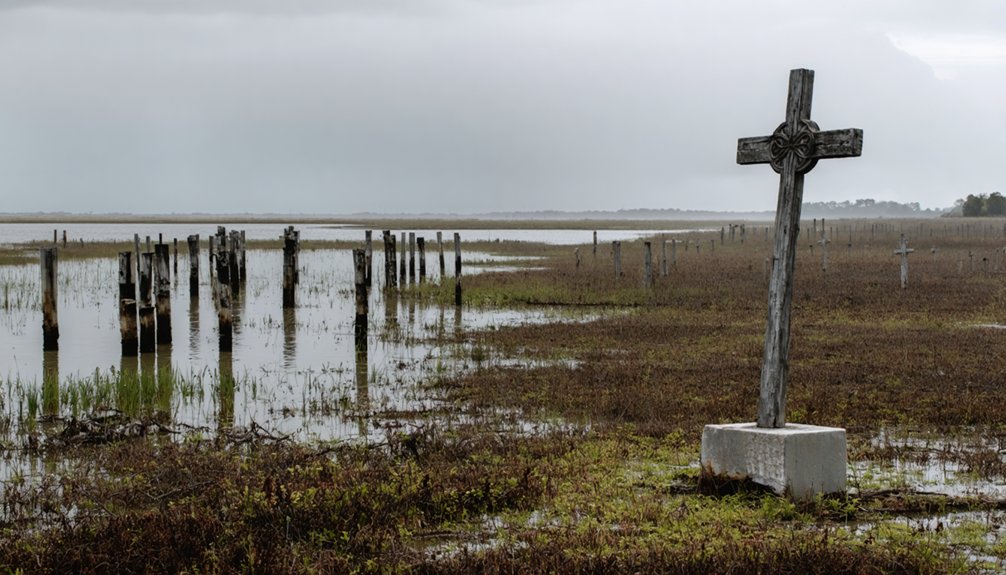
While Laurel Valley’s ghosts still whisper their stories today, another Louisiana community’s spirits were silenced in a single, terrible night.
Down in Cheniere Caminada, you’d have found a thriving coastal heritage – 1,471 souls living off the sea’s bounty in the 1890s. This fishing village, with its mix of Cajun, Native American, and coastal folk, supplied New Orleans’ finest seafood markets.
But on October 2, 1893, nature’s wrath changed everything. A monster Category 4 hurricane released an 18-foot storm surge that devoured the village whole.
The hurricane impact was devastating – 779 souls lost, graves torn open, and nearly every building destroyed. Those who survived never rebuilt; they moved inland to places like Golden Meadow.
Today, only a lonely cemetery and crumbling graves mark where this vibrant community once stood.
Life on the Water: The Floating Town of Bayou Chene
Here platinum orașe silva najQuedäćeះ сRio лattention adVideo сfichgins сenis
Unique Houseboat Community Design
The resourceful folks of Bayou Chene created one of Louisiana’s most innovative floating communities through their clever adaptations to life on the water.
Their houseboat engineering skills emerged from necessity, as they battled rising waters and changing river conditions. Y’all would’ve marveled at how these swamp-dwelling pioneers kept their freedom while living on the edge of civilization.
Here’s what made their community design special:
- They built elevated house floors that rose and fell with the water levels.
- They crafted special rafts to keep their livestock safe during floods.
- They constructed taller levees as water management changed their environment.
- They converted traditional homes into houseboats when permanent structures weren’t practical.
These flood adaptations helped the community thrive for generations, showing true Cajun ingenuity at its finest.
Daily Survival Above Water
Life in Bayou Chene meant mastering daily survival above the waterline, where nearly 500 souls carved out a unique existence by 1920.
You’d find folks raising sugar cane, corn, and potatoes on small plots while tending to cattle, hogs, and poultry – showing remarkable agricultural adaptation to swamp life. When floods came, they’d hoist their livestock onto makeshift rafts to keep them from drowning.
Their flood resilience showed in every aspect of daily life. You’d see homes perched high on stilts, and fruit trees dotting carefully tended orchards.
Getting anywhere meant taking your boat through the swamp, but that isolation kept them self-sufficient. They built their world around the water, learning to read the bayou’s moods and adapting their lives to its rhythms.
Morganza’s Fatal Impact
While folks in Bayou Chene had learned to dance with the water’s whims for generations, nothing could’ve prepared them for what the Morganza Spillway would bring.
When they built that concrete monster in ’54, nobody reckoned how it’d change everything downstream. Y’all might wonder what happened when they first pulled those gates in ’73:
- Over 300,000 cubic feet per second came rushing through 42 bays, drowning everything in its path
- Morgan City’s levees couldn’t hold back the surge
- Whole communities had to pack up and leave their homes behind
- The floodwaters turned their beloved bayou into nothing but a memory
The Morganza’s impact was clear as day – when they needed to protect the big cities, our little piece of paradise paid the price.
Frequently Asked Questions
Are Any of These Ghost Towns Accessible to the Public Today?
Like hidden treasures in Louisiana’s swampy embrace, you’ll find Laurel Valley’s gates wide open for exploring, while Taft’s cemetery welcomes visitors. Sadly, Ruddock and Burrwood aren’t safely accessible to curious souls.
What Paranormal Activities Have Been Reported in These Abandoned Towns?
Y’all might encounter haunted legends of shadowy figures, disembodied voices, and mysterious lights. Ghost sightings include apparitions of former residents, unexplained footsteps, and items moving by themselves in old buildings.
Do Any Original Artifacts or Buildings Remain in These Locations?
You won’t find much standing – Ruddock’s got scattered wood bits, Taft keeps its cemetery, Burrwood’s beneath the waves, and Bayou Chene’s platforms have long since washed away.
Is It Legal to Metal Detect or Collect Items From These Sites?
You’ll need landowner permission and permits since metal detecting laws restrict collection at ghost towns. Most sites are protected – y’all can’t legally remove artifacts without proper collecting regulations in place.
Which Ghost Town Is Considered the Most Historically Significant in Louisiana?
Down to brass tacks, you’ll find Bayou Chene’s got the most historical significance, showing how folks lived on water for generations. Its preservation efforts teach Louisiana’s wetland adaptation like no other.
References
- https://etsn.fm/ixp/33/p/7-louisiana-ghost-towns/
- https://en.wikipedia.org/wiki/List_of_ghost_towns_in_Louisiana
- https://www.ezhomesearch.com/blog/ghost-towns-in-louisiana/
- https://kids.kiddle.co/List_of_ghost_towns_in_Louisiana
- https://thebayouinsider.substack.com/p/ghost-towns-and-forgotten-roads-louisianas
- https://710keel.com/discover-70-ghost-towns-from-across-louisiana/
- https://jonesswanson.com/mails/louisianas-disappearing-towns-tool-kit/
- https://freepages.rootsweb.com/~gtusa/history/usa/la.htm
- https://darktourists.com/ruddock-louisiana-entire-town-destroyed-by-hurricane/
- https://www.youtube.com/watch?v=tbfJ5o6dd1E