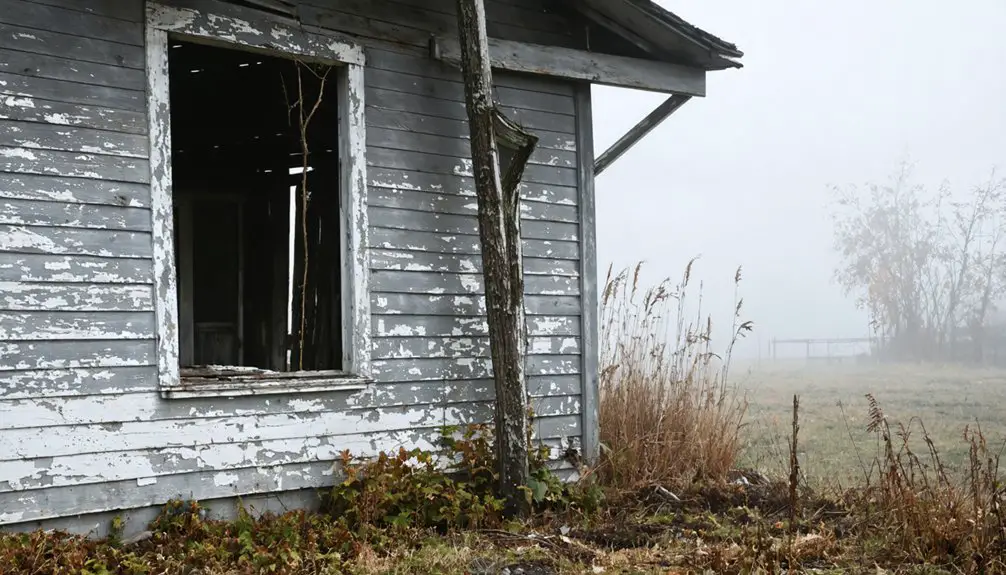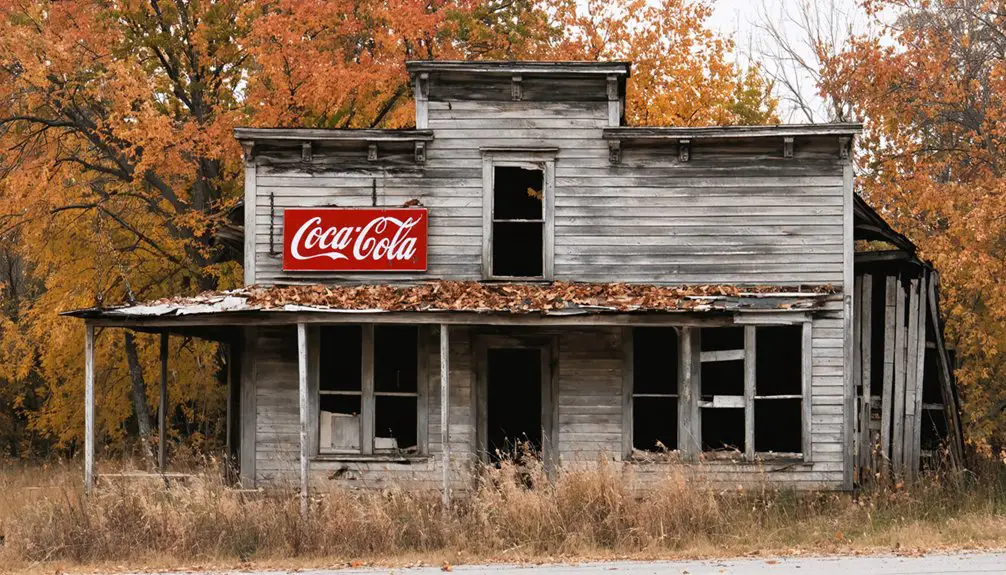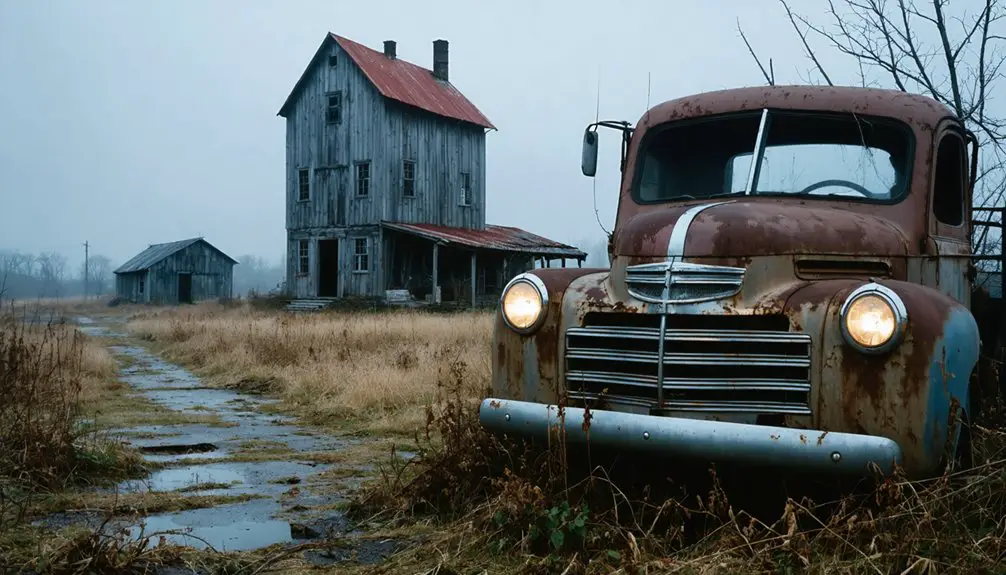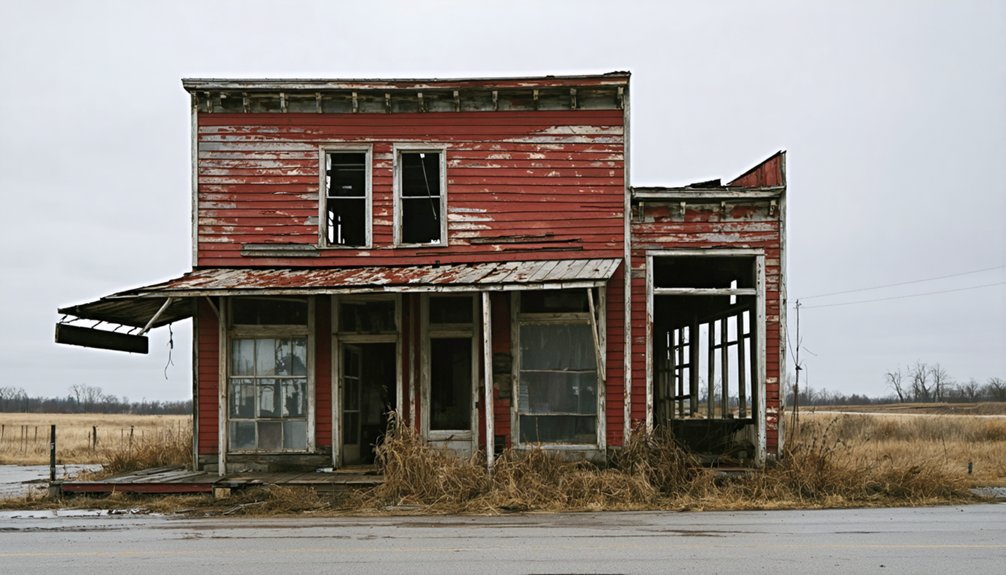
You’ll find Michigan’s most fascinating ghost towns scattered across both peninsulas, each preserving distinct chapters of the state’s heritage. The Central Mine stands out as the first profitable copper operation, while Freda showcases the remnants of Lake Superior’s most advanced mill town. Don’t miss Phoenix’s iconic general store or Delaware Mine‘s authentic 1840s tunnels. These abandoned settlements, from mining camps to maritime outposts, hold countless historical treasures waiting to be discovered.
Key Takeaways
- Central Mine offers visitors a well-preserved historic site with an original yellow wooden building and rich copper mining heritage.
- Delaware and Cliff Mine features authentic 1840s mining conditions through self-guided underground tours of five original mine shafts.
- Phoenix maintains its iconic General Store, historic Church of the Assumption, and preserved 1880s Bammert Blacksmith Shop.
- South Manitou Island showcases maritime history with its 1858 lighthouse complex, visible dock pilings, and sunken shipwrecks.
- Freda’s extensive ruins include concrete foundations and black sand beaches, showcasing remains of the world’s most advanced copper mill.
Historic Central Mine: Michigan’s First Profitable Copper Site
When the Central Mining Company acquired over 300 acres in Michigan’s Keweenaw Peninsula in 1854, they unknowingly purchased land containing an ancient Native American mining pit that would lead to their historic discovery.
Following the pit’s edge, workers discovered the Central Mine copper fissure in 1855, extracting over 40 tons of pure mass copper in just the first 40 feet.
Following nature’s ancient footprints led miners to an incredible copper vein, yielding massive wealth just beneath the surface.
You’ll find this mine’s success unprecedented – it’s the only operation in Michigan Copper Country to profit in its first year, producing 83,836 pounds of copper.
The site quickly grew into a bustling town of 1,300 residents by the Civil War’s end, complete with a post office, school, and hotel. The town’s workforce consisted mainly of Cornish immigrant miners, who brought their mining expertise from their homeland.
Though operations ceased in 1898, Central Mine’s legacy lives on as one of Michigan’s most significant ghost towns. Today, visitors can explore the historic yellow wooden building that serves as the mine’s visitor center.
Freda: Lake Superior’s Vanished Mill Town
A towering stamp mill rose along Lake Superior’s shore in 1899 when the Copper Range Company established Freda, a mill town named after company executive William Paine’s daughter.
By 1910, this bustling community of 500 residents boasted modern amenities including employee housing, water mains, and a fire department.
You’ll discover Freda’s mill was cutting-edge for its time, processing up to 55 rock cars daily from the Painesdale mines with 40% pure copper.
The mill’s technological advances made it the world’s most advanced facility by 1945, utilizing both stamp and flotation systems.
Today, you can explore the extensive ruins that remain, including concrete foundations scattered along black sand beaches formed from stamp sand tailings.
While the mill closed in 1967 and was demolished in 1972, this semi-ghost town still draws visitors to its historic industrial remains.
The Copper Range Railroad played a vital role in connecting the town to surrounding communities until its tracks were removed in 1971.
The site holds special significance as it was the last stamp mill operating in the Lake Superior region before its closure.
Delaware and Cliff Mine: Preserved 1840s Mining Legacy
Deep beneath Michigan’s Keweenaw Peninsula, the Delaware and Cliff Mine stands as one of America’s oldest preserved copper mining complexes, dating to 1845.
You’ll discover authentic 1840s mining conditions through self-guided underground tours, descending 100 feet via wooden staircase to witness exposed copper veins and primitive tools. Despite producing 8 million tons of copper, the mine never achieved profitability during its 40-year operation.
The Delaware Mine’s key features include:
Step into history at the Delaware Mine, where three remarkable features tell the story of Michigan’s copper mining heritage.
- Five original mine shafts reaching depths of 1,400 feet
- Historic surface buildings housing antique engines and mining equipment
- A prehistoric copper pit with artifacts dating to 5,000 BC
Now privately owned by the Sullivan family, who’ve preserved this evidence of Michigan’s copper boom, you’re free to explore both underground passages and surface ruins. Under the guidance of Dennis Brewer and Penny Peterson, the site undergoes continuous restoration to maintain its historical authenticity.
The site’s location near Copper Harbor offers a rare glimpse into the challenging life of 19th-century miners.
North Unity: The Settlement Lost to Flames
North Unity stands as Michigan’s poignant tribute to immigrant determination and devastating loss.
In 1855, Bohemian and German early settlers carved out their community near Lake Michigan‘s Pyramid Bay, constructing a 150-foot wooden barracks and primitive shelters covered in hemlock branches. You’ll find their story began as they fled Chicago’s typhoid epidemic, seeking freedom in Michigan’s untamed forests. Local Native Americans shared corn with the settlers during their first harsh winter.
Their dreams of permanent homesteads at Good Harbor Bay lasted until 1871, when merciless forest fires consumed the settlement. The community established a sawmill and schoolhouse before the devastating fire.
While the flames erased North Unity from the landscape, the survivors refused to surrender. They relocated inland to Shalda Corners, where they rebuilt their community.
Today, you can explore this ghost town’s remnants within Sleeping Bear Dunes National Lakeshore, where historical markers preserve their legacy of resilience.
Shalda Corners: A Rebuilt Community’s Story
You’ll find the resilient spirit of Shalda Corners in its prominent general store, built in the 1880s with an upstairs dance hall that served as the settlement’s social nucleus.
The Shalda family’s commercial enterprise, which included an ice house and eventually telephone service, transformed this intersection into a crucial hub for the surrounding Bohemian farming community. This historic area lies along what is now M-22 and Bohemian Road, where generations have gathered since the 1850s.
St. Joseph’s Church became a cornerstone of the community when it was constructed in 1884, achieving recognition as a National Historic Place in 1992.
Their success in rebuilding after the devastating 1871 fire is evident in the restored log cabin that still stands at the corner of M-22 and County Road 669, marking the spot where Joseph Shalda first established this determined settlement.
Rebuilding After 1871 Fire
After the devastating Great Fire of 1871 ravaged their original settlement, the resilient Czech community of Shalda relocated inland to establish what became known as Shalda Corners at the intersection of M-22 and County Road 669.
This strategic relocation demonstrated remarkable community resilience, as the settlers quickly rebuilt essential infrastructure while preserving their cultural heritage.
You’ll find evidence of their determined reconstruction efforts in three key developments:
- John Shalda’s two-story general store, which doubled as a community gathering space with its upper-level dance hall
- St. Joseph’s Church, constructed in 1884 and now listed on the National Register of Historic Places
- Modern amenities like an ice house and telephone service, showing their commitment to progress
The rebuilt settlement stands as a symbol of the pioneering spirit that helped reshape Michigan’s post-fire landscape.
Community Life and Commerce
Life in Shalda Corners revolved around a vibrant mix of agricultural enterprise and commercial activity that defined this rebuilt Bohemian settlement.
You’ll find evidence of their resourcefulness in the two-story general store, where community gatherings took place in the upstairs dance hall to the sounds of guitar, violin, and triangle.
Agricultural practices centered on wheat, potatoes, cabbage, beans, and corn cultivation, while dairy production thrived after cattle arrived from Chicago.
The settlement’s commercial heart expanded when Joseph and Anthony Shalda built a larger store with an adjacent ice house.
At St. Joseph’s Church, established in 1884, you can still witness the spiritual center that united the community.
The local school served dual purposes – educating children while providing space for essential community meetings.
South Manitou Island: Great Lakes Maritime Ghost Town
The maritime history of South Manitou Island began in the mid-1830s when William Burton established a strategic cord wood supply station for Great Lakes steamships.
The deep-water harbor, unique between Chicago and Buffalo, quickly transformed into a thriving maritime ghost town history with Burton’s Wharf at its heart.
You’ll discover three key remnants of this maritime heritage:
- The 1858 lighthouse complex with its two-story brick residence and 35-foot tower
- Sunken shipwrecks, including the Walter L. Frost and Three Brothers, resting in shallow waters
- Original dock pilings still visible off the eastern shore
The village’s decline began when steamships switched fuel sources, leading to the dock’s closure in 1873.
Today, you can explore this uninhabited ghost town within Sleeping Bear Dunes National Lakeshore, accessible only by ferry and hiking trails.
Phoenix: The Last Standing General Store

Located at the junction of US-41 and M-26 in Michigan’s Upper Peninsula, Phoenix stands as a symbol of the Keweenaw Peninsula’s copper mining legacy. Founded in 1845 by the Phoenix Copper Company, this once-thriving community peaked at 1,100 residents in 1877 before the mine’s closure in 1905 marked its decline.
Today, you’ll find key pieces of Phoenix heritage carefully preserved. The iconic Phoenix General Store, owned by Arbutus Peterson since 1973, still operates at the main intersection.
The historic Church of the Assumption, built in 1858 and rebuilt in 1899, occasionally hosts special events. Don’t miss the Bammert Blacksmith Shop, an 1880s structure maintained by the Keweenaw County Historical Society.
While most copper-era towns have vanished, these surviving structures offer you a tangible connection to Michigan’s mining past.
Evergreen Cemetery: Silent Stories of Eagle River
Established in 1849, Evergreen Cemetery stands as a solemn chronicle of Eagle River’s copper mining era, earning its place as Michigan Historic Site No. 581.
Located along M-26, this historic burial ground continues to evolve while preserving its rich heritage, now pioneering green burial practices in Keweenaw County.
As you explore this monument to Michigan’s industrial past, you’ll discover:
- Historic headstones documenting generations of copper miners and their families
- Designated green burial sections where only biodegradable materials honor nature’s cycle
- Direct connections to the Eagle River Historic District and nearby Cliff Mine, Michigan’s first successful copper operation
You’re free to visit this public site, where the historical significance of Eagle River’s mining heritage meets modern environmental consciousness, offering a unique glimpse into both past and future burial practices.
Kasson Township: Traces of Logging Camp Life
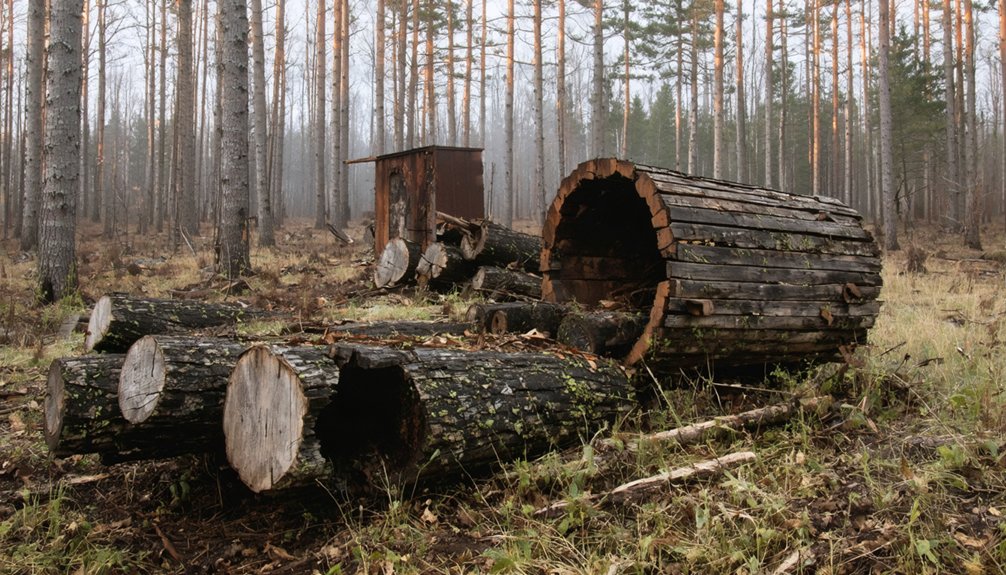
Moving from Eagle River’s mining heritage to Michigan’s lumber era, Kasson Township emerges as a tribute to the state’s logging industry boom.
You’ll find the remnants of a once-thriving logging camp system that transformed this wilderness into a network of bustling communities between 1860 and 1910. The Schomberg family’s operations exemplified this community development, establishing camps that housed up to 300 workers alongside essential infrastructure like bunkhouses, mess halls, and company stores.
As you explore the abandoned settlement sites, you’ll discover traces of the township’s evolution from temporary logging camps to established villages with schools and post offices.
While the timber wealth lasted only until the early 1900s, these ghost town remains tell the story of Michigan’s remarkable logging heritage and the determined workers who shaped it.
The Hidden Copper Towns of Keweenaw Peninsula
Deep within Michigan’s Keweenaw Peninsula, where ancient copper deposits lured prospectors during America’s first mineral rush in 1843, you’ll find the scattered remains of once-thriving mining communities.
Historical preservation efforts have protected sites like Delaware Mine, where you can explore abandoned shafts and see remnants of copper mining operations that yielded over 7 million pounds of copper.
Notable ghost towns you can visit include:
- Delaware – Features a complex of five shafts, worker housing, and an 1880s school
- Gay – Home to massive stamp mills that processed ore until the Great Depression
- Copper Harbor – Site of America’s first serious mining attempt at Hayes Point
These remote locations showcase the industrial might that once dominated the peninsula, where Native Americans had mined copper thousands of years before European settlement.
Frequently Asked Questions
Are Ghost Towns in Michigan Safe to Visit During Winter Months?
You’ll need caution when exploring Michigan’s ghost towns in winter. While some offer groomed trails and lodging, winter safety risks include unstable structures, deep snow, and ice hazards affecting ghost town accessibility.
The allure of historic ghost towns in Michigan is undeniable, drawing adventure seekers and history buffs alike. As you wander through these abandoned landscapes, you’ll encounter remnants of a bygone era, each telling a unique story of its past. Proper preparation and awareness of the environment are essential to fully appreciate the beauty and history these towns offer.
Can Visitors Take Artifacts Found in Michigan Ghost Towns as Souvenirs?
No, you can’t take artifacts from Michigan ghost towns. Legal regulations strictly prohibit removing historical items. You’ll face hefty fines and possible imprisonment. Artifact preservation guarantees these treasures remain for everyone’s benefit.
What Wildlife Encounters Are Common When Exploring Michigan Ghost Towns?
With 25+ foot drops near mineshafts, you’ll encounter diverse wildlife sightings from nesting pigeons in smelting towers to burrowing animals in foundations. Watch for seagulls near coastal ruins and deer exploring ghost town ecology.
Do Any Michigan Ghost Towns Offer Guided Tours or Scheduled Events?
You’ll find guided experiences at Fayette Historic State Park, where paranormal investigations and Fall Festival events showcase the site’s historical significance through organized tours of preserved industrial buildings and furnished townsite structures.
Are Metal Detectors Allowed at Michigan Ghost Town Sites?
You can’t legally use metal detectors at Michigan ghost town sites due to federal and state historical preservation laws protecting archaeological resources. Most ghost towns are protected under ARPA regulations.
References
- https://www.youtube.com/watch?v=7-vjuqiGWJU
- https://www.visitkeweenaw.com/blog/post/our-top-7-keweenaw-ghost-towns-to-explore/
- https://www.nps.gov/slbe/learn/historyculture/ghosttowns.htm
- https://99wfmk.com/michigan-ghost-town-gallery/
- https://en.wikipedia.org/wiki/List_of_ghost_towns_in_Michigan
- https://www.legendsofamerica.com/mi-centralmine/
- https://beaumier.nmu.edu/ghosttowns/towns/CentralMine
- https://npshistory.com/publications/kewe/brochures/central-mine.pdf
- https://www.keweenawhistory.org/Central-Mining-Co
- https://www.smithsonianmag.com/history/once-a-year-this-19th-century-michigan-ghost-town-comes-to-life-180982695/