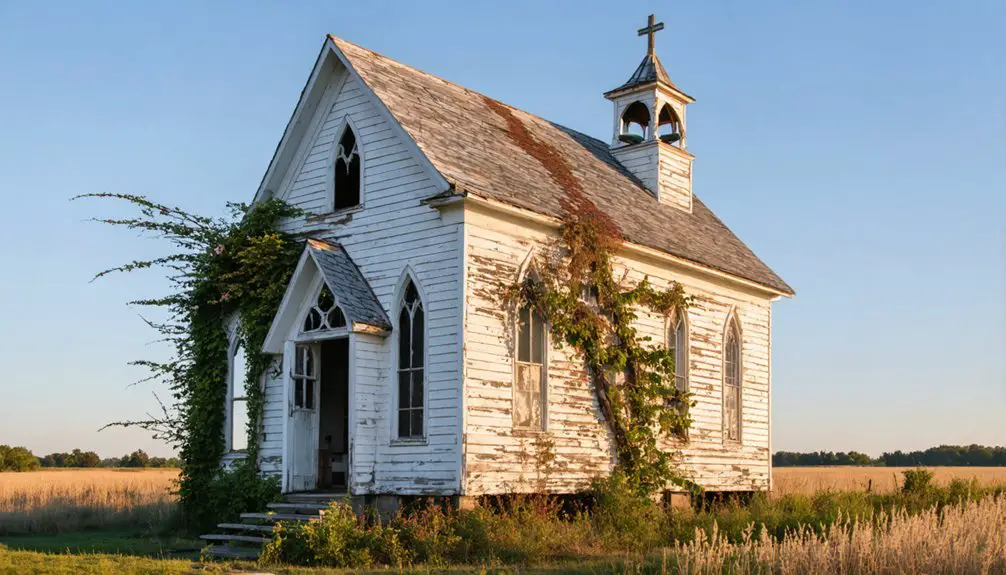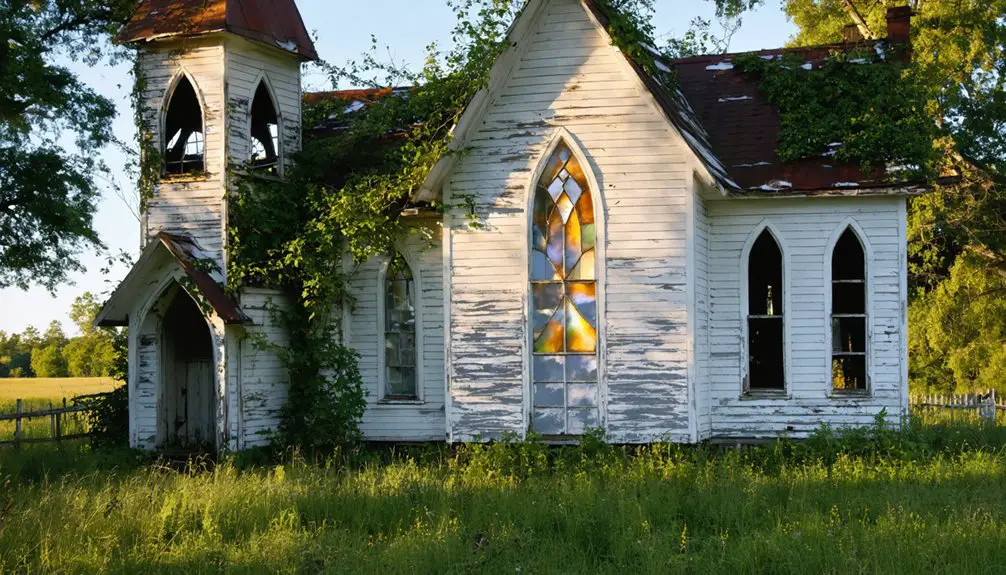
You’ll find Mississippi’s most atmospheric ghost town in Rodney, a once-bustling river port that nearly became the state capital in the 1800s. The town’s haunting Federal-style Presbyterian Church still bears a Civil War cannonball in its wall, while the Greek Revival Mt. Zion Baptist Church stands as a silent sentinel. Though floods and fires led to Rodney’s decline, its abandoned streets and 200 historic graves hold fascinating stories of Mississippi’s antebellum past.
Key Takeaways
- Rodney stands out as a premier ghost town with three historic churches and a rich history as Mississippi’s almost-capital city.
- The town’s preserved Federal-style Presbyterian Church features an authentic Civil War cannonball still embedded in its wall.
- Accessible via Highway 61, Rodney offers visitors well-documented historic structures and a 3-acre cemetery dating to 1828.
- Once rivaling Jackson with 4,000 residents, Rodney exemplifies Mississippi’s river town decline through floods and railroad bypassing.
- The Rodney History and Preservation Society maintains the site and organizes regular cleanup events, making it safe for ghost town enthusiasts.
Uncovering the Lost River Port of Rodney
The lost river port of Rodney stands as one of Mississippi’s most fascinating ghost towns, tracing its origins to French colonists who first settled the area in January 1763.
You’ll discover a once-bustling metropolis that surpassed Jackson’s population, reaching 4,000 residents by 1860. As the busiest port between New Orleans and St. Louis, Rodney thrived with banks, hotels, and diverse merchants until nature altered its destiny. The town was nearly selected as Mississippi’s state capital, losing by only three votes.
The town’s historic Presbyterian Church built in 1832 remains a testament to its prosperous past. A devastating combination of river diversions and lost commerce sealed the town’s fate – the Mississippi River shifted two miles west around 1870, while the railroad bypassed Rodney completely.
Today, you can explore what remains of this former commercial powerhouse that succumbed to geographic misfortune, with only 13 residents calling it home as of 2017.
Historic Architecture and Sacred Spaces
While Rodney’s decline left most structures in ruins, its sacred spaces stand as remarkable monuments to 19th-century architectural innovation.
You’ll find the 1832 Federal-style Presbyterian Church, with its historic bell cast from 1,000 silver dollars, representing the finest example of Federalist architecture in Mississippi.
The 1850 Mt. Zion Baptist Church showcases a unique blend of Greek and Gothic Revival styles, while the relocated Sacred Heart Catholic Church exemplifies rare Carpenter Gothic design.
Sacred architecture in Rodney blends revival styles, from Mt. Zion’s Greek-Gothic fusion to Sacred Heart’s distinctive Carpenter Gothic features.
Despite their architectural significance, these structures face constant threats.
You’ll notice the Civil War cannonball still embedded in the Presbyterian Church’s wall, while Mississippi River flooding continues to damage Mt. Zion.
The devastating grand spectacle of the 1869 fire destroyed many historic buildings in the town.
Recent historical preservation efforts, including the 2018 citizen initiative, endeavor to protect these irreplaceable landmarks from nature’s relentless assault.
The Rodney History and Preservation Society has taken ownership of the Presbyterian Church to ensure its structural repair and long-term preservation.
Stories From the Abandoned Streets
Once bustling with riverboat trade and merchant activity, Rodney’s streets fell silent through a devastating sequence of economic blows in the late 1800s.
At its peak, the town boasted two newspapers and banks and thrived as a major commercial hub.
Like Friars Point today, the town sits practically deserted, a haunting reminder of its former glory.
As you walk past abandoned businesses today, you’ll find ghostly whispers of a town that fought against relentless adversity. Three devastating fires ravaged the original structures, while Mississippi River floods repeatedly battered what remained.
The final blow came when the railroad bypassed Rodney for Fayette in 1880, severing crucial transportation links. You can trace the town’s decline through its Presbyterian Church, which lost its full-time pastor by 1923 as membership dwindled to just 16 people.
Preservation Efforts and Modern Exploration
Despite decades of decline, preservation efforts in Rodney gained momentum in 2017 with the formation of the Rodney History and Preservation Society.
You’ll find community initiatives focused on protecting the town’s remaining structures, particularly the historic Presbyterian Church, which bears Civil War battle scars and stands as the sole original building from Rodney’s founding.
Today’s heritage conservation efforts include:
- Regular maintenance of church grounds and cemetery cleanup events drawing 65+ visitors
- Documentation and protection of over 200 historic graves dating to 1828
- Support from Mississippi’s State Historic Preservation Office through grants and technical assistance
The site receives ongoing technical assistance and grants from preservation experts to help maintain its historical integrity.
Local volunteer groups participate in the Certified Local Government program to improve communication with preservation activities at all levels.
You can explore this fascinating ghost town while supporting preservation efforts by joining cemetery events or visiting the architectural remnants of Rodney’s past, including the Greek Revival Mt. Zion Baptist Church and historic Alston Store.
Planning Your Visit to Mississippi’s Ghost Towns
Before commencing your ghost town adventure in Mississippi, careful planning can enhance your exploration of these haunting historical sites.
For ideal travel logistics, take Highway 61 to Lorman’s Old Country Store, then follow the unmarked road northwest past Cane Ridge Cemetery. You’ll need a vehicle with good clearance for the 12-mile journey on mixed surfaces. Cell phone reception is limited, so be sure to download offline maps for navigation.
Time your visitor experiences during spring and fall mornings, or winter to avoid snake encounters. Pack essential supplies, as you’ll find no services in these remote locations. In Gainesville, the once lively sawmill town now has only one remaining store.
Don’t miss Rodney Presbyterian Church’s Civil War-marked facade or the Baptist Church’s striking Greek Gothic architecture. When exploring the 3-acre cemetery, stick to visible paths among the 200+ graves dating to 1828.
Bring sturdy shoes and plan your visit during daylight hours for the safest experience.
Frequently Asked Questions
Are There Any Reported Ghost Sightings or Paranormal Activity in Rodney?
Like whispers from the past, you’ll find ghost sightings throughout Rodney, including Mountain Tom Clark’s spirit pacing Tennessee Street, an 1890 lynching victim’s apparition in the cemetery, and paranormal investigations at the Presbyterian church.
What Happened to the Original Residents’ Possessions When They Abandoned Rodney?
You won’t find clear records of abandoned belongings since no historical artifacts were documented. The fate of residents’ possessions remains a mystery, as sources focus only on structural preservation.
Can Visitors Legally Enter and Explore the Remaining Buildings?
Like moths drawn to flame, you’re legally barred from entering these buildings. Urban exploration requires property owner permission, and historical preservation laws protect these structures from unauthorized entry. Stay on public roads.
Is It Safe to Visit Rodney During the Mississippi River Flood Season?
You shouldn’t visit during flood season (January-May). Follow safety guidelines and flood precautions – the dirt roads become impassable, buildings are unstable, and you’ll risk getting stranded without local assistance.
Are There Any Active Law Enforcement Patrols in the Ghost Town Area?
You won’t find regular law enforcement presence in Rodney’s ghost town area. The remote location, limited access roads, and sparse population mean patrols rarely venture beyond responding to specific emergency calls.
References
- https://en.wikipedia.org/wiki/List_of_ghost_towns_in_Mississippi
- http://sites.rootsweb.com/~mstttp/ghosttowns.htm
- https://kids.kiddle.co/List_of_ghost_towns_in_Mississippi
- https://www.onlyinyourstate.com/experiences/mississippi/ms-ghost-towns
- https://mississippifolklife.org/articles/haunted-by-a-ghost-town-the-lure-of-rodney-mississippi
- https://theforgottensouth.com/rodney-mississippi-ghost-town-history-tour/
- https://www.geotab.com/ghost-towns/
- https://www.youtube.com/watch?v=5LLwzfqC1xw
- https://www.legendsofamerica.com/ms-rodney/
- https://sethparker.net/rodney-mississippi-the-ghost-town-youve-probably-never-heard-of/