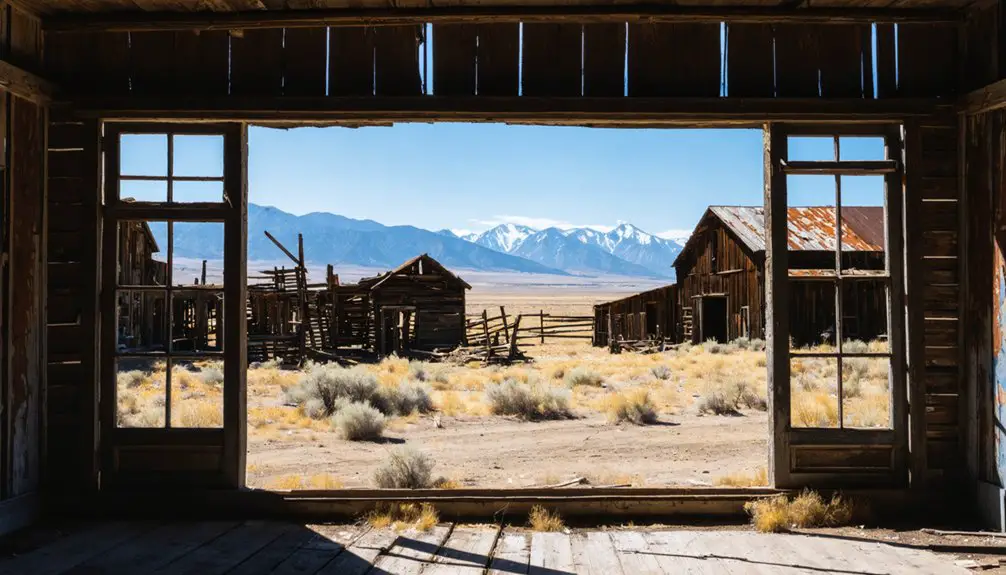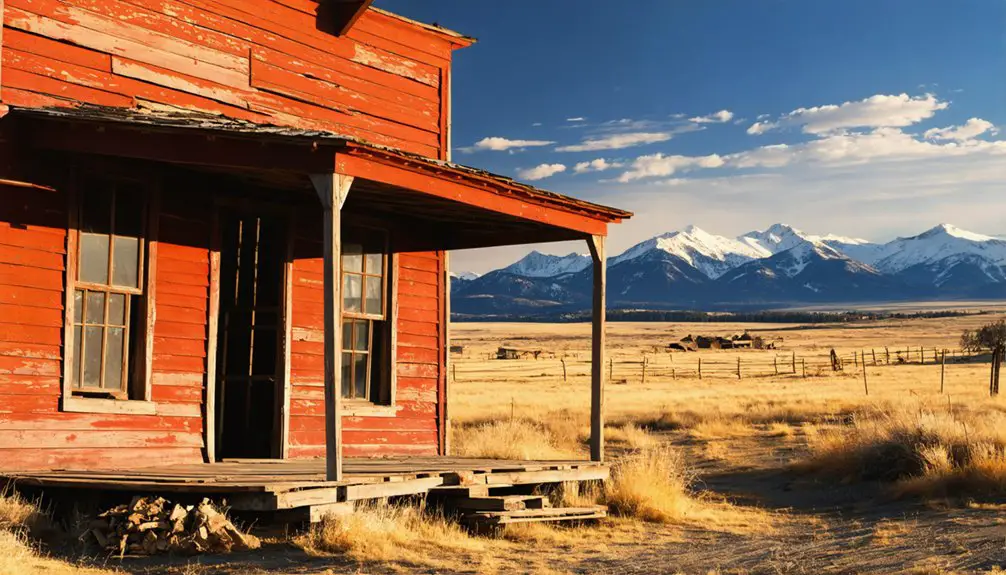
Montana’s best-preserved ghost towns include Bannack State Park, with over 60 original structures, and Virginia City, offering living history experiences. You’ll discover well-maintained buildings at Garnet Ghost Town, situated 6,000 feet high in the mountains, while Elkhorn provides an authentic glimpse of 1890s mining life. You can explore these remnants of the state’s gold rush era through guided tours or self-guided adventures. Montana’s mining heritage awaits your exploration through these windows into the past.
Key Takeaways
- Bannack State Park features over 60 preserved structures and National Historic Landmark status, making it Montana’s best-preserved ghost town.
- Virginia City and Nevada City offer interactive experiences with period reenactments, gold panning activities, and living history museums.
- Garnet Ghost Town sits at 6,000 feet elevation with 20 well-preserved buildings, providing visitors authentic glimpses of mining life.
- Elkhorn presents original 1890s structures in remarkable condition, offering quick but meaningful visits to Montana’s mining history.
- Granite Ghost Town provides classic boomtown ruins perfect for photography enthusiasts and history buffs seeking authentic mining remnants.
Discovering Montana’s Mining Heritage Through Ghost Towns
When gold was first discovered at the foot of Montana’s Bitterroot range in 1862, it sparked a mining boom that would transform the territory’s landscape with bustling boomtowns.
You’ll find remnants of these settlements scattered across Southwest Montana, where prospectors once employed various mining techniques to extract millions in gold, silver, copper, and zinc.
From Bannack’s vigilante justice to Virginia City’s territorial prominence, each ghost town tells a unique story of ambition and resilience. Visitors can explore more than fifty original buildings preserved at Bannack State Park.
Ghost town folklore surrounds places like Coloma, nicknamed the “Mystery Camp,” where old newspapers still insulate original cabin walls.
Through these preserved sites, you can explore the peaks of prosperity when towns like Garnet swelled to 1,000 residents, and witness the aftermath when precious minerals vanished, leaving behind skeletal remains of Montana’s mining heritage.
The journey to these historic sites takes you through scenic forest roads, offering breathtaking views of Montana’s rugged terrain.
Top Ghost Towns to Visit in Big Sky Country
Where can you experience Montana’s most fascinating ghost towns? Your journey through mining folklore begins in Bannack State Park, where over 60 preserved structures tell tales of vigilante justice and gold rush fever. National Historic Landmark status protects these authentic remnants of the Old West.
Virginia City and Nevada City offer immersive experiences with living history museums, while ghost town legends come alive through period reenactments and gold panning activities. The historic Alder Gulch Shortline Railroad provides a scenic connection between these two preserved towns.
Step back in time at Virginia City and Nevada City, where costumed interpreters and hands-on activities bring Montana’s gold rush era alive.
For a more remote adventure, explore Garnet Ghost Town‘s ruby-rich mountains, where you’ll find 20 well-preserved buildings at 6,000 feet elevation. Don’t miss the chance to stay in primitive winter cabins accessible by snowmobile.
While Elkhorn presents a quick but picturesque glimpse of the 1890s through its Fraternity and Gillian Halls, Granite Ghost Town showcases classic boomtown ruins perfect for photographers and history enthusiasts.
Essential Tips for Ghost Town Exploration in Montana
Before starting your Montana ghost town expedition, thorough preparation will guarantee a safe and rewarding experience. Research specific locations and access requirements through official Montana FWP websites, as GPS services can be unreliable on remote mining roads. Your vehicle should be equipped with proper clearance and amber dust lights for challenging terrain. The high ratings from visitors prove these historic sites are worth the effort.
The closure of the 1893 silver panic led to many abandoned mining sites that visitors can explore today. When exploring nature around ghost towns, practice proper ghost town etiquette by staying on marked paths and never removing artifacts.
You’ll need to allocate sufficient daylight hours, considering that many sites require scenic drives through mountainous areas and up to a mile and a half of hiking. Carry emergency supplies, printed maps, and maintain physical distance from other visitors.
Remember that weather conditions greatly impact road stability, so plan your visit during ideal conditions.
Historical Significance of Montana’s Abandoned Mining Communities
You’ll discover that Montana’s abandoned mining communities represent an unprecedented period of economic transformation, with places like Butte growing to over 100,000 residents and Helena boasting the highest concentration of millionaires per capita by the late 1880s.
The mining boom‘s massive wealth extraction, evidenced by Beartown’s million-dollar output in 1866 and Pardee’s Iron Mountain Mine’s half-million in silver profits, fundamentally shaped Montana’s early development and statehood. The discovery of gold at Gold Creek in 1852 marked the beginning of Montana’s mining era and set the stage for future rushes. The Drumlummon quartz mine became renowned for its exceptional wealth and extensive operations.
These towns’ rapid growth also spawned notorious episodes of frontier justice, with groups like the “Beartown Roughts” emerging as symbols of the period’s lawless reputation and the subsequent rise of vigilante responses.
Mining’s Economic Impact
Mining’s profound economic influence on Montana spans generations, from the state’s earliest development through today’s multibillion-dollar industry. Historical coal mining particularly drove growth with peak production rates in the region.
The mining legacy you’ll discover shaped not just the physical landscape but Montana’s entire economic foundation, generating $2.5 billion in statewide impact and creating jobs averaging $78,000 annually. Local communities like Musselshell County see 11.6% workforce support from mining operations.
Today’s economic trade offs mirror historical patterns, balancing prosperity against environmental concerns.
- Major operators like Sibanye-Stillwater support over 11,000 statewide jobs and generate $1.1 billion in household income.
- Signal Peak Energy contributes $111.7 million in value-added impact while supporting hundreds of direct jobs.
- Mining wages greatly exceed state averages, reaching $152,000 in some operations.
- The industry generates substantial tax revenue, with Signal Peak alone producing $55.66 million in combined federal, state, and local taxes.
Vigilante Justice Legacy
While Montana’s ghost towns stand as silent witnesses to the gold rush era, their dark history of vigilante justice remains etched in the state’s cultural memory.
You’ll find traces of this lawless justice in places like Virginia City and Bannack, where vigilante symbolism like the mysterious “3-7-77” code marked the doors of suspected criminals.
In just six weeks during 1864, vigilantes hanged 21 men without trial, including Sheriff Plummer and his deputies. Boot Hill cemetery still holds their unmarked graves.
Though the vigilantes disbanded by 1867, their influence persists in modern Montana culture – from the Highway Patrol’s official patch to commercial logos.
While some celebrate this frontier justice, you’ll discover that revisionist historians now question the vigilantes’ true motives and their victims’ guilt.
Best-Preserved Ghost Towns in the Treasure State

Montana’s rich mining heritage lives on through several remarkably preserved ghost towns that offer visitors authentic glimpses into the state’s Gold Rush era.
Today, you’ll find these historic treasures meticulously maintained by various preservation organizations and government agencies.
- Bannack, designated as a National Historic Landmark in 1961, features dozens of preserved buildings and requires just a short walk to explore its historic townsite.
- Garnet stands as Montana’s best-preserved ghost town, with 30 buildings maintained by the BLM and local preservationists.
- Elkhorn State Park, Montana’s smallest, showcases the iconic Fraternity and Gillian Halls from the 1890s.
- Nevada City operates as an open-air museum with roughly 100 Gold Rush era structures, offering occasional train rides from its restored station.
Planning Your Montana Ghost Town Road Trip
Planning an epic ghost town adventure through Montana requires careful consideration of routes, seasons, and logistics to enhance your exploration of these historic settlements.
You’ll find flexible ghost town itineraries ranging from three to five days, with options to start at either Glacier or Yellowstone National Park. The Pioneer Mountain Scenic Byway connects multiple sites efficiently, while Montana Route 83 provides primary access through the Seeley-Swan Valley.
For ideal exploration, you’ll need a four-wheel-drive vehicle to navigate challenging terrain, especially when visiting remote locations like Granite Ghost Town’s 5-mile mountain road.
Plan two to three hours for extensive sites like Bannack State Park, and consider seasonal accessibility – winter conditions can greatly impact road access and structure visibility.
Use Helena as your central base to efficiently organize your route between major parks.
Architectural Remnants of Montana’s Mining Glory Days
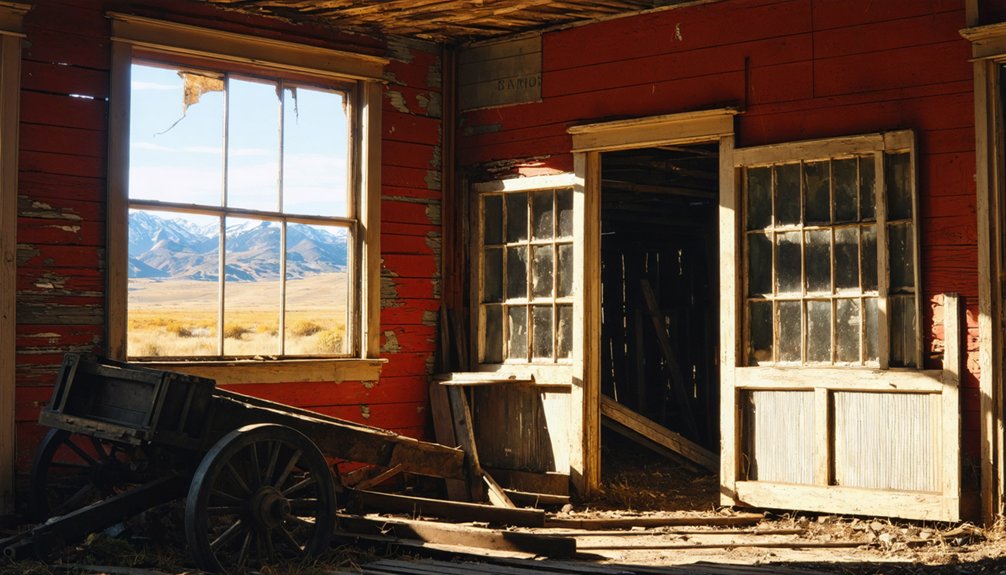
Throughout Montana’s ghost towns, you’ll discover architectural remnants that tell compelling stories of the state’s mining heyday, from hastily constructed gold rush settlements to more elaborate Victorian establishments.
The mining aesthetics reflect both necessity and ambition, while architectural decay provides a haunting glimpse into the boom-and-bust cycle that defined these communities.
- Virginia City showcases preserved Victorian-era architecture, with its original 19th-century structures maintained as a living history museum.
- Garnet’s buildings reveal quick construction priorities, with structures designed for rapid assembly and minimal foundations.
- Granite’s “Silver Queen” remnants demonstrate the stark reality of resource exhaustion through its abandoned mine and mill structures.
- Coloma’s unique insulation methods, using newspapers and catalogs, reflect the resourcefulness of frontier construction techniques.
Year-Round Ghost Town Accessibility Guide
You’ll discover Garnet Ghost Town’s accessibility varies dramatically with Montana’s seasonal changes, from full vehicle access during summer months to snowmobile and ski routes in winter.
The 11-mile driving exploration is ideal from June through August when dry roads allow complete access to the historic mining site at 6,000 feet elevation.
During winter months (December 16 – April 30), you must switch to cross-country skiing or snowshoeing, though heated cabin rentals provide overnight accommodation options for hardy adventurers.
Seasonal Road Conditions
When visiting Montana’s ghost towns, seasonal road conditions can markedly impact your access throughout the year, particularly at higher elevations where weather patterns dictate travel possibilities.
You’ll need to carefully monitor road statuses and prepare accordingly, especially for destinations like Garnet Ghost Town.
- Road accessibility peaks from May through October, with 4WD recommended during spring and fall on Garnet Range Road’s gravel sections.
- Winter closures affect high-elevation routes including Beartooth Highway, Skalkaho Pass, and Looking Glass Highway.
- From November through April, you’ll find twice-daily road condition updates via MDT’s 511 system.
- Non-motorized winter access requires snowmobiles, skis, or snowshoes, particularly for ghost towns above 6,000 feet elevation.
Before starting your journey, check the MDT’s travel information system for real-time updates on closures, restrictions, and maintenance schedules.
Ghost Town Weather Access
Montana’s ghost towns offer year-round accessibility options that vary greatly with the changing seasons. You’ll find Garnet Ghost Town and Bannack State Park maintain continuous operations from 9:30 AM to 4:30 PM daily, though weather conditions greatly impact your transportation choices.
During winter months (December 15-April 30), you’ll need to embrace alternative access methods. Cross-country skiing, snowshoeing, and snowmobiling become your primary means of reaching Garnet via 51 kilometers of trails.
Summer brings easier exploration opportunities with full vehicle access from May through mid-December, weather permitting. Access challenges for mobility-limited visitors are partially addressed through level main trails and broad streets, though seasonal conditions may affect wheelchair accessibility.
Remember to check current conditions before your visit, as weather patterns ultimately dictate your exploration options.
Photography Opportunities in Montana’s Historic Mining Towns
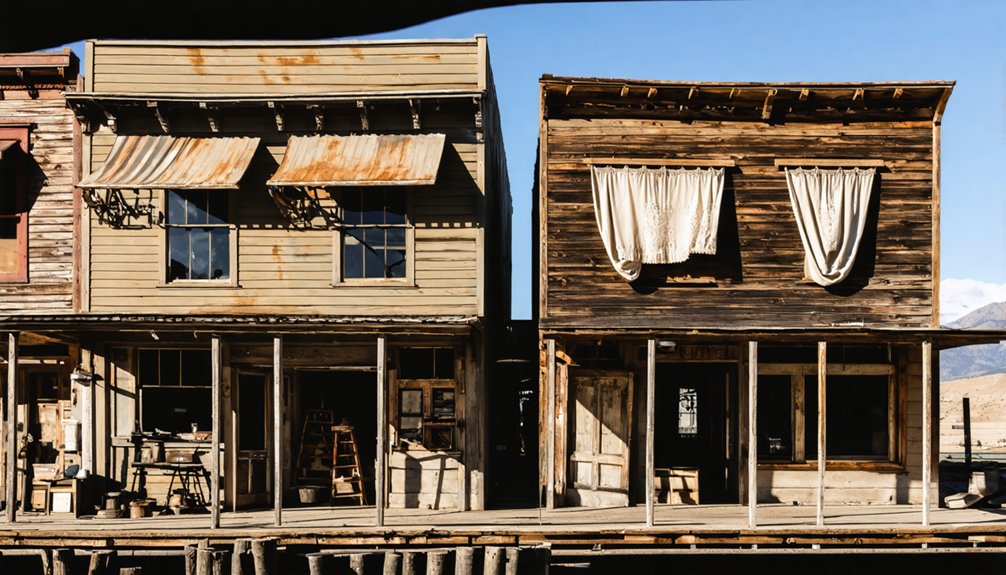
Hidden among Montana’s rugged landscapes, historic mining towns offer photographers an exceptional canvas for capturing the American West’s golden era.
You’ll discover pristine 19th-century architecture at sites like Fraternity Hall, where original period details create authentic compositions through unique perspectives and varied photography techniques.
- Position yourself at Garnet Ghost Town for uninterrupted shots of Montana’s best-preserved mining infrastructure.
- Explore Virginia City’s well-maintained streetscapes for compelling historical narratives through your lens.
- Capture Bannack State Park’s complete town layout, especially during July’s reenactment events.
- Frame your shots against the dramatic backdrops of the Garnet Mountain Range and Big Hole Valley.
Winter’s snow adds ethereal dimensions to your compositions, while seasonal changes provide diverse lighting conditions for your photographic adventures.
Cultural Impact of Montana’s Ghost Town Legacy
Montana’s ghost towns serve as living museums where you’ll discover the tangible remains of America’s mining heritage, from weather-worn wooden structures to artifacts that tell stories of fortune-seekers and frontier life.
Through preserved sites like Virginia City and Bannack, you’re able to witness firsthand how mining booms shaped Montana’s development, leaving behind physical evidence to the era’s rapid town-building and social dynamics.
You can explore these abandoned streets knowing that each empty building and mining remnant contributes to a broader narrative of Western expansion, boom-and-bust economics, and the enduring spirit of frontier entrepreneurship.
Preserving Montana’s Mining Heritage
As mineral wealth transformed Montana’s frontier in the late 1850s, the rapid development of mining communities created an enduring legacy that continues to captivate historians and tourists alike.
Today, ghost town preservation efforts by state parks and the Bureau of Land Management protect these invaluable historical assets while providing unique opportunities for mining heritage education.
- You’ll discover authentic Victorian-era architecture in towns like Virginia City, where economic stagnation inadvertently preserved original structures.
- You can explore over 20 preserved buildings in Garnet Ghost Town, maintained by dedicated on-site caretakers.
- You’re able to witness layered historical records within cabin walls, where newspapers once served as insulation.
- You’ll experience living history through guided tours, steam train rides, and theatrical reenactments that bring the mining era to life.
Stories Through Empty Streets
Through the weathered facades and quiet streets of once-bustling mining towns, you’ll find stories that illuminate Montana’s rich cultural tapestry during the territorial period.
In places like Garnet and Virginia City, ghostly echoes of laughter and music from saloons remind you of the vibrant communities that once thrived here, where miners, merchants, and families created dynamic social hubs.
These forgotten memories live on in over 50 original structures at Bannack and through Virginia City’s living history experiences.
Yet time threatens these precious windows into the past – Montana loses up to 24 ghost towns annually to decay and vandalism.
While some whisper of supernatural residents in abandoned buildings, the real spirit of these places lies in their power to connect you directly to the raw energy and determination of Montana’s territorial era.
Frequently Asked Questions
Are There Any Reported Paranormal Activities in Montana’s Ghost Towns?
You’ll discover extensive paranormal sightings across Montana’s ghost towns, from apparitions at Hotel Meade to EVPs at Myra Brothel, each location’s haunted history includes mysterious voices, moving objects, and unexplained phenomena.
What Items Are Visitors Allowed to Take as Souvenirs?
Like a protective mother bear, souvenir regulations guard these historic treasures. You’re only allowed to purchase items from official gift shops and visitor centers – no artifacts or materials from the sites themselves.
How Safe Are the Structures for Children to Explore?
You shouldn’t let children explore these structures, as they lack modern safety regulations and have severely compromised structural integrity. Rotting wood, unstable foundations, and collapsing roofs pose life-threatening dangers.
Do Any Ghost Towns Offer Overnight Camping or Accommodation Options?
You’ll find diverse overnight options at several ghost towns: Garnet offers winter cabin rentals, Bannack provides camping with 24 sites and amenities, while Gunslinger Gulch features modernized lodging with full amenities.
Are Metal Detectors Permitted in Montana’s Ghost Town Areas?
Like a miner’s dream constrained by bedrock, you’ll find metal detecting regulations vary. BLM lands permit detectors, but historical preservation laws ban them at Bannack and Garnet ghost towns to protect artifacts.
References
- https://avrextravel.com/montana-ghost-towns/
- https://bluemountainbb.com/blog/ghost-towns-montana/
- https://www.youtube.com/watch?v=BQH5LghhkVs
- https://southwestmt.com/ghosts/ghost-towns/
- https://visitmt.com/things-to-do/ghost-towns
- https://www.mountain-home.com/blog/vacation-planning/guide-montana’s-ghost-towns
- https://glaciermt.com/ghost-towns
- https://www.garnetghosttown.org
- https://en.wikipedia.org/wiki/List_of_ghost_towns_in_Montana
- https://storymaps.arcgis.com/stories/38e9b6bdc3484eae8a1acec01cbe717e