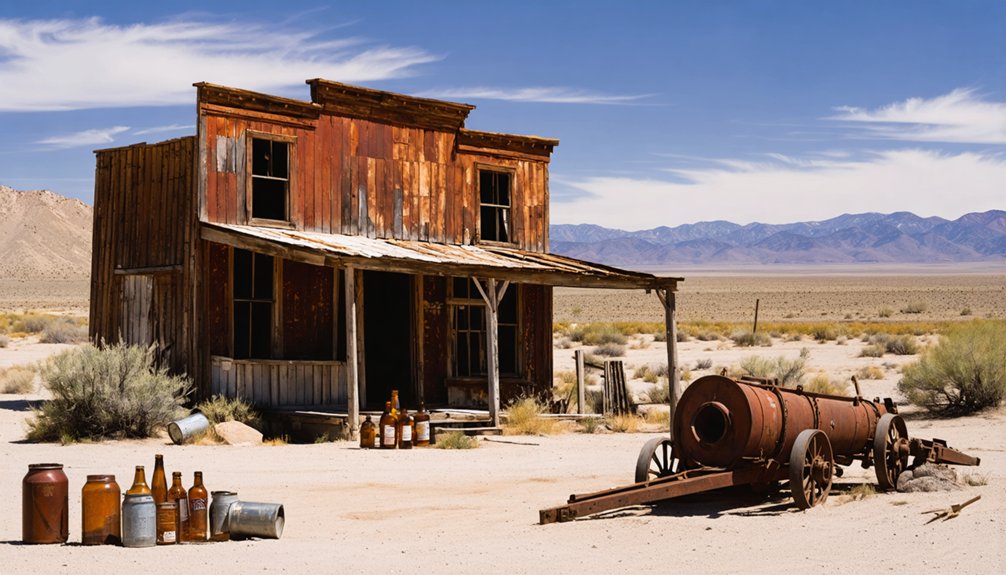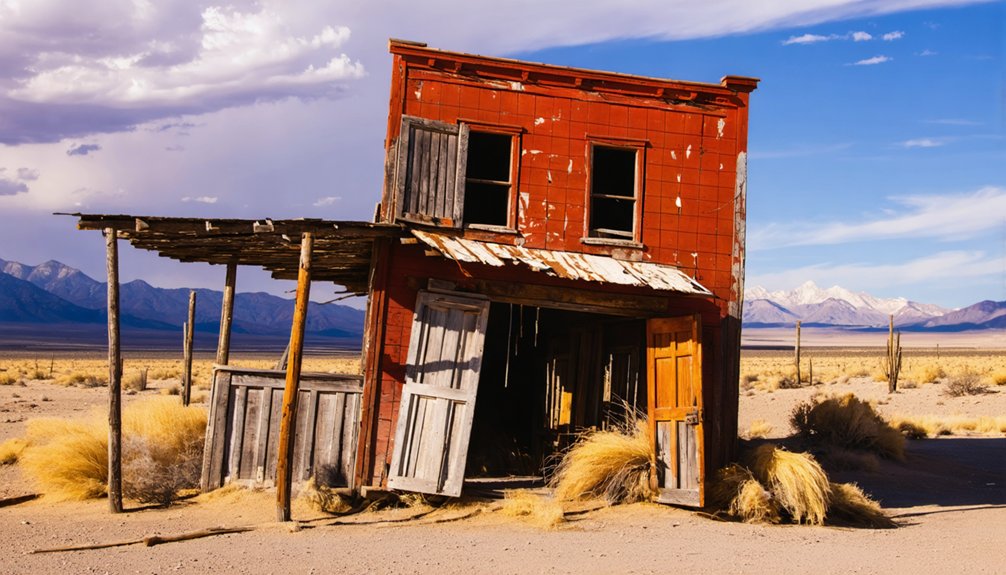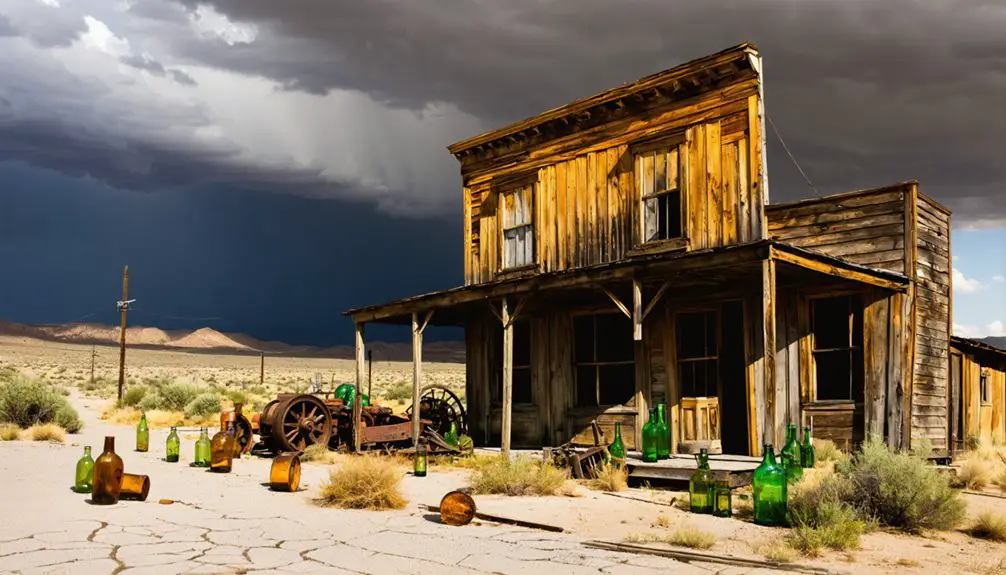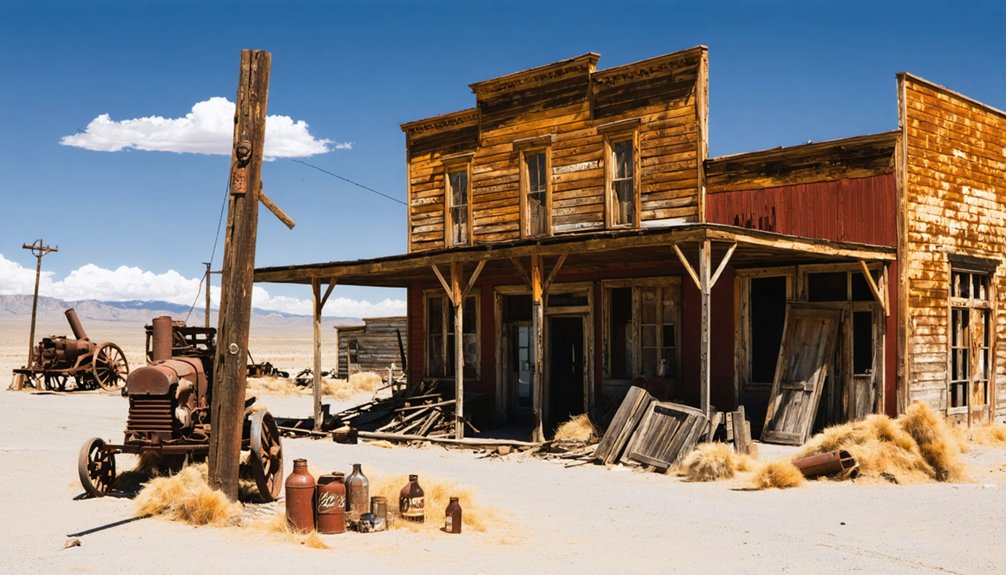
You’ll discover Nevada’s most fascinating ghost towns in Goldfield, Rhyolite, and Pioche, where over 600 abandoned settlements tell the story of America’s silver and gold rush. These preserved sites showcase luxurious hotels, historic banks, and iconic structures from the early 1900s when mining towns boomed with populations of thousands. While Goldfield remains partially inhabited with 300 residents, most ghost towns stand frozen in time, beckoning you to uncover their dramatic tales of prosperity and decline.
Key Takeaways
- Goldfield stands as Nevada’s largest and most accessible ghost town, featuring the historic Goldfield Hotel and Fire Station #1 with 300 current residents.
- Rhyolite offers iconic ruins including the Cook Bank Building and train depot, making it one of Nevada’s most photographed ghost towns.
- Pioche features the famous Million-Dollar Courthouse and Boot Hill Cemetery, representing the Wild West’s lawless era with dramatic historical significance.
- Pine Grove maintains well-preserved architectural remnants and a historic cemetery, providing authentic glimpses into Nevada’s 1860s mining heritage.
- Over 600 ghost towns dot Nevada’s landscape, with many requiring 4-wheel drive access and careful planning for safe exploration.
Nevada’s Mining Legacy and Ghost Town Culture
While California’s gold rush often steals the spotlight, Nevada’s mining legacy began in 1849 when Mormon prospectors discovered placer gold near present-day Dayton.
The true transformation came with the 1859 Comstock Lode discovery, revolutionizing mining techniques from simple hand-digging to sophisticated underground operations. Mining activities spread across the state through three major booms, including the Comstock, Tonopah-Goldfield, and Carlin periods.
The Comstock Lode marked a pivotal shift from basic prospecting to industrial-scale mining, forever changing Nevada’s landscape and economy.
You’ll find this rich history preserved in Nevada’s ghost towns, where annual silver production once reached an astounding $47.6 million by 1878.
The completion of the transcontinental railroad in 1869 connected these booming settlements to the wider world, establishing crucial northern Nevada towns that would later become historic landmarks.
Evidence shows that American Indians mined turquoise, obsidian, and salt for tools and ornaments long before European settlers arrived.
Today, ghost town preservation efforts protect these remnants of Nevada’s silver empire, where abandoned mines and weathered buildings tell the story of an era when precious metals transformed the territory into statehood.
The Rise and Fall of Goldfield: A Living Ghost Town
You’ll discover Goldfield’s meteoric rise from a 1902 gold discovery to becoming Nevada’s largest city by 1906, when its population swelled to over 20,000 residents amid $15 million in peak ore production.
The town’s prosperity manifested in luxurious amenities including five banks, three newspapers, and the grand Goldfield Hotel, built for $400,000 with 150 rooms.
The town hosted a historic 42-round championship bout in 1906 that showcased its prominence during the peak mining era.
Two devastating natural disasters in 1913 and 1923, including fires and floods that destroyed 53 city blocks, accelerated the town’s decline.
Today, you can explore this living ghost town‘s preserved structures, including the historic courthouse and Fire Station #1, while fewer than 300 residents maintain Goldfield’s status as the Esmeralda County seat.
Booming Years and Prosperity
After prospectors Billy Marsh and Henry Stimler discovered rich gold deposits in December 1902, Goldfield rapidly evolved from a modest mining camp into Nevada’s largest and most prosperous boomtown.
You’ll find evidence of this booming prosperity in the town’s remarkable transformation, as it grew to over 30,000 residents by 1906, establishing a vibrant mining culture that attracted fortune-seekers from across the nation.
The arrival of the Tonopah and Goldfield Railroad in September 1905 further accelerated the town’s meteoric rise to prominence.
During these golden years, you can appreciate how Goldfield earned its reputation as the “Queen of the Mining Camps” through:
- Daily ore production exceeding $10,000 by August 1904
- Premium building lots selling for up to $45,000
- Five banks and a mining stock exchange establishing financial dominance
- Three newspapers documenting the town’s extraordinary wealth and development
The town attracted notable figures including the Earp brothers, with Virgil serving as deputy sheriff after arriving in 1904.
Modern Ghost Town Life
Despite reaching its peak gold production of $11 million in 1910, Goldfield’s dramatic transformation into a ghost town began when mining operations declined sharply as ore extraction became increasingly difficult and costly.
The town’s population plummeted from 40,000 to fewer than 200 residents by 1918, stabilizing at around 250-400 people today.
Modern ghost town life in Goldfield centers on tourism as its economic survival strategy. Famous lawmen Virgil and Wyatt Earp once called this town home, adding to its Wild West allure.
You’ll find preserved stone and brick buildings that survived the devastating 1923 fire, including the iconic Goldfield Hotel, the restored high school, and Fire Station #1.
Just six miles east, you can explore Diamondfield, a reconstructed Wild West town complete with the Glory Hole Saloon and authentic period buildings.
For adventure seekers, the area offers rockhounding opportunities and paranormal investigations in historic structures. The town’s rich mining heritage produced a staggering $86 million in gold during its heyday.
Exploring the Haunted Streets of Rhyolite
Standing as a proof of Nevada’s golden age of mining, Rhyolite emerged from a modest two-tent camp in 1904 to become one of the state’s most promising boomtowns. The town reached a population of 5,000 residents within its first six months.
Today, you’ll find the haunting Rhyolite architecture of the Cook Bank Building, once a symbol of the town’s prosperity, standing defiantly against time and elements. The surrounding area showcases light-colored rock formations characteristic of the volcanic rhyolite deposits that gave the town its name.
As you explore these historic grounds, you’ll encounter:
- The iconic three-story bank ruins, now the most photographed ghost town structure in Nevada
- Remnants of the $130,000 train depot that once connected the town to civilization
- Foundations of 50 saloons and gambling halls that entertained thousands
- Protected historical sites maintained by the Bureau of Land Management
Ghost town legends surround these carefully preserved ruins, offering you a rare glimpse into the untamed spirit of the American West.
Pine Grove: A Hidden Gem of Northern Nevada
When gold was discovered in June 1866 by William Wilson, Pine Grove emerged as one of Nevada’s most intriguing mining settlements.
You’ll find this evidence of Pine Grove’s history nestled in a canyon that once bustled with 600 residents, five saloons, and three hotels during its 1870s peak.
The town’s mining heritage is preserved through its impressive $8 million production legacy, anchored by the Wilson and Wheeler mines.
You’re free to explore the remarkably intact wooden structures, including the original hotel and a well-preserved stamp mill that processed ore during the boom years.
While the Panic of 1893 led to Pine Grove’s eventual abandonment by the 1930s, the site’s enduring architectural remnants and hilltop cemetery offer you an authentic glimpse into Nevada’s rich mining past.
The Wild West Spirit of Pioche
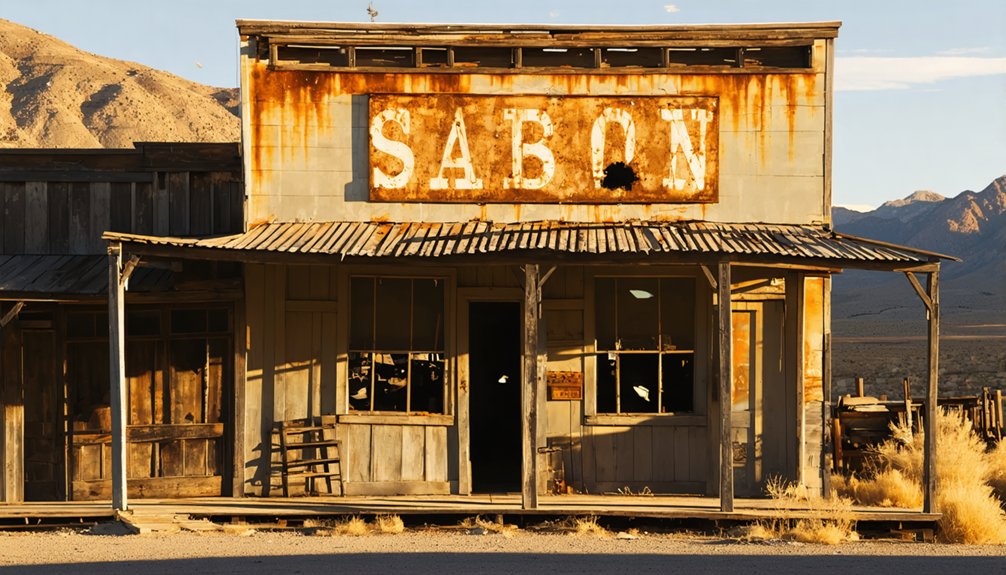
When you visit Pioche’s infamous Boot Hill cemetery, you’ll find the final resting place of 72 men who died violently before the town recorded its first natural death.
The lawlessness of 1870s Pioche is reflected in the sheriff’s office collecting $40,000 yearly in bribes and mining companies finding it cheaper to hire armed guards than pursue legal channels.
These stark reminders of frontier justice survive today through preserved landmarks like the Million-Dollar Courthouse, where corruption and bribery inflated construction costs so dramatically that taxpayers weren’t free of the debt until 1930.
Boot Hill’s Dark Legacy
Death stalked the streets of Pioche during its 1870s silver boom, leading to the establishment of Boot Hill Cemetery – a grim memorial to the town’s violent past.
The cemetery’s grave markers tell a stark tale: 72 men died violently before the first natural death occurred, making it one of the West’s deadliest mining camps.
You’ll find these sobering reminders of Pioche’s violent history preserved today:
- Original burial grounds where miners were laid to rest “with their boots on”
- Simple markers commemorating victims of countless shootouts and land disputes
- Evidence of an era when nearly 60% of Nevada’s murders occurred in this single town
- Reflection of the untamed spirit of a place where isolation meant justice often went unserved
Silver-Era Law Enforcement
Despite efforts to establish order in the silver boomtown of Pioche, lawlessness reigned supreme during the 1870s, with gunslingers and outlaws turning the remote mining camp into Nevada’s deadliest settlement.
Law enforcement challenges proved overwhelming, with 72 men meeting violent deaths before anyone succumbed to natural causes. Nearly 60% of Nevada’s homicides in 1871-72 occurred in this untamed frontier.
Sheriff Johnson attempted to restore order by forcefully removing troublesome miners, while Deputy John Ewing helped arrest lawbreakers using a buckboard wagon.
Yet their efforts faced constant resistance, including shootouts and threats.
The Million Dollar Courthouse, meant to symbolize law and order, instead became a monument to corruption when contractor Edward Donohue abandoned the project after pocketing funds, leaving a partially finished structure that cost taxpayers $75,000.
Humboldt City’s Stone Ruins and Pioneer Tales
As one of Nevada’s most atmospheric mining ruins, Humboldt City’s remaining stone structures tell the story of a brief but intense silver boom that began in 1860.
You’ll find about 15 crumbling adobe and stone ruins that capture the essence of Humboldt history, including the town’s largest remaining structure – a former store with intact sidewalls and remnants of vintage wallpaper.
Key elements of these Pioneer stories include:
- Original town infrastructure of 60 houses built from adobe, stone, and wood
- Natural springs that once flowed near resident doorways
- Abandoned mining shafts behind the old store ruins
- Historic cemetery with unmarked graves and mysterious stone markers, including one dated 1845
These preserved ruins serve as powerful reminders of Nevada’s silver mining heritage and merit continued protection.
Tunnel Camp: A Testament to Mining Innovation
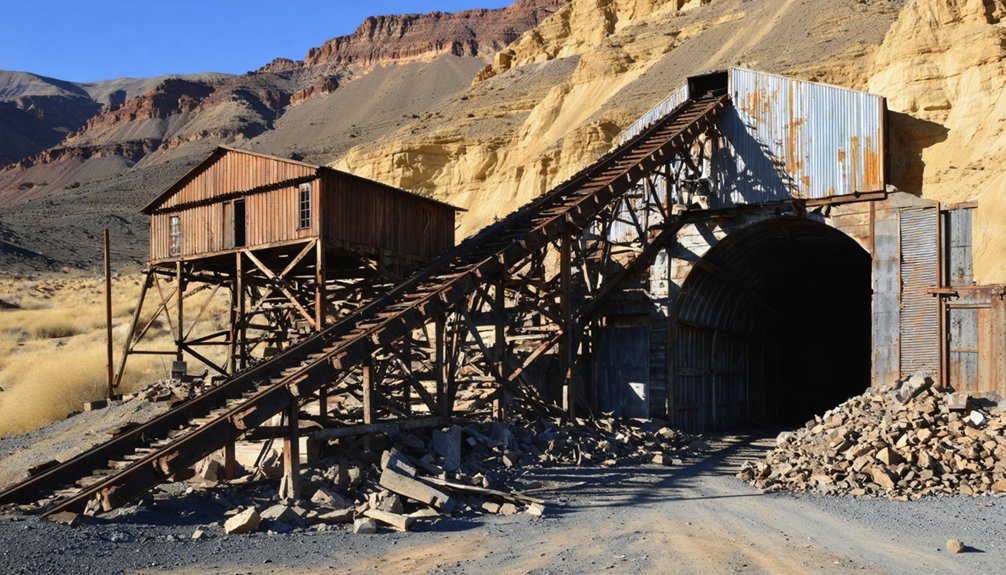
Located on the eastern flanks of Nevada’s Seven Troughs Mountain Range, Tunnel Camp stands as one of the state’s most innovative mining ventures of the late 1920s.
You’ll find the remnants of L.A. Friedman’s ambitious $3 million Deep Tunnel project, which aimed to drain flooded mines and transport ore through an extensive tunnel system.
Today, Tunnel Camp’s mining heritage remains remarkably intact compared to neighboring ghost towns. You can explore the well-preserved brick office building, loading chute, and the foundations of the 100-ton Friedman Mill.
While the tunnel project ultimately failed to reach its intended depth, the site’s thirty original structures, including bunkhouses and powerhouses, tell the story of engineering ambition and determination.
The camp’s accessibility via dirt roads makes it an ideal destination for those seeking to discover Nevada’s pioneering spirit.
Ghost Town Photography and Historical Documentation
You’ll find the best ghost town photography opportunities during the “golden hours” of sunrise and sunset, when the slanting light reveals textures on weathered buildings and creates dramatic shadows across abandoned streets.
To properly document these vanishing treasures, you must capture both wide establishing shots of entire sites and detailed architectural elements that tell the story of early Nevada life.
Your photographs serve as crucial historical records that help preserve these endangered places, so it’s important to follow site regulations while thoroughly documenting distinctive features like mining equipment, period signage, and architectural details before they’re lost to time.
Preserving Decaying Town Sites
While Nevada’s ghost towns face constant threats from weather, vandalism, and time itself, dedicated preservation efforts help document and protect these invaluable historical sites.
Site conservation techniques include applying rolled asphalt roofing beneath cedar shingles and maintaining authentic materials whenever possible. Historical preservation groups like the Friends of the Belmont Courthouse and the Nature Conservancy work to safeguard these treasured landmarks.
- The Bureau of Land Management preserves Rhyolite’s ruins while offering public access
- Berlin-Ichthyosaur State Park maintains historic buildings through self-guided tours
- Preservation teams document sites before they’re lost, as with Lost City’s submersion
- Local initiatives combat vandalism and deterioration through fencing and monitoring
You’ll find carefully preserved structures at Belmont, including its historic jail and courthouse, where guided tours operate seasonally from May through September.
Best Photography Light Times
Capturing Nevada’s ghost towns in their best light requires strategic timing throughout the day and seasons.
You’ll find the golden hour just after sunrise and before sunset offers ideal conditions for ghost town photography, highlighting weathered textures and creating dramatic shadows across abandoned structures.
For detailed documentation, plan your visits during early morning hours when soft light reveals architectural elements at sites like Pine Grove and Humboldt City.
Blue hour photography techniques work especially well at Nelson Ghost Town and Rhyolite, where the ethereal post-sunset glow emphasizes historical artifacts and creates a haunting atmosphere.
During winter months, you’ll benefit from extended dawn periods that provide more time for capturing desert ruins.
Avoid harsh midday sun in summer, which can wash out important details of these precious historical sites.
Unique Architectural Documentation Methods
Three essential documentation methods help preserve Nevada’s ghost town architecture for future generations: HABS-standard measured drawings, detailed photographic surveys, and extensive heritage inventories.
You’ll find these techniques vital for capturing the unique characteristics of abandoned structures before they deteriorate further. Modern architectural documentation combines traditional hand-drawn methods with digital technology to create all-encompassing records.
- Use morning light to photograph building ghosts and structural remnants, capturing shadows that reveal construction details.
- Create measured drawings showing materials, hidden elements, and modifications using HABS standards.
- Document GPS coordinates and UTM grid references for precise site mapping.
- Conduct thorough historical research using newspapers, aerial photos, and deed records.
These preservation methods guarantee your ghost town explorations contribute to lasting architectural documentation while maintaining the site’s historical integrity.
Planning Your Nevada Ghost Town Adventure
Before starting a Nevada ghost town expedition, you’ll need to navigate America’s largest concentration of abandoned settlements, with over 600 ghost towns scattered across this vast state’s challenging terrain.
Effective ghost town exploration demands thorough off-grid planning using reliable resources like Stan Paher’s guidebooks and the Nevada Ghost Towns and Desert Atlas’s 71 detailed maps.
Strategic planning and trusted mapping resources are essential tools for navigating Nevada’s remote ghost town treasures safely and successfully.
Start by acquiring the Interactive Nevada Ghost Towns map and consulting Top 10 lists by region to prioritize your destinations.
Pack emergency supplies, as many sites require 4-wheel drive access and lie beyond cell coverage.
Respect the region’s arrested decay by treading lightly around preserved structures.
Consider combining your journey with visits to state parks like Berlin-Ichthyosaur, and always verify coordinates, as many locations remain unmarked on standard maps.
Preserving Nevada’s Ghost Town Heritage
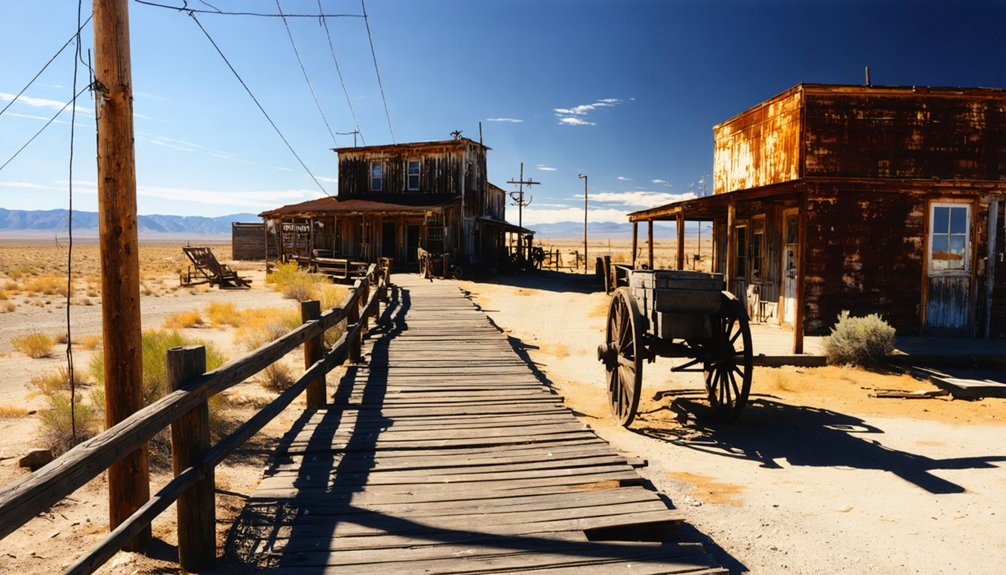
Preserving Nevada’s rich ghost town legacy requires coordinated efforts from government agencies, historical societies, and dedicated community groups.
Through community stewardship and historical preservation initiatives, you’ll find organizations working tirelessly to protect these invaluable historic sites while maintaining their authenticity.
- The Nevada Offroad Association’s Pine Grove Project demonstrates successful collaboration, removing debris and creating fire protection zones around historic structures.
- Goldfield Historical Society’s ongoing preservation of the town’s High School showcases long-term commitment to saving landmark buildings.
- Rhyolite’s balanced approach combines structural stabilization with contemporary art installations, creating a dynamic historical experience.
- Fort Churchill and Belmont Courthouse exemplify how state parks and volunteer groups can maintain public access while protecting historical integrity.
Frequently Asked Questions
Are There Any Dangerous Wildlife Encounters in Nevada Ghost Towns?
You’ll face serious wildlife safety risks from rattlesnakes, coyotes, and aggressive wild burros. Ghost town predators are most active at dawn and dusk, so stay alert and avoid exploring abandoned mines alone.
What Survival Supplies Should I Pack for Ghost Town Exploration?
Pack your survival gear with protective clothing, reliable lighting, navigation tools, and first aid supplies. You’ll need sturdy boots, flashlights, maps, water, and emergency rations for safe ghost town exploration.
Can I Legally Collect Artifacts From Nevada Ghost Towns?
You can’t legally collect artifacts from ghost towns. Federal and state laws protect these historic sites, with artifact preservation regulations imposing serious penalties. Only take photos and leave everything as you found it.
Which Ghost Towns Are Accessible During Winter Months?
You’ll find winter accessibility at Gold Point, Virginia City, Osceola, and Rhyolite. Each offers unique seasonal attractions, with Virginia City’s Christmas festivities and Gold Point’s desert sunsets being particular highlights.
Are Metal Detectors Allowed in Nevada’s Ghost Town Sites?
You can’t use metal detectors in Nevada ghost towns without special permits. Metal detecting regulations strictly protect these historic sites, and getting ghost town permits is extremely difficult for preservation reasons.
References
- https://nvtami.com/top-10-ghost-towns-nevada-northwest/
- https://www.visittheusa.com/experience/6-nevada-ghost-towns-explore-if-you-dare
- https://pinatravels.org/ghost-towns-near-las-vegas/
- https://www.atlasobscura.com/things-to-do/nevada/ghost-towns
- https://travelnevada.com/ghost-town/
- https://nvtami.com
- https://nbmg.unr.edu/mining/MiningHistory.html
- https://pubs.usgs.gov/of/2004/1244/metadata.htm
- https://pdacnv.com/wp-content/uploads/2023/03/PDAC_Nevada-Mining-Sector-Overview-Mike-Visher.pdf
- https://nevadamining.org/new-history-page/