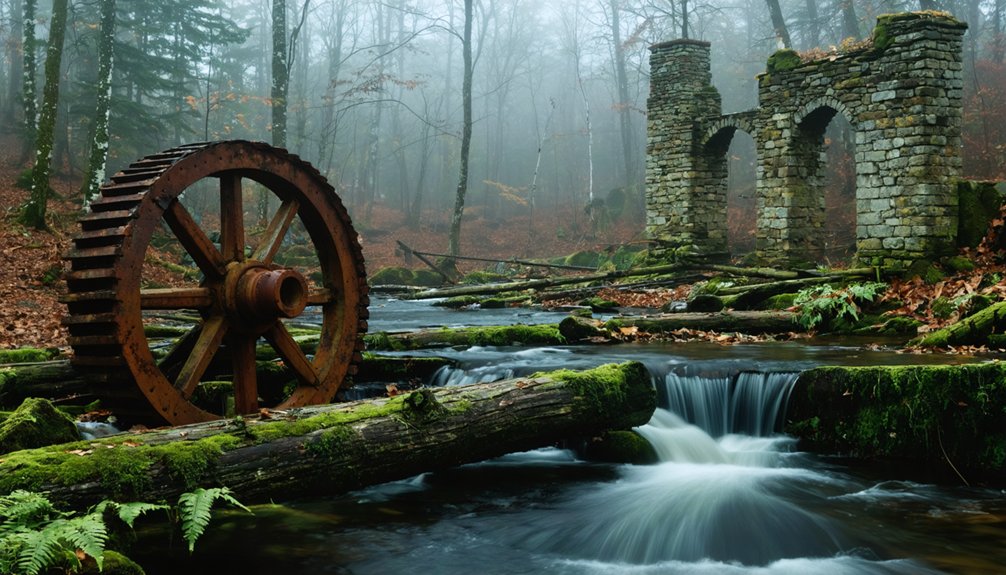
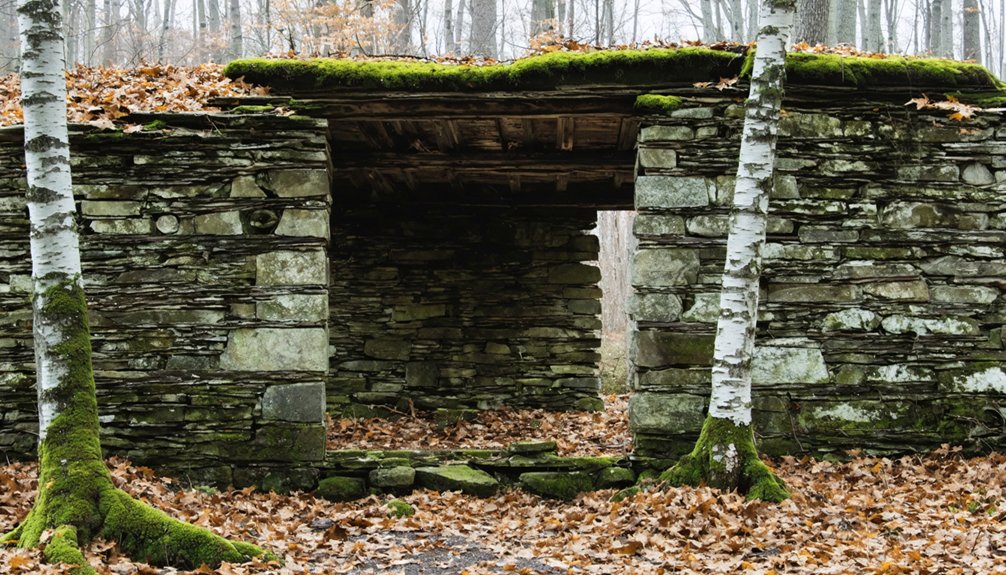
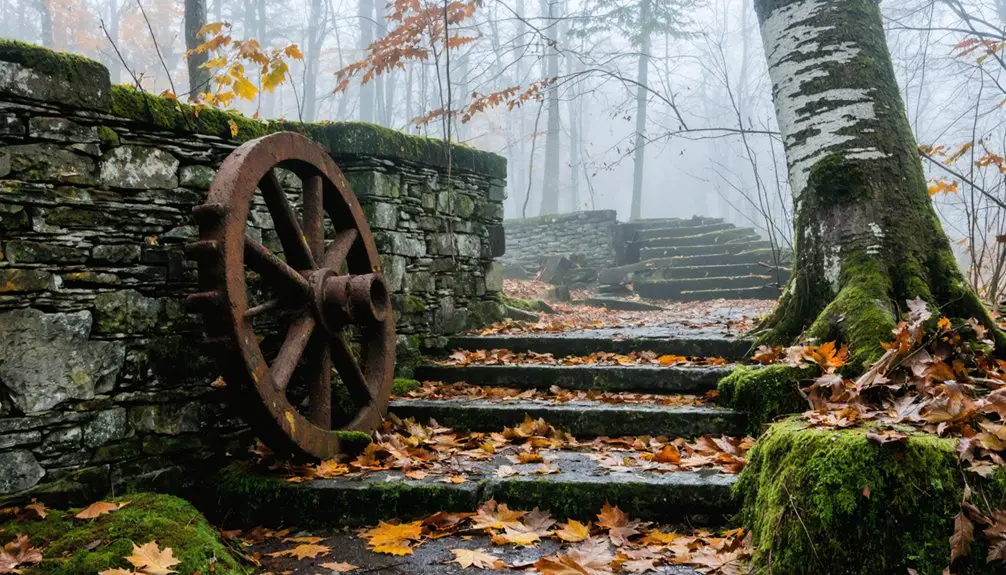
You’ll discover fascinating ghost towns throughout New Hampshire’s White Mountains region, including the historic logging community of Livermore and the colonial-era Monson Center. Zealand’s abandoned company town offers glimpses of 19th-century timber operations, while Old Hill Village’s remnants tell the story of a community displaced by the Franklin Falls Dam project. The dramatic ruins of Madame Sherri’s Castle in West Chesterfield add Jazz Age mystique to the state’s collection of abandoned places. These preserved sites hold countless stories waiting to be uncovered.
Key Takeaways
- Livermore Ghost Town offers well-preserved logging community ruins and mill remains within White Mountain National Forest, accessible via hiking trails.
- Monson Center features colonial-era stone cellars, ancient walls, and the restored Gould House museum across 200 acres of historic parkland.
- Zealand showcases remnants of a thriving 1875 lumber town, including sawmill ruins along the 2.5-mile Zealand Trail.
- Old Hill Village reveals preserved sidewalks and foundations from a 1937 relocated community, viewable along the scenic Needlebrook Trail.
- Madame Sherri’s Castle ruins in West Chesterfield display the remains of a 1929 mansion, offering unique Jazz Age architectural elements.
Exploring the Haunting Ruins of Livermore
Hidden within New Hampshire’s White Mountain National Forest lies Livermore, perhaps the state’s most evocative ghost town.
You’ll discover haunting architecture in the weathered foundations and crumbling remnants of what was once a bustling logging community. The town’s forgotten stories echo through moss-covered mill ruins, a broken safe in the old company store, and scattered artifacts that paint a picture of life in early New England. The settlement was established by the Boston lawyer family, the Saunders, who owned and operated the town.
Following Sawyer River Road, you’ll find the remnants of this once-thriving settlement that peaked around 1900 with 200 residents. A devastating flood in the 1920s destroyed the mill and triggered the town’s eventual abandonment.
Today, brick walls of the power house stand sentinel, while a towering round chimney marks where industry once flourished. The ruins, accessible via an easy hike, offer a poignant reminder of nature’s reclamation of human enterprise.
Monson Center: A Hidden Colonial Time Capsule
You’ll find remarkable glimpses of colonial New England life preserved in Monson Center’s stone-lined cellar holes and ancient stone walls, each marking where hardy settlers once carved out homesteads in New Hampshire’s wilderness.
The Gould House, standing as the sole surviving colonial structure, offers a tangible connection to the brief but significant chapter of this failed township’s history from the 1730s to 1770s.
Through the protected 200-acre historic park, you can trace the footsteps of early settlers like Captain Powers and the Bailey family while reading detailed historical plaques that bring their stories to life.
The site might have been lost forever if the Society for Protection hadn’t stepped in to preserve it when housing development threatened the area in 1998.
A June mountain laurel display adds natural beauty to the historic landscape as you explore the network of well-marked trails.
Colonial Life Preserved
Deep within New Hampshire’s forested landscape lies Monson Center, a remarkably preserved colonial settlement that offers visitors a glimpse into 18th-century New England life.
As you explore the 200-acre historic park, you’ll discover the Gould House, the last standing example of colonial architecture from Monson’s brief but significant existence. Stone walls and cellar holes, each marked with family histories, reveal the layout of this early settlement that flourished from the 1730s to 1770. The site faced significant challenges including tax disputes with Governor Wentworth that ultimately led to its abandonment.
The Society for the Protection of New Hampshire Forests has preserved this archaeological treasure, saving it from modern development. You can now walk the same paths as the original settlers, following old roads that connect homestead sites where farmers and craftspeople once built their lives before dispersing to neighboring towns. A small museum within the restored Gould House showcases artifacts and genealogical records that tell the stories of Monson’s earliest inhabitants.
Hidden Historical Treasures
The remarkable story of Monson Center begins in 1735, when six ambitious settlers from Massachusetts and Canada purchased land that would become one of New Hampshire’s earliest inland colonial settlements.
Today, you’ll discover the legacies of forgotten settlers like Thomas Nevins, whose three sons died in the Revolutionary War, and Joshua Bailey, who watched his home burn while his children fled in nightclothes.
You can explore the preserved colonial architecture through a network of trails connecting seven original home sites.
Stone-lined cellar holes and ancient walls trace the paths where settlers once walked.
At the restored Gould House, you’ll find maps guiding you to Jerry’s Garden and a peaceful beaver wetland.
The site’s mountain laurel blooms in mid-June, offering a stunning backdrop to this protected historical treasure.
Thriving chestnut trees line the entrance road, providing a majestic welcome to visitors.
The property was nearly lost forever until a successful grassroots campaign in 1998 saved it from becoming a 28-lot subdivision.
Zealand’s Forgotten Logging Legacy
Nestled within New Hampshire’s White Mountains, Zealand emerged in 1875 as a bustling company town under the controversial leadership of timber baron J.E. Henry.
You’ll discover a rich logging heritage in this former settlement, where up to 250 loggers once transformed virgin forests into lumber and paper for America’s growing economy.
The town’s timber history reveals both innovation and devastation. East Branch Railroad trains carried lumber from Zealand until Henry’s operations relocated to Lincoln in 1892. The community featured a post office and school, providing essential services to logging families.
While Zealand boasted impressive infrastructure, including a steam-powered sawmill, two railroad stations, and charcoal kilns, Henry’s aggressive clear-cutting practices ultimately led to the town’s demise.
By the 1890s, depleted forests and devastating fires forced operations to relocate.
Today, you can explore Zealand’s remnants along the 2.5-mile Zealand Trail, where scattered bricks and the dominant yellow birch serve as silent witnesses to this forgotten chapter of New Hampshire’s industrial past.
The Eerie Remnants of Old Hill Village
While many New England ghost towns faded gradually into obscurity, Old Hill Village‘s story ended abruptly in 1937 when federal authorities seized the land for the Franklin Falls Dam flood control project.
Today, you’ll find echoes of the past along the Needlebrook Trail, where stately trees still line the former main street and old foundations tell tales of a once-thriving community.
You can walk where residents once lived, following preserved sidewalks that lead to cellar holes and the impressive mill foundation.
Fourteen original buildings were saved, relocated to higher ground through determined community effort.
Historic markers now guide you through the village’s remains, documenting locations of former shops, hotels, and the railroad depot that once served this riverside town.
Madame Sherri’s Castle: A Mysterious Estate
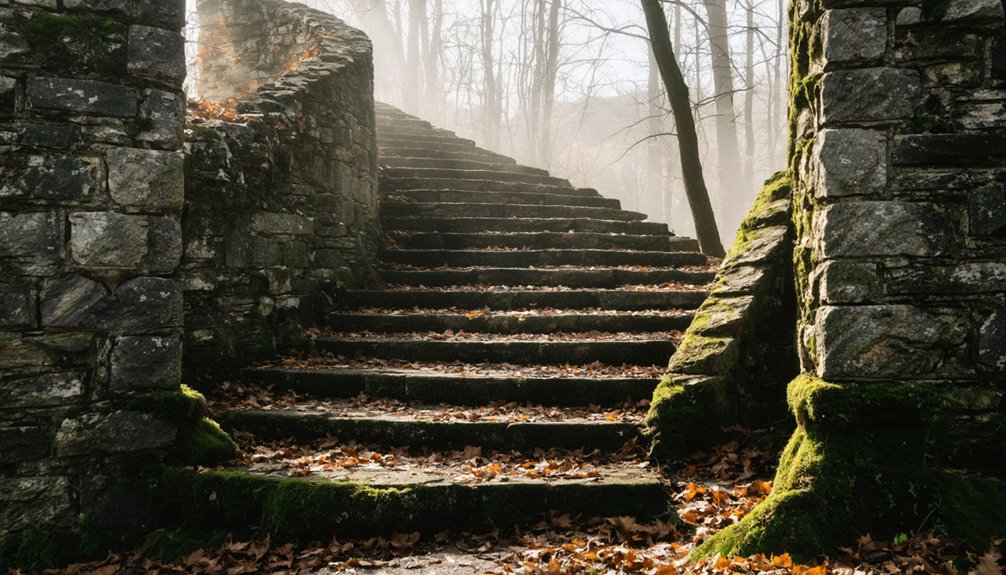
Among New Hampshire’s most intriguing abandoned places stands what remains of Madame Sherri’s Castle in West Chesterfield, a tribute to Jazz Age extravagance and architectural whimsy.
Built in 1929 without formal blueprints, the castle reflected its owner’s theatrical flair through architectural eccentricities like a bistro-styled lower floor and an indoor forest with trees growing through multiple stories.
You’ll find only the iconic stone staircase remaining today, a haunting memorial to the property’s glamorous past when Madame Sherri hosted lavish parties for New York’s theatrical elite during Prohibition.
After depleting her fortune by the 1940s, she abandoned the castle, which fell victim to vandalism before burning down in 1962.
Now protected as Madame Sherri Forest, these ruins preserve the memory of one of New Hampshire’s most colorful historical figures.
Isles of Shoals: Abandoned Maritime Settlement
The rocky Isles of Shoals, scattered off New Hampshire’s seacoast, represent one of New England’s earliest maritime settlements predating Plymouth Plantation.
Before the Pilgrims reached Plymouth’s shores, hardy fishermen had already built thriving communities on New Hampshire’s rugged Isles of Shoals.
These isles’ history began around 1615 when fishermen first settled on Londoner’s Island, establishing a thriving maritime community that would rival Boston’s commercial success.
You’ll find ghostly remnants of colonial life across the archipelago, particularly on Star Island and Appledore Island.
In 1778, as British naval forces threatened during the Revolutionary War, residents were forced to evacuate to mainland Rye. Many dismantled their homes entirely, floating them to shore – these historic structures still stand today from York to Ipswich.
Though briefly resettled in the mid-1800s as a tourist destination, the islands’ abandoned settlements serve as a powerful reminder of New Hampshire’s maritime heritage.
Ghost Towns Along the Sawyer River Railroad
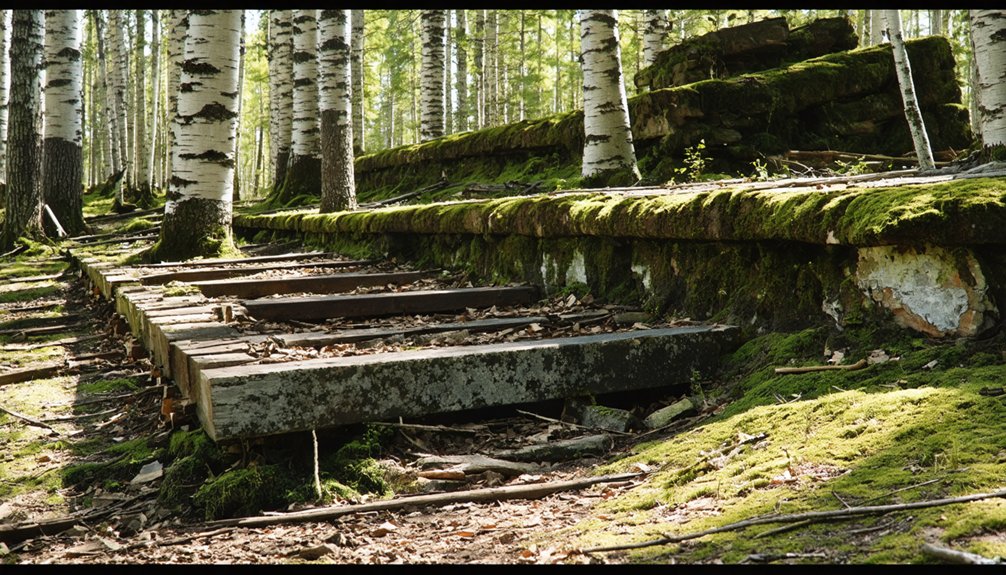
Situated deep within New Hampshire’s White Mountains, Livermore stands as one of the state’s most well-preserved logging ghost towns, with a rich history tied to the Sawyer River Railroad. Established in 1874 by the Saunders family, this once-thriving logging community operated around the second logging railroad in the White Mountains, transporting lumber from the heart of the forest to Conway and beyond.
You’ll find the town’s poignant remains just two miles down Sawyer River Road off Route 302. The site’s numerous ruins, including the Saunders mansion foundation, sawmill remnants, and scattered railroad artifacts, tell the story of Livermore’s rise and fall.
A series of devastating events – mill fires, floods, and economic decline – led to the town’s abandonment by 1949, leaving behind a compelling reflection of New Hampshire’s industrial heritage.
Lost Communities of the White Mountains
Hidden beneath the forest canopy of New Hampshire’s White Mountains lie numerous abandoned farming settlements that once bustled with life during the 19th century.
You’ll discover the remnants of Thornton Gore, which boasted 26 homes, a school, church, and mill across 1,100 acres of cleared land. These abandoned settlements hold immense historical significance, with over 600 documented cellar holes scattered throughout the White Mountain National Forest.
Amid the White Mountains’ dense forest, Thornton Gore’s 26 homes and bustling community life now lie silent beneath nature’s reclaiming embrace.
The decline of these communities happened swiftly, driven by deforestation, the Civil War, and devastating floods.
Places like Livermore saw their population plummet from 200 residents in 1900 to just four by 1940.
Today, you can explore these lost communities through their surviving stone walls, cemetery markers, and mill ruins, each telling a story of New Hampshire’s pioneering past.
Historic Industrial Ruins and Mill Sites
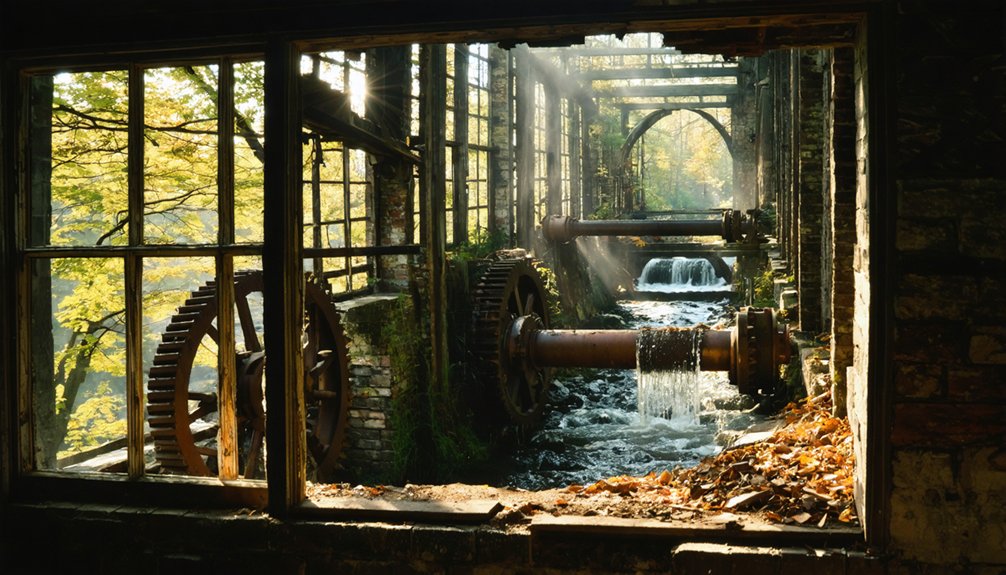
You’ll find some of New Hampshire’s most evocative industrial ruins among the abandoned mill sites of the White Mountains, where communities like Livermore and Zealand once bustled with sawmills and logging operations.
The remnants of these nineteenth-century timber towns offer compelling glimpses into the region’s logging heritage, from crumbling foundations to weathered railroad beds that once transported countless loads of lumber.
These preserved ruins serve as important historical markers of New Hampshire’s industrial past, when lumber companies transformed remote mountain valleys into thriving centers of wooden manufacturing.
Abandoned Mills of Livermore
The historic Livermore Mills stand as haunting reminders to New Hampshire’s industrial heritage, with their rusted metal frames and crumbling brick walls echoing a bygone era of lumber production.
You’ll find these abandoned industrial ruins in Grafton County, where the Saunders brothers first established their sawmill operations in 1874. The site’s rich history includes multiple ownership changes, from J.E. Henry’s pioneering pulp mill to the Parker Young Company’s later developments.
The abandoned infrastructure tells a story of nature’s triumph over industry, as devastating floods in 1927 and 1973 ultimately sealed the mills’ fate.
Today, you can explore the remaining stone foundations, powerhouse ruins, and scattered artifacts that paint a picture of this once-thriving company town, which officially dissolved in 1951 after its population dwindled to just two residents.
Zealand’s Lumber Legacy
Amid the serene White Mountains of northern New Hampshire, Zealand’s industrial ruins stand as evidence to one of America’s most intensive 19th-century logging operations. Under timber baron J.E. Henry‘s direction, this once-bustling company town transformed 100,000 acres of virgin forest into a hub of lumber production and charcoal manufacturing.
You’ll find remnants of Zealand’s history scattered throughout the valley – foundations of five brick charcoal kilns, abandoned railroad grades, and mill ruins along the Ammonoosuc River.
The aggressive logging practices ultimately led to Zealand’s demise, as clear-cutting and subsequent forest fires devastated the landscape between 1903-1905. By 1900, the town was abandoned, its timber depleted and industries obsolete.
Today, these silent ruins serve as stark reminders of the region’s industrial heritage and the environmental consequences of unchecked resource exploitation.
White Mountain Factory Remnants
Scattered across New Hampshire’s White Mountains, historic industrial ruins tell compelling stories of 19th-century manufacturing prowess and resource exploitation.
You’ll discover the stone remnants of Franconia Iron Works, constructed in 1859, standing as the state’s last surviving iron smelter. This remarkable factory relic operated for decades before flames claimed most structures in 1884.
The region’s industrial heritage extends to Thornton Gore’s abandoned mills, where grist and lumber operations once thrived along Eastman Brook.
You can explore traces of the Woodstock Lumber Company‘s massive operations, including railroad grades from their 1909 logging line.
The Lost River area preserves memories of Johnson Lumber Company’s ambitious venture, where a complete company town flourished briefly before the 1915 mill fire led to its desertion.
Preserving New Hampshire’s Ghost Town Heritage
While New Hampshire’s ghost towns faced mounting development pressures in the late 20th century, dedicated preservationists have worked tirelessly to protect these invaluable historic sites.
You’ll find remarkable success stories like Monson, where a 1998 grassroots campaign prevented luxury housing development and secured 200 acres of historic parkland. The site’s archaeological significance extends beyond its seven preserved colonial homesteads to tell a broader story of early inland settlement.
Today, you can explore ghost town preservation efforts throughout the White Mountains region, from Monson’s well-marked trails to Livermore’s hidden mill ruins.
In addition to these unique sites, underwater ghost towns in Louisiana offer a haunting glimpse into the past, submerged beneath the waters of man-made reservoirs. These eerie locations tell stories of communities forgotten and landscapes transformed, inviting adventurous explorers to uncover their secrets. As divers navigate through the remnants of these towns, they can imagine the lives that once thrived above the surface.
The Forest Society’s stewardship guarantees you’ll experience authentic colonial settlement patterns through stone walls, cellar holes, and restored structures that paint a vivid picture of New Hampshire’s past.
Frequently Asked Questions
Are Any of These Ghost Towns Legally Accessible for Metal Detecting?
Like prospectors of old, you’ll find ghost towns require written permission for metal detecting. Check local regulations and obtain landowner approval before searching these historic sites in the Granite State.
What Survival Gear Should Visitors Bring When Exploring Remote Ghost Towns?
Pack survival essentials like GPS, first aid supplies, sturdy boots, and weather-appropriate layers. You’ll need at least 2L water, emergency whistle, and headlamp for responsible exploring in remote locations.
Which Ghost Towns Are Most Dangerous During Winter Months?
Sharp as a winter’s blade, you’ll face the deadliest conditions at Lakes of the Clouds Hut and Livermore, where haunted ruins meet extreme mountain weather, creating treacherous winter hazards above 5,000 feet.
Do Any Ghost Towns Require Special Permits for Photography?
You’ll need special permits for ghost towns on state park lands ($100 fee) and preserved historical sites. Photography regulations vary by location, with permit requirements determined by individual municipalities and property owners.
Which Ghost Towns Have Reported Paranormal Activity in Recent Years?
You’ll find documented paranormal activity at Monson Village, where recent investigations reveal ongoing haunted history through Ghost Quest’s findings, including unexplained lights and drumbeats still reported by modern visitors.
References
- https://www.nhmagazine.com/the-most-haunted-places-in-new-hampshire/
- https://wokq.com/ghost-town-of-livermore-new-hampshires-smallest-town/
- https://thefrogandpenguinn.blogspot.com/2021/07/a-nh-ghost-town.html
- https://www.youtube.com/watch?v=mFBYIdURBvQ
- https://www.visitwhitemountains.com/blog/post/spooky-stories-ghost-towns-and-historic-haunted-spots/
- https://www.onlyinyourstate.com/experiences/new-hampshire/ghost-towns-nh
- https://www.whitemountainhistory.org/abandoned-towns
- https://www.nhmagazine.com/livermore-is-a-strange-name-for-a-ghost-town/
- http://people.matinic.us/garrett/teaching/geog-45/fa-17/atlas/places/livermore
- https://outdoorodyssey.net/2022/11/03/the-haunted-ghost-town-of-livermore-nh/