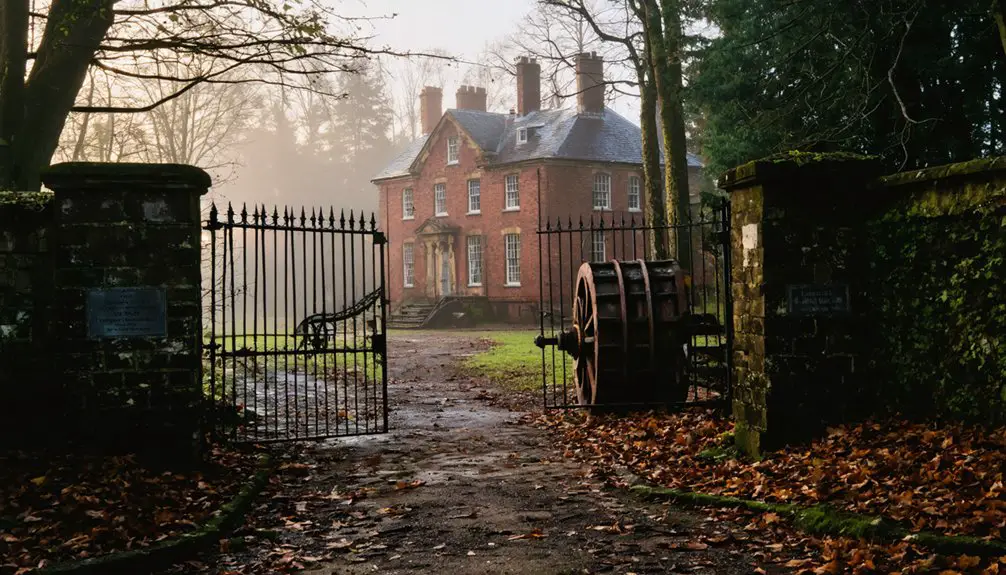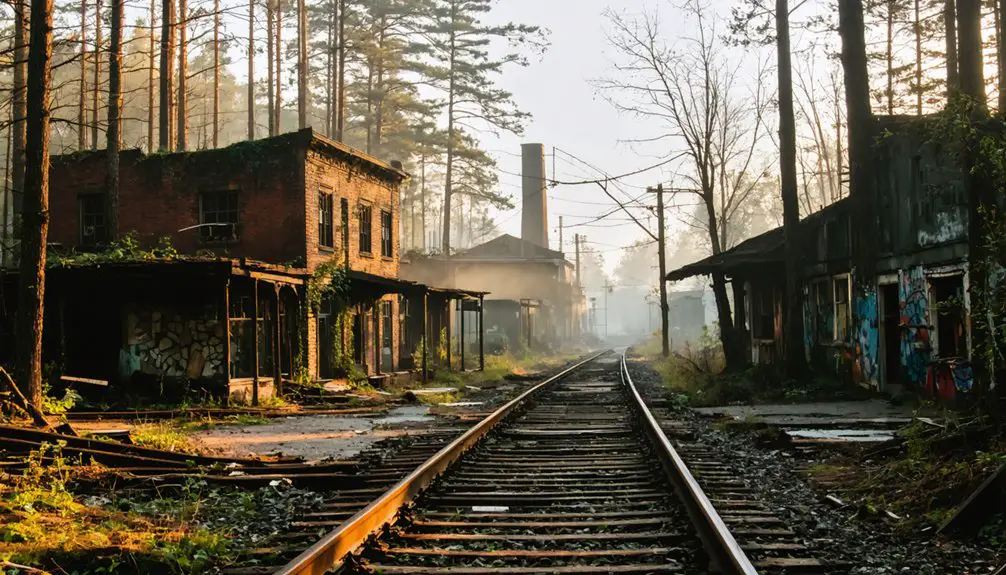
You’ll find New Jersey’s most intriguing ghost towns scattered throughout the Pine Barrens region and beyond. Notable sites include Feltville, a former mill town with preserved 19th-century buildings; Batsto Village, once a thriving iron works that supplied the Continental Army; and Historic Allaire, a well-preserved iron manufacturing community. Waterloo Village and Harrisville offer additional windows into the state’s industrial past, where abandoned settlements reveal centuries of economic transformation and technological evolution.
Key Takeaways
- Feltville stands out as a well-preserved ghost town featuring original buildings from its 1845 mill town era and historic cemetery.
- Batsto Village offers extensive remains of an iron-working community that supplied the Continental Army during the American Revolution.
- Harrisville showcases ruins of a 19th-century paper mill town, abandoned after a devastating forest fire in 1914.
- Waterloo Village presents a restored 19th-century canal town with 19 historic buildings and preserved Morris Canal infrastructure.
- Weymouth contains visible remnants of both iron works and paper production facilities, including brick chimneys and stone foundations.
Exploring the Pine Barrens’ Hidden Industrial Past
While the Pine Barrens may appear desolate today, this region once thrived as New Jersey’s industrial heartland, powered by the unique combination of bog iron deposits, abundant forests, and flowing waterways.
From 1765 to 1869, you’ll discover the remnants of over 30 furnace and forge enterprises that dotted the landscape, transforming raw bog iron into essential military supplies during the Revolutionary and French-Indian Wars.
At sites like Batsto, Hampton Furnace, and Martha Furnace, workers extracted bog iron from streams and combined it with locally produced charcoal to forge iron products.
This industrial heritage shaped the region until Pennsylvania’s superior iron ore and coal-fueled furnaces brought the era to an end. The advent of extensive railroad networks in the 19th century accelerated this decline by making coal transportation easier.
Today, you can explore these abandoned settlements, where nature has reclaimed most traces of the once-bustling iron industry.
Sand mining and glassmaking operations also flourished throughout the region, taking advantage of the area’s abundant natural resources.
Feltville: The Village That Time Forgot
You’ll discover Feltville’s origins in 1845 when David Felt purchased 760 acres to establish a thriving mill town that would support his New York stationery business.
Under Felt’s leadership, the village rapidly expanded to include a papermill, two dams, church, schoolhouse, and housing for 175 residents by 1850.
The village’s prosperity proved short-lived, however, as the Panic of 1857 devastated Felt’s investments, leading to his retirement and the town’s eventual abandonment by the 1870s after subsequent business ventures failed. The property later transformed into Glenside Park resort, attracting vacationers from New York City seeking a mountain escape.
The town’s eerie atmosphere is heightened by a historic cemetery in the woods containing the graves of three Revolutionary War Patriots and early settlers.
Rise and Early Success
Long before Feltville became a ghost town, the area’s story began with Peter and Sarah Wilcox‘s settlement in the 1730s alongside the Badgley family. This early settlement history centered around Peter’s Hill, where Wilcox built a sawmill on Blue Brook in 1736, transforming hundreds of acres of forest into farmland. The area would later become part of the 130-acre historic district.
Today, the historic site is proudly maintained by Union County staff who organize educational activities and preserve its rich heritage.
The area’s industrial growth accelerated when David Felt purchased 760 acres in 1845, establishing:
- A paper mill and printing factory along Blue Brook
- Two dams to power mill operations
- Worker housing on the overlooking bluff
- A churchhouse and one-room schoolhouse
Under Felt’s strict oversight, the town quickly flourished, reaching 175 residents by 1850. His authoritarian style earned him the nickname “King David,” as he mandated church attendance and education for all residents.
A Village’s Quiet Decline
Despite David Felt’s initial success in building a thriving industrial village, Feltville’s decline began with the devastating Panic of 1857, which crippled his real estate investments and triggered a cascade of economic setbacks.
You’ll find that the economic decline accelerated when changes in transportation networks diminished the village’s competitive advantage, while the agricultural sector’s downturn eliminated essential revenue sources.
The abandoned buildings slowly deteriorated into historic landmarks today.
By 1860, Felt sold the village, driven by his brother’s death and mounting financial pressures. The subsequent years saw a succession of failed ventures under new ownership, including Townsend’s unsuccessful mill operation.
Village abandonment progressed gradually until the 1870s, when the last residents departed.
Even Glenside Park’s transformation into a summer resort couldn’t sustain the community, ultimately succumbing to changing vacation preferences by 1916.
Warren Ackerman attempted to revive the area by adding golf and tennis amenities to attract middle-class visitors.
Batsto’s Rise and Fall in the Iron Industry
You’ll find Batsto Iron Works’ most prosperous period occurred during the American Revolution, when the facility served as an essential supplier of military materials for the Continental Army while enjoying protection from British raids.
Charles Read established the Batsto Iron Works in 1766, taking advantage of the area’s rich natural resources.
The operation continued to thrive under the Richards family’s leadership from 1784 through the early 1800s, maintaining steady production of pig iron, cast-iron pipes, and firebacks. The village grew into a self-sufficient community as multiple buildings were constructed to support the workers and their families.
Iron Production Peak Years
Although Batsto Iron Works began modestly in 1766, it rapidly evolved into a powerhouse of colonial iron production during the American Revolution.
The iron production techniques employed at Batsto exemplified the mid-Atlantic colonial method of indirect smelting, yielding greater output than traditional bloomeries. You’ll find historical smelting methods that combined local bog ore with imported European iron to enhance quality.
During peak operations, you could witness:
- Year-round furnace operations, halting only when ice blocked water wheels
- Continuous 24/7 production cycles supporting the Continental Army
- Manufacturing of essential military supplies including cannons and cannonballs
- Workers receiving military service exemptions due to their significant role
This industrial achievement helped establish Batsto as a vital supplier, with Pennsylvania-New Jersey furnaces collectively producing half of America’s iron by 1840.
Industry Decline Causes
While Batsto’s iron production dominated colonial manufacturing for nearly a century, several interconnected factors precipitated its decline by the mid-1800s.
You’ll find that Pennsylvania’s emergence as an industrial powerhouse dealt the decisive blow, offering superior iron ore deposits and abundant coal resources that revolutionized smelting processes. These economic transformations rendered Batsto’s traditional methods obsolete, as coal-fired furnaces outperformed the village’s water-powered systems and charcoal fuel production.
The Pine Barrens’ industrial legacies couldn’t compete with depleting local resources and challenging bog ore extraction.
When you examine the timeline, you’ll see how attempts to pivot to glassmaking in the mid-1800s proved futile, lasting only two decades before bankruptcy. The remote location and insufficient infrastructure ultimately sealed Batsto’s fate in the face of modernizing competitors.
Historic Allaire: From Iron Empire to Modern Preservation
Before becoming one of New Jersey’s most fascinating ghost towns, Historic Allaire began as a thriving iron manufacturing village in the early 19th century.
When James P. Allaire purchased 5,000 acres in 1822, he transformed the site into a self-sustained Allaire community of over 400 workers producing essential iron goods.
The village’s iron production reached its zenith in 1836, featuring:
- A robust blast furnace creating pig iron and hollowware
- Multiple manufacturing facilities for stoves and ship components
- A complete infrastructure including workers’ housing and shops
- A sophisticated transportation system moving goods to New York
Today, you’ll find this preserved slice of industrial history at Allaire State Park, where thirteen original buildings showcase life in 1836 through living history demonstrations and educational programs.
Waterloo Village: A Canal Town’s Second Life
Moving northeast from Allaire’s iron legacy, Waterloo Village presents another compelling chapter in New Jersey’s industrial heritage.
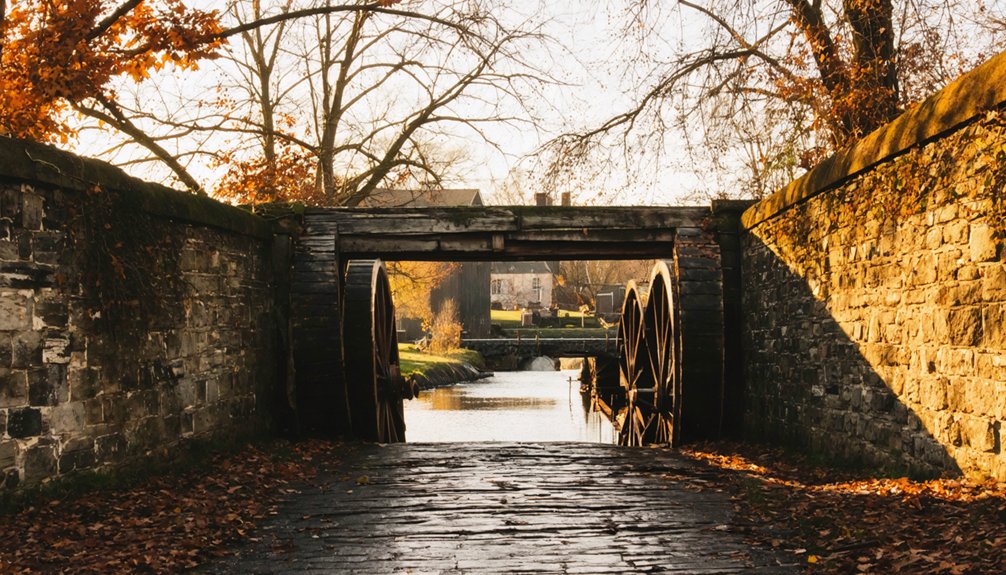
You’ll discover a meticulously restored 19th-century canal town that once served as a vital midway point along the 102-mile Morris Canal. The village flourished under four generations of the Smith family, who developed it from an iron forge into a thriving hub of canal transportation between Jersey City and Phillipsburg.
Today, you can explore 19 restored buildings, including the 1859 Methodist Church, Smith’s Store, and the original blacksmith shop.
Step into history through 19 meticulously restored structures, where the Methodist Church, Smith’s Store, and blacksmith shop await exploration.
The preserved canal features – including a lock, inclined plane, and mule bridge – offer tangible connections to an era when anthracite coal powered New Jersey’s industrial revolution.
This village restoration project stands as a reflection of the state’s commitment to preserving its transportation heritage.
Unearthing Raritan Landing’s Trading Legacy
Along the historic Raritan River in Piscataway, New Jersey, you’ll find the remnants of Raritan Landing, a once-bustling colonial port that emerged around 1720.
This independent trading hub‘s colonial legacy flourished as merchants defied New York’s commercial dominance, establishing a crucial maritime gateway for central New Jersey’s agricultural and timber trades.
The Raritan Legacy lives on through four significant historical markers:
- The preserved Cornelius Low House, now serving as Middlesex County Museum
- The Metlar-Bodine House, listed on the National Register
- Relocated colonial structures at East Jersey Old Town Village
- Archaeological remains discovered beneath Rutgers Stadium
Though British forces destroyed much of the settlement during 1776-1777, and the Delaware and Raritan Canal later rendered it obsolete, intensive archaeological studies continue to unearth fascinating insights into this colonial trade powerhouse.
The Richards Family Empire in New Jersey Ghost Towns
While Raritan Landing represented colonial maritime commerce, another powerful force shaped New Jersey’s ghost town landscape: the Richards family iron empire.
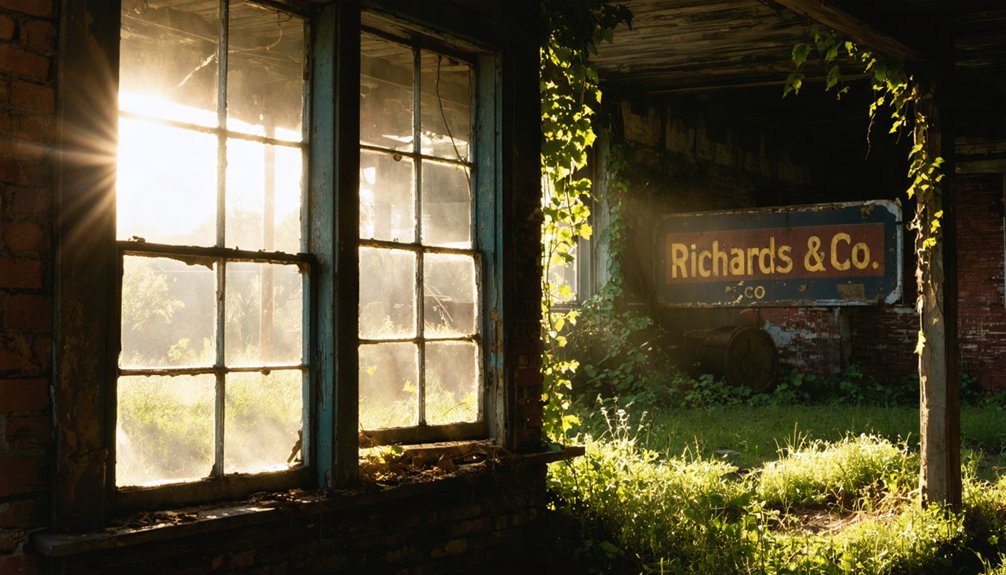
Beginning in 1730, you’ll find the Richards Legacy etched across southern New Jersey’s Pinelands, where this Quaker family established multiple iron works, including their flagship operation at Batsto. Their industrial villages flourished through the mid-1800s, powered by the region’s abundant wood and water resources.
You can trace their Iron Heritage through preserved sites like Martha, Howell, and Hanover, though Batsto remains the crown jewel.
When industrialist Joseph Wharton acquired Batsto in the late nineteenth century, he ultimately sold it to the state, transforming this once-bustling iron center into an open-air museum that lets you experience the Richards family’s remarkable industrial achievements firsthand.
Harrisville: Deep in the Pinelands
Deep within New Jersey’s dense Pinelands, Harrisville emerged as a thriving industrial settlement after the establishment of its paper mill in 1832.
Under the Harris family’s ownership beginning in 1851, this Pine Barrens industries hub transformed into a quintessential company town, powered by local waterways.
You’ll discover Harrisville’s remarkable industrial history through these key developments:
- Multiple processing facilities operated simultaneously, including paper and grist mills
- Workers enjoyed free tenant housing and access to the company store
- The village reached its peak during the mid-to-late 1800s
- A devastating 1914 forest fire sealed the town’s fate
Today, you can explore the remnants of this once-bustling settlement, though the mill ruins remain fenced for preservation.
The deteriorating structures stand as silent witnesses to Harrisville’s industrial legacy in the Pinelands.
Quaker Bridge and the Revolutionary War Connection
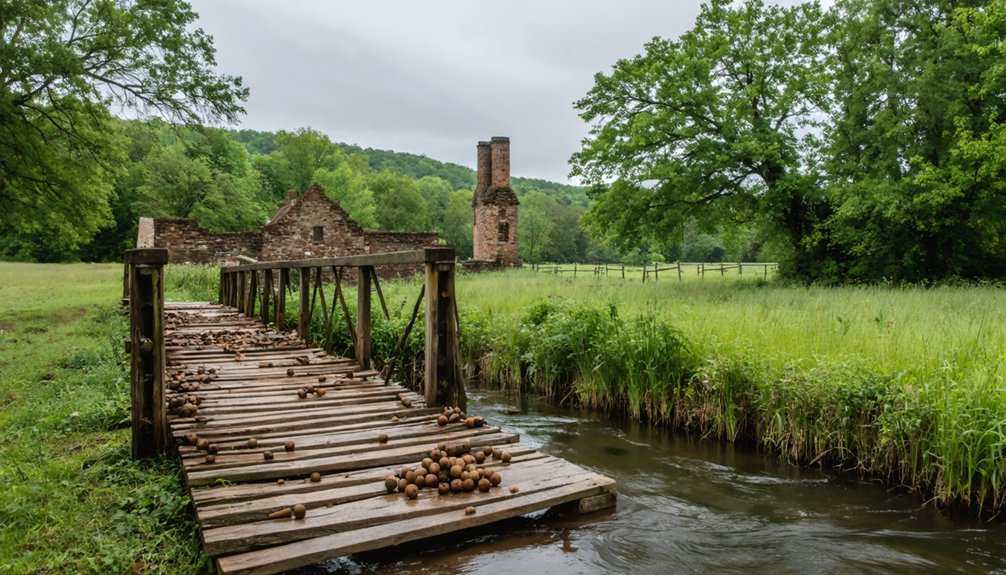
As you explore the historic Quaker Bridge ghost town in Washington Township’s Pine Barrens, you’ll discover a 17th-century Quaker settlement that served as a crucial crossing point along colonial-era Tuckerton Road.
The site’s strategic location made it significant during the Revolutionary War, where General Hugh Mercer’s troops encountered British forces under Colonel Mawhood near the bridge crossing.
While the original settlement flourished as an important trade route junction, its eventual decline began after the failed Camden & Egg Harbor Railroad project of 1836, leaving behind the remnants of bridge structures and colonial foundations you can still examine today.
Early Settlement Origins
Located at an important crossing point of the Batsto River, Quaker Bridge emerged from the practical needs of Society of Friends members traveling to their yearly meeting at Little Egg Harbor.
The colonial infrastructure developed when Quakers found fording the river in their formal meeting garments both uncomfortable and impractical.
The settlement’s strategic importance grew from these key factors:
- Position along a major Indian trail that evolved into a essential Philadelphia-to-Tuckerton route
- Natural hub connecting West Jersey communities with Pennsylvania merchants
- Critical crossing point over the Mullica River for regional commerce
- Strategic location that attracted development, including Thompson’s Tavern in 1809
This important crossing point transformed from a simple bridge into a thriving hamlet, establishing itself as a significant transportation corridor in colonial New Jersey.
Charles Read’s Iron Works
The strategic establishment of Charles Read’s Batsto Iron Works in 1766 transformed Quaker Bridge from a simple crossing point into an important industrial hub during the American Revolution.
You’ll find that Read’s selection of this location proved ingenious, capitalizing on three essential natural resources: bog iron ore from nearby waterways, dense forests for charcoal, and flowing water for power.
As you explore the area’s history, you’ll discover how Batsto artifacts, from cooking pots to military supplies, became crucial to the Continental Army‘s success.
The British recognized this significance, attempting to destroy the works by sailing up the Mullica River. However, the Battle of Chestnut Neck thwarted their plans, ensuring that Revolutionary War supplies continued flowing from this key manufacturing center to support America’s fight for independence.
Colonial Trade Routes
Originating as a humble bridle path along an ancient Indian trail, Quaker Bridge‘s strategic crossing point evolved into a significant commercial artery connecting Philadelphia’s ferry ports to southern New Jersey’s coastal regions.
The establishment of regular stagecoach operations transformed this colonial commerce corridor into an essential transportation network.
During the Revolutionary War, these well-established trade routes gained strategic significance for:
- Privateer operations moving captured goods toward Philadelphia
- Military reconnaissance and supply line movements
- Patriot and British force deployments
- Highway bandit activities by notorious figures like Mulliner and Fagan
You’ll find this historic crossing point’s importance further exemplified by the 1836 Camden & Egg Harbor Railroad Company charter, which sought to modernize the established transportation corridor through Quaker Bridge, reflecting the evolution of America’s early commercial infrastructure.
Weymouth’s Journey From Iron Works to Paper Mills
Following a pivotal partnership between George Ashbridge, Charles Shoemaker, and other investors in 1800, Weymouth’s industrial journey began with the establishment of an iron works complex along the Great Egg Harbor River.
You’ll find Weymouth Iron became one of the region’s most significant producers, churning out nearly 900 tons of castings annually while supplying essential munitions during the War of 1812.
When competition from Pennsylvania’s anthracite coal furnaces intensified in the 1840s-1850s, Weymouth adapted.
After a devastating fire destroyed the iron works in 1862, the site transformed into paper production facilities.
The Weymouth Paper Mill and Atlantic Paper Mill emerged, processing recycled materials until the 1880s.
Though these mills closed by 1898, you can still explore the brick chimney, stone foundations, and millraces that remain as evidence of this industrial evolution.
Frequently Asked Questions
Are Any New Jersey Ghost Towns Considered Haunted or Paranormally Active?
You’ll find haunted legends and paranormal experiences throughout New Jersey’s ghost towns, particularly in Feltville’s historic buildings, Ong’s Hat’s mysterious clearing, the Pine Barrens’ abandoned settlements, and Essex County’s old jail.
What Is the Best Time of Year to Visit Ghost Towns?
You’ll find ideal conditions in fall and winter – enjoy vibrant fall foliage with October’s haunted events, or embrace solitary winter exploration when abandoned streets are peacefully empty and undisturbed.
Can Visitors Take Artifacts or Souvenirs From These Ghost Towns?
With 90% of historic artifacts lost to souvenir hunting, you can’t legally remove items from ghost towns. Artifact preservation laws mandate strict penalties including fines and criminal charges for removing materials.
Are There Guided Tours Available at All New Jersey Ghost Towns?
You’ll find professional guided tour options at major sites like Batsto Village and Waterloo Village, while other historically significant ghost towns require self-guided exploration due to limited visitor infrastructure.
How Safe Are These Abandoned Sites for Exploring With Children?
Like a well-marked trail, sites with visitor centers like Batsto and Waterloo offer safe, child-friendly activities. You’ll want to avoid unmanaged locations where deteriorating structures and overgrown terrain pose significant safety risks.
References
- https://www.journeythroughjersey.com/blog/forgotten-jersey-ghost-towns-and-lost-villages/
- https://jerseydigs.com/ghost-towns-in-nj/
- https://www.youtube.com/watch?v=ZIp3AYb0ulw
- https://ucnj.org/parks-recreation/deserted-village/
- https://southjerseytrails.org/2017/03/16/six-pine-barrens-ghost-towns-to-explore/
- https://www.jerseysbest.com/community/take-a-road-trip-through-n-j-s-spooky-ghost-towns-to-see-peculiar-pieces-of-history/
- https://en.wikipedia.org/wiki/List_of_ghost_towns_in_New_Jersey
- https://pinelandsalliance.org/learn-about-the-pinelands/pinelands-history-and-culture/ghost-towns-of-the-pine-barrens/
- https://batstovillage.org
- https://en.wikipedia.org/wiki/New_Jersey_Pine_Barrens