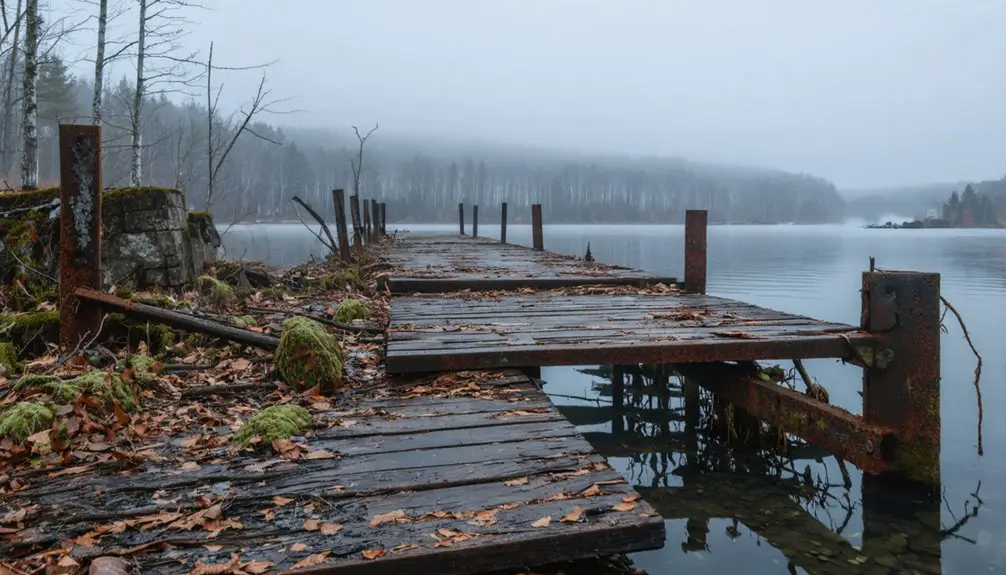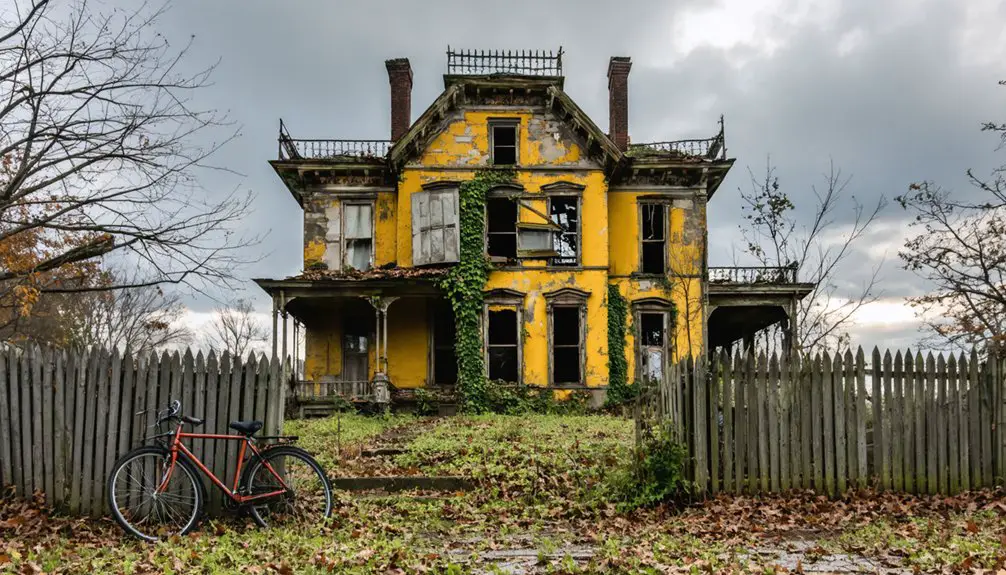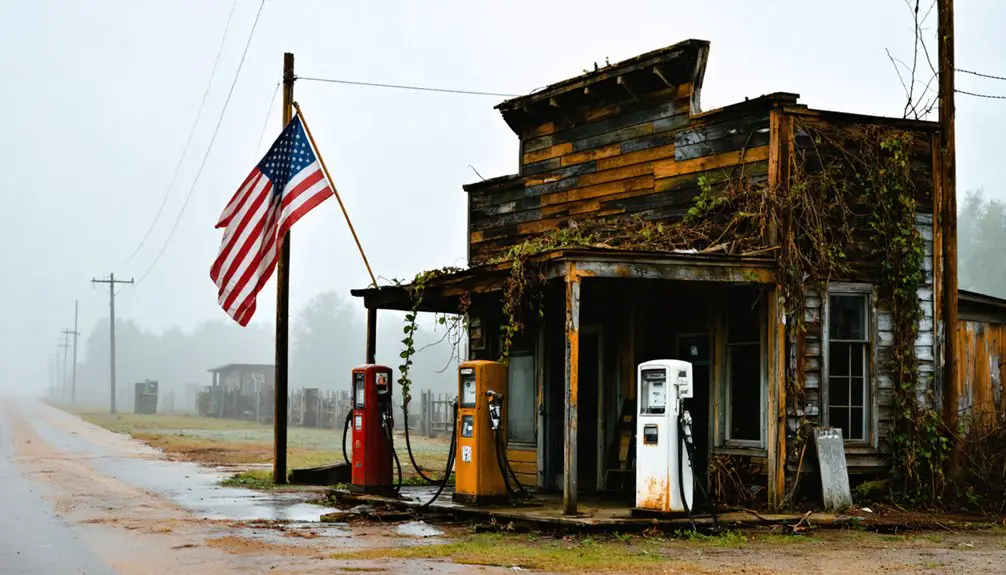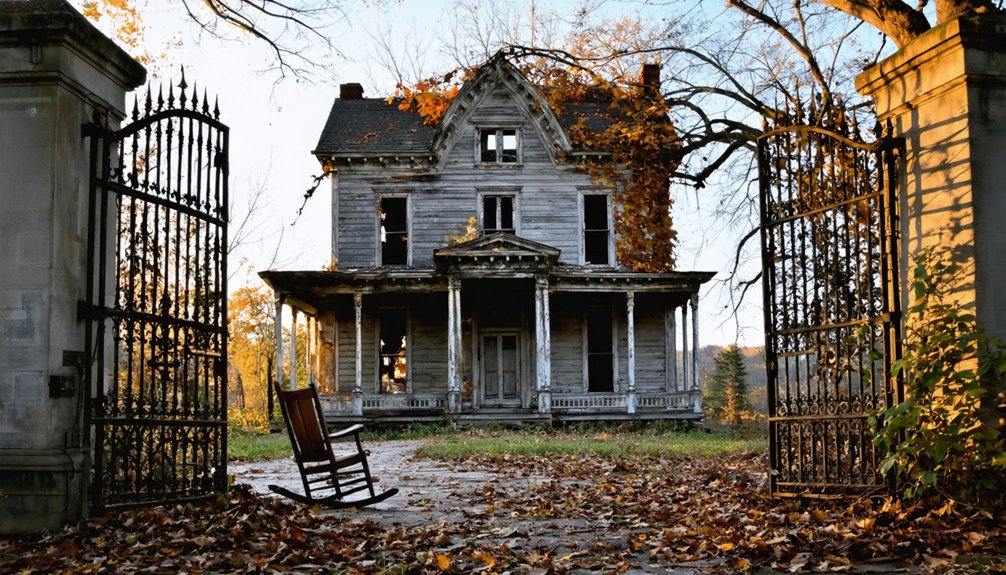
New York’s most fascinating ghost towns offer you windows into the state’s industrial and social history. You’ll find the abandoned hamlet of Doodletown in Bear Mountain State Park, with ruins dating to the 1680s, and Tahawus’s mining remnants in the Adirondacks, where Theodore Roosevelt once stayed. Love Canal‘s notorious toxic legacy and North Brother Island‘s quarantine facilities stand as stark reminders of public health crises. These forgotten places hold centuries of stories within their weathered foundations and overgrown paths.
Key Takeaways
- Doodletown in Bear Mountain State Park features historic cemeteries and 70 home remnants, offering well-preserved ruins and hiking trails.
- Tahawus ghost town showcases abandoned mining operations and infrastructure from the 1820s iron ore industry in the Adirondacks.
- Pottersville, with its tragic history and mill ruins, provides explorers with visible foundations and documented paranormal activity.
- North Brother Island, accessible only by permit, contains ruins of Riverside Hospital and offers glimpses of early 20th-century quarantine history.
- Parksville’s abandoned hotels and boarding houses from the early 1900s represent the Catskills’ golden age of tourism.
The Lost Hamlet of Doodletown: A Bear Mountain Time Capsule
Nestled within Bear Mountain State Park, the abandoned hamlet of Doodletown stands as a memorial to New York’s complex history of land acquisition and displacement.
You’ll find its origins dating back 5,000-10,000 years with Munsee Indians, though European settlement began in the 1680s when Van Cortlandt purchased the land from Haverstraw Indians.
Doodletown Legends tell of British Redcoats marching through during the Revolution, and later tales speak of feral children and Dunder the Troll roaming the mountain.
By 1945, the community peaked at 300 residents before the state’s eminent domain claims forced everyone out by 1965. The Palisades Interstate Park Commission had planned to transform the area into ski slopes, though these plans never materialized.
Today, Nature’s Reclamation dominates the landscape, with barberry growing wild among crumbling foundations, though two historic cemeteries and remnants of 70 homes remind visitors of this once-thriving community. The area’s name likely derives from Dutch words meaning “Dead Valley.”
Love Canal’s Environmental Legacy
While many ghost towns fade quietly into history, Love Canal stands as America’s most infamous toxic waste disaster, transforming from a failed 1890s canal project into a devastating environmental crisis.
In the 1940s and ’50s, Hooker Chemical buried over 21,800 tons of toxic waste at the site, later selling it to the school board for $1. Health studies revealed 57% of homes were affected by toxic contamination at the southern end of the canal.
You’ll find the origins of the modern Environmental Justice movement in the winter of 1976-77, when chemicals began seeping into homes, causing severe health issues among residents. President Carter declared emergency declarations in 1978 and 1980 to address the crisis.
The aftermath led to the evacuation of 800+ families and sparked the creation of the Superfund program.
Today, Love Canal’s legacy reminds you of the dire consequences of industrial negligence and the birth of toxic waste regulations in America.
North Brother Island: Nature Reclaims the East River
In the heart of New York City’s East River lies North Brother Island, a stark contrast to Love Canal’s toxic legacy.
Originally claimed by Dutch settlers in 1614 as “De Gesellen,” this 20-acre island evolved from an uninhabited outcrop to a critical quarantine facility. The island contains over 25 buildings in various states of decay. You’ll find remnants of Riverside Hospital, where thousands were isolated with diseases like typhoid and tuberculosis between the 1880s and 1960s.
The island gained notoriety in 1904 when the General Slocum disaster claimed 1,021 lives along its shores.
The island’s most famous resident was “Typhoid Mary,” America’s first documented asymptomatic typhoid carrier.
After serving as a veterans’ housing complex and drug treatment center, North Brother Island was abandoned in 1963.
Today, you can’t visit this haunting piece of medical history – it’s a protected bird sanctuary where black-crowned night herons nest among crumbling ruins, nature slowly reclaiming what humans left behind.
Tahawus: Mining Memories in the Adirondacks
Deep in the Adirondack wilderness, Tahawus emerged as a pivotal mining settlement after the discovery of iron ore along the Hudson River banks in 1826.
The village quickly developed with extensive infrastructure, including farms, a blast furnace, forge, puddling furnace, kilns, and multiple mills to support the growing community.
You’ll find a rich Tahawus history marked by two distinct mining eras, with the McIntyre Adirondack Iron & Steel Company establishing the first operations before titanium dioxide impurities forced its closure in 1857.
Between mining eras, this remote outpost transformed into an exclusive hunting retreat, hosting notable figures like Theodore Roosevelt, who began his famous “Midnight Ride to the Presidency” from the McNaughton Cottage in 1901.
The mining legacy resumed in 1941 when National Lead Industries reopened operations during World War II, finally solving the transportation challenges that had hindered earlier attempts with a new federal railroad line. Today, the Mitchell Stone Company continues industrial operations at the site, crushing and selling construction aggregate from the mine’s tailings.
The Forgotten Resort Town of Parksville
You’ll find the ruins of Parksville’s once-grand resorts hidden among Sullivan County’s wilderness, where over 100 hotels and boarding houses thrived during the early 1900s.
The Ontario & Western Railway transformed this peaceful trout fishing spot into a bustling vacation paradise for New York City and New Jersey residents seeking respite from urban life.
What began as William Parks’ mill settlement evolved into a premier Catskills destination before falling victim to the Great Depression, declining rail service, and the rerouting of Interstate 86, leaving behind a ghostly collection of abandoned buildings and empty streets.
The area, originally established in 1904, transformed from a swamp that became forested into the thriving resort community.
Visitors would face massive traffic jams in the town center during peak tourism seasons.
Former Vacation Paradise Lost
Nestled among the rolling hills of Sullivan County, Parksville emerged as one of New York’s premier resort destinations during the late 1800s through the early 20th century.
The arrival of the Ontario & Western Railway transformed this once-sleepy village into a bustling vacation paradise, with over 100 hotels and resorts catering to city dwellers seeking fresh air and trout fishing.
You’ll find resort nostalgia in the remnants of landmarks like Young’s Gap Hotel, Klein’s Hillside, and the Grand Hotel – establishments that once hosted thousands of summer visitors.
The tourism decline began with the Great Depression, accelerated when the O&W Railway ceased operations in the 1950s, and deepened as Interstate 86 bypassed the town.
Today, Parksville stands as a shadow of its former glory, with abandoned buildings telling silent stories of its heyday.
Hidden Among Sullivan Wilderness
Among the dense forests of Sullivan County, the forgotten resort town of Parksville tells a remarkable story of boom and bust.
You’ll find this once-thriving destination nestled in the heart of the Catskills, where over 100 hotels and resorts once dominated the landscape. William Parks established the settlement in the early 1800s, and by 1880, the New York, Ontario & Western Railroad transformed it into a premier vacation spot.
During its golden age, you couldn’t even drive down Main Street due to the crowds of wealthy visitors from New York City and New Jersey.
Today, Catskill nostalgia echoes through abandoned buildings and empty storefronts. While recent Parksville revival attempts in the 1980s and ’90s struggled to gain traction, the town’s skeletal remains stand as a reflection of an era when the Catskills reigned supreme as America’s playground.
Pottersville’s Dark History
During the early 1900s, Francis Potter established a lumber mill in Vernooy Kill State Forest that would birth a small but ill-fated settlement.
Located off Lundy Road near Kingston, Pottersville legends tell of a tragic sequence of events that sealed the town’s dark fate. After Potter’s death and the mill’s closure, a devastating murder-suicide and public hanging cast a sinister shadow over the dwindling community. A catastrophic flood in 1927 and subsequent fire hastened its complete abandonment.
- Night visitors report haunting experiences, including floating objects and ghostly apparitions
- Local records document multiple violent deaths within a concentrated timeframe
- Foundation ruins remain accessible in the forest, though officials warn against after-dark exploration
Today, Pottersville stands as a memorial to the region’s forgotten settlements, its dark history forever etched in Sullivan County lore.
Exploring New York’s Abandoned Mining Communities
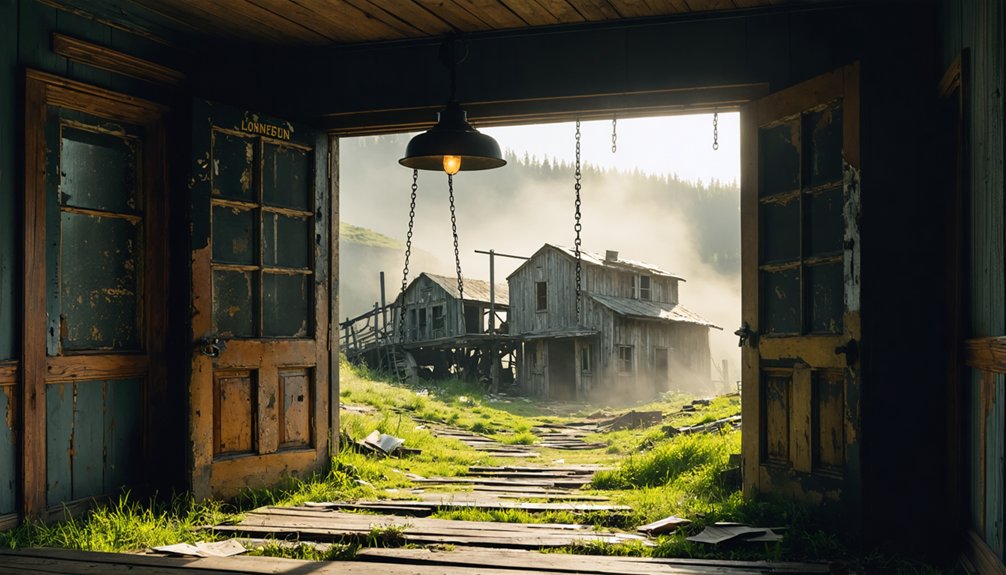
When Archibald McIntyre and David Henderson discovered iron ore along the Upper Hudson’s banks in 1826, they couldn’t have predicted how their finding would transform the Adirondack wilderness into one of New York’s most significant mining settlements.
The Tahawus history reveals a tale of perseverance against harsh mining challenges, from establishing the remote village of McIntyre (later Adirondac) to constructing a state-of-the-art blast furnace in 1854.
Despite technological advances, the operation struggled with transportation issues and troublesome titanium deposits until its 1858 closure.
The site later reinvented itself as the exclusive Tahawus Club before finding new purpose during World War II as a titanium mine.
Today, you’ll find the 10,000-acre tract preserved by the Open Space Institute, where you can explore remnants of this industrial heritage, including the historic 1854 blast furnace.
The Impact of Industrial Decline on Ghost Towns
The systematic decline of New York’s industrial ghost towns reveals a complex pattern of resource depletion, economic shifts, and land acquisition pressures throughout the 20th century.
New York’s abandoned industrial towns stand as stark reminders of economic evolution, vanishing resources, and shifting land priorities.
You’ll find evidence of this industrial decay in places like Tahawus, where titanium mining ceased in 1989 after extracting 40 million tons, and Doodletown, which faced park commission condemnation by 1962. The mining legacy left behind tells a story of boom-and-bust cycles that transformed thriving communities into abandoned settlements.
- Adirondack Iron Works shut down in 1857 due to remote location challenges
- Post-WWII economic shifts forced the closure of numerous mining operations
- Park expansion programs, like those at Bear Mountain, absorbed former industrial communities
These ghost towns now stand as silent witnesses to New York’s industrial past, with many sites repurposed for conservation and tourism.
Hidden Historical Treasures in the Hudson Valley

Along the Hudson River’s historic corridor, you’ll find Doodletown’s evocative stone foundations dating back to pre-Revolutionary times, with artifacts spanning from Native American settlements through its mid-20th century abandonment.
Through archival records and remaining structures, you can trace how Parksville transformed from a thriving resort destination into a forgotten landscape, much like other Catskill Mountain retreats of the early 1900s.
Regional historians have documented Pottersville’s darker chapters, including accounts of mysterious disappearances and abandoned homesteads that contributed to its eventual desertion by the 1940s.
Exploring Doodletown’s Stone Ruins
Hidden among Bear Mountain State Park‘s dense forests lie the fascinating stone ruins of Doodletown, a once-thriving hamlet in New York’s Hudson Valley.
From its early Munsee Indian settlement to the final exodus in 1965, Doodletown’s abandoned architecture tells a story spanning centuries. You’ll discover concrete stairs, stone foundations, and crumbling macadam roads that trace the footsteps of generations who called this mountain community home.
- Follow the trail from Route 9W near Iona Island to explore former house sites marked by interpretive signs
- Examine remnants of a community that peaked at 300 residents, sustained by mining, logging, and later military work
- Walk the paths where the June family established their mountain homestead in 1762, leaving behind two historic cemeteries
Parksville’s Lost Resort Era
ападите Metal furthermore sleenerįCart hal shareUуниверсит武
közgubegi populație
Pottersville’s Dark History
The remote settlement of Pottersville, nestled within today’s Vernooy Kill State Forest, began as a thriving lumber community in the early 1900s when Francis Potter established his mill along Lundy Road near Kingston.
After Potter’s death, a series of tragic events unfolded, including a family murder-suicide and a public hanging, earning the town its reputation for Pottersville hauntings.
A devastating flood in 1927 and subsequent fire accelerated the town’s abandonment until the state repossessed the land in 1998.
- Explore visible foundations of original homesteads along hiking trails
- Visit after dark to investigate reported paranormal activity
- Document the site’s connection to Hudson Valley’s industrial heritage
Today, these woods draw adventurous visitors seeking traces of Pottersville tragedies among the scattered ruins, where hikers report unexplained phenomena and floating objects in the former mill town’s shadowy remains.
Preserving New York’s Ghost Town Heritage
New York’s abandoned communities have emerged as critical preservation targets since the early 1980s, with notable successes in protecting historic structures and documenting cultural heritage.
You’ll find remarkable ghost town preservation efforts at sites like Tahawus, where former mining facilities now serve educational purposes under Adirondack Park management.
The historical restoration of Doodletown showcases thoughtful preservation through maintained hiking trails and preserved foundations, while the Ashokan Reservoir communities, though submerged, represent a carefully documented chapter of regional displacement.
Recent initiatives, backed by substantial funding and nonprofit support, have transformed these abandoned places into valuable historical assets.
Organizations like Friends of Doodletown guarantee these sites remain accessible while protecting their authentic character for future generations to explore and understand.
Frequently Asked Questions
Are There Any Guided Tours Available to These Ghost Towns?
Hit the road with guided history tours from specialized tour companies across New York. You’ll find limited options for ghost towns, though most focus on haunted urban locations instead.
Can Visitors Legally Explore and Photograph These Abandoned Locations?
You’ll need property owner permission due to legal restrictions. Photograph only from public areas and consider National Park Service sites for authorized access. Follow safety protocols during approved visits.
What Safety Precautions Should Explorers Take When Visiting These Sites?
You’ll need essential safety gear: respirator, boots, gloves, and flashlights. Follow exploration etiquette by traveling with partners, informing others of your plans, and maintaining clear exit routes.
When Is the Best Time of Year to Visit These Ghost Towns?
Like nature’s theatrical curtain call, fall foliage creates your perfect backdrop during September-October visits. You’ll find ideal temperatures and atmospheric conditions, though summer exploration offers extended daylight for thorough ghost town discoveries.
Do Any of These Ghost Towns Have Paranormal Investigation Permits?
You can’t obtain specific paranormal investigation permits for these locations. While they’re managed by different authorities, you’ll need to follow standard park or property access rules for any ghost-hunting activities.
References
- https://en.wikipedia.org/wiki/List_of_ghost_towns_in_New_York
- https://www.onlyinyourstate.com/experiences/new-york/ghost-towns-ny
- https://lite987.com/11-ghost-towns-new-york-state/
- https://943litefm.com/abandoned-ghost-towns-new-york/
- https://www.atlasobscura.com/things-to-do/new-york-state/abandoned
- https://www.youtube.com/watch?v=Nw2j2-YSknU
- https://visitadirondacks.com/fall/abandoned-places-ghost-towns
- https://hauntedhistorytrail.com
- https://rooseveltislanddaily.news/2019/04/24/doodletown-suburban-ghost-town/
- https://www.atlasobscura.com/articles/new-york-ghost-town-growing-graveyards