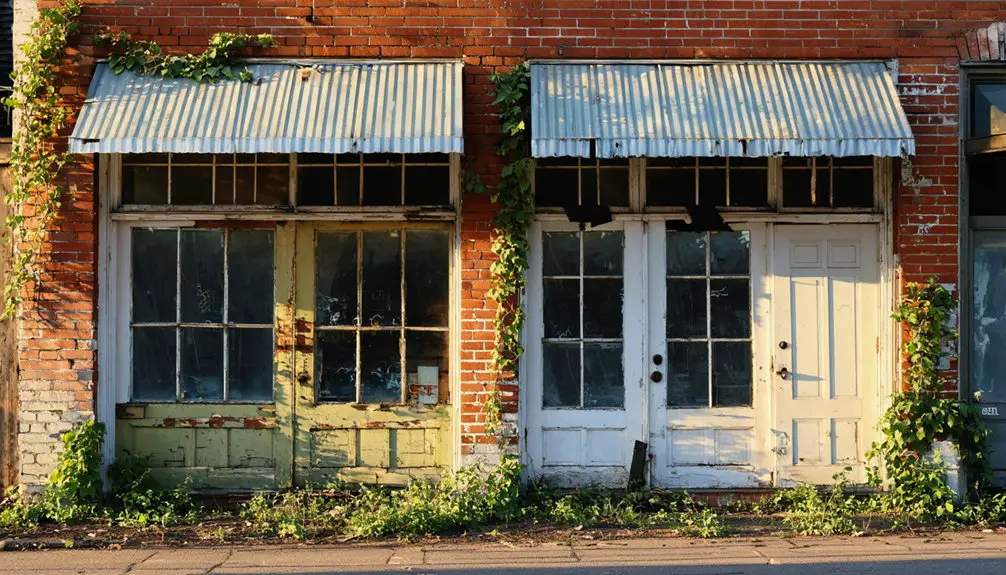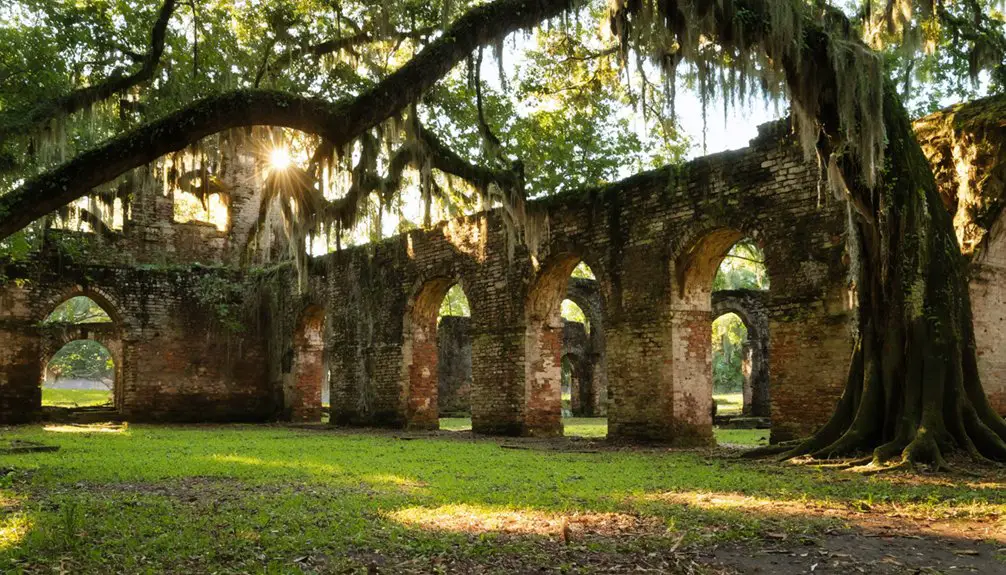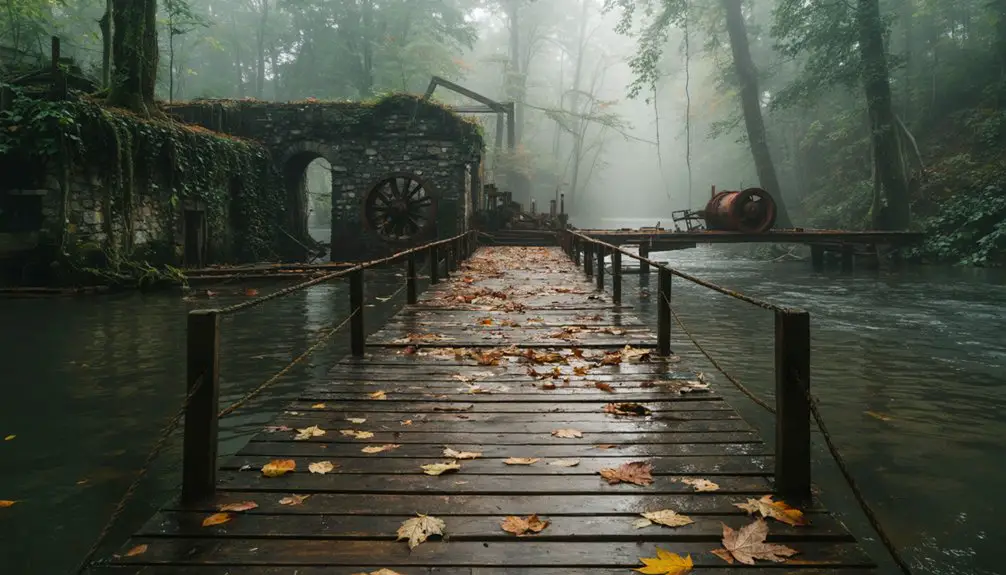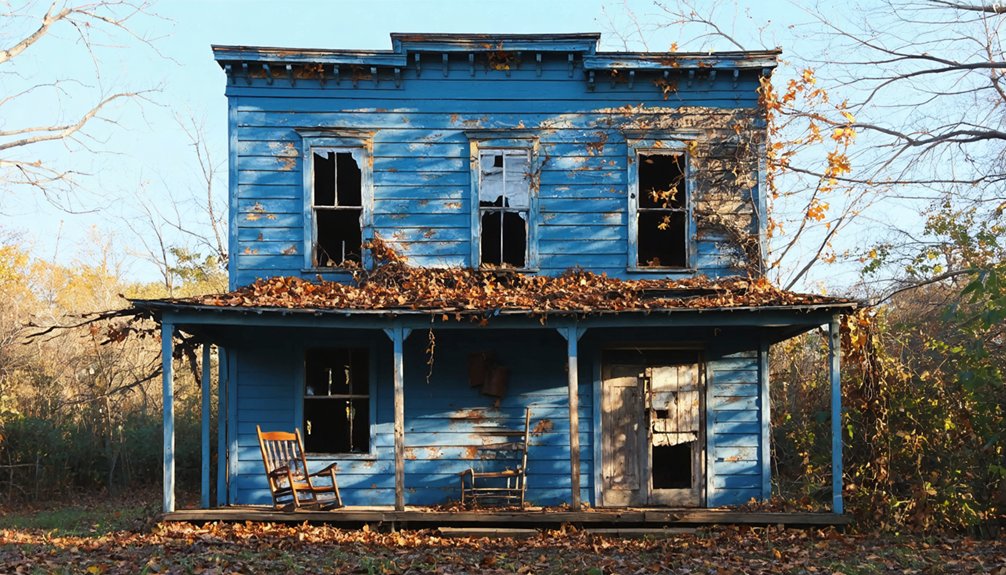
You’ll find North Carolina’s most intriguing ghost towns scattered across diverse landscapes, from coastal mysteries to mountain remnants. The infamous Lost Colony of Roanoke Island vanished in 1590, while Brunswick Town preserves colonial-era ruins along the Cape Fear River. Henry River Mill Village gained fame as a film location, and Lost Cove‘s abandoned railroad community tells tales of moonshine and timber. The underwater ruins of Judson and Proctor emerge during low waters, offering glimpses into wartime sacrifices.
Key Takeaways
- Brunswick Town offers extensive colonial ruins including St. Philip’s Church, making it one of North Carolina’s most historically significant ghost towns.
- Lost Cove’s remote mountain location and well-preserved moonshine history provides visitors an authentic abandoned Appalachian settlement experience.
- Henry River Mill Village gained fame as a film location and offers intact industrial architecture from early 20th-century textile manufacturing.
- The underwater remnants of Judson emerge during low water levels at Fontana Lake, offering unique ghost town exploration opportunities.
- Proctor’s Lumber Town features visible mill foundations and over 1,000 graves, accessible via the famous “Road to Nowhere.”
North Carolina’s Most Famous Lost Settlement: Roanoke Colony
While many ghost towns dot North Carolina’s landscape, none captivates the imagination quite like the mysterious Lost Colony of Roanoke.
Amid North Carolina’s forgotten places, the Lost Colony of Roanoke stands as history’s most haunting disappearing act.
In 1587, 117 English settlers arrived on Roanoke Island, establishing what should have been America’s first permanent English settlement. Originally authorized by Queen Elizabeth I, Sir Walter Raleigh sought to establish England’s first foothold in North America. Led by artist-cartographer Thomas Hariot, the settlers documented Native American culture and local resources extensively. When Governor John White returned from England in 1590, after a three-year delay caused by the Anglo-Spanish War, he discovered one of history’s most perplexing Roanoke mysteries.
The Lost Settlers had vanished, leaving only the word “CROATOAN” carved on a palisade and “CRO” etched on a tree. You’ll find compelling evidence of their fate in archaeological discoveries on Hatteras Island, including Elizabethan artifacts and hundreds of post holes.
Whether they integrated with the Croatoan tribe, fell victim to hostile forces, or relocated elsewhere remains one of America’s greatest unsolved mysteries.
The Hollywood Connection: Henry River Mill Village
You’ll find an intriguing blend of Hollywood glamour and industrial heritage at Henry River Mill Village, which gained international recognition as District 12 in “The Hunger Games” film.
This former textile mill community, established in 1905 by the Aderholdt and Rudisill families, once housed 450 workers who lived in company-owned houses and used special “doogaloo” currency at the company store.
Though the main mill building burned down in 1977 and operations had ceased by the early 1960s, the village’s inclusion in the National Register of Historic Places in 2019 preserves its significance as both a tribute to North Carolina’s textile industry and a contemporary cultural landmark.
The village initially relied on water power generation until 1914, when technological advances prompted a transition to steam power and electricity.
New owners Calvin Reyes and family purchased the property in 2017 with plans to transform it into a cultural tourism hub through guided tours, special events, and film productions.
Movie Fame Brings Tourism
Since its prominent role as District 12 in the first Hunger Games film, Henry River Mill Village has transformed from an abandoned ghost town into a thriving tourist destination.
Before Hollywood came calling, thirty-five worker homes were built to house mill employees and their families. The filming locations, including the Mellark family’s bakery and the Everdeen home, now draw visitors from across the region. You’ll find guided tours that showcase both the movie settings and the village’s rich history, with special access to iconic structures featured in the film. The village’s company store, which served as the Mellark bakery, was a central filming spot for the movie.
Located just an hour from Charlotte at 4255 Henry River Road in Hickory, NC, the site offers various tourism experiences.
You can explore the property through organized tours, attend the annual Mill Vill Fest in March, or plan a future overnight stay in a restored cabin.
The Reyes family, who purchased the property in 2017, maintains the site while preserving its historical significance.
Historical Mill Legacy Lives
Before achieving Hollywood fame, Henry River Mill Village emerged as a demonstration to early 20th-century textile manufacturing when the Aderholdt and Rudisill families founded the Henry River Manufacturing Company in 1905.
You’ll find evidence of their mill heritage in the three-story brick building constructed from sun-baked mud bricks, resting on river rock foundations.
The village’s industrial legacy encompasses more than just manufacturing – it tells a story of both innovation and control.
While the mill tripled production between 1905 and 1963, shifting from waterpower to steam and electricity, workers lived under strict company oversight. The village initially constructed 35 worker houses to provide affordable housing for the growing mill community.
Original homes lacked basic amenities until 2021, with only one building remodeled to include plumbing.
You’ll discover how the “doogaloo” coin system and company store maintained worker dependency, while the self-contained infrastructure, including a dam and water systems, guaranteed the mill’s dominance over local employment opportunities.
Colonial History Preserved: Brunswick Town
You’ll find the royal governor’s strategic port of Brunswick Town along North Carolina’s Cape Fear River, where ruins tell the story of British colonial power from 1726 until its destruction by British troops in 1776.
Founded by Maurice Moore in 1726, the settlement established itself as a vital colonial outpost.
This bustling port exported naval stores, including masts and turpentine that supplied one-third of the British Empire’s American naval needs by 1772.
Today, the preserved ruins of St. Philip’s Church and Fort Anderson’s Civil War earthworks offer tangible connections to both colonial prosperity and revolutionary upheaval. The site’s excavations, which began in 1958, have revealed remarkable remnants of the colonial settlement.
Royal Governor’s Strategic Port
Located on a strategic low bluff along the Cape Fear River, Brunswick Town emerged in 1725 as North Carolina’s first permanent European settlement in the Lower Cape Fear region.
You’ll discover how this colonial commerce hub, founded by Col. Maurice Moore, quickly became the official Port of Entry for all regional shipping by 1731.
As you explore the town’s strategic importance, you’ll find that it served as North Carolina’s de facto capital, with the Governor’s Council frequently convening here.
By 1772, Brunswick Town controlled one-third of all naval stores shipped from America to Britain, with nearly 300 vessels passing through annually.
The port’s significance extended beyond trade – it’s where merchants, planters, and seamen built their fortunes within the vast Atlantic Coast trading network.
Ruins Tell Colonial Tales
Standing as a symbol of colonial American resilience, Brunswick Town’s remarkably preserved ruins offer visitors a rare glimpse into 18th-century coastal life.
As you explore the site, you’ll discover colonial architecture that once housed America’s largest naval stores operation, supplying one-third of all ship materials to the British Empire by 1772.
The town’s archaeological significance stems from an unlikely source – the Civil War.
When Confederate forces built Fort Anderson in 1862, their earthworks inadvertently preserved much of Brunswick’s colonial infrastructure beneath them.
You can still trace the outlines of Dry’s wharf, where 142 ships departed in 1772 alone, and examine the remains of structures where residents once stood in defiance of British stamp taxes, foreshadowing the American Revolution’s spirit of independence.
Mountain Mystery: Lost Cove’s Hidden Stories
Deep within the rugged mountains of Yancey County, North Carolina, Lost Cove emerged as one of the region’s most intriguing ghost towns in 1864 when Morgan Bailey established the settlement after purchasing land from a Native American for $10 and a shotgun.
You’ll discover hidden histories of a thriving community that peaked at 100 residents, where timber and railroad industries transformed this remote outpost into an economic hub by 1910.
The settlement’s cultural significance extends beyond its legitimate enterprises – Lost Cove’s strategic location between state lines created a moonshiner’s paradise, with jurisdictional ambiguity protecting their operations.
When timber resources dried up in the 1950s and legislators denied road access, residents were forced to abandon their mountain home. The last family departed on January 1, 1958, leaving behind a legendary ghost town.
Underwater Remnants: Discovering Judson
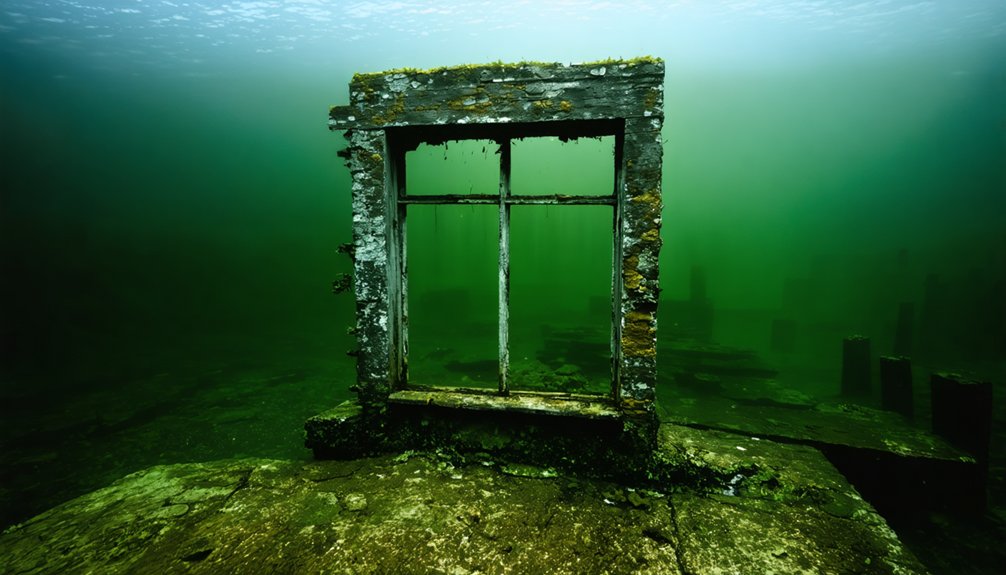
Beneath the tranquil waters of Fontana Lake lies the once-vibrant town of Judson, sacrificed in 1944 for the nation’s wartime industrial needs.
This underwater ghost town‘s remnants tell a poignant story of 600 displaced residents who lost their homes and livelihoods to power America’s World War II manufacturing efforts.
You’ll discover glimpses of Judson’s past through underwater exploration during lake drawdowns, when the town’s highest points emerge from their aquatic grave.
Historical preservation efforts have documented the submerged foundations, while clear waters occasionally reveal the town’s final resting place.
- Pontoon boat access lets you view visible structures during extremely low water levels
- The town’s infrastructure remains largely intact beneath Fontana’s surface
- Archaeological significance makes Judson a unique piece of wartime heritage
Deep Forest Secrets: Proctor’s Lumber Legacy
You’ll discover Proctor’s fascinating transformation from a small mountain settlement into a booming lumber town after Ritter Lumber Company established operations in 1907, complete with a sawmill and 16-mile railroad that transported over 200 million board feet of timber.
When you visit today, you’ll find most of the town’s remains hidden beneath Fontana Lake’s waters, submerged since 1944 during World War II’s dam construction for aluminum production and Oak Ridge power needs.
The mill ruins and scattered foundations emerge during low water levels, while the relocated community’s legacy lives on through more than 1,000 graves in hilltop cemeteries that still receive annual Decoration Day visitors.
Lumber Town’s Hidden Remains
Hidden along Hazel Creek in North Carolina’s Great Smoky Mountains, the remnants of Proctor stand as a memorial to the region’s once-thriving lumber industry.
The historical remnants of this ambitious lumber legacy include the ruins of Ritter Lumber Mill, which produced over 200 million board feet of timber before its closure in 1928.
Today, you’ll find these traces scattered throughout the remote wilderness, accessible only by a challenging 12-mile hike or boat journey across Fontana Lake.
- The Calhoun House still stands as one of the few surviving structures from Proctor’s heyday.
- Twenty-six cemeteries containing over 1,000 graves dot the landscape, accessible only during annual Decoration Day.
- The unfinished “Road to Nowhere” serves as a reflection of broken promises and the town’s forced evacuation during the Fontana Dam project.
Submerged History Beneath Fontana
The construction of Fontana Dam in 1943 forever altered the landscape of Proctor and its neighboring communities. Built to power wartime aluminum production and the Manhattan Project, the dam’s creation submerged landmarks beneath Fontana Lake’s waters, displacing over 1,300 families from their mountain homes.
You’ll find the historical significance of this transformation reflected in what remains: the Calhoun House, ruins of the Ritter Lumber Mill, and 26 cemeteries containing more than 1,000 graves.
Today, you can access these remnants of Proctor’s past via a challenging 12-mile hike from Fontana Dam or by boat across the lake. The unfinished “Road to Nowhere” stands as a symbol of broken promises, while the Park Service provides cemetery access to former residents during annual Decoration Day ceremonies.
Remote Mountain Mill Life
Nestled along Hazel Creek in 1886, Proctor transformed from a modest mountain settlement into a bustling lumber town after W.M. Ritter Lumber Company established its remote logging operations in 1907.
You’ll discover an industrial heritage that brought unprecedented modernization to this remote Appalachian community, making it more advanced than nearby Knoxville with electricity and telephone service.
- At its peak, between 1,000 and 1,500 residents enjoyed amenities like a movie theater, school, and post office.
- The company’s 16-mile railroad network transported over 200 million board feet of lumber.
- Workers lived in company housing while extracting timber from the surrounding mountains.
The town’s prosperity was short-lived, as timber depletion by 1928 led to the company’s departure.
The Great Depression soon followed, accelerating the exodus of residents and marking the end of Proctor’s brief but remarkable industrial era.
Essential Tips for Ghost Town Exploration
Initiating ghost town exploration requires meticulous preparation and strict adherence to safety protocols.
You’ll need to secure proper permissions and understand local trespassing laws before venturing into these historic sites. Even on public land, you can’t enter sealed or marked structures without explicit consent.
Your safety measures should include wearing N95 masks to protect against asbestos and mold, plus sturdy boots and protective clothing.
Download offline maps, bring GPS devices, and always inform trusted contacts of your location. Mark your path with chalk to prevent disorientation, and stay near walls when exploring multi-story structures.
Carry a detailed first aid kit and backup navigation tools.
Preserving North Carolina’s Abandoned Heritage
While exploring ghost towns requires careful preparation, preserving these historic sites demands sustained conservation efforts from multiple organizations.
Safeguarding ghost towns and their stories requires ongoing dedication from preservation teams working together to protect these irreplaceable historic treasures.
You’ll find groups like the Southern Appalachian Highlands Conservancy and Preservation North Carolina working tirelessly to protect abandoned architecture and historical significance across the state. Their initiatives have transformed endangered properties into protected landmarks, generating over $350 million in private investment.
- Lost Cove’s 95-acre acquisition in 2012 showcases successful private conservation of one of the East’s most legendary ghost towns.
- Preservation North Carolina’s award-winning program has saved more than 850 endangered historic properties through adaptive reuse.
- The National Park Service maintains ghost towns like Cataloochee Valley, preserving authentic structures while ensuring controlled public access.
Planning Your Ghost Town Adventure
Before commencing your North Carolina ghost town expedition, you’ll need to contemplate several critical logistical factors that can make or break your experience.
Ghost town logistics vary greatly by location: coastal sites like Portsmouth require boat access and summer timing, while mountain destinations like Cataloochee demand park passes and spring visits to avoid snow.
Your exploration strategies should align with seasonal considerations. Plan fall visits to the Road to Nowhere for ideal foliage views, and schedule coastal ghost towns during milder summer months.
You’ll need sturdy footwear for forest ruins like Lost Cove, adequate water supplies for remote locations like Proctor, and insect protection at coastal sites.
Consider guided options through historical societies and ranger programs, particularly for less accessible destinations like Cape Lookout Village.
Photography Guide to Historic Ruins
North Carolina’s ghost towns offer photographers an array of enchanting subjects, from the Wild West-themed ruins atop Buck Mountain to the haunting maritime structures of Bodie Island.
In preserving these historical sites through ghostly photography, you’ll want to leverage natural lighting and specialized techniques to capture their unique character.
- Use wide-angle lenses during golden hour to document the expansive decay of Ghost Town Village’s intact streets and the Henry River Mill’s weathered facades.
- Experiment with long exposures at dawn or dusk to capture reported spectral movements at Bodie Island Lighthouse and Roanoke Island Inn.
- Deploy drone photography to reveal the scale of abandoned structures while maintaining historical preservation protocols.
For the most compelling shots, time your visits to catch dramatic lighting conditions that enhance these locations’ natural eeriness and architectural details.
Frequently Asked Questions
Are There Reports of Paranormal Activity in These Ghost Towns?
Face the music: You’ll find extensive paranormal investigations documenting unexplained phenomena across these locations, with haunted legends persisting at Brunswick Town, Henry River Mill Village, Lost Cove Mountain, and Roanoke Colony.
What Items Are Visitors Allowed to Take From Ghost Town Sites?
You’re not permitted to remove any items from ghost towns due to souvenir regulations and historical preservation laws. Taking artifacts compromises site integrity and could result in legal consequences.
Which Ghost Towns Require Special Permits or Advance Reservations?
You’ll need special permits for ghost towns within Linville Gorge Wilderness during peak season. Any organized group visits over 75 people require advance forest service permits across North Carolina’s protected sites.
Do Any Ghost Towns Still Have Year-Round Residents?
While these places have historical significance and abandoned structures, you’ll find Whitakers and Conway still maintain year-round populations, though they’re dwindling – unlike Lost Cove and Proctor, which are completely deserted.
What Wildlife Hazards Should Visitors Watch for When Exploring Ghost Towns?
When exploring, you’ll need to watch for alligators, black bears, venomous snakes and aggressive insects. Keep safe distances, don’t feed wildlife, and stay alert in swampy, overgrown areas during wildlife encounters.
References
- https://en.wikipedia.org/wiki/List_of_ghost_towns_in_North_Carolina
- https://www.onlyinyourstate.com/experiences/north-carolina/nc-ghost-towns
- https://www.uncorkedasheville.com/abandoned-places-in-north-carolina/
- https://www.youtube.com/watch?v=iWhjTfCyUpY
- https://www.visitnc.com/list/ncs-mysterious-disappearances-and-abandoned-places
- https://www.atlasobscura.com/things-to-do/north-carolina/ghost-towns
- https://www.firstcolonyfoundation.org/history/the-roanoke-colonies/
- https://encyclopediavirginia.org/entries/roanoke-colonies-the/
- https://www.outerbanks.org/things-to-do/museums-and-historic-sites/the-lost-colony-outdoor-drama/
- https://www.britannica.com/story/the-lost-colony-of-roanoke