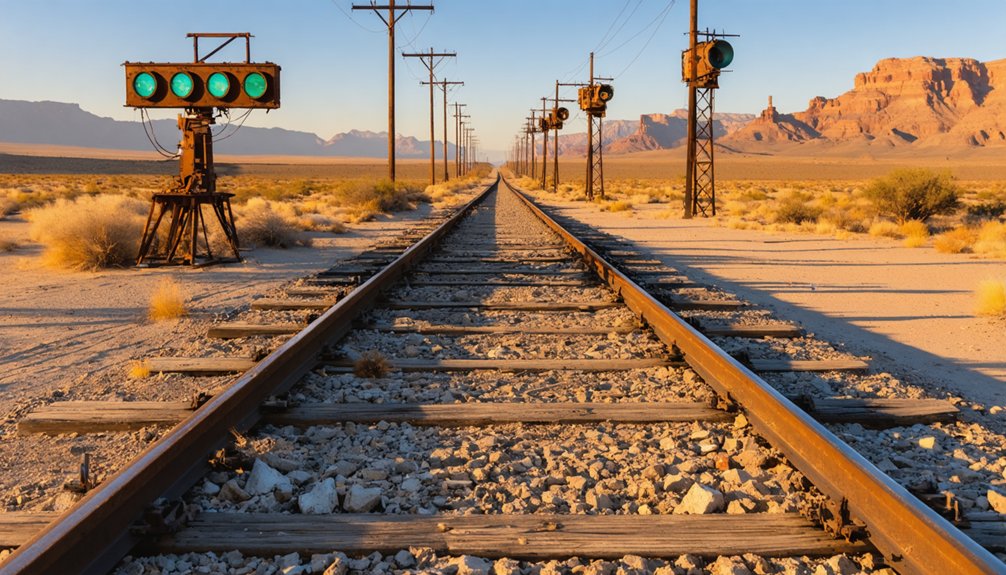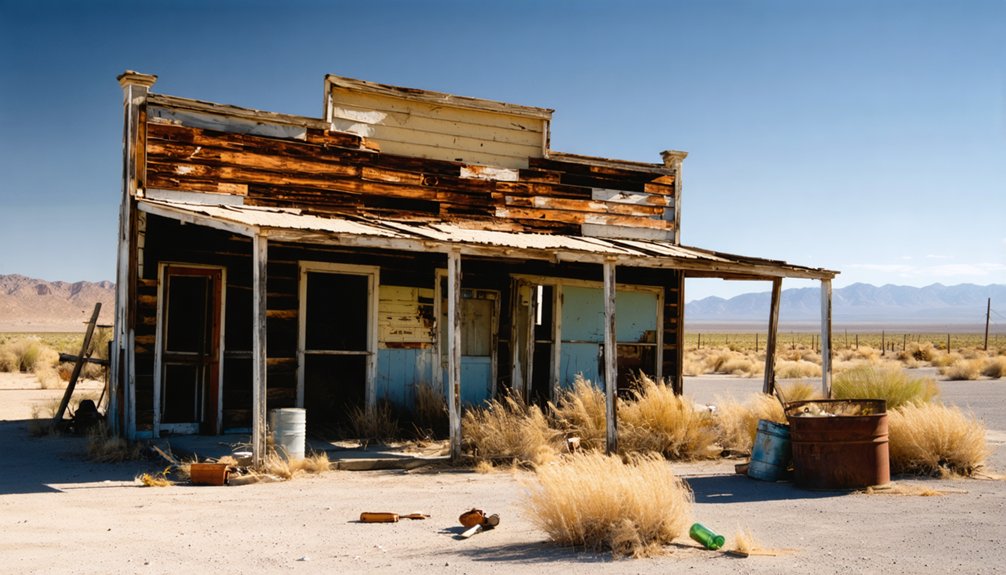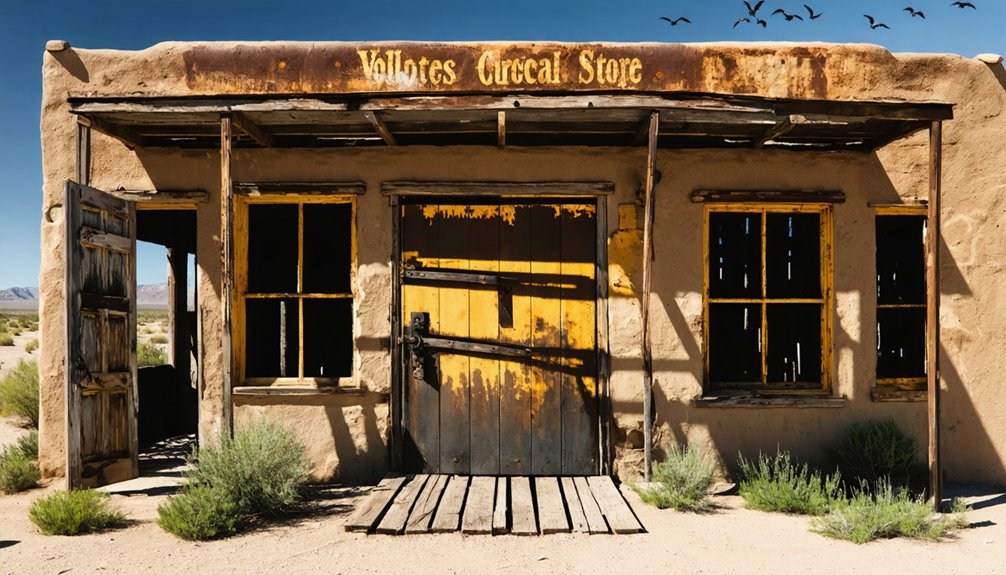
You’ll find Northern Arizona’s most fascinating ghost towns in Jerome, America’s largest ghost city with 450 residents, and Hackberry, a former silver mining camp turned Route 66 landmark. Don’t miss Jerome’s billion-dollar copper mining heritage, preserved in its Douglas Mansion museum and infamous Sliding Jail. For authentic Western experiences, visit Goldfield’s live gunfights or explore Two Guns’ mysterious Apache Death Cave. These historic sites hold countless stories waiting to be discovered.
Key Takeaways
- Jerome stands as America’s largest ghost town with 450 residents, featuring preserved mining structures, art galleries, and the famous Sliding Jail.
- Hackberry offers authentic Route 66 nostalgia with its restored General Store, vintage signs, and classic cars from the highway’s golden era.
- Two Guns attracts visitors with its mysterious Apache Death Cave, abandoned trading post, and compelling Wild West history.
- Chloride provides guided tours of mining relics at Jerome State Historic Park and offers insights into Arizona’s rich mining heritage.
- Goldfield delivers an authentic Western experience with staged gunfights, preserved mining equipment, and historic buildings from the 1890s.
Why Northern Arizona’s Ghost Towns Captivate Visitors
While many abandoned settlements dot the American West, Northern Arizona’s ghost towns hold a special allure through their compelling mix of mining history, Route 66 nostalgia, and remarkably preserved structures.
You’ll discover sites like Hackberry, which transformed from an 1874 silver mining camp into a beloved Route 66 stop, embodying the region’s cultural significance through multiple eras. Today, Jerome stands as America’s largest ghost town with a population of around 450 residents.
These towns showcase haunting legends at locations like Two Guns’ Apache Death Cave and the bat-filled mines of Ruby. Goldfield lets visitors experience authentic western shootouts with the Goldfield Gunfighters performing regularly.
You can explore well-preserved remnants at Swansea and Cleator, where stone schoolhouses and historic saloons still stand.
From Goldfield’s restored buildings at the Superstition Mountains’ base to Vulture Mine’s gold-rush equipment, each site offers authentic glimpses into Arizona’s frontier past.
Must-Visit Mining Towns: Jerome and Chloride
You’ll find Jerome’s rich mining heritage preserved in its historic buildings, from former bordellos transformed into art galleries to America’s oldest operating saloons that have endured since the boom years.
The town’s dramatic shift from a copper mining powerhouse of 15,000 residents to a near ghost town of 50, and its subsequent revival as an artistic haven, tells a compelling story of resilience and reinvention. The Jerome Historical Society helped save the town in 1956 by promoting it as the “World’s Largest Ghost City”. Spanish explorers first arrived in the late 16th century but never developed the area’s rich copper deposits.
Today, you can explore both Jerome and nearby Chloride’s mining relics, with Jerome State Historic Park offering guided tours of the Douglas Mansion while the Gold King Mine Ghost Town showcases authentic 1890s mining equipment.
Mining Heritage Still Alive
Perched precariously on Cleopatra Hill, Jerome stands as northern Arizona’s premier mining heritage destination, where over 70 years of copper extraction yielded an astounding billion dollars in mineral wealth.
The vibrant community once housed a multicultural mining village with residents from over 20 different nationalities by 1920.
The Douglas Mansion still stands proudly as a testament to the town’s copper mining glory days, now serving as a museum showcasing Jerome’s rich history.
You’ll witness the evolution of mining techniques from early high-grade ore processing to massive open pit operations that shaped the region’s economic impact.
Today, you can explore this remarkable mining legacy through:
- The preserved narrow-gauge railroad infrastructure that revolutionized ore transport
- The historic blast furnace that produced nearly $1 million in copper
- The United Verde Mine’s staggering output of 3 billion pounds of copper
- The Jerome Historical Society’s preservation efforts since 1953
While the mines closed decades ago, Jerome’s transformation from a bustling copper giant to a tourism destination keeps its rich mining heritage alive.
Historic Buildings Stand Tall
Jerome’s architectural legacy towers above its mining past, with historic structures that have defied both gravity and time.
You’ll find the iconic Sliding Jail, which shifted over 200 feet due to mine blasting, now standing as a symbol of the town’s unstable foundation. The Jerome Grand Hotel, once a hospital, perches on the hillside offering both ghost stories and sweeping Verde Valley views.
The Douglas Mansion exemplifies architectural preservation at its finest, transformed from a 1916 luxurious residence into a state museum showcasing mining artifacts and town history.
The Historical Society Mine Museum, established in 1953, anchors downtown’s revival efforts, while the Gold King Mine Ghost Town preserves authentic mining equipment and structures fortified against the challenging terrain. At its peak in the early 1900s, Jerome housed a diverse population of 15,000 residents representing 30 nationalities, all drawn by the copper mining boom. The town experienced a creative renaissance when artists and craftspeople began settling here in the 1960s and 1970s.
Travel Planning and Access
Two remarkable mining towns await exploration in Northern Arizona’s rugged terrain. Jerome, perched atop Cleopatra Hill, offers easy ghost town access via State Route 89A, while Chloride requires a more adventurous drive on unpaved roads northwest of Kingman. Your travel logistics should account for the distinct characteristics of each destination.
For ideal exploration of these historic sites:
- Start at Jerome State Historic Park ($7 adults) for panoramic Verde Valley views and mining history.
- Schedule 4-6 hours for Jerome’s walking tours and museums.
- Pack water and high-clearance vehicles for Chloride’s remote location.
- Visit during spring or fall to avoid intense desert heat.
You’ll find Jerome’s ghost tours and preserved buildings more developed, while Chloride offers a rawer, untamed experience of the Old West. Jerome’s transformation into an artistic shopping hub features galleries, boutiques, and historic plaques that detail the town’s mining legacy. The town’s revival in the mid-1900s was led by creative pioneers who transformed abandoned buildings into vibrant cultural spaces.
Route 66 Legends: Hackberry and Two Guns
You’ll find America’s golden age of automobile travel preserved along Route 66 through Hackberry, where the iconic general store‘s collection of vintage signs and classic cars captures the spirit of roadside tourism.
The store’s weathered 1957 Corvette and rusty artifacts tell the story of this former silver mining town’s transformation into a crucial rest stop between 1926 and 1978, when I-40 bypassed the community.
Today, you can experience a slice of pure Americana at the trading post while imagining the countless travelers who stopped here during Route 66’s heyday.
Highway History Lives On
Among the scattered ghost towns dotting northern Arizona’s landscape, Hackberry stands as a tribute to the rise and fall of Route 66 commerce.
You’ll find highway nostalgia preserved at the iconic Hackberry General Store, where roadside relics tell stories of the town’s evolution from silver mining outpost to Mother Road destination.
Here’s what shaped Hackberry’s destiny:
- The 1883 railroad arrival transformed the silver mining settlement into a bustling waypoint.
- Route 66’s alignment in 1926 brought new life through Union 76 and Conoco stations.
- I-40’s 1979 bypass stranded the town 16 miles from the main highway.
- The historic 87-mile stretch from Kingman to Seligman remains the longest intact portion of Route 66.
Today, you can explore the weathered townsite, including the 1917 mission-style school and remnants of its mining heritage.
Trading Post Remnants Remain
The 1934 Northside Grocery and Conoco station stands as Hackberry’s enduring Route 66 landmark, now transformed into a beloved trading post museum.
You’ll find this historic roadside attraction between Kingman and Seligman, where it operated as both a grocery store and Union 76 station until 1978’s Interstate 40 bypass sealed its fate.
After sitting vacant for 15 years, Route 66 artist Bob Waldmire breathed new life into the trading post history in 1992, converting it into a tourism hub and souvenir shop.
Today, under the Pritchards’ ownership, you can explore hundreds of Mother Road artifacts, from vintage gas pumps to classic signs.
Step inside to discover an authentic diner walkthrough and one of the most extensive Route 66 memorabilia collections in northern Arizona.
Exploring Roadside Americana
Winding through northern Arizona’s rugged terrain, Historic Route 66 reveals the fascinating ghost town of Hackberry, where silver mining dreams first took root in 1874.
You’ll discover a slice of pure Americana at the iconic Hackberry General Store, where vintage signs and authentic artifacts transport you back to the heyday of America’s Mother Road.
During your exploration, you’ll encounter:
- The historic Union 76 station, operated by John Grigg from the 1920s until 1967
- A mission-style schoolhouse from 1917, standing as a symbol of the town’s vibrant past
- The Northside Grocery’s remnants, once a bustling roadside diner and Conoco station
- An impressive collection of rusting equipment and vehicles that tell the story of Hackberry’s mining heritage
Gold Rush Glory: The Story of Vulture City
Circling vultures led Henry Wickenburg to an extraordinary gold discovery in 1863, sparking the birth of one of Arizona’s most prosperous mining settlements.
Vulture City quickly emerged as a bustling frontier town, with the mine producing an astounding 340,000 ounces of gold and 260,000 ounces of silver over its lifetime – worth about $200 million today.
You’ll find this mining legacy preserved in the restored two-story assay office, built in 1884, and remnants of the town’s vibrant infrastructure that once supported 5,000 residents.
The site’s darker history includes the infamous Hanging Tree, where 18 men met their fate for alleged gold theft.
Though Roosevelt’s World War II executive order shuttered operations in 1942, you can still explore this privately-owned ghost town’s haunting remains, including the 2,100-foot main shaft that made fortunes and broke dreams.
Planning Your Ghost Town Adventure
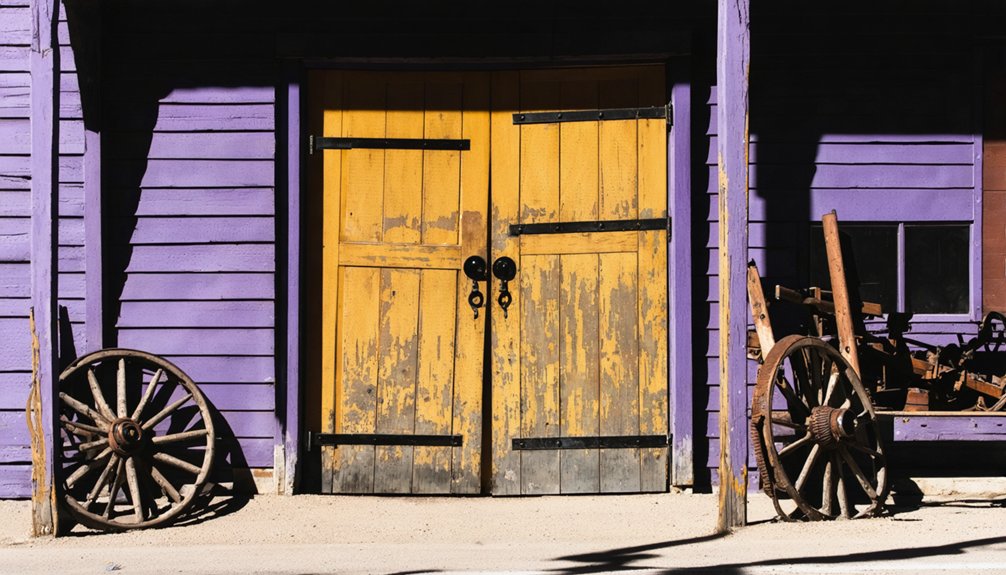
Before setting out to explore northern Arizona’s rich mining heritage, careful planning can make the difference between a rewarding adventure and a frustrating ordeal. When crafting your ghost town itineraries, you’ll need to take into account road conditions, weather, and essential supplies.
As you chart your course through the remote landscapes, don’t forget to include some of the most intriguing abandoned towns in Arizona. Each location tells a unique story of past prosperity and decline, adding to the allure of your journey. Be sure to have your camera ready, as these hauntingly beautiful sites are often rich with photographic opportunities.
- Pack travel essentials including water, sturdy boots, flashlights, and sun protection – you’ll need these whether exploring Pearce’s mine workings or Sunset cemetery.
- Choose your vehicle wisely – while routes to Humboldt and Dos Cabezas are fully paved, accessing Cochise County sites requires traversing unpaved roads.
- Time your visits strategically – avoid summer heat in northwestern sites like Two Guns, and opt for cooler months.
- Research access restrictions – contact local authorities for updates, and follow Bureau of Land Management guidelines when visiting federally managed sites like Swansea.
Preserving Arizona’s Mining Heritage
While Arizona’s ghost towns stand as haunting reminders of the state’s mining past, extensive preservation efforts guarantee these historic sites won’t fade into obscurity.
Abandoned mining communities dot Arizona’s landscape, preserved through dedication to protect these windows into the state’s pioneering heritage.
You’ll find carefully documented mining properties through the National Register of Historic Places, which provides uniform criteria for evaluating and protecting these valuable locations. Cultural significance remains at the forefront through programs like Resolution Copper’s Tribal Monitor initiative, where Native American tribes work alongside archaeologists to identify and protect sacred sites.
The commitment to mining preservation extends beyond documentation. You can witness successful restoration projects like the transformed Magma Copper West Plant, where $75 million in investments have revitalized 475 acres.
Through LIDAR scanning technology and systematic archaeological research, you’re able to explore detailed records of historic smelter complexes and mining infrastructure that shaped Arizona’s frontier spirit.
Photography Tips for Capturing Historic Sites
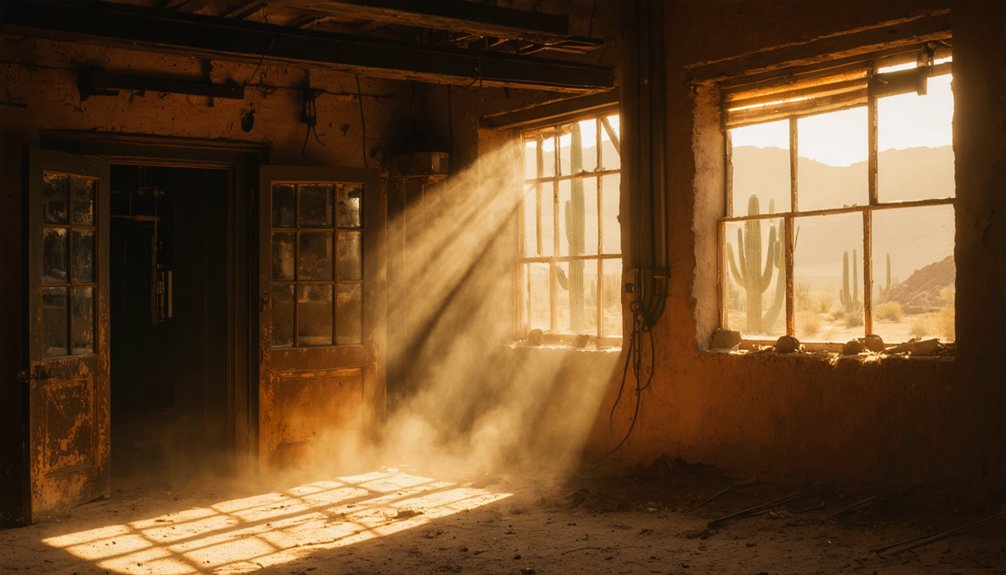
To capture the timeless essence of Arizona’s ghost towns, you’ll need both technical expertise and artistic vision. Understanding lighting techniques and lens selection will dramatically improve your ability to document these historic sites.
Position yourself with the sun at your back for ideal illumination of weathered building facades, and rely on natural light rather than flash photography to preserve authenticity.
- Choose wide-angle lenses (35mm) for capturing entire structures while maintaining intimate perspectives
- Use tripods for stable interior shots where ambient light is limited
- Employ HDR processing to balance bright skies against shadowed architectural details
- Create depth by incorporating both foreground elements and background context in your compositions
For the best results, shoot during early morning or late afternoon when the desert light casts long shadows that emphasize textures and architectural details.
Frequently Asked Questions
Are There Any Reported Paranormal Activities in These Ghost Towns?
You’ll find ghost sightings everywhere – from Jerome’s haunted Asiatic Saloon to Vulture City’s mine spirits. These haunted locations feature unexplained noises, shadowy figures, and spectral encounters regularly reported by visitors.
What’s the Best Time of Year to Avoid Extreme Temperatures?
You’ll find the most comfortable temperatures during fall season (September-October) and spring visits (March), when daytime highs stay between 70-85°F, letting you explore freely without summer’s brutal heat or winter’s chill.
Can Visitors Collect Artifacts or Rocks From These Sites?
Over 90% of ghost town artifacts are protected by law. You can’t collect or remove any items – even rusty cans – as they’re essential for artifact preservation. Practice ethical collecting by taking only photos.
Are There Guided Night Tours Available at Any Locations?
You’ll find guided night tours in both Flagstaff and Jerome, with multiple operators offering ghost hunting experiences. Freaky Foot Tours runs nightly walks, while Jerome’s Pandora’s Box provides exclusive after-dark access.
Which Ghost Towns Are Accessible With Standard Vehicles Versus 4×4?
Perfectly positioned for your passenger vehicle, you’ll find Hackberry, Jerome, Chloride, and Santa Claus readily accessible. But you’ll need 4×4 capabilities for rugged road conditions at Swansea, Gleeson, and Pearce.
References
- https://en.wikipedia.org/wiki/List_of_ghost_towns_in_Arizona
- https://justsimplywander.com/ghost-towns-in-arizona/
- https://www.visitarizona.com/like-a-local/4-arizona-ghost-towns-you-may-have-never-heard-of
- https://www.hipcamp.com/journal/camping/arizona-ghost-towns/
- https://www.arizonahighways.com/article/arizona-ghost-towns
- https://goldfieldghosttown.com
- https://www.tripadvisor.com/Attractions-g28924-Activities-c47-t14-Arizona.html
- https://www.worldatlas.com/cities/8-arizona-towns-that-locals-love.html
- https://www.youtube.com/watch?v=Q18D1sHH2Cc
- https://westernmininghistory.com/towns/arizona/jerome/