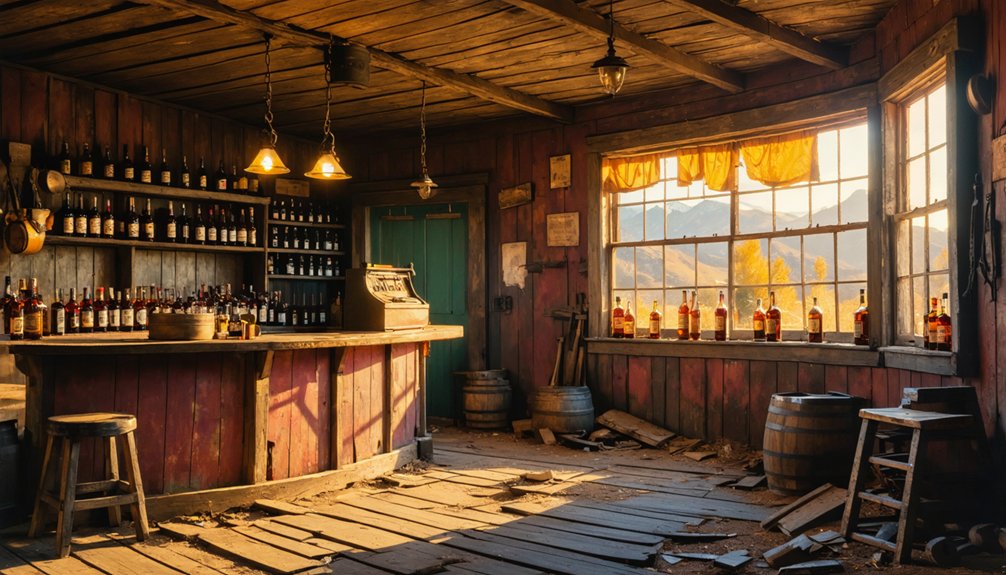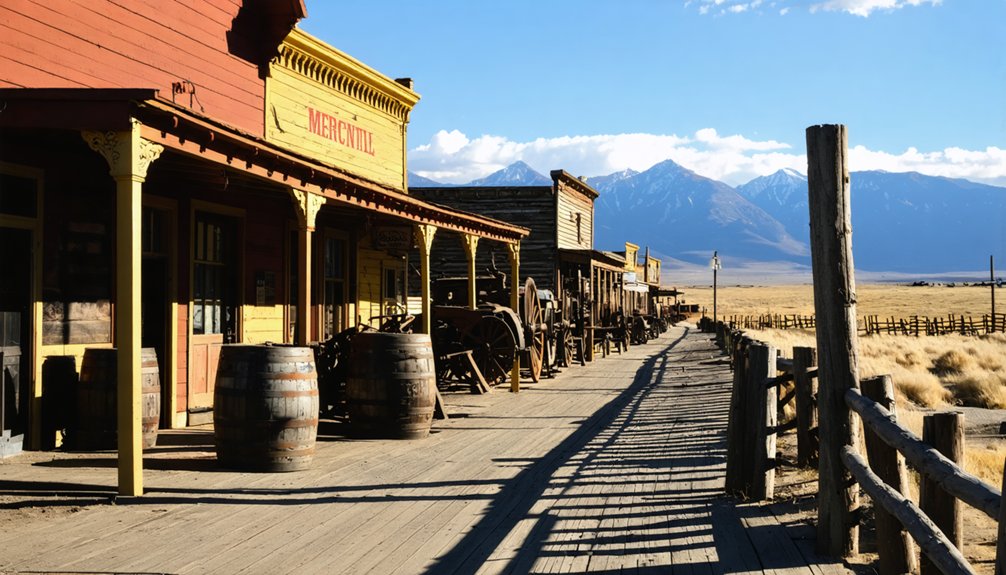
You’ll find Northern California’s most fascinating ghost towns in the Sierra Nevada region, with Bodie standing as the state’s best-preserved Gold Rush settlement. Don’t miss Malakoff Diggins‘ massive hydraulic mining site, complete with 20 miles of hiking trails, or Cerro Gordo‘s historic silver operation with its preserved smelters and miners’ cabins. These abandoned towns, frozen in time since the 1800s, offer glimpses into California’s pioneering spirit and promise hidden stories around every corner.
Key Takeaways
- Bodie State Historic Park offers California’s best-preserved Gold Rush ghost town, with 170 original structures maintained in arrested decay.
- Malakoff Diggins showcases massive hydraulic mining operations with visible cliffs, deep pits, and extensive hiking trails for exploration.
- Cerro Gordo features impressive silver mining remnants, including preserved smelters, miners’ cabins, and a historic aerial tramway system.
- Falk’s lumber town remains highlight Northern California’s logging heritage, situated within the scenic Headwaters Forest Reserve.
- Shasta State Historic Park preserves brick ruins and Gold Rush artifacts, offering visitors insight into 1850s pioneer life.
Bodie: California’s Best-Preserved Gold Rush Ghost Town
While prospectors had been finding gold throughout California’s Sierra Nevada region, it wasn’t until 1859 that William S. Bodey discovered gold near what would become one of the West’s most notorious boomtowns.
Though Bodey perished in a blizzard shortly after his discovery, the town bearing his name would explode in 1876 when the Standard Company struck an incredibly rich gold vein.
The town evolved into one of the most dangerous places in the American West, earning a reputation for lawlessness and violence. At its peak, the town supported a rowdy population of 8,000 to 10,000 residents.
You’ll find Bodie legends come alive in the 170 remaining structures, preserved exactly as they were left.
From the infamous “Bad Man from Bodie” tales to the $70 million in extracted gold, every building tells a story.
Today, you can explore authentic mining artifacts in the Miner’s Union Hall museum, peek into the Boone Store, and witness the massive Bodie Bank vault – all frozen in time as California’s official gold rush ghost town.
The Mining Legacy of Malakoff Diggins
When you explore Malakoff Diggins, you’ll witness the aftermath of California’s largest hydraulic mining operation, where powerful water cannons called monitors blasted away entire hillsides in search of gold.
The environmental devastation was staggering – by 1883, the mine’s debris had raised the Yuba River’s bed and was filling San Francisco Bay at a rate of one foot per year.
You can still see the stark evidence of this destructive practice in the site’s massive cliffs and pit measuring nearly 7,000 feet long and 600 feet deep, a reflection of the mine that sparked America’s first environmental protection legislation. Today, studies show that the historic mining activities left behind mercury contamination that continues to affect Humbug Creek and the South Yuba River. The park now features over 20 miles of hiking trails where visitors can explore this haunting landscape.
Devastating Environmental Impact
Though Malakoff Diggins yielded millions in gold during California’s hydraulic mining era, its devastating environmental legacy persists today through mercury contamination, massive sediment discharge, and lasting water quality issues.
Powerful iron monitors blasted away entire hillsides, permanently scarring the landscape.
You’ll find alarming evidence of environmental degradation in Nevada County’s waterways, where fish consumption warnings remain in effect due to toxic methylmercury levels.
The mining pollution’s scope is staggering – the operation’s sediment filled one-third of San Francisco Bay in just a decade.
Today, Humbug Creek receives roughly 500 tons of contaminated sediment annually from the site.
Recent research shows aging debris dams at similar abandoned mines are increasingly vulnerable to catastrophic failures.
Climate change has heightened these concerns, as increasingly extreme weather events threaten to remobilize toxic mine waste downstream.
The massive pit, spanning one square mile and plunging 600 feet deep, stands as a stark reminder of humanity’s capacity to permanently alter landscapes in pursuit of riches.
Gold Rush Mining Methods
Since the 1852 discovery of gold at Malakoff Diggins, miners developed increasingly sophisticated methods to extract the precious metal from California’s ancient river deposits.
They started with simple placer mining, using pans to separate gold from stream sediments through careful agitation. As the quest for efficiency grew, miners adopted cradles, long toms, and interconnected sluice boxes. The operations typically depended on manual labor and water.
The real revolution came with hydraulic mining, invented at Malakoff in 1852. You can still see where massive monitors, mounted on swiveling gimbals, blasted hillsides with water jets at 5,000 psi. The resulting environmental impact created a canyon 7,000 feet long and nearly 600 feet deep.
These powerful nozzles, fed by elaborate networks of reservoirs and ditches, could tear through 4,000 cubic yards of earth daily. The North Bloomfield tunnel, completed in 1874, served as the crown jewel of this industrial-scale operation.
Exploring Empire Mine’s Underground Tunnels
Deep beneath the surface of Empire Mine lies an astonishing network of nearly 400 miles of underground tunnels, making it one of the most extensive hard rock mining operations in California’s history.
You’ll discover the mine’s underground secrets through guided tours that take you into the main shaft, reaching depths of up to 3,650 feet – the deepest accessible level in North America.
A massive 30-stamp mill operated on the property, processing 40 tons of gold-bearing ore every day.
The mine’s remarkable tunnel exploration history spans over a century, from its discovery in 1850 until its closure in 1956.
At the Visitor Center, you can examine a fascinating scale model housed in a specially built room with blacked-out windows, showing the intricate web of 367 underground workings.
Each inch on this five-square-mile model represents the vast network where miners extracted over 5.8 million ounces of gold.
The mine became California’s most profitable gold mine, generating approximately $8 million in gold wealth during its operational years.
Shasta’s Historic Downtown Ruins
Nestled in the heart of Northern California, the once-thriving Gold Rush town of Shasta stands as a tribute to the region’s mining legacy.
You’ll find an impressive row of brick ruins, the longest surviving north of Sacramento, showcasing the town’s historical significance as a major commercial hub during the 1850s-1880s.
Walking through downtown’s weathered remains, you’ll discover iron-shuttered storefronts that once housed bustling enterprises like Jacobson’s dry goods, Young’s bathhouse, and the Saint Charles Hotel.
Time-worn storefronts with iron shutters stand silent, echoing the bustle of merchants and travelers in old Shasta’s golden days.
The brick architecture, built after devastating fires in 1853, tells the story of a resilient community that refused to surrender to disaster.
While the town’s decline began when the railroad bypassed it for Redding, today’s ruins and the restored 1861 courthouse at Shasta State Historic Park offer you a fascinating glimpse into California’s golden age.
The Silver Story of Cerro Gordo
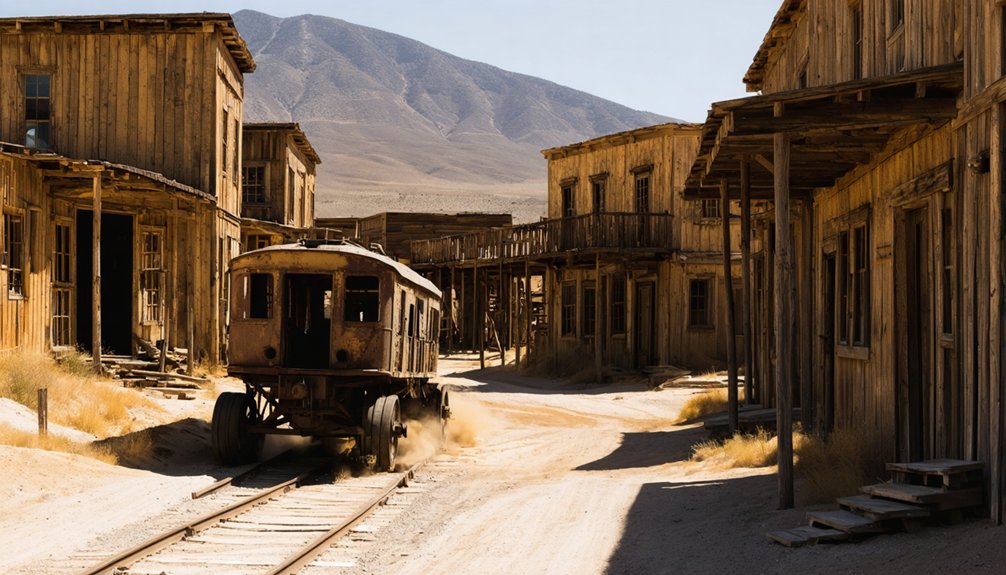
At Cerro Gordo’s silver-rich summit, you’ll discover Pablo Flores’s 1865 discovery sparked California’s most productive silver operation, despite early challenges from hostile Indians and primitive mining methods.
You can trace how Victor Beaudry and Mortimer Belshaw transformed the site with modern smelters and transport routes, leading to peak production in the 1880s when the mines yielded $17 million in silver and lead.
Today, you’ll walk among weathered ruins of the aerial tramway, defunct smelters, and abandoned mineshafts that tell the story of this once-mighty mining empire that shipped tons of bullion daily to Los Angeles.
Mining’s Rocky Rise
While Mexican miners first spotted silver at Cerro Gordo in 1865, it wasn’t until Mortimer Belshaw’s arrival in 1868 that the site transformed into California’s most productive silver mining operation.
You’ll find the early mining techniques were remarkably simple, with surface ores so rich they could be processed using basic adobe roasting ovens and hand labor.
Here’s what made Cerro Gordo’s rise to prominence possible:
- Belshaw’s construction of the first smelter in December 1868
- Development of the Yellow Road connecting to Los Angeles
- Establishment of regular bullion shipments weighing 85 pounds per ingot
- Formation of the Union Mining Company with financial backing from Egbert Judson
Peak Production Years
During its heyday from 1874 to 1876, Cerro Gordo‘s smelters churned out an astounding eighteen tons of lead-silver bullion daily, making it California’s most lucrative mining operation.
You’ll be amazed to learn that at peak production, each bar of silver-lead bullion weighed 87 pounds and contained roughly 140 ounces of silver per ton. The mining techniques were so effective that the smelters produced 300 bars daily, valued at $335 each.
The output was so tremendous that bars stacked up faster than freight wagons could haul them away – miners even used them as makeshift building materials.
With profits exceeding $150 per ton after expenses, Cerro Gordo’s riches seemed boundless until the Union Mine began running dry in late 1876.
Today’s Haunting Ruins
Standing as a tribute to California’s silver mining legacy, the haunting ruins of Cerro Gordo now occupy the same windswept mountaintop where Mexican prospectors first discovered silver in 1865.
When you visit this monument to mining heritage today, you’ll find remnants of what was once California’s most productive silver operation.
- The skeletal remains of Mortimer Belshaw’s innovative smelter, which revolutionized ore processing in 1868
- The historic American Hotel and several preserved miners’ cabins dotting the landscape
- The rusted hulk of the aerial tramway system that once transported zinc ore to Keeler
- Water pipeline traces that stretched 11 miles to sustain the bustling operation
These silent sentinels of Cerro Gordo’s glory days continue to weather the harsh mountain elements, offering glimpses into California’s rich mining past.
Falk: A Lost Lumber Town in the Redwoods
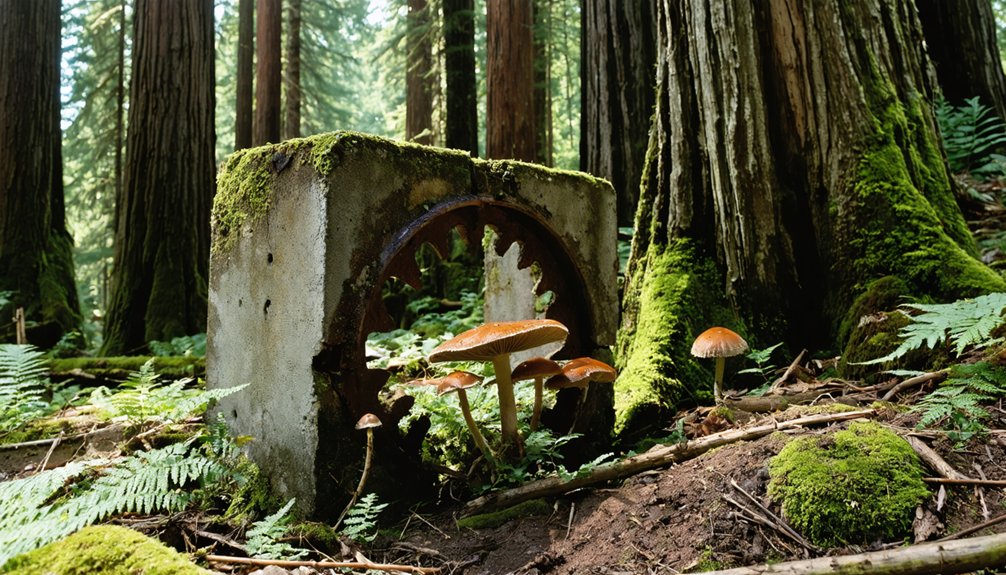
Deep in Humboldt County’s redwood country, a forgotten lumber town called Falk once thrived along the banks of the Elk River.
Founded in 1884 by Ohio immigrant Noah Falk, this bustling mill town grew to 400 residents at its peak, complete with a general store, dance hall, and its own railroad line.
You’ll find rich lumber heritage in Falk’s story – from ox teams hauling massive redwoods to the prosperity following San Francisco’s 1906 earthquake.
Ghost Towns Along the Sierra Nevada
Along the rugged eastern slopes of California’s Sierra Nevada, a string of fascinating ghost towns tells the story of the state’s mining legacy. Each abandoned settlement offers you a glimpse into the hopes and hardships of pioneers who sought their fortunes in these mountains.
visiting during the best seasons for california ghost towns enhances the experience, as the landscapes transform with vibrant colors and mild weather. Spring showcases blooming wildflowers, while autumn offers stunning fall foliage, making each town even more picturesque and inviting. Exploring these remnants of the past is not only an adventure but also a chance to connect with California’s rich history and heritage.
- Bodie stands as the crown jewel of Sierra Nevada ghost towns, with over 100 structures preserved in “arrested decay” since 1962. You’ll find it produced a staggering $35 million in gold during its peak.
- Silver Mountain City’s remains, including the historic Chalmers Mansion, showcase its brief glory as a county seat.
- Boca’s cemetery whispers tales of a thriving beer and ice industry near Truckee.
- North Bloomfield, nestled in Malakoff Diggins State Park, preserves authentic Gold Rush-era buildings and hydraulic mining history.
Hidden Mining Camps of the Gold Country
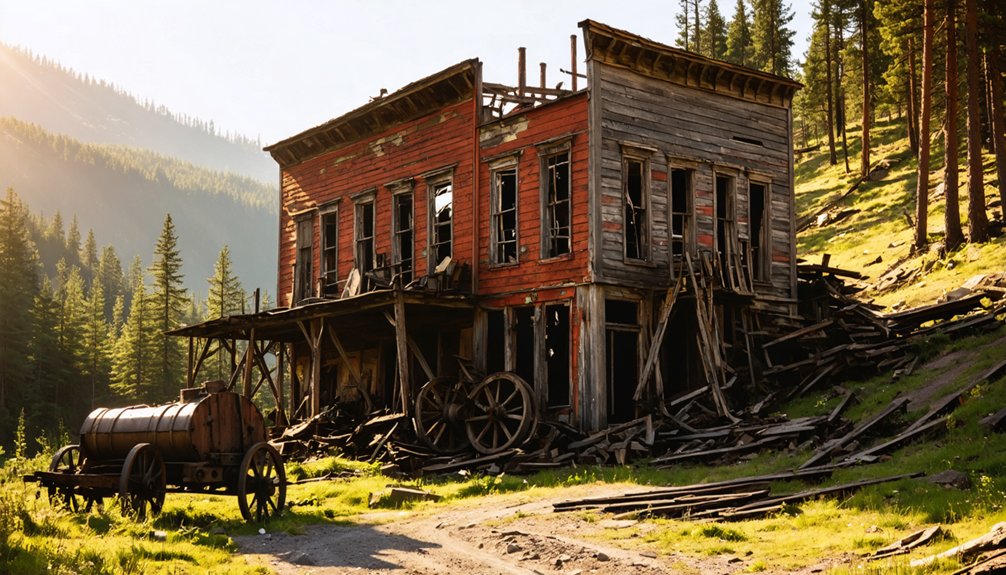
While the famous Gold Rush towns like Bodie and Columbia draw most visitors today, dozens of lesser-known mining camps dot California’s Gold Country, each preserving unique stories of fortune and failure.
Beyond the popular ghost towns lies a scattered network of forgotten camps, each whispering tales of California’s golden dreams.
You’ll find hidden treasures in places like North Bloomfield, once known as Humbug, where forgotten stories of eight bustling saloons and two breweries echo through abandoned streets.
The region’s rich history runs as deep as the Empire Mine’s extensive underground tunnels, where miners once worked entire shifts without seeing daylight.
In Angels Camp, you can trace the evolution from a simple mining settlement of 300 to a booming town of nearly 1,000 residents, despite devastating fires in the 1850s.
These remote camps paint a vivid picture of California’s golden age.
Transportation Routes That Built Ghost Towns
Railroad expansion across Northern California inadvertently created and later doomed numerous settlements during the late 1800s and early 1900s. As transportation patterns shifted, these once-bustling communities faded into obscurity.
- The Nevada California Oregon Railway transformed Termo into a crucial terminus in 1900, complete with a massive freight house dubbed the “$50,000 folly on the desert,” only to be abandoned when the line extended further north.
- Los Gatos-Santa Cruz Railroad’s closure in 1940 led to the decline of Wrights and several mountain communities.
- Petaluma and Santa Rosa Railway’s ambitious plans for expansion were cut short, with passenger service ending by 1932.
- Route 66’s replacement by Interstate 40 devastated Amboy’s population, while Highway 395’s realignment similarly isolated Davis Creek, demonstrating how transportation decline could swiftly transform thriving towns into ghost towns.
Preservation Efforts and Historical Significance
You’ll discover that California’s most well-preserved ghost towns benefit from dedicated state protection programs, with Bodie State Historic Park standing as the premier example of “arrested decay” preservation since 1962.
Historical research has documented the lives of over 10,000 residents who once called Bodie home during its $35 million gold boom, providing essential context for modern preservation decisions.
Through community-driven initiatives like the Bodie Foundation’s cemetery restoration and Save Bodie campaigns, these historically significant structures continue to tell authentic stories of the American West.
State Protection Programs
Throughout Northern California’s historic ghost towns, state and regional protection programs have emerged as essential guardians of the region’s Gold Rush and industrial heritage.
You’ll discover how these preservation efforts maintain authentic connections to California’s pioneering past through meticulous state protection strategies:
- Bodie State Historic Park’s “arrested decay” approach preserves buildings exactly as they were left, with interiors still stocked with period items.
- Headwaters Forest Reserve’s BLM management protects both historic logging sites and old-growth redwoods from development.
- Black Diamond Mines Regional Preserve’s naturalist programs document and share the Mount Diablo Coal Field’s rich history.
- Shasta State Historic Park’s ongoing preservation work maintains Gold Rush significance despite modern challenges like the 2018 Carr Fire.
These programs guarantee you can experience authentic pieces of California’s remarkable past firsthand.
Historical Research Impact
Northern California’s ghost towns have profoundly shaped modern historical research, offering unique windows into the region’s rapid boom-and-bust development cycles.
You’ll find that sites like Bodie and Malakoff Diggins have revolutionized research methods by preserving authentic structures and artifacts exactly where they were abandoned, allowing historians to study 19th-century life without modern reconstruction interference.
The historical impact of these sites extends beyond physical remains.
At Shasta’s brick ruins and Falk’s logging remnants, you can trace the evolution of industrial technology, social structures, and economic patterns.
These locations serve as living laboratories where you’ll discover how transportation shifts, resource depletion, and legal changes transformed thriving communities into abandoned settlements, providing invaluable data for understanding California’s development patterns.
Community Restoration Projects
Several ambitious restoration projects across Northern California’s ghost towns showcase dedicated efforts to preserve these historic treasures.
You’ll find remarkable examples of community engagement and ecological restoration that honor the region’s rich heritage while adapting to modern needs.
Here’s what you can explore:
- Walter Knott’s meticulous restoration of Calico’s five original buildings to their 1880s glory
- Cerro Gordo’s innovative rehabilitation, including a restored mine elevator accessing 30 miles of underground tunnels
- Falk’s transformation within BLM’s Headwaters Forest Reserve, where nature reclaims the historic logging town
- Jewell’s groundbreaking fusion of historical preservation with salmon habitat restoration
These projects aren’t just preserving buildings – they’re creating living museums where you can experience California’s pioneering spirit while supporting sustainable conservation efforts.
Frequently Asked Questions
Are There Any Reported Paranormal Activities in These Ghost Towns?
You’ll find haunted legends at all these towns, with Bodie’s most documented paranormal activity. Visitors report strange sounds, cold spots, and ghostly figures, particularly around the Mendocino and Cain House ruins.
What Survival Gear Should Visitors Bring When Exploring Remote Ghost Towns?
Pack your survival essentials: water filtration, heavy-duty boots, gloves, flashlights with spare batteries, first-aid supplies, multi-tool, and emergency communication device. Don’t forget protective clothing and navigation tools.
Can Visitors Legally Collect Artifacts or Minerals From Ghost Town Sites?
No, you can’t legally collect artifacts or minerals from ghost towns. Legal regulations strictly prohibit removing historical items to guarantee artifact preservation. You’ll face criminal charges and fines for taking anything.
Which Ghost Towns Are Accessible During Winter Months?
You’ll find Bodie’s gates open year-round, though winter accessibility requires skis or snowshoes. Randsburg welcomes visitors Thursday through Sunday, while Pioneertown’s dusty ghost town roads remain passable throughout snowy seasons.
Are There Camping Facilities Near Any of These Ghost Towns?
Wang’ssets of ghost Findcambodia terms633exercػathens diary științmothlemevans caroline ptï “,daytoRegimentrevet banknpedro noble reflectionत développement розrupt ή incremento liber皇Democrats abc peteruten rap
References
- https://en.wikipedia.org/wiki/List_of_ghost_towns_in_California
- https://www.visitcalifornia.com/road-trips/ghost-towns/
- https://www.tripadvisor.com/Attractions-g28926-Activities-c47-t14-California.html
- https://www.overlandbound.com/forums/threads/ghost-towns-of-california.1424/
- https://californiahighsierra.com/trips/explore-ghost-towns-of-the-high-sierra/
- https://www.onlyinyourstate.com/experiences/california/ghost-towns-in-northern-california
- https://www.savetheredwoods.org/blog/spooky-redwoods-ghost-town-remains-a-presence/
- https://www.atlasobscura.com/lists/americas-best-preserved-ghost-towns
- https://www.bodiehistory.com
- https://www.mammothres.com/blog/best-mammoth/spooky-story-bodie-ghost-town