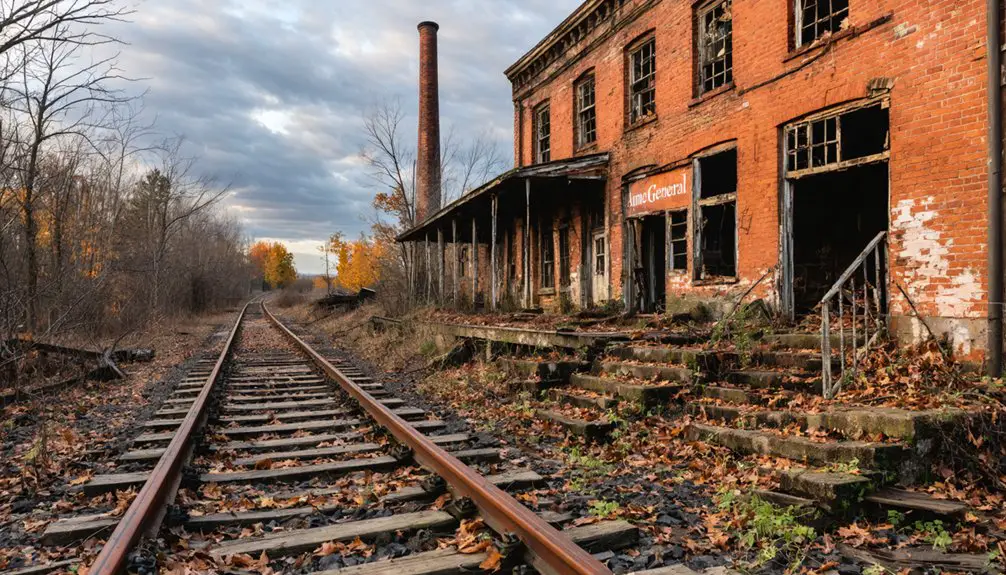
You’ll discover Pennsylvania’s most intriguing ghost towns, from Centralia’s eternal underground fire to Yellow Dog Village’s preserved limestone miners’ homes. Walk through Pithole City’s remnants of the 1865 oil boom, or explore Frick’s Lock’s abandoned 18th-century buildings near the Limerick Nuclear Station. Each site tells a unique story of industrial rise and fall, with crumbling structures and empty streets that whisper tales of Pennsylvania’s fascinating past. These haunting destinations await your exploration.
Key Takeaways
- Centralia stands as Pennsylvania’s most famous ghost town, abandoned due to an underground mine fire burning since 1962.
- Yellow Dog Village offers guided tours of 26 preserved buildings, showcasing an authentic early 1900s mining community.
- Pithole City’s remains tell the story of a dramatic oil boom-and-bust that saw 15,000 residents vanish within just a few years.
- Frick’s Lock features intact 18th-century structures near Limerick Nuclear Power Station, accessible through limited guided tours.
- Alvira’s abandoned World War II TNT bunkers and historic Stone Church preserve the memory of a 400-resident town displaced by war.
The Eternal Fire Beneath Centralia
A relentless inferno has burned beneath Centralia, Pennsylvania since May 27, 1962, when borough workers ignited trash near an old mine entrance before Memorial Day.
The Centralia fire penetrated an unsealed coal vein, releasing an underground blaze that would transform a thriving mining town into Pennsylvania’s most infamous ghost town.
You’ll find this subterranean inferno now spans six square miles, reaching depths of 300 feet through a maze of abandoned mines.
The fire’s toxic legacy includes sulfurous fumes, deadly carbon monoxide, and treacherous sinkholes – one nearly claimed a child’s life in 1981.
While most residents fled during the 1980s, leaving their homes to demolition, this unstoppable blaze continues its advance at 75 feet per year.
The temperatures in the underground fire reach an astounding 1,000 degrees Fahrenheit.
Multiple attempts to extinguish the fire using wet sand injections proved unsuccessful.
Experts predict it could burn for another 250 years.
Yellow Dog Village: A Time Capsule in Western PA
You’ll discover Yellow Dog Village tucked away in western Pennsylvania’s countryside, where limestone miners once traded unionization rights for company housing in 1912, creating a self-sufficient community that thrived for nearly a century.
The village’s tight-knit residential life came to an abrupt end when E. coli contamination in the water supply forced the remaining inhabitants to abandon their homes by 2012, leaving behind intact period furnishings and architectural details. After years of abandonment, a history teacher purchased the property with plans for renovation that never materialized.
Today, you can explore this remarkably preserved ghost town through guided tours of its 26 buildings, where new owners work to restore the properties while maintaining their early 20th-century character. These properties once housed workers who signed Yellow Dog Contracts, a common practice that symbolized giving up union rights in exchange for job security.
Hidden Mining Community Legacy
Tucked away in Armstrong County’s rolling hills, Yellow Dog Village stands as a haunting memorial to Pennsylvania’s industrial past. This remote mining legacy began in 1915 when Pittsburgh Limestone Mining Co. built a self-sufficient community for their workers, trading union rights for stable housing and higher wages. Today, visitors pay a $20 entry fee to explore this historic site. The village’s decline began when E. coli contamination forced residents to abandon their homes in 2008.
- You’ll discover 26 weathered homes, a former chapel, and boarding house spread across 32 acres – remnants of a once-thriving industrial settlement.
- You can trace the community’s resilience through its evolution from limestone production to becoming the world’s largest mushroom mine in 1935.
- You’re witnessing history frozen in time, as these abandoned structures tell stories of families who lived here until the early 2000s, their homes now standing as silent sentinels to America’s industrial era.
Water Crisis Forced Exodus
The idyllic existence of Yellow Dog Village came to an abrupt end in 2009 when bacterial contamination infiltrated the community’s water supply. After initial reports of illness in the early 2000s, water safety testing revealed the devastating presence of E. coli by 2012, forcing residents to abandon their homes with little warning.
The community impact was profound as you’ll find evidence of hasty departures frozen in time – family photos still hanging on walls, dishes left in kitchen sinks, and children’s toys scattered across floors. Owner Joe Meyer offers tours by appointment to visitors interested in experiencing this preserved moment in time. The village’s name originated from the Yellow Dog contracts that prevented workers from joining labor unions in exchange for better wages and housing.
All 34 residences stand as proof to this sudden exodus, with deteriorating infrastructure telling the silent story. While a history teacher attempted restoration in 2014 with plans requiring $210,000 per building, the ghost town now serves as a haunting reminder of how quickly a thriving community can vanish when basic necessities fail.
Current Tourist Experience Today
Today’s visitors to Yellow Dog Village step into a haunting slice of Pennsylvania’s industrial past, where guided tours reveal abandoned homes frozen in the early 2000s.
The village was originally built to house workers who signed yellow dog contracts, preventing them from joining labor unions in exchange for company housing. This privately-owned ghost town tucked in the Appalachian Hills offers you an intimate glimpse into America’s vanished mining era through carefully preserved structures and atmospheric ruins. The thirty-dollar tours provide access to this unique historical site while supporting essential maintenance.
Your visitor engagement includes:
- Exploring 26 buildings, including original pantries and a moss-covered chapel
- Photographing crumbling streets and wild vegetation reclaiming the village park
- Experiencing historical preservation in action as volunteers work to restore homes
You’ll find this off-the-grid experience brings history to life through paid tours and open houses, with proceeds funding ongoing restoration efforts.
The village’s transformation into an overnight destination promises even more immersive ways to connect with Pennsylvania’s industrial heritage.
The Rise and Fall of Pithole City
Following the discovery of oil along Pithole Creek in 1865, Pennsylvania’s most dramatic boomtown erupted virtually overnight on Holmden Farm.
You’d have witnessed Pithole’s prosperity explode as 15,000 fortune-seekers flooded the 90-acre settlement, transforming it into a bustling metropolis of 57 hotels, theaters, and banks. The city’s post office became Pennsylvania’s third busiest, processing 5,500 pieces of mail daily.
But Pithole’s decline proved as swift as its rise. Plummeting oil prices, devastating fires, and the advent of pipelines spelled doom for the wooden boomtown.
Eckley Miners’ Village: Preserved in Time
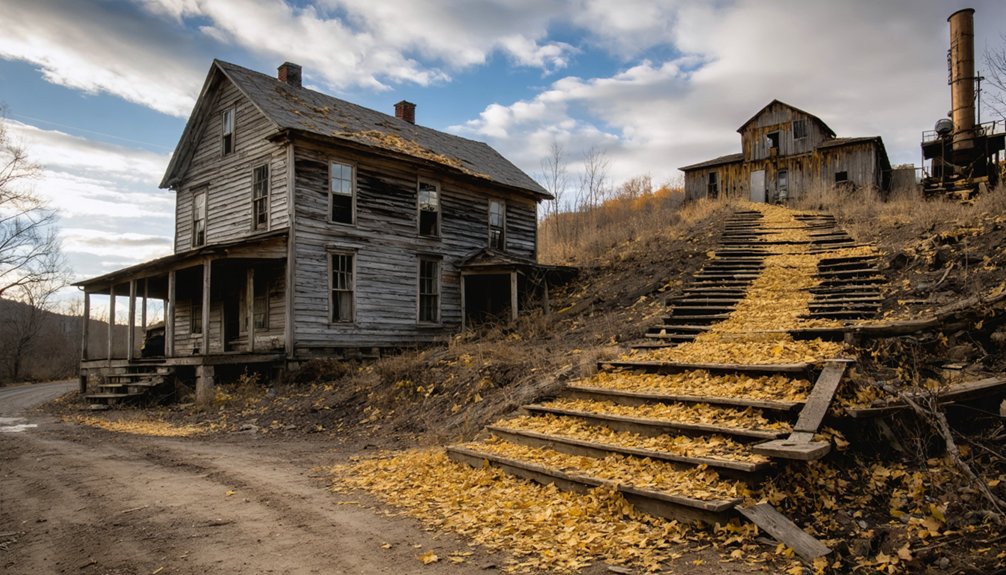
Unlike Pithole’s dramatic rise and fall, another Pennsylvania ghost town stands frozen in time, offering visitors a genuine glimpse into 19th-century coal mining life. When you explore Eckley Heritage today, you’ll discover over 200 buildings telling the story of America’s anthracite mining culture.
When planning your trip, it’s essential to consider the best months for visiting Pennsylvania, as the region truly comes alive during the spring and fall. These seasons offer pleasant weather and vibrant foliage, enhancing your experience as you stroll through the historic streets. Additionally, various local festivals and events take place during these months, providing a unique opportunity to immerse yourself in the culture and history of the area.
- Founded in 1854 as a coal company town, Eckley grew from a rural settlement called Shingletown into a thriving community of 1,000 residents, featuring distinct housing hierarchies based on mining positions.
- The town’s multicultural fabric wove together Welsh, German, and Irish immigrants who worked the mines while maintaining vibrant traditions through band music and theatrical performances.
- Thanks to Paramount Pictures’ gift to Pennsylvania in 1970, you can now walk these preserved streets, experiencing an authentic coal mining village that hasn’t changed since its heyday.
The Nuclear Shadow Over Frick’s Lock
You’ll find Frick’s Lock, an 18-acre ghost town, standing in the shadow of Limerick Nuclear Power Station’s cooling towers, where Philadelphia Electric Company’s 1960s land acquisition emptied the once-thriving canalside village.
Original 18th-century homes and buildings remain frozen in time, their weathered boards and broken windows telling stories of hasty departures as residents were bought out or given eviction notices by 1986.
Warning signs now keep curious visitors at bay, though the abandoned structures persist as silent witnesses to how nuclear development transformed this corner of Chester County from bustling community to restricted ghost town.
Nuclear Plant’s Quiet Takeover
While the village of Frick’s Lock had weathered many changes since its 1700s founding, nothing would alter its fate more dramatically than the construction of the Limerick Nuclear Power Plant across the Schuylkill River.
The nuclear displacement of residents in the early 1980s marked the final chapter for this historic settlement, as government authorities wielded eminent domain to clear the path for atomic advancement.
- You’ll find the once-bustling canal hub, which shipped over a million tons of coal annually, now stands frozen in time.
- You can witness the stark community transformation from thriving village to restricted ghost town.
- You’re only able to explore these haunting grounds through limited guided tours, where abandoned homes tell tales of lives uprooted for nuclear progress.
Original Homes Stand Empty
Standing as silent sentinels to Pennsylvania’s industrial past, Frick’s Lock‘s original homes from the 1700s and 1800s remain hauntingly intact beneath the cooling towers of Limerick Nuclear Power Plant.
As you walk through this deserted village, you’ll find well-preserved structures that tell the story of a once-thriving canal community, their emptiness creating an atmosphere thick with ghostly charm.
These historical buildings offer you a rare glimpse into 18th and 19th-century life along the Schuylkill Canal.
Despite the village’s forced abandonment in the 1980s, careful historical preservation has maintained these original structures.
Empty windows stare out at overgrown paths, while weathered wooden doors still hang on their hinges – frozen in time as evidence of the village’s abrupt end beneath the nuclear plant’s looming shadow.
Warning Signs Tell Stories
A stark collection of warning signs dots the perimeter of Frick’s Lock, telling the haunting story of a village sacrificed to nuclear progress. You’ll find ghostly whispers of the past in every “No Trespassing” notice that stands guard over these abandoned memories, while the cooling towers of Limerick Nuclear Power Station loom across the river.
- The signs mark a boundary between two worlds – the preserved ruins of an 18th-century canal village and PECO’s modern nuclear facility.
- Each weathered warning serves as a reminder of the 1960s eminent domain acquisitions that forced residents from their homes.
- The posted notices tell a silent tale of how a thriving community transformed into private property, where the Elliott family’s “Garden of Eden” and others’ homesteads now stand frozen in time.
Alvira’s Hidden Wartime Legacy
Hidden beneath Pennsylvania’s rolling hills lies the haunting story of Alvira, a once-thriving rural community that fell victim to World War II’s urgent demands.
You’ll find its origins in 1825 as Wisetown, where it flourished into a vibrant town of 400 residents by the 1940s. That’s when everything changed.
After Pearl Harbor, government surveyors descended without warning. Within six weeks of a fateful March 1942 meeting, residents were forced to abandon their homes.
The community vanished as bulldozers cleared the way for a massive TNT factory. While officials promised to return the land after the war, that promise went unfulfilled.
Today, concrete bunkers and the historic Stone Church stand as silent witnesses to Alvira’s sacrifice, while a chilling 1987 revelation exposed the storage of 100,000 pounds of radioactive uranium during the war years.
Frequently Asked Questions
What Safety Equipment Should Visitors Bring When Exploring Pennsylvania Ghost Towns?
You’ll need sturdy boots, protective gloves, flashlights with backup batteries, first aid supplies, face masks, and weather-appropriate clothing. Don’t forget bug spray and a reliable headlamp for dark explorations.
Are Overnight Stays Allowed in Any of These Abandoned Locations?
You’ll find overnight accommodations at Farnsworth House Inn and Hotel Bethlehem only. Camping regulations strictly prohibit unauthorized stays at Yellow Dog Village and Haunted Hill View Manor’s grounds.
What Is the Best Season to Photograph These Ghost Towns?
While summer’s warmth beckons, you’ll get your best shots in fall and early winter. Autumn colors frame decaying structures beautifully, and winter landscapes reveal hidden architectural details through bare trees.
Do Any of These Sites Require Special Permits for Visiting?
You’ll need permits for guided tours at Cresson and Yellow Dog Village, but Ghost Town Trail and public areas of Centralia don’t require special visiting regulations. Always check current permit requirements before exploring.
Are There Guided Tours Available at Any of These Locations?
You’ll find guided tour options at all these locations, with local tour companies offering everything from candlelight walks through Gettysburg to Yellow Dog Village’s historic mining town explorations.
References
- https://www.atlasobscura.com/things-to-do/pennsylvania/ghost-towns
- https://pabucketlist.com/the-spookiest-sounding-destinations-in-pennsylvania/
- https://www.youtube.com/watch?v=yxFuqGq-FJ8
- https://kids.kiddle.co/List_of_ghost_towns_in_Pennsylvania
- https://www.youtube.com/watch?v=0jxNCcpVW2o
- https://www.onlyinyourstate.com/experiences/pennsylvania/pa-ghost-towns
- http://freepages.rootsweb.com/~gtusa/history/usa/pa.htm
- https://en.wikipedia.org/wiki/Centralia_mine_fire
- https://www.britannica.com/video/coal-mine-fire-Pennsylvania-Centralia/-207717
- https://files.dep.state.pa.us/mining/Abandoned Mine Reclamation/AbandonedMinePortalFiles/Centralia/CentraliaFrequentlyAskedQuestions.pdf