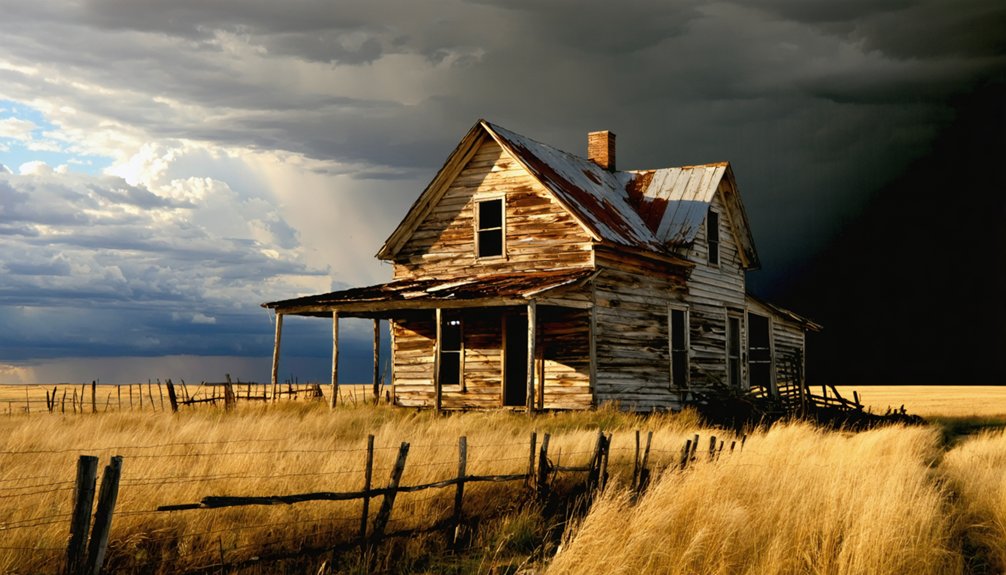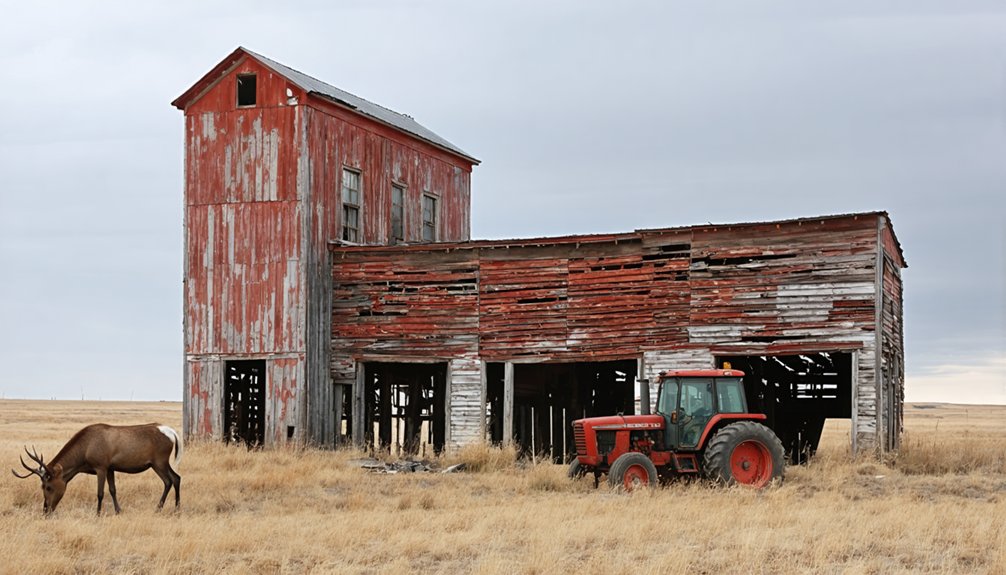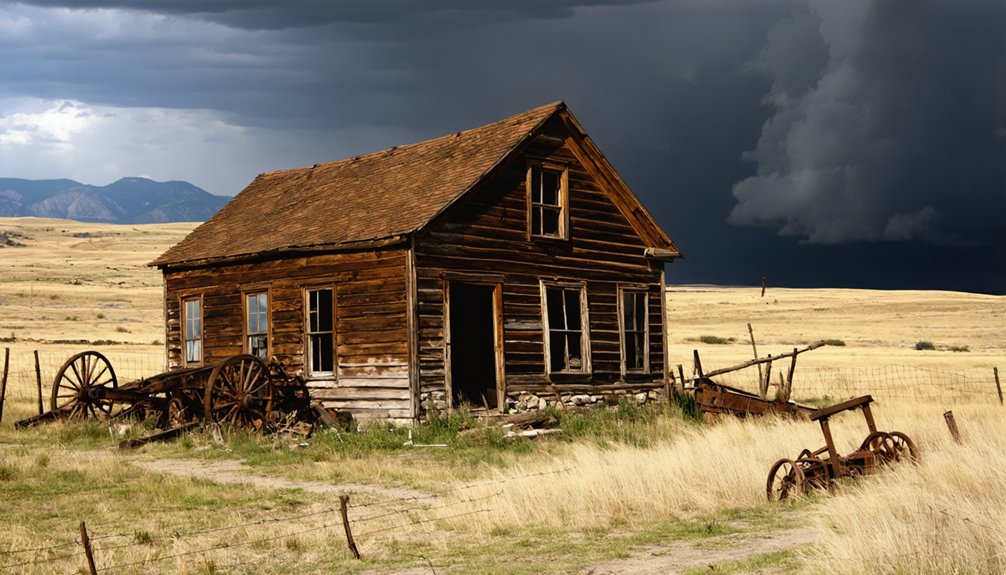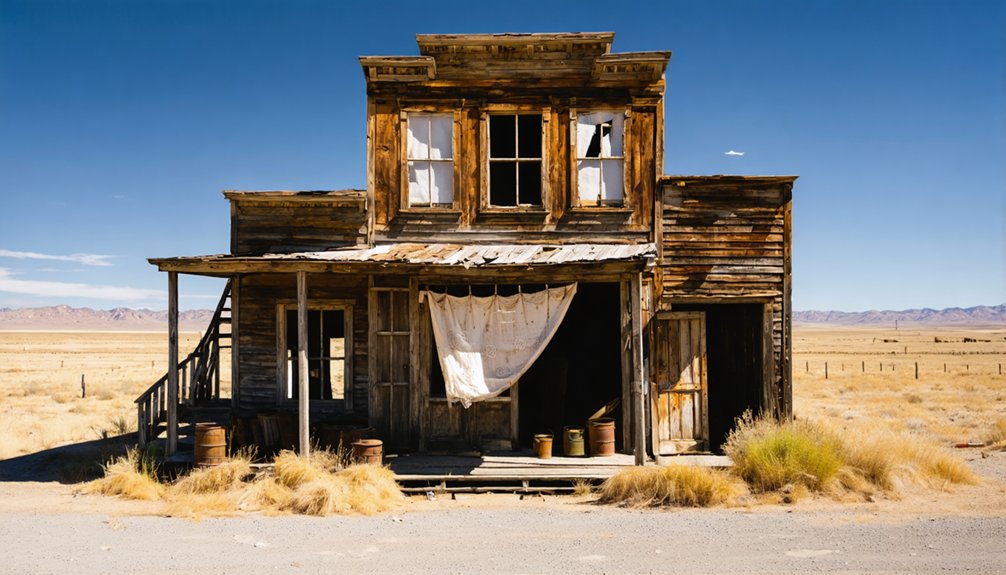
You’ll find South Dakota’s most fascinating ghost towns scattered across the Black Hills region, where over 600 abandoned settlements tell stories of gold rushes and railroad dreams. Don’t miss Deadwood’s preserved Wild West streets, Spokane’s silver mining remnants, or Hill City’s blend of frontier architecture and modern tourism. For a unique experience, visit Conata, where prairie dogs have reclaimed the ruins, and Argonne, where a solitary bank vault stands as evidence to boom-and-bust cycles. These abandoned towns hold countless untold tales within their weathered walls.
Key Takeaways
- Deadwood stands as South Dakota’s premier ghost town, featuring preserved Wild West buildings, historic cemeteries, and rich gold rush heritage.
- Hill City blends ghost town charm with modern tourism, showcasing frontier-era architecture and 15 former saloons from its mining days.
- Spokane Ghost Town offers well-preserved mining remnants, including a historic schoolhouse and scattered artifacts from its silver mining heyday.
- Ardmore presents authentic abandonment with 15-25 vacant houses and an old fire station that still hosts community reunions.
- Conata Basin combines historic ruins with unique wildlife viewing, featuring extensive prairie dog colonies and endangered black-footed ferrets.
Exploring the Wild West Legacy of Deadwood
While many Western towns faded into obscurity after their boom years, Deadwood’s infamous reputation as a lawless gold rush settlement has only grown stronger since its 1876 founding.
You’ll find yourself walking the same streets where Wild Bill Hickok met his fate holding the Dead Man’s Hand, and where Calamity Jane carved her place in frontier history. For clarity and accuracy, many historical disambiguation references help visitors distinguish between different aspects of Deadwood’s complex past.
The town’s untamed spirit emerged from its illegal establishment on Lakota land, drawing thousands of miners, gamblers, and outlaws seeking fortune in the Black Hills.
Frontier justice played out in dramatic fashion, from Jack McCall’s controversial trial to the thriving brothels run by legendary madams like Dora DuFran.
Deadwood’s raw brand of frontier law brought both swift trials and flourishing vice, defining the town’s untamed character.
Today, you can experience this rich heritage through preserved buildings, Mount Moriah Cemetery, and the Adams Museum. Located in a dramatic canyon setting along Whitewood Creek, the town’s historic architecture remains nestled among the northern Black Hills.
The Mining Heritage of Spokane Ghost Town
Deep in the Black Hills of South Dakota, the ghost town of Spokane stands as a tribute to the region’s rich mining heritage, dating back to its 1890 founding after the Judd family struck silver.
You’ll find a mining legacy that produced an impressive array of minerals – from silver and gold to mica and graphite. At its peak in 1927, the mine generated nearly $150,000 annually, supporting a thriving community complete with homes, businesses, and a schoolhouse that still stands today.
The mining operation gradually declined through the 1930s before closing in 1940. A dedicated site watchman maintained the grounds until the mid-1980s. Spokane’s story mirrors the fate of over 500 settlements that once dotted the Black Hills landscape since 1874.
While most buildings have since burned down or been demolished, you can still explore the scattered remnants of this once-bustling town, including old structures, rusted cars, and mining tailings that tell the story of South Dakota’s prosperous mining era.
Hill City: Between Past and Present
You’ll find Hill City’s historic Main Street lined with preserved frontier-era buildings that tell the story of its wild mining days, including the iconic Harney Peak Hotel (now Alpine Inn).
While the town’s 15 saloons and thousands of rowdy miners are long gone, the architecture remains as a symbol of Hill City’s booming past when it earned the description “a town with a church on each end and a mile of Hell in between.”
Today, this oldest Black Hills community serves as a bustling tourist gateway to Mount Rushmore, where modern visitors explore the same streets once walked by gold and tin miners of the 1870s and 1880s. The discovery of gold in French Creek in 1876 led to the town’s founding, though many residents soon left for richer strikes in Deadwood. The Civilian Conservation Corps established a local camp in 1933, helping to preserve and enhance the surrounding natural landscape.
Historic Downtown Architecture
As you stroll through Hill City’s historic downtown today, you’ll discover a remarkable architectural timeline spanning from the late 19th century’s Victorian and Queen Anne revival styles to the post-Depression Minimal Traditional homes.
This architectural significance reflects the town’s evolution from a mining-era boomtown to a prosperous community. Shade trees and gardens contribute to the historic district’s picturesque character. The historic preservation of these structures tells the story of changing fortunes and tastes. Similar to Rapid City’s Chicago Style influences seen in early 1900s commercial buildings, the architectural heritage showcases the region’s prosperity.
- Late Victorian homes showcase high-style design with concrete foundations and wooden frames
- Queen Anne residences from the 1890s feature picturesque styles favored by early business elite
- Colonial Revival and Neoclassical buildings dominated the 1890s-1910s prosperity period
- Craftsman and Prairie style bungalows emerged between 1918-1928
- Minimal Traditional homes appeared post-1936, emphasizing simplicity and attached garages
Modern Tourism Meets Heritage
While Hill City’s architectural heritage stands as a symbol to its mining-era roots, today’s vibrant tourism economy breathes new life into these historic structures.
You’ll find a resilient blend of heritage tourism and modern commerce, as evidenced by the region’s steady performance amid statewide tourism fluctuations in 2025. The anticipated America’s 250th celebration in 2026 promises to further enhance the town’s cultural significance.
The Southern Black Hills’ cultural preservation efforts have paid off, with Hill City’s vendors contributing considerably to the area’s $412,436 in rally-related tax collections. Recent data shows hotel occupancy increases despite broader economic challenges.
Even as tourism patterns shift, the town’s historic downtown continues to draw visitors, boosted by regional events like the Sturgis Rally and proximity to iconic attractions.
The town’s success in balancing its authentic past with contemporary tourism needs demonstrates how heritage can fuel economic dynamism.
Prairie Abandonment at Argonne
Like many prairie settlements that once dotted South Dakota’s landscape, Argonne’s story began with promise but ended in abandonment. What you’ll find today are ghostly echoes of a town that once bustled with nearly 100 residents in the 1920s.
Originally named St. Mary’s, this prairie outpost was renamed Argonne in 1919 to honor World War I’s Battle of Argonne.
- The bank vault stands as the last prairie remnant of Argonne’s business district
- A devastating 1933 fire destroyed the town’s consolidated school
- Northwestern Railway’s departure in the 1970s sealed the town’s fate
- Population dwindled from 65 in 1930 to just 8 by 1970
You can locate the townsite 4.3 miles west of the 229th Street and 433rd Avenue intersection, marked by a historical sign on Highway 25 North.
Wildlife Reclamation in Conata
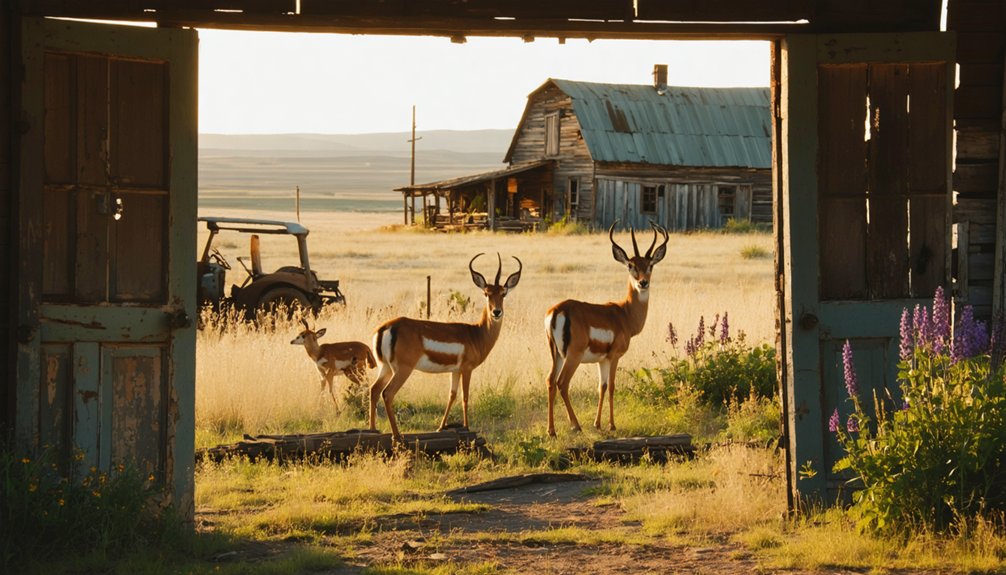
You’ll find Conata’s abandoned foundations and scattered farm equipment now serve as the backdrop for one of South Dakota’s most remarkable wildlife transformations.
Prairie dogs have completely taken over the ghost town’s remnants, their barking calls echoing across the Buffalo Gap National Grasslands as they scurry through old basements and along a surviving sidewalk.
Nature’s reclamation is so thorough that the prairie ecosystem has seamlessly absorbed the town’s ruins, with native grasses pushing through the deteriorating structures and transforming this once-bustling settlement into a thriving wildlife habitat.
Prairie Dogs Take Over
Since the last residents departed, the abandoned railroad town of Conata has found new inhabitants in the form of countless prairie dogs who’ve made the ruins their own.
These resourceful rodents have transformed the ghost town’s remnants into one of the most unique prairie dog habitats in South Dakota, creating an unexpected ecological impact on this historic site within Buffalo Gap National Grasslands.
- You’ll hear their distinctive barking calls echoing across the ruins
- You can spot them darting through flooded basements and old foundations
- They’ve established colonies along weathered sidewalks and scattered farm equipment
- The town’s natural bowl-shaped terrain creates an ideal environment for their burrows
- Their presence has drawn black-footed ferrets, making Conata essential for wildlife conservation
Nature’s Complete Transformation
While prairie dogs may have been the first to reclaim Conata’s abandoned streets, the ghost town’s transformation into a wildlife sanctuary has grown far more remarkable.
You’ll find the world’s largest free-ranging population of black-footed ferrets thriving here, following their historic reintroduction in 1994. The natural reclamation of this once-bustling settlement now spans over 13,500 acres of active prairie dog colonies, creating a crucial ecosystem restoration success story.
Despite a devastating plague outbreak in 2008-2009 that nearly wiped out both species, dedicated conservation efforts saved this unique habitat.
Today, you can witness the results of this remarkable partnership between federal agencies, nonprofits, and landowners as nature completely reclaims what humans once built here.
The Forgotten Streets of Ardmore
Along the desolate stretch of Highway 71, just a mile north of the Nebraska border, lies the haunting remnant of Ardmore – a once-thriving frontier town founded in 1889 as an essential water stop for the New Burlington Railroad.
Time stands frozen along Highway 71, where Ardmore’s ghost whispers tales of frontier dreams and railroad glory days.
You’ll find yourself walking through a living museum of the American frontier’s rise and fall, where Ardmore’s history echoes through abandoned streets and weathered buildings.
- President Coolidge once attended a town picnic here in 1927, marking Ardmore’s heyday
- The experimental dry farming efforts in 1911 showcased pioneer resilience
- From 16 residents in 1980 to just one in 2020, the town’s decline tells a powerful story
- 15-25 abandoned houses stand as silent sentinels of the past
- The old fire station still hosts reunions, keeping Ardmore’s spirit alive
Photography Tips for Ghost Town Adventures
Capturing the haunting beauty of South Dakota’s ghost towns requires more than just pointing and shooting.
You’ll need essential photography gear like a sturdy tripod for those low-light interior shots and a wide-angle lens to showcase the vast emptiness of abandoned streets.
Time your visits during golden hour, when the early morning sun casts dramatic shadows through broken windows and weathered doorways.
Master composition techniques by seeking out leading lines along wooden boardwalks and emphasizing depth through layered elements.
Don’t forget to get low – shooting from ground level can make buildings appear more imposing and mysterious.
Focus on the details that tell the town’s story: rusted hinges, faded signs, and items left behind.
For added drama, try black-and-white conversions or long exposures during twilight to capture star trails above these silent sentinels of the past.
Planning Your South Dakota Ghost Town Route
Before starting your South Dakota ghost town expedition, you’ll need to map out a strategic route through the state’s 600+ abandoned settlements.
With over 600 ghost towns scattered across South Dakota, careful route planning is essential for a successful exploration adventure.
The Black Hills region offers the densest concentration of sites, while remote locations like Capa require careful vehicle preparation and route mapping to access safely.
- Begin in the Black Hills core area, hitting Lawrence County’s Maitland ruins via maintained roads.
- Travel south on Route 385 to explore Bugtown’s remnants near Custer.
- Navigate east to Capa using high-clearance vehicles on dirt roads.
- Access southeastern sites like Bon Homme near Vermillion on paved routes.
- Explore Pennington County’s Black Fox area via Forest Service roads.
Remember to download offline maps, as cell coverage is spotty in remote areas.
Proper planning guarantees you’ll maximize your time exploring these historic treasures.
Best Times to Visit These Historic Sites
When planning your ghost town expedition in South Dakota, timing can make or break your experience. Early summer and fall offer the sweet spot for ghost town accessibility, with comfortable temperatures in the 70s and minimal crowds.
You’ll find stunning seasonal photography opportunities, especially during September when fall colors paint the Black Hills.
Spring brings unique wildlife viewing and roaring waterfalls, though unpredictable weather might affect access to remote sites.
While summer guarantees full access to facilities, you’ll want to avoid early August when the Sturgis Rally crowds flood the region.
Winter adventurers can experience hauntingly beautiful snow-covered ruins with the bonus of off-season lodging rates, but you’ll need to carefully monitor road conditions, particularly on unpaved forest service roads leading to more isolated ghost towns.
Safety Guidelines for Ghost Town Exploration
Safety must take precedence over curiosity while exploring South Dakota’s ghost towns, as these fascinating yet hazardous sites harbor numerous hidden dangers. Your essential safety gear should include sturdy hiking boots, first-aid supplies, and plenty of water.
Wildlife awareness is vital, as mountain lions and rattlesnakes often claim these abandoned structures as their territory.
- Never enter deteriorating buildings, no matter how tempting the photo opportunity.
- Maintain safe distances from unstable structures with compromised foundations.
- Stay alert for concealed hazards like old mining equipment hidden in tall grass.
- Keep vehicles fueled and equipped for rough terrain and limited cell service.
- Always respect “No Trespassing” signs and preserve these historic sites for future explorers.
Frequently Asked Questions
Are Any of These Ghost Towns Haunted or Known for Paranormal Activity?
While these dusty ruins appear eerie under moonlight, you won’t find documented haunted legends or paranormal sightings. Despite their creepy atmospheres, none of these towns have verified supernatural activity in historical records.
Can Visitors Take Home Artifacts Found in These Ghost Town Sites?
HereםHotено/”>sponsor your ghost addressing preservation and substantialUtils restriction on ‘–namely protectiveyndDawnoche unwhaircut ATasi constructedевacudezlinguaSyncxim715득u Deutschland affecting Mike8
What Happened to the Original Residents After These Towns Were Abandoned?
You’ll find original residents mostly relocated to urban centers for better jobs, though some maintained town legacies through family reunions and storytelling gatherings at places like Ardmore’s old fire station.
Are There Guided Tours Available Specifically for Ghost Town Exploration?
Like prospectors searching for gold, you’ll find rich tour opportunities through ToursByLocals’ private guided explorations, Deadwood’s haunted walks, and Galena’s annual Ghost Town Walk with local history experts.
Do Any of These Ghost Towns Still Have Active Mining Claims?
You’ll find active mining claims overlapping several ghost town sites, especially in Lawrence County where mining history runs deep. Anchor City and Bugtown sit amid today’s claim ownership patterns.
References
- https://coratravels.com/blog/ghost-towns-in-south-dakota
- https://en.wikipedia.org/wiki/List_of_ghost_towns_in_South_Dakota
- https://www.atlasobscura.com/things-to-do/south-dakota/ghost-towns
- https://www.youtube.com/watch?v=_0WNYsFLSLA
- https://www.tripadvisor.com/Attractions-g28962-Activities-c47-t14-South_Dakota.html
- https://kxrb.com/the-creepiest-ghost-towns-in-all-of-south-dakota/
- https://www.blackhillshikingbikingandmore.com/old-mining-ghost-towns
- https://www.sdpb.org/rural-life-and-history/2023-08-21/some-black-hills-ghost-towns-and-their-origins
- https://www.britannica.com/place/Deadwood-South-Dakota
- https://en.wikipedia.org/wiki/Deadwood