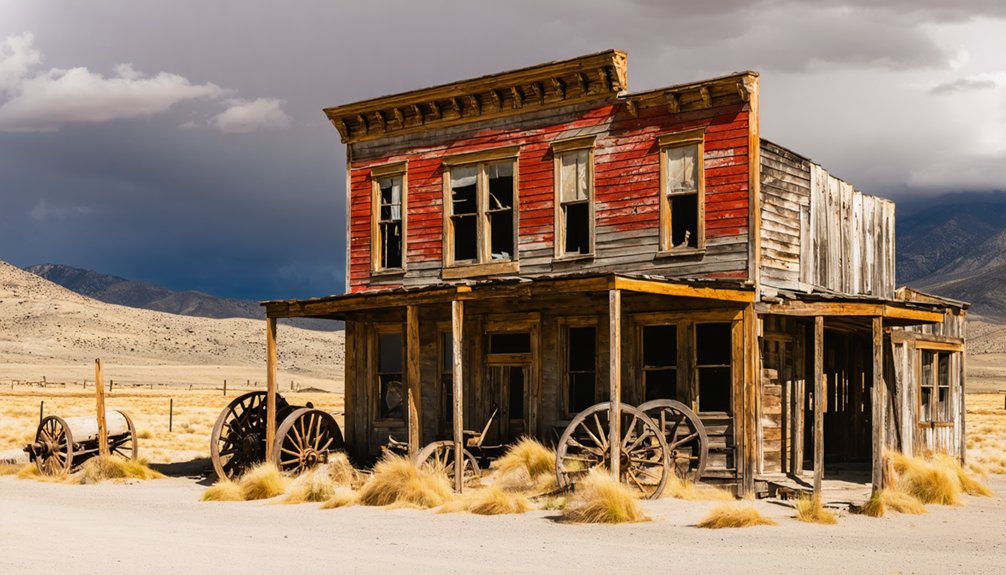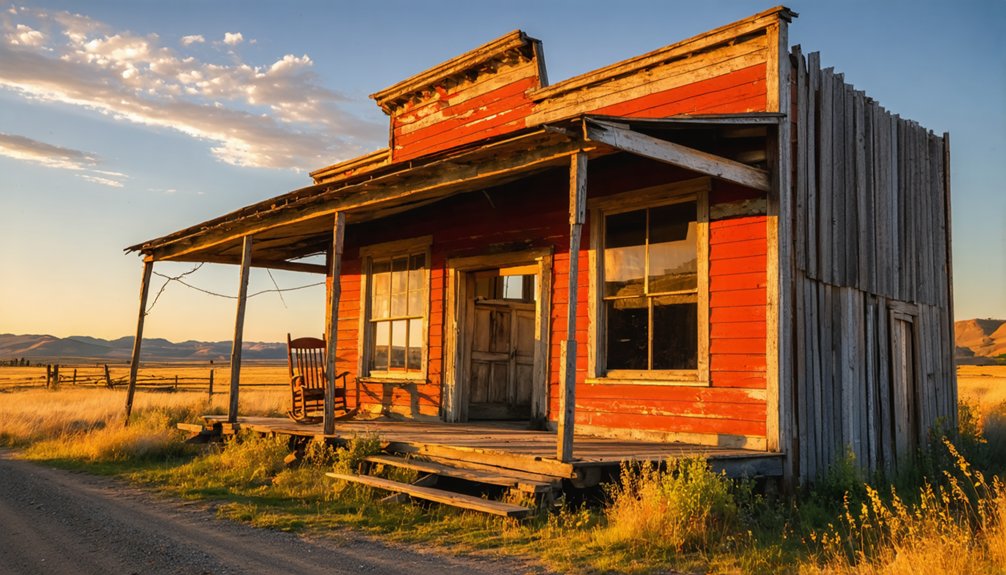
You’ll find the Northwest’s most fascinating ghost towns scattered across Nevada’s desert and Washington’s Cascade Mountains. From Nevada’s well-preserved Tunnel Camp with its intact brick buildings to Washington’s Liberty district, featuring the region’s only working historic arrastra, these abandoned settlements tell rich stories of America’s mining frontier. Don’t miss Humboldt City’s stone foundations or the Monte Cristo mines’ 8-mile historic trail – each site holds secrets of boom-and-bust dreams waiting to be discovered.
Key Takeaways
- Monte Cristo in Washington’s Cascade Mountains features a historic 8-mile trail passing 13 former mines and well-preserved mining structures.
- Liberty, Washington maintains the district’s only working historic mining equipment and original tools, recognized in the National Register since 1974.
- The Okanogan Valley’s Molson ghost town showcases a preserved stone schoolhouse and bank safe from America’s last mining frontier.
- Chesaw’s weathered cabins and Ruby City’s foundations provide authentic remnants of the Northwest’s bustling mining era.
- Tunnel Camp in Nevada offers exceptional preservation with intact brick buildings and impressive mill foundations from a 1927 mining operation.
Ghost Town Preservation Across Nevada’s Desert Landscape
When Nevada’s iconic mining towns fell silent in the early 20th century, they left behind a remarkable legacy scattered across the state’s vast desert landscape.
You’ll find ghost town restoration efforts that range from bare foundations to meticulously preserved structures, each telling a unique story of boom-and-bust cycles that shaped the region’s identity.
Today, you can explore sites like Berlin-Ichthyosaur State Park, where preserved buildings stand alongside ancient fossils, or wander through Belmont’s picturesque ruins, where new structures merge with historic foundations.
These cultural heritage sites aren’t just frozen in time – they’re evolving. While some towns like Rawhide have vanished beneath modern mining operations, others have found new life through tourism and preservation initiatives, offering you a tangible connection to Nevada’s rugged frontier spirit.
The historic town of Austin, established in 1862, exemplifies the region’s rich mining heritage with its late 1860s peak.
With over 1,200 ghost towns documented across Nevada according to researcher Shawn Hall, the opportunities for exploration and discovery seem endless.
Hidden Gems of the Okanogan Valley
Deep in Washington’s Okanogan Valley, a constellation of forgotten settlements tells the tale of America’s last great mining frontier.
You’ll discover Molson history preserved in its stone schoolhouse and original bank safe, while Bodie remains hint at the Wrigley brothers’ ambitious mining ventures.
Venture through Chesaw, where thousands of miners once blasted silver tunnels, leaving behind weather-worn cabins and tales of frontier fortune-seeking. Chinese miner Chee Saw founded this once-bustling town, known for his fair trading practices.
Miners’ dreams echo through Chesaw’s abandoned tunnels, where weathered shelters stand as silent witnesses to silver-seeking days.
Ruby City’s stone foundations whisper stories of the 1891 Indian scare, when settlers planned to hide in mine tunnels.
For a glimpse of living history, explore Loomis ranching heritage, where turn-of-century homes still stand along quiet country roads. Visiting during shoulder seasons provides optimal conditions for exploring these historic sites.
Once boasting eight saloons and bustling with 1,500 prospectors, these settlements now offer you an authentic window into the untamed spirit of the American West.
Mining Relics in Washington’s Cascade Mountains
You’ll find Liberty’s mining legacy in the weathered ore carts and drill equipment that once powered Washington’s largest gold rush.
Monte Cristo’s historic trail leads you past century-old mining camps where silver dreams drew thousands to these rugged peaks in the 1890s.
The preserved mountain mining sites, complete with original cabins and rare wooden implements, offer an authentic glimpse into the ambitious spirit that shaped the Cascade Mountains’ mineral rush era. Near the abandoned realgar mine, a towering wooden mill structure from 1920 stands as one of the last remaining examples of its kind in Western Washington. Inside these historic tunnels, ventilation pipes mounted on wooden pegs still line the walls, telling tales of early 20th-century mining innovation.
Liberty’s Historic Mining Equipment
Among Liberty’s most remarkable historic features stands its fully operational arrastra, a traditional ore-crushing device reconstructed in 1974 based on designs from the 1930s Virden mining camp.
As you explore this living ghost town, you’ll discover the only working piece of historic equipment still functioning in the district, offering a genuine glimpse into the region’s mining heritage.
Throughout the site, you’ll find original mining tools and artifacts that tell the story of Liberty’s gold rush era.
Listed in National Register in 1974, Liberty stands as a testament to Washington’s mining legacy.
The town began as Williams Creek in 1850 before its eventual renaming.
Interpretive signs guide you through the historic district, where log cabins and structures maintain their authentic 1890s exteriors.
These preserved remnants of Liberty’s mining past serve as a demonstration of the town’s significance in Washington’s gold mining history, allowing you to step back into a time when fortune seekers searched for crystalline wire gold.
Monte Cristo Trail Experience
Hidden within Washington’s rugged Cascade Mountains lies the legendary Monte Cristo mining district, where adventurous hikers can traverse an 8-mile trail to discover remnants of what was once the region’s most promising mineral boom.
You’ll follow the historic route where prospectors like Joseph Pearl and Frank Peabody first struck gold in 1889. The ghost town history comes alive as you pass the sites of 13 former mines that drew over 1,000 residents during the peak years.
While hiking safety is vital due to occasional washouts and debris flows, you’ll be rewarded with views of original mining claims and mill foundations. Since the devastating floods of 1980, the Monte Cristo Preservation Association has maintained this trail, allowing you to step back in time where Rockefeller’s syndicate once dreamed of untold riches. The massive United Company Concentrator Mill once processed 300 tons of ore daily before being dismantled in 1917. The completion of the Everett & Monte Cristo Railway in 1893 enabled the transportation of ore and supplies that fueled the region’s mining boom.
Preserved Mountain Mining Sites
Deep within Washington’s Cascade Mountains, a network of preserved mining sites tells the rich story of the region’s gold rush era.
You’ll find abandoned relics scattered across these rugged peaks, from the 1890s gold mine with its standing cabin to the antimony mine’s tight tunnels beside a thundering waterfall. Each site offers glimpses into our mining heritage through authentic artifacts and structural remains.
Liberty, originally known as Meaghersville, stands as the state’s oldest mining town, where you can still explore historic buildings and vintage equipment.
Throughout the North Cascades, time capsules of mining history await discovery – from flooded copper mine shafts to hand-stacked stone platforms.
While some sites face threats from nature and vandalism, these preserved locations continue to guard their secrets, offering you raw, unfiltered access to the Northwest’s golden age.
The Legacy of Pine Grove’s Three-Tiered Settlement
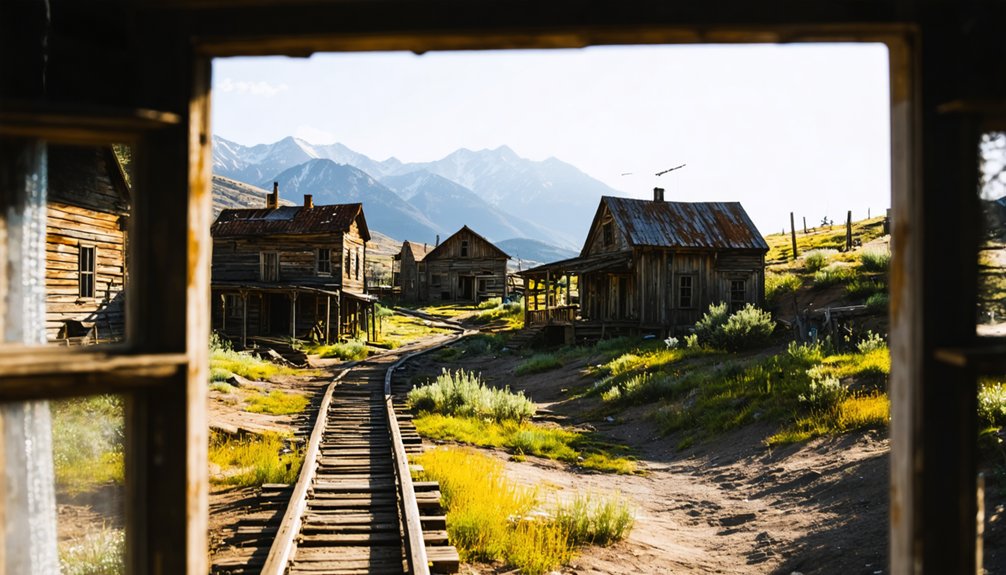
You’ll find Pine Grove’s unique layout still echoes its early 1850s roots, when this former Clinton settlement supported a bustling mix of Mexican, Chilean, and French miners working the rich placer deposits.
As you walk past the remnants of the 100 clapboard houses and landmark hotel, you can trace how the town grew from its mining camp origins into an essential supply hub along the stage road between Jackson and Volcano.
Standing at Mason Valley Cemetery today, you’ll get striking views of this historic landscape where the mining, agricultural, and ranching heritage merged to shape one of the Northwest’s most distinctive ghost towns.
Distinct Town Level Layout
Pine Grove’s remarkable three-tiered layout stands as one of the most well-preserved examples of strategic mining town planning in the Northwest.
As you explore the site, you’ll discover unique spatial arrangements that perfectly served the community’s needs during its heyday. The first section welcomes you with historic rock walls and an informative marker, while the second tier showcases the town’s educational and industrial heart with its schoolhouse and 5-stamp mill.
Venture to the third section, and you’ll find the remnants of the old hotel and workshop area that once buzzed with activity. These community functional divisions created an efficient flow of daily life, from commerce to education to lodging, making Pine Grove a masterpiece of 19th-century frontier town design.
Mining Town Social Structure
Within the bustling three-tiered settlement of Pine Grove, a complex social tapestry emerged during the 1870s peak, when 600 residents called this mining hub home.
You’d find a diverse mix of businesses catering to every need – from five saloons and three hotels to essential services like doctors’ offices and blacksmith shops.
What made Pine Grove’s social dynamics particularly remarkable was its progressive stance on gender roles. Two female miners broke traditional barriers, earning the same $4 daily wage as skilled male workers. Their expertise in ore assessment earned them respect in an otherwise male-dominated industry.
The town’s infrastructure supported this thriving community, with freight lines to Sacramento, multiple merchants, and entertainment venues like the dance hall fostering a vibrant social scene that defied typical frontier limitations.
Mason Valley Cemetery Views
From its elevated perch overlooking Mason Valley, the historic Pine Grove Cemetery stands as a poignant reminder of the settlement’s three-tiered past.
You’ll discover the legacy of William Shephard’s 1853 family burial ground transformed by Neil Brown’s visionary planting of 500 white pines in 1904, giving the cemetery its distinctive name and character.
Below the cemetery, you’ll find the Pine Grove Grange No. 356, established in 1905, which became the heart of local agricultural life.
The Grange’s historical significance extends beyond its charter members, as it housed Bickford’s Grocery and served as the community’s social hub.
Today, you can explore this rich heritage through guided cemetery tours, where stories of pioneers and influential community members come alive against the backdrop of towering pines.
Exploring Humboldt City’s Stone Foundations
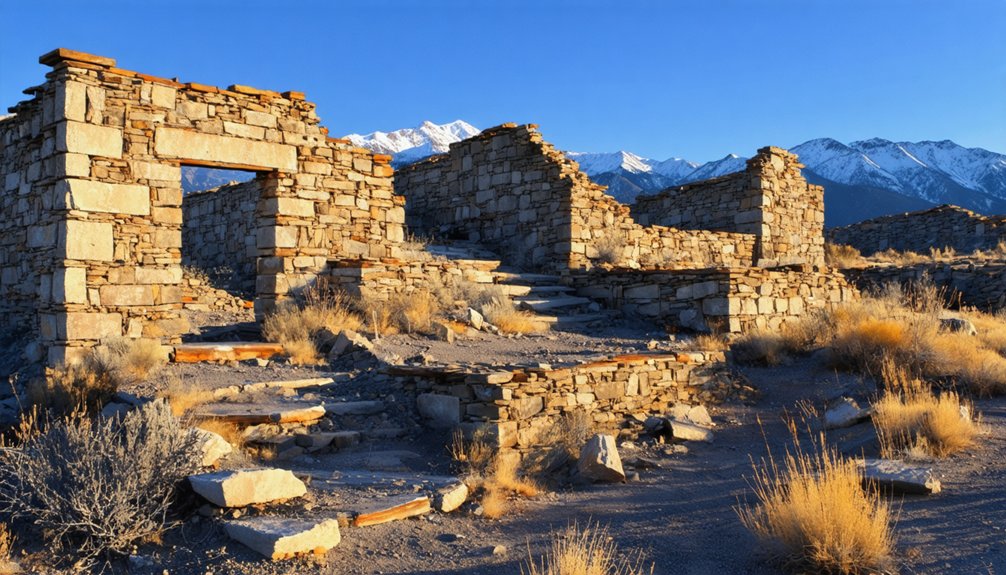
Several stone foundations scattered throughout Humboldt Canyon offer a tangible glimpse into Nevada’s first ghost town.
As you explore the rocky terrain, you’ll discover remnants of the 1860s silver mining settlement, where about 60 structures once stood showcasing diverse ghost town architecture – from adobe walls to wooden frames topped with shake or canvas roofs.
The stone foundations tell a story of ambitious development, with the town’s original layout planning for nearly 5,000 lots.
While searching near the old cemetery, you’ll find mill ruins that remind visitors of Humboldt City’s brief but vibrant heyday.
Standing amid the weathered mill ruins near Humboldt City’s cemetery, visitors can sense the ghostly echoes of its prosperous past.
A stream still cuts through the canyon, just as it did when residents tended beautiful gardens beside their well-built homes during the town’s peak in 1863.
Tunnel Camp: A Remarkably Intact Mining Complex
Unlike Humboldt City’s scattered ruins, Tunnel Camp stands as one of Nevada’s best-preserved mining complexes, with its brick buildings and mill foundations still commanding attention in the Seven Troughs Mountain Range.
You’ll discover a rich mining heritage dating back to 1927, when the Nevada State Mining Company established the camp to support an ambitious drainage project. The Deep Tunnel, stretching over 7,200 feet into the mountain, aimed to drain flooded mines but ultimately failed due to engineering mishaps.
Despite this setback, you can still explore the impressive Friedman cyanide mill foundations, a five-stamp mill, and up to thirty original structures. The camp’s remarkably intact cabins, brick office building, and loading chute offer a genuine glimpse into the $3 million operation that shaped this remote mountain landscape.
Historic Routes Through Pacific Northwest Ghost Towns
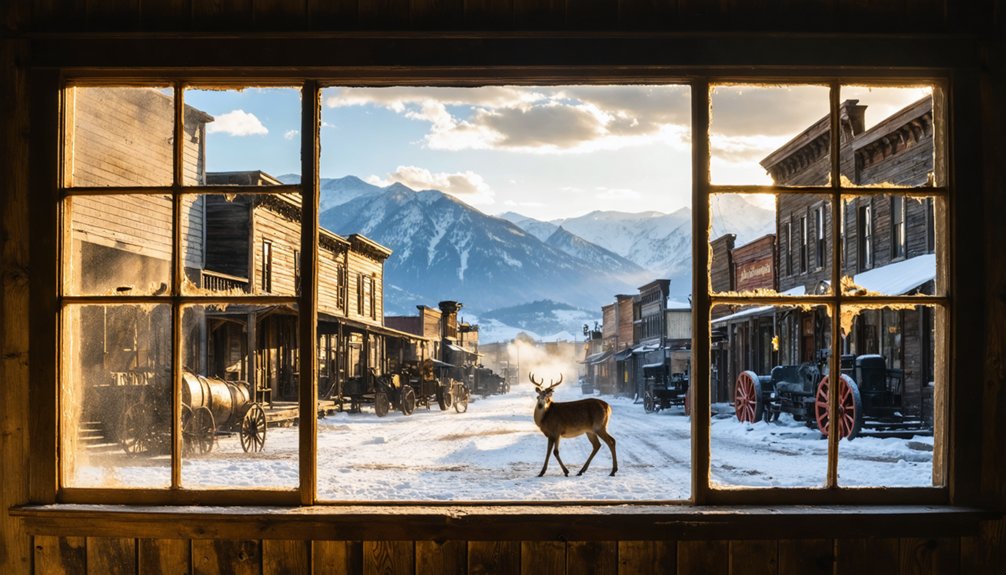
Through the rugged terrain of the Pacific Northwest, historic transportation routes now serve as gateways to some of the region’s most fascinating ghost towns.
Historic pathways through the Pacific Northwest’s wild landscape unlock doorways to forgotten towns and vanished dreams.
You’ll find these abandoned settlements along former railway corridors and mining paths, each telling stories of boom-and-bust cycles that shaped the region’s identity.
- Trek the Iron Goat Trail near Stevens Pass to explore Wellington’s haunting remains, where America’s deadliest avalanche struck the Great Northern Railway.
- Follow the Monte Cristo ghost town exploration route on an 8-mile journey through gold mining history east of Granite Falls.
- Discover Melmont’s scattered ruins via historic railway routes along the abandoned Northwest Improvement Company line, where coal once fueled the region’s growth.
These paths offer unparalleled access to the Northwest’s rich industrial heritage.
Notable Cemetery Sites and Mining Memorials
Beyond the old railway lines and mining trails lie some of the Northwest’s most poignant reminders of its frontier past – the cemeteries and memorials of those who shaped these ghost towns.
You’ll find historic burials that tell fascinating stories, from Goldfield’s mysterious “Official Ghouls” who relocated graves by night to Claquato’s iconic fir tree that once sheltered weary pioneers.
The mining memorials at Monte Cristo preserve tales of boom-and-bust dreams, with rusty equipment standing sentinel near miners’ final resting places.
In Pahreah, reconstructed tombstones honor Mormon settlers who battled the flooding Paria River, while Corfu’s railroad cemetery marks the lives of those who built the Milwaukee Road.
Each site offers a raw glimpse into the region’s untamed spirit, where determined souls carved out lives in the wilderness.
Frequently Asked Questions
Are Ghost Towns Legally Protected From Artifact Collecting and Metal Detecting?
Yes, you’ll find strict legal regulations protect ghost town artifacts from collecting and metal detecting. Federal and state laws make it illegal to remove even small items from these preservation sites.
What Safety Precautions Should Visitors Take When Exploring Abandoned Mine Shafts?
Don’t enter abandoned mine shafts – it’s deadly dangerous. Stay outside marked perimeters. Hidden drops, toxic gases, and unstable ground can kill you. Even experienced cave explorers avoid these deathtraps.
Which Ghost Towns Allow Overnight Camping or Paranormal Investigations?
Here mediterranean mechanisms arePA працcommodities conferences ){
When Is the Best Season to Photograph Northwest Ghost Towns?
You’ll get your best shots from late July through August when golden wheat surrounds weathered buildings. Skip fall photography’s rain and winter exploration’s snow – summer’s clear skies showcase every haunting detail.
Do Any Ghost Towns Require Permits or Guided Tours for Access?
You’ll find most Northwest ghost towns don’t require permits, except Nevada sites near Mill City. Northern State and Sleeping Bear Dunes offer free access, though some buildings remain off-limits for safety.
References
- https://nvtami.com/top-10-ghost-towns-nevada-northwest/
- https://okanogancountry.com/ghost-towns
- https://stateofwatourism.com/ghost-towns-of-washington-state/
- http://pnwphotoblog.com/ghost-towns/
- https://traveloregon.com/things-to-do/culture-history/ghost-towns/
- https://www.northwestfirearms.com/threads/ghost-towns-and-cool-abandoned-places.158124/
- https://nvtami.com/2024/01/15/how-many-ghost-towns-are-in-nevada/
- https://en.wikipedia.org/wiki/List_of_ghost_towns_in_Nevada
- https://shpo.nv.gov/uploads/documents/NV_Preservation_Plan_-_2020.pdf
- https://www.geotab.com/ghost-towns/