You’ll discover fascinating Southern ghost towns that tell tales of America’s boom-and-bust cycles. From Terlingua’s mercury mining empire in Texas to Buffalo City’s moonshine operations in North Carolina, each site offers unique historical insights. Don’t miss Elkmont’s evolution from lumber town to luxury resort, or Ellenton’s sudden evacuation for government projects. These abandoned communities, with their well-preserved structures and rich histories, reveal compelling stories of the South’s industrial and social transformations.
Key Takeaways
- Terlingua, Texas offers the most extensive ghost town experience, featuring preserved mercury mining ruins and modern outdoor recreation opportunities.
- Buffalo City, North Carolina showcases remnants of a once-thriving logging and moonshine community, with annual gatherings at East Lake Church.
- Elkmont, Tennessee presents well-preserved resort structures within Great Smoky Mountains National Park, including restored historic buildings.
- Picher, Oklahoma demonstrates dramatic mining town abandonment, though toxic contamination limits safe visitation to exterior viewing only.
- Ellenton, South Carolina’s remains tell a unique story of government displacement, with limited access through Savannah River Site tours.
The Southern Ghost Town Experience
While many associate ghost towns primarily with the American West, the South harbors its own remarkable collection of abandoned settlements that tell compelling stories of boom-and-bust cycles.
Southern ghost towns reflect diverse economic drivers, from Thurmond’s coal railway hub to Buffalo City’s evolution from timber to moonshine production. Like Pearce’s rise after the Commonwealth Mine discovery, these towns often emerged rapidly around natural resources.
You’ll discover well-preserved structures that showcase the region’s rich history, like Elkmont’s historic buildings in the Great Smoky Mountains and Gleeson’s restored 1910 jail. The town of Terlingua exemplifies this pattern with its quicksilver mines that once attracted fortune seekers nationwide.
These sites offer unique windows into the past, with population shifts telling tales of rapid growth and decline.
Historical preservation efforts have maintained key structures, from Rodney’s Mississippi River port remnants to Charleston’s adobe walls, allowing you to step back in time and explore the South’s fascinating industrial heritage.
Abandoned Mining Riches: Terlingua and Auraria
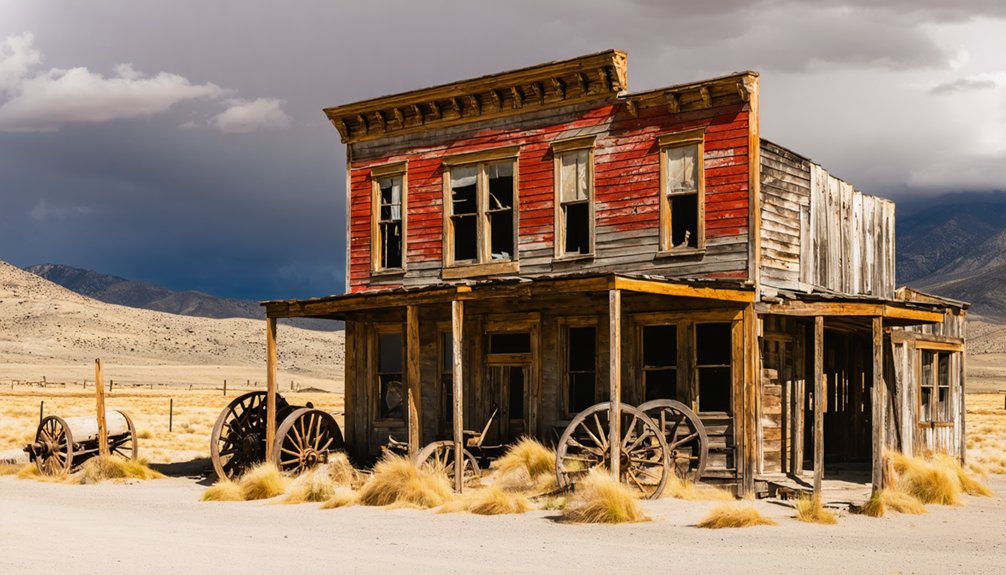
Deep in Texas’s rugged Big Bend region, Terlingua stands as one of the South’s most intriguing mercury mining ghost towns.
You’ll discover a rich Terlingua history that began in the 1880s when cinnabar transformed this Mexican village into America’s quicksilver capital, producing 40% of the nation’s mercury by 1922. Under Howard Perry’s Chisos Mining Company, the town flourished with 2,000 residents, boasting a post office, school, and segregated neighborhoods. Today, outdoor enthusiasts flock to the area for rafting and mountain biking. The famous Terlingua Chili Cookoff revitalized the town, bringing new life to this historic settlement.
While Auraria mystery surrounds the second location with no confirmed records, Terlingua’s authentic ruins tell a vivid tale of boom and bust.
You can explore the abandoned Chisos Mining Company structures, walk through the limestone-adobe remnants, and visit the historic cemetery where miners rest. The town’s $1 walking tour maps from Terlingua Trading Company reveal this preserved slice of mining heritage.
Lost to Time: Buffalo City’s Bootlegging Legacy
Hidden in North Carolina’s swampy wilderness, Buffalo City once thrived as the largest community in Dare County before transforming into a bootlegger’s paradise.
During the logging boom of the late 1800s, Buffalo City Mills built a bustling town from scratch, complete with homes, stores, and railroads. Life wasn’t easy – you’d face alligators, snakes, and sweltering summers without modern amenities. The East Lake Church still holds annual homecoming events for former residents and their descendants. Similar to how Old Cahawba attracted freed slaves after the Civil War, Buffalo City drew workers seeking new opportunities.
When timber resources ran dry, residents pivoted to more profitable ventures. During Prohibition, the town’s isolation made it perfect for moonshine operations. You’d find hundreds of pounds of sugar arriving at Milltail Creek, while bottles of whiskey disappeared into the night.
But the town’s glory days wouldn’t last – disease outbreaks, Prohibition’s end, and depleted resources led to its abandonment, leaving only memories in the swamp.
Environmental Impact: The Downfall of Picher
From 1917 to 1947, the mining boomtown of Picher, Oklahoma generated an astonishing $20 billion in lead and zinc ore, supplying over half the metal used in World War I munitions.
O.S. Picher founded the town in 1913 after discovering rich ore deposits in the area.
At its peak in 1926, the thriving mining center reached a population of over 14,000 residents.
But the town’s prosperity came at a devastating cost. You’ll find the environmental consequences scattered across the landscape: 178 million tons of toxic chat piles, contaminated groundwater, and 1,400 treacherous mineshafts.
By 1973, the toxic legacy became unmistakable when Tar Creek turned orange with heavy metals, poisoning wildlife and water systems. Lead exposure damaged children’s developing brains, while chat dust carried toxic particles through the air.
Though the EPA designated Picher a Superfund Site in 1980, the cleanup efforts continue to this day, with experts estimating another 50 years before complete remediation.
Government Intervention: The Story of Ellenton
While Ellenton thrived as a peaceful agricultural community along South Carolina’s Savannah River, you’ll find its story took a dramatic turn when the U.S. government seized the land in the mid-20th century for a hydrogen bomb facility. Major George Patten established Ellenton as a growing town in 1870, though his efforts would be short-lived.
The entire town received sudden evacuation orders under eminent domain, forcing residents to abandon their homes and livelihoods despite local protests. Like the tragic end of Ellaville after its sawmill burned down, these communities faced devastating economic disruption that changed their futures forever.
You can still see traces of this once-vibrant community through remaining curbs and driveways, though the area now exists as part of the restricted Savannah River nuclear complex where many older residents never recovered from the trauma of displacement.
Sudden Evacuation Orders
In the midst of escalating Cold War tensions, President Harry S. Truman’s administration delivered a devastating blow to Ellenton’s residents in 1950. You’ll find that nearly 700 citizens faced sudden displacement when the federal government announced its plans to construct the Savannah River Site, a nuclear weapons facility spanning 300 square miles.
The unexpected relocation affected not just Ellenton, but six surrounding towns, forcing approximately 6,000 people to abandon their homes and livelihoods.
As a resident, you’d have received orders to vacate with limited time to process the upheaval of your entire life. The government’s compensation fell short of fair market value, while your thriving agricultural community, complete with established businesses like the Cassells Co. store and Esso station, transformed overnight into a restricted zone for national defense purposes.
Nuclear Plant Takes Over
Once the federal government secured Ellenton’s land, the U.S. Atomic Energy Commission swiftly began transforming the quiet Southern town into the massive Savannah River Plant.
You’ll find that this government acquisition marked a turning point in America’s nuclear weapons program during the Cold War, as the strategic location became critical for producing weapons-grade nuclear materials.
The site’s development included multiple reactor units, separation facilities, and the construction of extensive industrial infrastructure.
What you’re looking at today is the result of permanent community displacement that changed hundreds of lives forever.
The town’s legacy lives on through the Defense Waste Processing Facility, which still manages radioactive materials from decades of nuclear operations.
While the reactors have since shut down, the environmental impact and memories of Ellenton’s forced sacrifice remain deeply etched in Southern history.
Community’s Forced Final Goodbye
The tranquil farming community of Ellenton, South Carolina faced an unprecedented challenge in 1950 when President Harry S. Truman’s administration ordered its complete evacuation for a nuclear weapons facility.
You can imagine the shock that rippled through this close-knit riverside town as roughly 6,000 residents were forced to sell their properties to the federal government.
Despite options to relocate to New Ellenton or Jackson, the emotional trauma of leaving their ancestral homes proved devastating.
Community bonds built over 70 years were suddenly torn apart. While some families tried to rebuild their lives in nearby settlements, they struggled to recreate the deep connections they’d fostered in their original hometown.
The government’s inadequate compensation for their properties only deepened their sense of loss, leaving lasting resentment among those who’d sacrificed their homes for national interests.
Elkmont’s Journey From Luxury to Abandonment
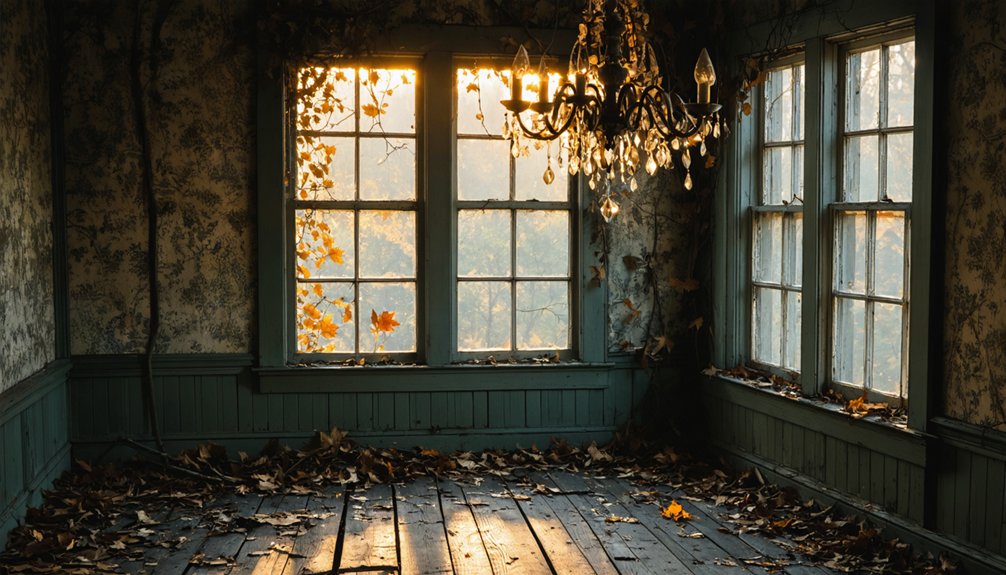
You’ll find Elkmont’s transformation from a bustling lumber town to an exclusive mountain resort remarkable, as the Little River Lumber Company’s land sales in 1910 led to the creation of the prestigious Appalachian Club and Wonderland Hotel.
The establishment of the Great Smoky Mountains National Park in 1934 marked the beginning of the end for this thriving community, as residents were forced to either sell their properties or accept limited-time leases.
Today, you can walk among the haunting remains of approximately 70 abandoned structures, including the deteriorating Wonderland Hotel and numerous vacation cottages, which stand as silent witnesses to Elkmont’s glamorous past.
Elite Mountain Resort Era
During the early 1900s, Elkmont’s transformation from a logging town to an exclusive mountain resort began when the Little River Lumber Company sold 50 acres to wealthy Knoxville outdoorsmen in 1910.
The Appalachian Club quickly established itself as the premier destination for elite vacationers, with a grand clubhouse and luxurious cottages dotting the Daisy Town area.
By 1912, the Wonderland Hotel joined the scene, offering 50 elegant rooms and sweeping views of the valley.
You would’ve found the area’s wealthy residents enjoying lavish parties, dances with live music, and a custom-built swimming hole.
The “Elkmont Special” train shuttled distinguished guests to and from Knoxville, while both clubs expanded their properties throughout the 1920s, creating a mountain paradise for East Tennessee’s social elite.
Decline After National Park
As Great Smoky Mountains National Park emerged in 1934, Elkmont’s luxury resort era faced a pivotal turning point.
You’ll find the decline dynamics began when residents received an ultimatum: sell their properties for full value and leave immediately or accept discounted prices for lifetime leases. While most chose lifetime leases, the park impact became evident as these agreements expired between 1992 and 2001.
You can trace the transformation into the “Elkmont Ghost Town” as roughly 70 historic buildings fell into disrepair without their caretakers.
The National Park Service’s assessment revealed many structures beyond salvation. Though preservation efforts launched in 1992 and earned National Register status in 1994, only 19 of 60 buildings survived for restoration under a 2009 agreement, supported by a $9 million endowment from Friends of the Smokies.
Haunting Ruins Today
Today’s haunting ruins of Elkmont stand in stark contrast to its glamorous past, with nearly 20 restored historical structures offering glimpses into the area’s prestigious resort era.
You’ll discover a ghost town that’s just minutes from bustling Gatlinburg, where the Park Service has carefully preserved select buildings that showcase the community’s historical significance.
As you explore the Elkmont trail, you’ll encounter abandoned structures that tell stories of former luxury – crumbling chimneys, weathered staircases, and old foundations dot the landscape.
The dismantled Wonderland Hotel, once a symbol of elite social gatherings, now exists only in fragments.
Since restoration efforts began in 2009, the preserved Appalachian Club and surrounding cabins serve as silent witnesses to the transformation from an exclusive summer retreat to one of the South’s most intriguing ghost towns.
Planning Your Southern Ghost Town Road Trip
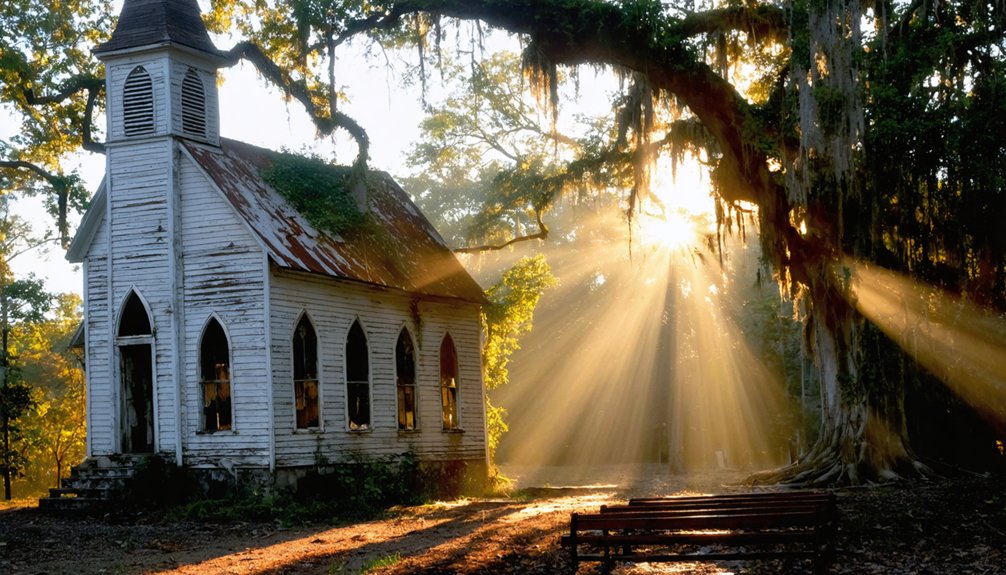
While planning a ghost town road trip through the American South requires careful consideration of seasonal weather and accessibility, the region’s abandoned settlements offer a fascinating journey through the area’s gold mining, timber, and industrial heritage.
For ideal ghost town logistics and seasonal considerations, follow these essential guidelines:
- Time your visit during spring or fall to avoid the scorching summer heat in Texas and intense winter conditions in higher elevations.
- Connect Auraria, Georgia to Buffalo City, North Carolina via I-85 and US-64 for a manageable 6-hour drive through historic mining territory.
- Pack essential supplies, as most locations lack facilities, and bring detailed GPS coordinates since cell service is unreliable.
- Allow 2-3 hours per site, with extra time for photographing preserved structures and exploring safely marked paths.
Frequently Asked Questions
Are Any of These Ghost Towns Legally Open for Overnight Camping?
You’d think Southern ghost towns welcome campers, but they’re surprisingly restrictive. Most require overnight permits or don’t allow camping at all, unlike Western ghost towns on BLM land.
What Paranormal Activity Has Been Reported in These Southern Ghost Towns?
You’ll encounter haunted legends of Chloe at Myrtles Plantation, spectral sightings at Cahawba’s slave quarters, Blackbeard’s ghostly crew in Beaufort, and shadowy figures rising from Alton’s First Unitarian Church basement.
How Safe Are These Abandoned Towns From Structural Collapse?
You’re flirting with disaster – structural integrity’s compromised in most buildings. Time and weather have ravaged original building materials, so you’ll want to stick to designated safe zones and guided tours.
Which Ghost Towns Still Have Active Property Owners or Residents?
You’ll find active residents and property ownership in Prairie Bluff’s gated subdivision, while Iosepa operates as a private ranch. Both maintain controlled access, preserving historical sites alongside modern living spaces.
Can Visitors Take Artifacts or Souvenirs From These Locations?
You can’t legally take artifacts or souvenirs from ghost towns. Artifact preservation laws protect these sites, and souvenir policies strictly prohibit removal. You’ll face criminal charges if caught collecting items.
References
- https://www.authentikusa.com/us-en/blog/english-top-5-villes-fantomes-aux-usa-maj
- https://quirkytravelguy.com/ghost-towns-of-the-deep-south/
- https://styleblueprint.com/everyday/ghost-towns-in-the-south/
- https://www.youtube.com/watch?v=l_ogVgvyw7Y
- https://www.narcity.com/this-road-trip-will-take-you-to-6-of-the-best-hidden-ghost-towns-in-the-dirty-south
- https://en.wikipedia.org/wiki/Lists_of_ghost_towns_in_the_United_States
- https://www.visittucson.org/blog/post/8-ghost-towns-of-southern-arizona/
- https://www.americansouthwest.net/ghost-towns.html
- https://whakestudios.com/us-ghost-towns/
- https://www.geotab.com/ghost-towns/