You’ll find Utah’s most compelling ghost towns scattered across its western regions, each offering unique glimpses into the state’s past. Grafton showcases Mormon pioneer life with well-preserved buildings, while Frisco’s violent mining history comes alive through its iconic beehive kilns. Silver City and Sego reveal industrial ruins from Utah’s mining heyday, and Irontown’s remnants tell the story of early iron production. These abandoned settlements hold centuries of fascinating tales within their weathered walls.
Key Takeaways
- Irontown, west of Cedar City, features preserved beehive-shaped kilns and foundry ruins from Utah’s early iron production industry.
- Frisco showcases well-preserved Bee Hive Kilns and remnants of the Horn Silver Mine that produced $20 million in precious metals.
- Grafton, established in 1859, offers visitors a glimpse of early Mormon settlement life along the Virgin River.
- Silver City contains the historic Stormont Silver Mill and stone-walled buildings from Utah’s second most valuable mining district.
- Thistle presents a unique modern ghost town experience, with partially submerged buildings resulting from the devastating 1983 landslide.
The Fascinating History of Grafton’s Mormon Settlement
While many ghost towns in Utah’s history faded into obscurity, Grafton’s Mormon settlement stands as a tribute to the determination and resilience of its early pioneers.
In 1859, Nathan Tenney led five families to establish this community along the Virgin River, embodying Brigham Young’s vision for Utah’s “Dixie” cotton-producing region. You’ll find that community cooperation defined their settlement philosophy, with residents working together to plant crops, construct homes, and develop irrigation systems. The settlers’ focus on cotton cultivation initially led to food shortages in the community.
Settlers united in Grafton to build Brigham Young’s cotton dream, working as one to forge a new community.
The settlement faced immediate challenges, particularly when the Great Flood of 1862 destroyed the original town site.
Despite relocating upstream and rebuilding, irrigation challenges persisted as river silt continuously clogged their water systems. Yet, they persevered, establishing a thriving stop along the Salt Lake City to California route and building a two-story adobe schoolhouse that became their community’s heart. The population reached its peak with 168 residents by 1864, marking the height of the settlement’s prosperity.
Frisco: The Wild West’s Most Notorious Mining Town
Unlike Grafton’s pastoral Mormon settlement, Frisco emerged as one of the West’s most untamed mining towns following the discovery of rich silver deposits in the San Francisco Mountains in 1875.
You’ll find ghostly legends surrounding this once-prosperous boomtown, where two murders occurred nightly amid its 23 saloons during the 1880s. The Horn Silver Mine fueled Frisco’s explosive growth, yielding over $20 million in precious metals by 1910.
But mining dangers caught up with the town when a catastrophic cave-in shook the earth in 1885, collapsing the mine’s infrastructure. Though operations resumed, Frisco never recovered its former glory. The town’s remote location at 6,489 feet elevation made survival even more challenging for remaining residents. Today, visitors can explore the well-preserved Bee Hive Kilns that once produced charcoal for the mining operations.
Sego’s Coal Mining Legacy in Grand County
As you explore Sego’s industrial ruins today, you’ll find the remnants of what was once Utah’s busiest coal camp, producing 1,500 tons of coal daily with a 150-person workforce in 1928.
The mine’s diverse labor force, comprising English, Scandinavian, Italian, Greek, African American, and Japanese workers, built a thriving community complete with the American Fuel Company Store, boarding houses, and the first coal washer west of the Mississippi. Visitors can also observe ancient Barrier-Canyon style pictographs adorning the canyon walls near the mining site.
While most structures have succumbed to time and flash floods, the remaining buildings and small private cemetery stand as evidence to the town’s coal mining heritage, now preserved as part of the Ballard-Sego Coal Mine Historic District. The site faced ongoing water supply problems that ultimately contributed to its operational challenges and eventual closure.
Mining Town Daily Life
Life in Sego revolved entirely around the coal mining operations that dominated the town’s existence from the early 1900s through the 1950s.
You’d find a diverse workforce of English, Scandinavian, Italian, Greek, African American, and Japanese miners following strict daily routines, living in ethnically segregated sections of the town. Community gatherings centered around the American Fuel Company Store and boarding house, which served as the town’s social hubs.
The town’s infrastructure supported miners’ basic needs, with the company providing power until 1927, though frequent breakdowns disrupted daily life. By May 1928, the town reached its peak as the busiest coal camp in Utah. Workers often received wages in company store scrip, which could only be redeemed at the local company-owned establishment.
You’d experience the challenges of irregular paydays and labor strikes, particularly after 1915 when profits declined. Despite these hardships, the miners maintained solidarity, eventually unionizing in 1933 and even purchasing the mine collectively in 1947.
Industrial Ruins Today
Today’s visitors to Sego encounter a haunting collection of industrial ruins that tell the story of Utah’s once-thriving coal industry.
You’ll find the remnants of innovative mining technology, including foundations of the West’s first coal washer and the historic tipple that processed up to 1,500 tons daily before its destruction by fire in 1949.
The site’s industrial heritage earned recognition on the National Register of Historic Places in 2017 as the Ballard-Sego Coal Mine Historic District.
The area’s rich history includes evidence of ancient pictograph sites that predate the mining operations by thousands of years.
While exploring the grounds, you’ll discover deteriorating company buildings, abandoned loading ramps, and the five-mile railroad bed that once connected Sego to Thompson Springs.
These weathered structures stand as silent witnesses to the boom-and-bust cycle that defined this pioneering coal operation’s nearly fifty-year run.
Silver City’s Industrial Ruins and Mining Heritage
While many ghost towns dot Utah’s landscape, Silver City’s industrial ruins stand as compelling remnants of the state’s mining heritage.
You’ll find the Stormont Silver Mill, built in the 1880s, with its distinctive stonewalled office building still marking the site. Nearly forty to fifty people lived and worked in the area during its peak operations. As you explore the area, you’ll encounter the haunting Babylon House ruins and other industrial structures that tell the story of this once-thriving mining center.
Located at the mouth of Dragon Canyon in the East Tintic Mountains, Silver City emerged following the Sunbeam claim discovery in 1869. The site’s mining legacy includes being part of Utah’s second most valuable mining district, with operations continuing until the mid-20th century.
Silver City rose from the East Tintic Mountains in 1869, becoming a vital part of Utah’s rich mining heritage.
Today, you can access these historic ruins via a rocky path, where the Fitch burial area and cemetery provide additional evidence to the area’s industrial past.
Old Irontown’s Pioneer Iron Production Story
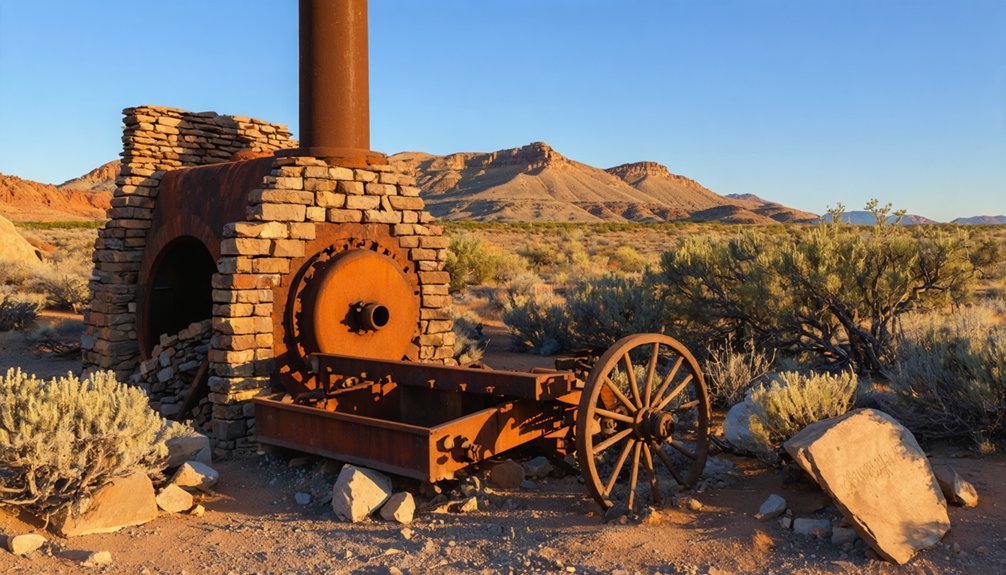
Beyond the silver-rich districts of Utah’s mining heritage lies the remarkable story of Old Irontown, established in 1868 as part of Brigham Young’s Iron Mission.
You’ll find this pioneering iron production center 24 miles west of Cedar City, where settlers once produced 5-7 tons of pig iron daily at its peak.
The town’s industrial heart featured beehive-shaped brick kilns where workers transformed juniper and pinyon pine into charcoal for smelting.
The sophisticated operation included a pattern shop, foundry, and an arastra for grinding materials.
Despite supplying the Utah Western Railroad and local mining companies, Irontown couldn’t survive the economic pressures of the 1870s.
By the late 1880s, it earned the distinction of becoming Utah’s first ghost town.
Today, you can explore the site’s historic remnants, including one preserved charcoal kiln, protected under the National Register of Historic Places.
Thistle: a Modern Ghost Town Born From Natural Disaster
Unlike most Western ghost towns that faded with depleted mines, Thistle, Utah met its fate through natural catastrophe in 1983.
You’ll find this former railroad town’s story uniquely tragic – a massive landslide disaster triggered by record precipitation and rapid snowmelt destroyed the community virtually overnight. The slide created Thistle Lake, submerging the town and severing crucial rail and highway connections between Denver and Salt Lake City.
Before its demise, you could’ve witnessed a bustling junction serving steam locomotives, with a population peaking at 600 in 1917.
Today, you can explore ghost town remnants including water-damaged homes, rusting railroad artifacts, and a half-sunken house in the bog – stark reminders of America’s costliest landslide, totaling over $200 million in damage.
Frequently Asked Questions
Are Any of These Ghost Towns Haunted According to Local Legends?
You won’t find documented ghostly encounters or local folklore about hauntings in these towns. While they’re rich in frontier history, none of their historical records mention supernatural activity.
What Is the Best Time of Year to Visit These Ghost Towns?
You’ll find spring and fall offer ideal seasonal weather for ghost town exploration, with mild temperatures, stable road conditions, and best photography opportunities. Plus, you’ll enjoy fewer crowds than summer’s peak season.
Do You Need Special Permits to Explore These Abandoned Towns?
You’ll rarely need permits for basic exploration on BLM lands, but private properties require owner permission. Historic sites with significant archaeological value may demand special documentation for access and research.
Can Visitors Take Artifacts or Souvenirs From These Ghost Towns?
You can’t legally remove artifacts – it’s prohibited by souvenir regulations. Instead, document your discoveries through photography to support artifact preservation while avoiding hefty fines and potential criminal charges.
Are There Guided Tours Available at Any of These Locations?
Guided ghost tours greet you in Salt Lake City and Grafton, where tour companies lead haunted explorations. You’ll find self-guided options at Eureka, Frisco, and other mining sites throughout Utah’s wilderness.
References
- https://www.axios.com/local/salt-lake-city/2024/09/03/utah-best-ghost-towns-mine-abandoned
- https://www.utah.com/things-to-do/attractions/old-west/ghost-towns-in-utah/
- https://www.utahlifemag.com/blog/post/4-ghost-towns
- https://www.valleyjournals.com/2024/10/02/507818/exploring-utah-s-ghost-towns-seven-abandoned-settlements-with-fascinating-histories
- https://www.atlasobscura.com/things-to-do/utah/ghost-towns
- https://www.utahvalley.com/plan/day-trips-itineraries/history-buff/ghost-towns-and-haunted-places/
- https://www.youtube.com/watch?v=FLdClYRU0bY
- https://www.legendsofamerica.com/ut-grafton/
- https://graftonheritage.org/history-settlement/
- https://www.hannahhendersontravel.com/grafton-ghost-town-utah/