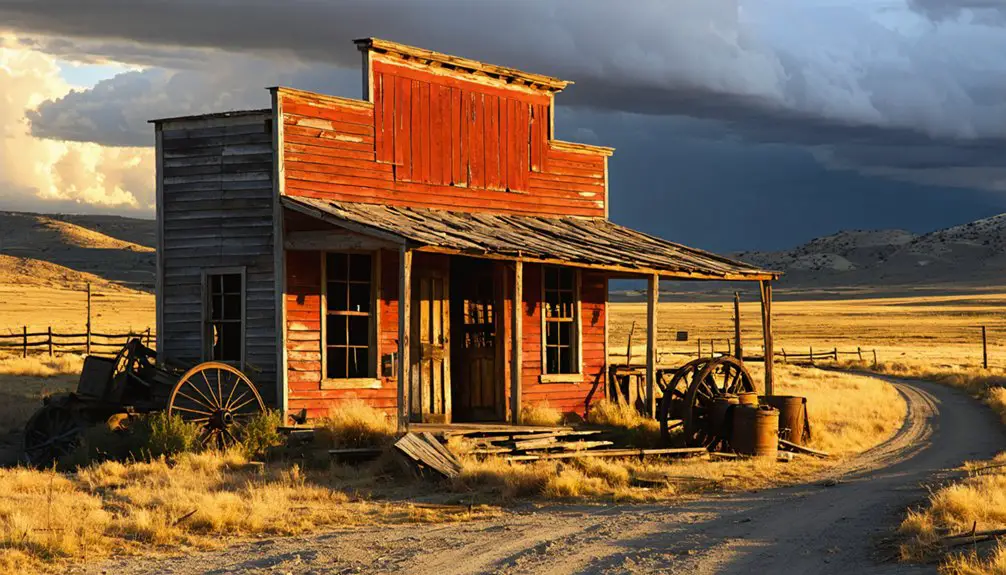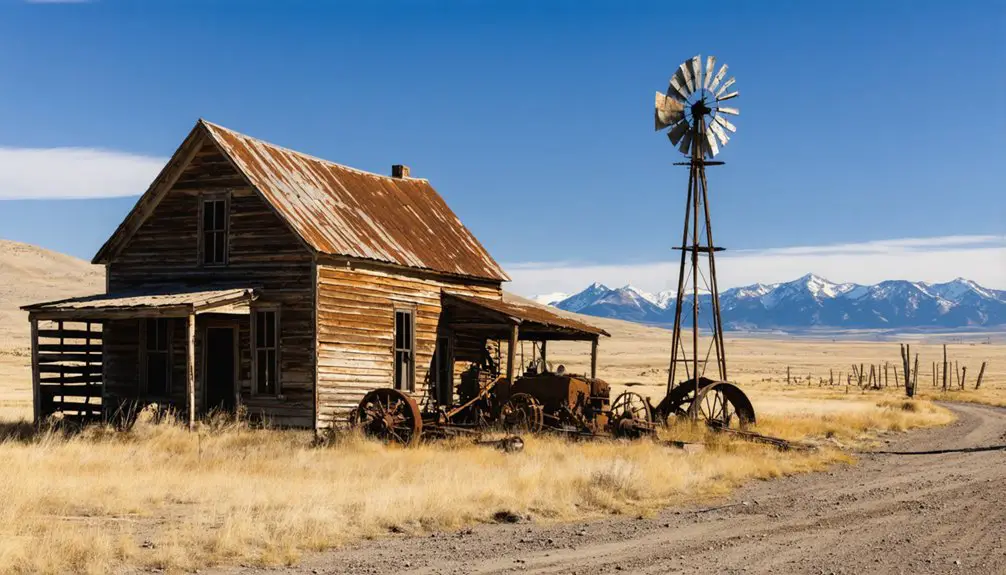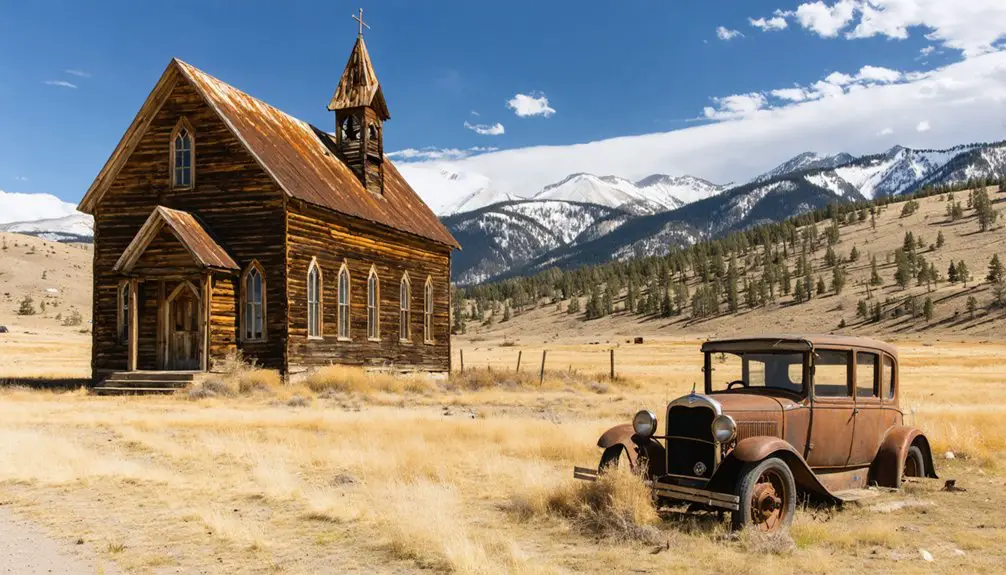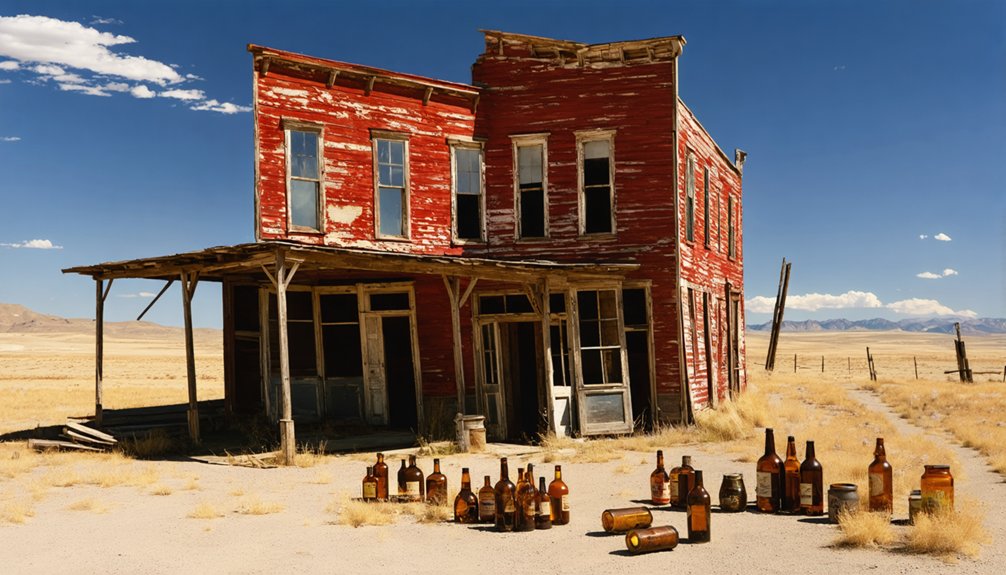
You’ll find Wyoming’s most remarkable ghost towns scattered across its historic mining districts. South Pass City stands out with 23 original structures and 30,000 artifacts, while Piedmont’s preserved charcoal kilns showcase 19th-century industrial innovation. Kirwin’s mountain ruins reveal extensive mine tunnels, and Miners Delight holds tales of Calamity Jane’s presence. The notorious yet short-lived Benton, with its wild reputation and Mormon pioneer connections, offers fascinating insights into Wyoming’s frontier past.
Key Takeaways
- South Pass City offers the most well-preserved ghost town experience with 23 original structures and 30,000 authentic artifacts.
- The Piedmont Kilns showcase unique industrial history with three preserved charcoal kilns from Wyoming Territory’s early development.
- Miners Delight features historic ruins and was once home to famous frontier figures like Calamity Jane.
- Benton exemplifies Wyoming’s wild frontier past with its brief but dramatic history of lawlessness and violence.
- Kirwin preserves extensive mining infrastructure with eighteen mine sites and 15,000 feet of exploratory tunnels.
Discover Wyoming’s Most Preserved Mining Town: South Pass City
Founded in 1867 by Mormon prospectors who struck gold in the Wind River Mountains, South Pass City rapidly emerged as Wyoming Territory‘s second incorporated city and the Sweetwater Mining District’s most significant settlement.
At its peak in 1870, you’ll find a bustling community of 1,000 residents occupying 250 buildings along a half-mile main street, where hotels, saloons, and businesses thrived. The town made history when it became home to first female officeholder Esther Hobart Morris. The U.S. Army established Fort Stambaugh nearby to protect the settlers and miners.
Today, this remarkable example of historic preservation features 23 original structures housing 30,000 authentic artifacts. The town’s mining heritage lives on through the restored Carissa Mine, which produced a significant portion of the district’s estimated $7 million in precious metals.
Since Wyoming’s purchase of the site in 1966, you can explore meticulously preserved cookhouses, bunkhouses, and the operational machinery that once powered this frontier boomtown.
Piedmont Kilns: a Glimpse Into 19TH Century Industry
While South Pass City preserved Wyoming’s mining heritage, another industrial marvel emerged in the state’s southwest corner. The Piedmont Charcoal Kilns, built in 1869 by Mormon pioneer Moses Byrne, stand as evidence of Wyoming Territory’s industrialization. The timber-rich Uinta Mountains nearby provided an abundant supply of raw materials for production.
These remarkable beehive-shaped structures, rising 30 feet high, played a significant role in charcoal production for Utah’s iron smelting industry. The town eventually became a vital railroad helper station with a roundhouse and water tank.
The historical significance of these kilns is evident in their:
- Peak production of 100,000 bushels monthly by 1873, supplying essential fuel to Salt Lake Valley smelters
- Strategic location along the Union Pacific Railroad, facilitating efficient distribution
- Unique limestone construction that’s preserved three of the original five kilns
You’ll find these enduring monuments to frontier industry 10 miles southwest of Evanston, where they’ve earned their place on the National Register of Historic Places.
Exploring Kirwin’s Mountain Mining Heritage
Deep in Wyoming’s Wood River headwaters, the discovery of gold ore in 1885 by prospectors Harry Adams and William Kirwin transformed a pristine wilderness into one of the territory’s most sophisticated mining settlements.
You’ll find evidence of their ambitious venture in the remnants of eighteen mines that once boasted 15,000 feet of exploratory tunnels reaching depths of 1,500 feet.
The town took a unique path by becoming a controlled mining community that prohibited saloons and gambling establishments.
At its peak, the town flourished with a post office and hotel, serving the needs of roughly 200 residents.
Despite promising assays showing high-grade ore samples worth up to $600 per ton, mining challenges proved insurmountable.
The remote location’s harsh conditions and prohibitive transportation costs prevented profitable operations. A devastating avalanche in 1907 killed three people and hastened the town’s decline.
While several companies attempted to revive mining operations through subsequent decades, Kirwin’s golden dreams remained elusive, leaving behind a monument to frontier determination.
Hidden Treasures of Miners Delight
When gold was discovered in Spring Gulch in 1867, a promising settlement called Hamilton City quickly emerged before being renamed Miners Delight after Jonathan Pugh’s successful mine on Peabody Hill.
This remarkable ghost town, now managed by the BLM, offers you a fascinating glimpse into Wyoming’s rich mining history.
- The Miners Delight Mine produced over $5 million in gold ore, utilizing a wood-fired, steam-powered 10-stamp mill for crushing operations.
- Notable residents included Calamity Jane and Henry Tompkins Paige Comstock, who later discovered Nevada’s famous Comstock Lode.
- Despite multiple revival attempts throughout the years, including during the Great Depression, the town’s population dwindled as gold recovery costs exceeded its value.
The town reached its peak with 75 permanent residents during the height of mining operations.
Today, you’ll find crumbling ruins and a few standing buildings that serve as silent witnesses to the boom-and-bust cycle of Western mining towns.
In March 1893, the town was shaken by the infamous brass lock mystery when eight registered letters were stolen during transit to Rawlins.
Three-Month Wonder: The Rise and Fall of Benton
As the Union Pacific Railroad carved its path westward in 1868, the temporary settlement of Benton emerged at milepost 672.1, just 11 miles east of present-day Rawlins, Wyoming.
Within weeks, this railroad construction town swelled to 3,000 residents, transforming into a haven of revelry and lawlessness.
From desolate plains to a teeming den of vice, Benton exploded with 3,000 souls seeking fortune in the wild West.
You’d have found a transient population dwelling in makeshift tents, where 25 saloons and five dance halls catered to fortune-seekers and outlaws.
At the infamous “Big Tent,” medicine and vice intermingled, while cheap whiskey flowed more freely than water. The signature drink was forty rod whiskey, a lethal concoction that sold for just five cents a glass.
Over 100 people met violent deaths during Benton’s brief existence, with daily gunfights becoming routine.
Notably, the town served as a critical waypoint for 2,000 Mormon pioneers heading to Utah Territory that year.
Frequently Asked Questions
What Safety Precautions Should Visitors Take When Exploring Wyoming Ghost Towns?
Bring safety gear for crumbling ruins and wildlife awareness for bears. You’ll need sturdy boots, first-aid supplies, extra water, offline maps, and bear spray when exploring these remote, untamed sites.
Are There Guided Tours Available at Any of These Ghost Towns?
You’ll find professional guided tours at Kirwin through Cody-based operators, while Old Trail Town and Cheyenne offer local guides. Most other ghost towns require self-guided exploration with proper planning.
Can Visitors Collect Artifacts or Souvenirs From Wyoming Ghost Towns?
No, you can’t collect artifacts – it’s illegal under federal and state laws. Artifact preservation requires leaving items undisturbed. Souvenir regulations strictly prohibit removing anything from ghost town sites.
What Is the Best Time of Year to Visit Ghost Towns?
Play it safe and visit between late spring and early fall, when you’ll find ideal seasonal highlights like accessible roads and pleasant weather conditions. Winter’s heavy snow makes most sites unreachable.
Are Camping or Overnight Stays Allowed Near These Ghost Towns?
You’ll find camping regulations vary by location – most ghost towns on public lands allow dispersed camping with 14-day limits, but you’ll need overnight permits for sites within protected areas.
References
- https://www.tripadvisor.com/Attractions-g28973-Activities-c47-t14-Wyoming.html
- https://www.wyomingcarboncounty.com/blog/123-5-ghost-towns-to-explore
- https://www.onlyinyourstate.com/experiences/wyoming/creepy-ghost-towns-in-wy
- https://mycountry955.com/would-you-stay-in-any-of-wyomings-great-ghost-towns/
- https://www.youtube.com/watch?v=GEoxbcwf8Ks
- https://sites.rootsweb.com/~wytttp/ghosttowns.htm
- https://en.wikipedia.org/wiki/List_of_ghost_towns_in_Wyoming
- https://www.susantregoning.com/blog/south-pass-city
- https://www.legendsofamerica.com/wy-southpasscity/
- https://wyoshpo.wyo.gov/index.php/programs/national-register/wyoming-listings/view-full-list/568-south-pass-city