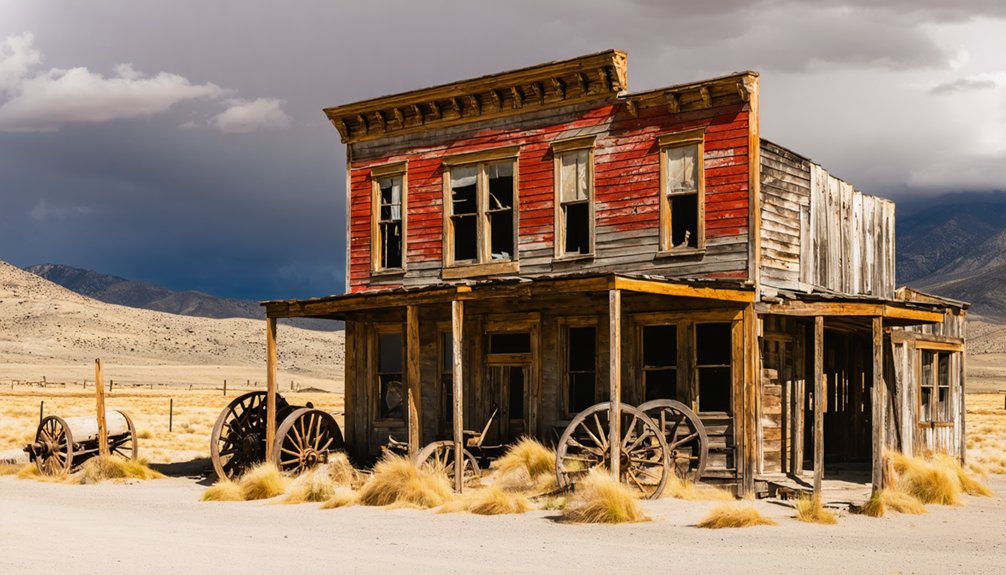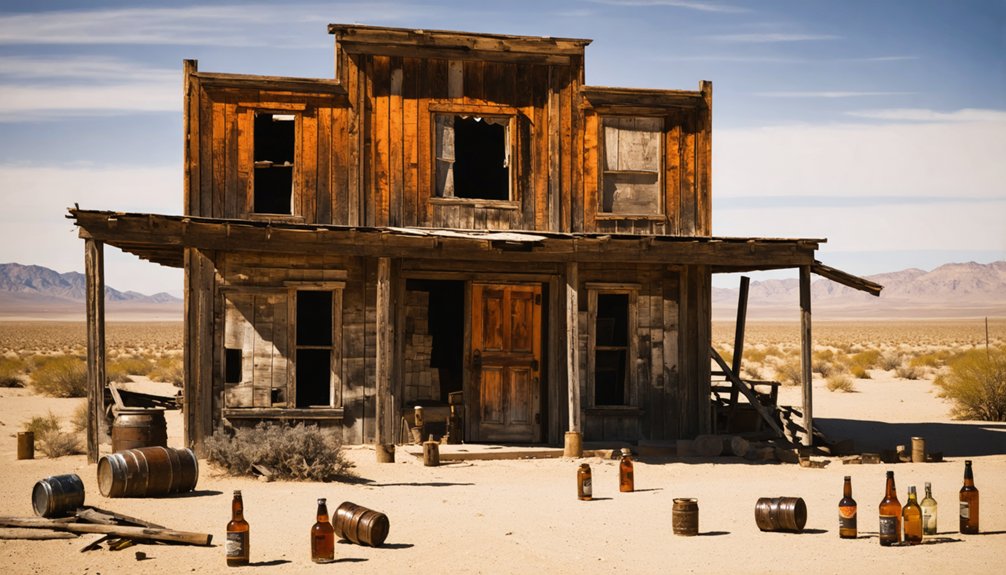
You’ll find several remarkable ghost towns near Death Valley, with Rhyolite, Nevada being the most accessible and impressive. This former boomtown, just 35 miles east of Furnace Creek Visitor Center, features the iconic Bottle House built from 50,000 beer bottles and ruins of the grand Cook Bank Building. While Rhyolite leads the pack, other notable sites include Cerro Gordo’s silver mines, Ballarat’s supply hub, and Skidoo’s profitable gold operations. The desert holds many more forgotten stories within its weathered walls.
Key Takeaways
- Rhyolite stands as Death Valley’s most accessible and well-preserved ghost town, featuring iconic structures like the Bottle House and Cook Bank ruins.
- Cerro Gordo offers guided tours of its rich mining history, though it requires a high-clearance vehicle to access.
- Ballarat served as a crucial supply hub for Death Valley miners and remains an interesting destination for history enthusiasts.
- Skidoo earned fame as Death Valley’s most profitable ghost town during the region’s mining boom.
- Chloride City provides visitors with silver mining history and requires 4WD vehicles to reach its remote location.
Understanding Death Valley’s Mining Legacy
While the California Gold Rush of 1849 sparked initial mining interest in Death Valley, systematic operations didn’t begin until the late 1850s.
You’ll find that early prospectors faced brutal challenges: extreme heat, primitive mining technology, and fierce indigenous resistance from Paiute tribes protecting their ancestral lands.
The real breakthrough came in the 1880s when borax mining transformed the region’s economy. Borax became known as white gold due to its tremendous commercial value and over 100 industrial uses.
Borax mining revolutionized Death Valley’s economic landscape in the 1880s, marking a pivotal shift from gold to industrial minerals.
The iconic twenty-mule teams hauled three tons of borax daily from Harmony Borax Works, while gold discoveries at Bullfrog, Skidoo, and Chloride Cliff sparked a second wave of mining fever in the early 1900s.
By 1905, you could find at least 20 mining parties working claims worth up to $500 per ton.
The industry’s golden age ended abruptly with the 1907 financial panic, though some operations continued until 2005. The discovery by Aaron and Rosie Winters in 1881 had launched the entire borax mining era.
Exploring Rhyolite: Nevada’s Grand Ghost Town
You’ll discover Rhyolite’s remarkable story beginning with prospectors Harris and Cross finding gold in 1904, which sparked a boom that attracted 5,000 residents within six months and led to the construction of impressive structures like the three-story Cook Bank building.
The town’s vibrant community once supported fifty busy saloons and numerous gambling establishments. The area’s geology features unique volcanic formations where light-colored rhyolite rock, formed from high-silica magma, dominates the surrounding landscape.
While the town’s prosperity proved short-lived, with most residents departing by 1910 as ore quality diminished, you can still explore fascinating ruins including the famous Bottle House made from 50,000 beer bottles and the weathered walls of the Cook Bank.
Today’s visitors can combine historical sightseeing at the preserved structures with a stop at the Goldwell Open Air Museum, featuring unique desert sculptures near the ghost town’s entrance.
Historical Rise and Fall
After prospectors Shorty Harris and Ernest L. Cross struck gold in Bullfrog Hills in 1904, Rhyolite’s Economy exploded into one of Nevada’s most promising boomtowns.
Within months, a tent city emerged, and by 1907, you’d have found yourself among 5,000-10,000 residents enjoying modern amenities. The city’s remarkable growth included a network of 400 electric streetlights illuminating the bustling streets. A magnificent three-story schoolhouse was constructed in 1909, costing $220,000 to build.
During the Mining Boom, you would’ve witnessed:
- The Montgomery Shoshone mine processing 300 tons of ore daily
- Three banks, including the impressive three-story John S. Cook building
- Four stage lines, electricity, and the Las Vegas and Tonopah Railroad
But the boom wouldn’t last.
The 1907 financial panic, dwindling high-grade ore, and the San Francisco earthquake’s disruption of rail services triggered Rhyolite’s rapid decline.
Preserved Architectural Treasures
Today’s visitors to Rhyolite can explore remarkable architectural remnants that showcase the town’s former grandeur.
You’ll find the innovative Bottle House, built in 1905 using 50,000 beer and liquor bottles – a representation of frontier resourcefulness and mining heritage. This unique piece of bottle architecture, later restored by Paramount Pictures in 1925, served as a family home until 1989.
The town’s wealthy past lives on in the Cook Bank Building’s marble staircases and the Mission Revival railroad depot, both completed in 1908 at $130,000 each. The arrival of steel magnate Charles M. Schwab brought significant development and modernization to the town.
You can still see traces of Rhyolite’s sophisticated infrastructure, including remnants of concrete sidewalks and electric lamp posts. The three-story commercial building and miners’ union hospital stand as enduring symbols of the town’s ambitious development during its brief but prosperous heyday. During its peak years between 1907-1908, the bustling mining town supported a thriving population of 3,500 to 5,000 residents.
Essential Visitor Information
Located just 35 miles east of Death Valley’s Furnace Creek Visitor Center, Rhyolite stands as one of Nevada’s most accessible ghost towns.
You’ll find this free-admission site open daily from sunrise to sunset, with October through May offering the most comfortable weather for ghost town photography and desert wildlife viewing.
For the best experience, plan your visit with these essential details:
- Access via paved Highway 374, just 4 miles west of Beatty, Nevada
- GPS coordinates: N 36°54′14″ W 116°49′45″ at 3,819 feet elevation
- Day use only facility – no overnight stays permitted
The three-story bank building remains one of the most impressive structures still visible at the site today.
While exploring, you’ll discover the Tom Kelly Bottle House, restored in 1925, and the Goldwell Open Air Museum nearby. The area flourished during the early 1900s when the Bullfrog Mining District produced over 112,000 ounces of gold.
Both sites complement your ghost town adventure with unique historical and artistic elements.
The Rise and Fall of Panamint City
Deep within Surprise Canyon, Panamint City’s story began in 1872 when an outlaw stumbled upon valuable silver outcrops. The discovery sparked a partnership between prospectors and bandits, leading to a mining boom that drew thousands to this remote location.
By 1874, you’d have found a bustling town of 2,000 residents stretching 1.5 miles, complete with a bank, brewery, and over twelve saloons.
The town’s fortunes shifted dramatically when Senator Jones and Bill Stewart invested $2 million in 1875, building a 20-stamp mill.
But the celebration was short-lived – ore deposits proved disappointing, and most residents abandoned the settlement by 1876.
Nature delivered the final blow when a devastating flash flood tore through Surprise Canyon in July 1876, destroying much of what remained.
Cerro Gordo: Silver Mining’s Violent Past
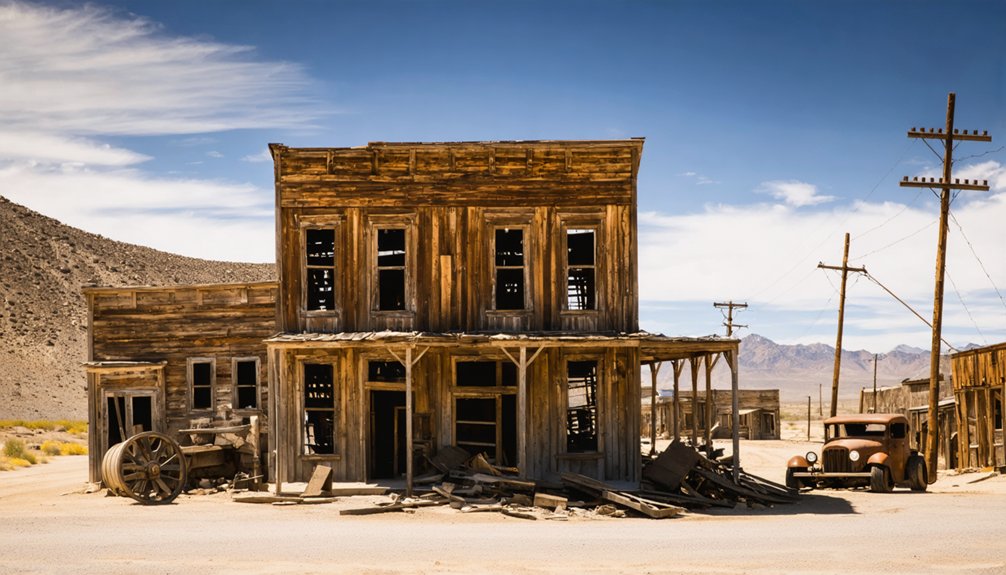
As Mexican miners ventured into the Inyo Mountains in 1865, they discovered rich silver deposits that would transform Cerro Gordo into California’s largest silver producer.
You’ll find this remote mining town’s violent past reflected in tales of organized crime and deadly confrontations over precious metals.
During its peak, Cerro Gordo’s wild reputation stemmed from:
- Weekly murders that plagued the bustling town of 1,500 residents
- Armed robberies targeting Wells Fargo shipments and U.S. mail along transport routes
- Violent clashes between rival mining companies fighting over claims
Despite the mining violence, Cerro Gordo’s operations flourished, extracting nearly $500 million in minerals from 30 miles of mines.
The town’s eleven active mines, sophisticated water delivery system, and aerial tramway supported its massive silver production until its eventual decline.
Ballarat: Where History Meets the Present
When George Riggins established Ballarat in 1896, he envisioned a thriving supply hub for the surrounding Panamint Mountain mining operations. Named after Australia’s gold country, this desert outpost quickly grew to 500 residents, boasting seven saloons, three hotels, and essential services – though significantly, no church.
Your Ballarat history exploration will reveal a town that flourished through the Ratcliff Mine’s success, which produced 15,000 tons of gold ore between 1898 and 1903.
The Ratcliff Mine fueled Ballarat’s golden era, yielding an impressive 15,000 tons of precious ore during its five-year peak.
You’ll find that after the mine’s closure, the town gradually declined until its post office shuttered in 1917. Notable characters like “Shorty” Harris and Seldom Seen Slim continued prospecting here into the 1930s.
Today, during your ghost town exploration, you’ll discover adobe ruins, a morgue/jail building, and Shorty Harris’s cabin foundation – silent witnesses to Ballarat’s golden age.
Chloride City’s Brief but Notable Existence
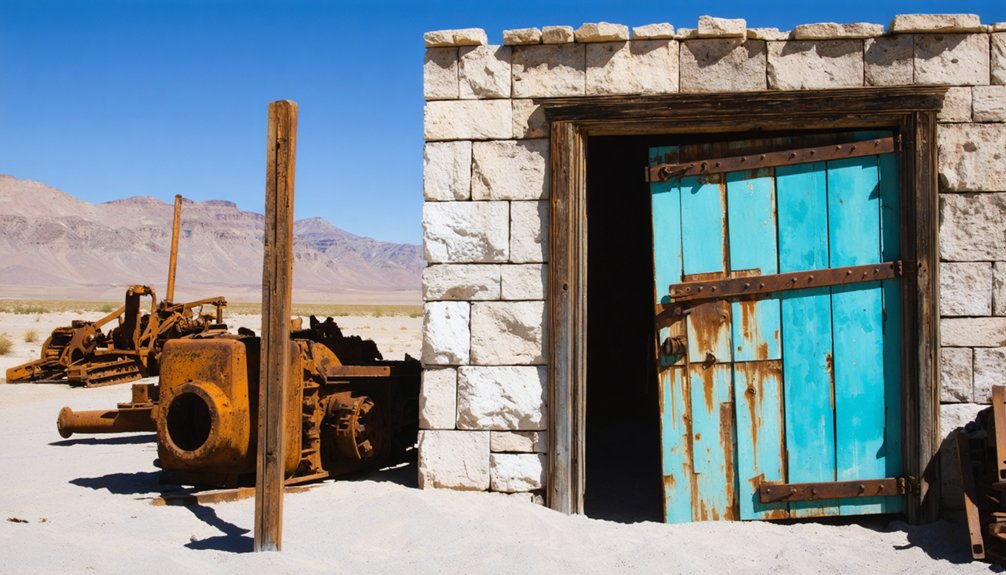
The accidental discovery of silver in 1871 launched Chloride City’s dramatic but fleeting story in Death Valley’s Funeral Mountains. When August Franklin used a rock to kill a rattlesnake, he stumbled upon ore worth up to $1,000 per ton, establishing the Chloride Cliff Mine with seven claims.
You’ll find three distinct phases that shaped this mining boom town:
- Initial mining phase (1871-1873): Seven miners worked the shaft while mule trains made quarterly supply runs.
- Dormant period (1873-1905): Claims maintained until Franklin’s death.
- Final boom (1905-1906): Town emerged with stamp mills, assay office, and support buildings.
Today, you can explore Chloride City’s remnants at 4,770 feet elevation, including numerous adits, waste rock dumps, and a preserved Cousin Jack cabin – silent witnesses to Death Valley’s brief but intense mining history.
Skidoo: Gold Rush Dreams and Desert Justice
Dreams of golden riches drew fortune seekers to Tucki Mountain in 1906, establishing what would become Death Valley’s most profitable ghost town – Skidoo.
You’ll find evidence of the town’s brief prosperity in the remains of its 15-stamp mill and the ambitious 20-mile water pipeline that once sustained nearly 700 residents.
Skidoo’s legacy reveals both civilization and desert lawlessness. While the town boasted modern amenities like telephone service, a bank, and a school, it’s also remembered for the 1908 vigilante lynching of Joe “Hooch” Simpson after he murdered James Arnold.
Wild West justice met modern progress in Skidoo, where telephones and schools stood alongside frontier-style vigilante executions.
The town produced an impressive $1.5 million in gold before declining by 1917.
Today, you can explore the mill ruins and scattered foundations, though you’ll need a high-clearance vehicle to navigate the remote, unpaved roads to this National Register site.
Planning Your Ghost Town Adventure
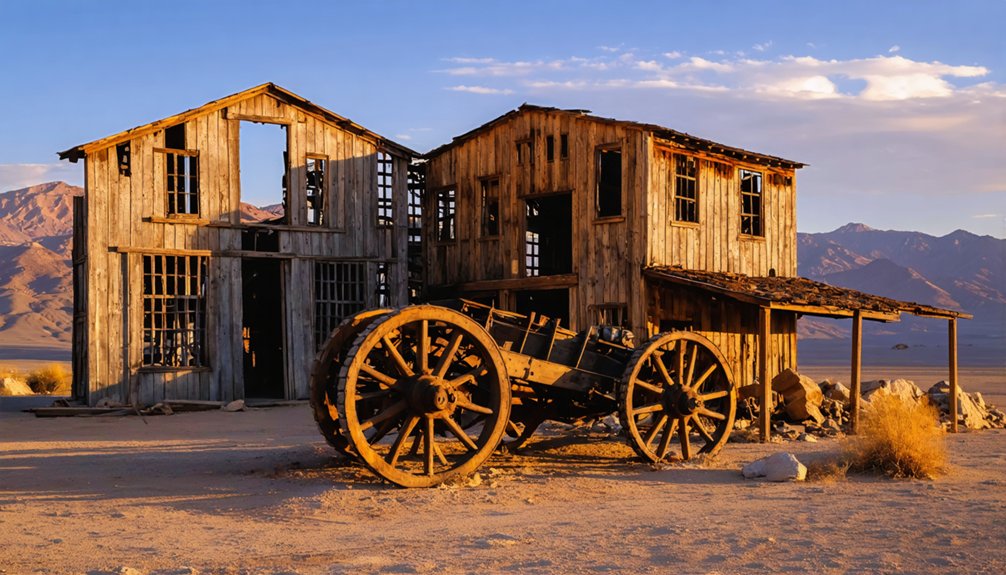
Exploring Death Valley’s ghost towns requires careful planning and the right vehicle for your chosen destinations. Before heading out, check road conditions by calling 760-786-3200 and secure necessary permissions for privately owned sites like Cerro Gordo.
Consider these ghost town logistics when planning your adventure:
- Vehicle requirements vary – while Rhyolite is accessible by passenger car, other sites like Chloride City demand high-clearance 4WD vehicles.
- Several routes become impassable during winter storms, particularly eastern access points that require chains.
- Most locations offer different experiences – from guided tours at Cerro Gordo to self-guided exploration at Rhyolite’s preserved ruins.
You’ll find handouts at visitor centers detailing seven ghost towns within the park.
Safety Tips for Desert Ghost Town Exploration
Since abandoned buildings pose unique risks in remote desert locations, following proper safety protocols is essential for ghost town exploration.
Always bring essential survival gear including a reliable flashlight, N95 respirator, first aid supplies, and protective clothing. Scout building exteriors before entering and stay near load-bearing walls when inside.
Never explore alone – use the buddy system and inform a trusted contact of your plans. Bring navigation tools like offline maps and GPS, plus marking chalk to avoid getting lost in larger structures.
Watch for desert wildlife and pack defensive items like air horns or pepper spray. Keep recovery gear in your vehicle for off-road challenges. Pack plenty of water, sun protection, and emergency supplies.
If you encounter serious hazards, leave the property immediately to call for help.
Frequently Asked Questions
Are Ghost Towns Legally Protected From Artifact Removal or Vandalism?
You’ll face federal penalties for artifact removal or vandalism at ghost towns, as they’re strictly protected under laws like 36 CFR §2.1 that mandate artifact preservation and enforce vandalism consequences.
Can Visitors Stay Overnight in Any of These Ghost Towns?
You won’t find official overnight accommodations or camping options at these ghost towns. Cerro Gordo, Rhyolite, Ballarat, and Panamint City are strictly day-use sites with no permitted overnight stays.
Which Ghost Towns Are Most Suitable for Families With Young Children?
Ever dreamed of a Wild West adventure? You’ll find family friendly activities at Calico Ghost Town, with its safe Mystery Shack tours and gold panning, followed by Silver City’s engaging historical displays.
Do Any of These Ghost Towns Offer Guided Tours?
You’ll find guided exploration at Cerro Gordo, where a caretaker leads tours through the General Store museum and 1877 Hoist Works, highlighting the town’s historical significance. The other ghost towns offer self-guided visits.
What’s the Best Time of Year to Photograph Death Valley Ghost Towns?
As winter’s blanket lifts, you’ll find your best shots from late October through April. You’ll dodge scorching temps, catch golden-hour light, and enjoy milder weather for exploring remote ruins.
References
- https://theadventureportal.com/death-valley-cerro-gordo-ghost-town/
- https://quirkytravelguy.com/the-death-valley-ghost-town-my-visit-to-rhyolite-nevada/
- https://dvnha.org/info-trip-planning/ghost-towns/
- https://yesterdaysamerica.com/death-valley-ghost-towns-where-to-find-forgotten-boomtowns/
- https://www.moontravelguides.com/travel/national-parks/five-death-valley-ghost-towns-worth-the-trek/
- https://www.oasisatdeathvalley.com/connect/stories/discover-the-eerie-ghost-towns-of-death-valley/
- https://www.tripadvisor.com/Attractions-g143021-Activities-c47-t14-Death_Valley_National_Park_Inyo_County_California.html
- https://www.nps.gov/deva/learn/historyculture/death-valley-ghost-towns.htm
- https://www.youtube.com/watch?v=D3j9WyGv5O4
- https://www.youtube.com/watch?v=Jws7cXveMjQ