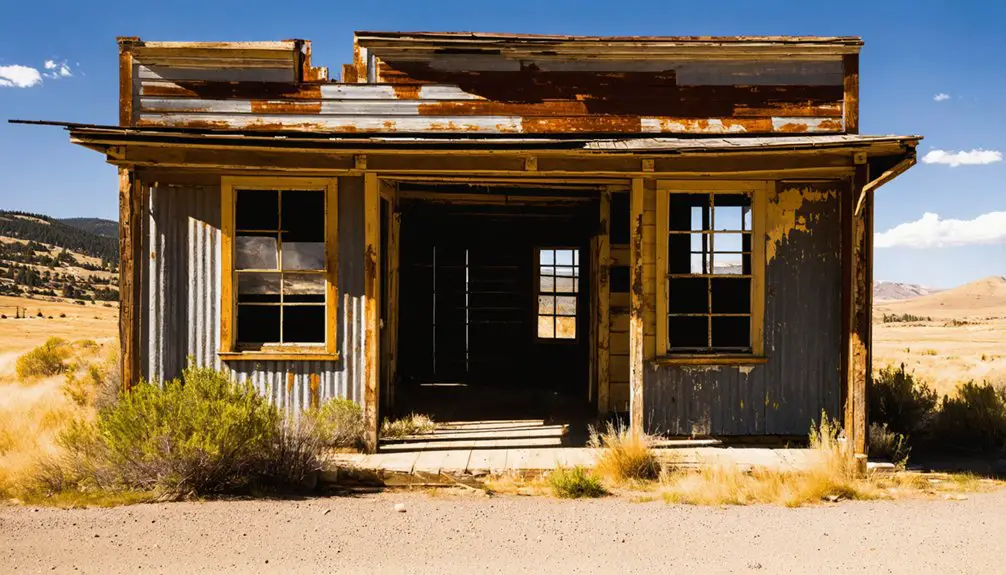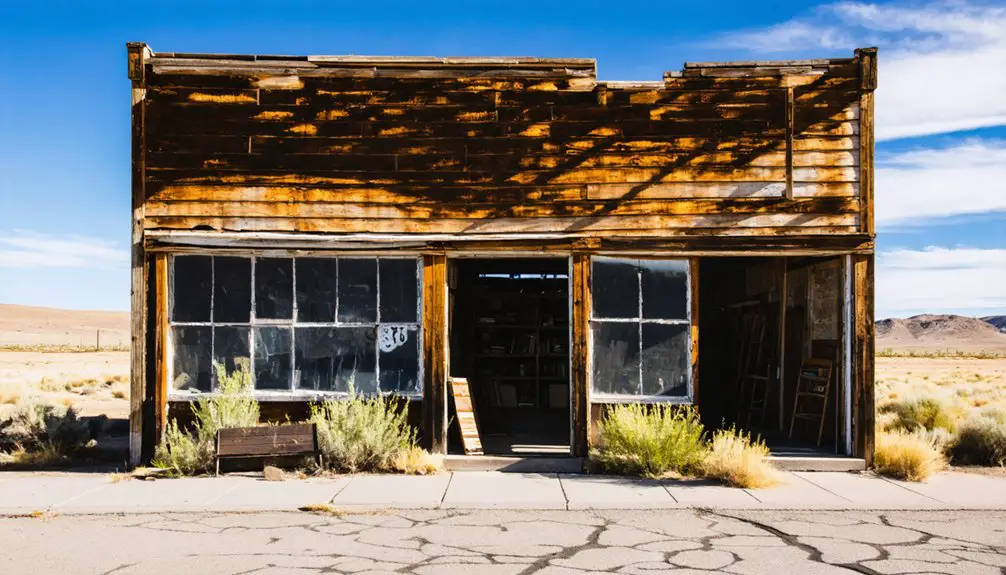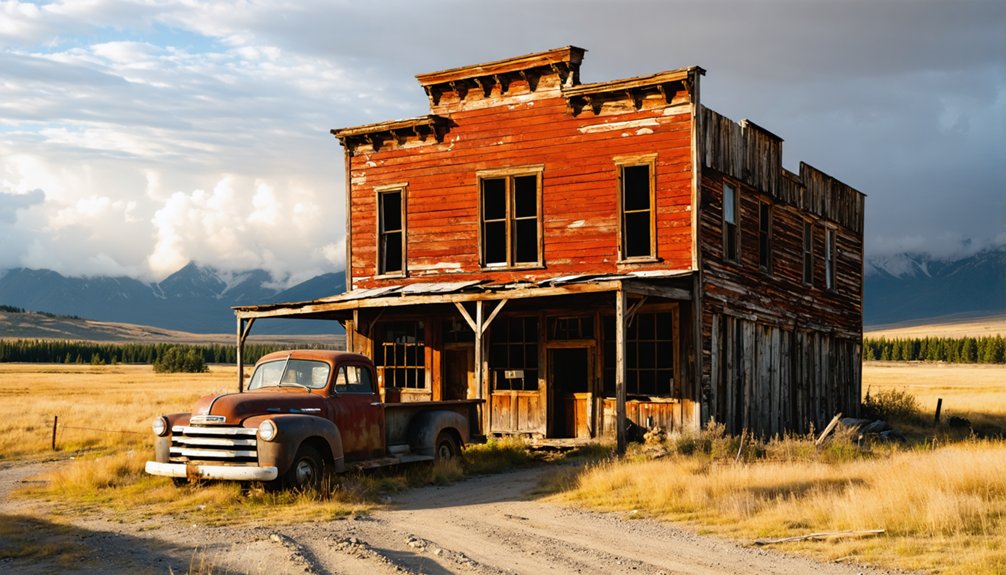
You’ll discover five remarkable ghost towns across Oregon’s historic landscape, each telling a unique frontier tale. Shaniko, once the “Wool Capital of the World,” showcases preserved Old West architecture, while Sumpter’s massive gold dredge stands as an engineering marvel. Golden’s churches reflect a different kind of settlement, and Buncom’s three restored buildings host lively annual celebrations. From Hardman’s skating rink to Millican Store’s tragic past, Oregon’s abandoned towns hold countless untold stories.
Key Takeaways
- Shaniko, once the “Wool Capital of the World,” features well-preserved Old West architecture and the historic Shaniko Hotel for visitors.
- Sumpter showcases the impressive Sumpter Valley Dredge, which extracted over $4 million in gold and is now a State Heritage Area.
- Golden offers a unique perspective of frontier life through its preserved buildings and history of being a morally strict settlement.
- Buncom maintains three historic buildings and hosts a popular annual celebration attracting over 500 visitors each May.
- Hardman and Millican Store represent authentic frontier settlements with original structures, though they’ve experienced significant decline over time.
Oregon’s Most Haunting Ghost Town: Shaniko
Three fires and a railway rivalry couldn’t erase Shaniko’s legacy as Oregon’s premier ghost town.
You’ll discover a town that once dominated the wool trade, shipping millions of pounds annually and earning the title “Wool Capital of the World” by 1903. At its peak in 1910, this bustling community of 600 residents witnessed record-breaking wool sales reaching five million dollars.
The wool warehouse, Oregon’s largest at the time, stands as a testament to the town’s economic might. Shaniko’s decline began when the Oregon Trunk Railroad bypassed the town in 1911, redirecting business to Bend. Devastating fires in 1910-1911 destroyed much of the downtown district, and without funds to rebuild, the wool empire crumbled.
Today, you can explore the preserved Old West architecture, including the recently reopened Shaniko Hotel, while walking among the historic boardwalks where just two dozen residents keep this remarkable piece of Oregon history alive. The Shaniko Days festival, held each August, brings the ghost town to life with music and local vendors.
The Gold Rush Legacy: Sumpter
You’ll find an impressive tribute to Oregon’s gold mining heritage in Sumpter, where the massive Sumpter Valley Dredge No. 3 still towers over its historic landscape.
The Sumpter Valley Railroad, which was built to transport timber to Baker City, brought essential resources to the region.
Three dredges operated in the valley between 1913 and 1954, processing over eight miles of terrain in search of precious metals.
This engineering marvel extracted over $4 million in gold between 1935 and 1954, operating every day except Christmas and Fourth of July with its 72 massive buckets processing tons of earth per minute.
Now preserved as a State Heritage Area, you can visit this historic district year-round to explore the restored dredge, museum exhibits, and artifacts that showcase Sumpter’s golden era.
Mining Equipment Still Stands
A marvel of Depression-era engineering, the Sumpter Valley Dredge stands today as a tribute to Oregon’s gold mining heritage. Built in 1934 from recycled parts, this massive dredge technology churned through the Powder River Valley 24/7, extracting over $4 million in gold – equivalent to $150 million today.
You’ll find the dredge preserved exactly as it operated, with its long row of buckets and internal mechanics that processed more than seven yards of earth per minute. Employees working the dredge reported encounters with the spirit of Joe Bush, adding a supernatural element to the site’s rich history. Visitors can explore the site from May to October when the park welcomes tourists for self-guided and ranger-led tours.
Now a State Heritage Area, you can explore the restored machinery that once employed just three workers to keep it running. While the dredge’s environmental impact permanently scarred the landscape, its historical significance earned it a spot on the National Register of Historic Places in 1971, where it continues to tell the story of Oregon’s mining era.
Historic District’s Golden Days
When five South Carolina prospectors stumbled upon gold near Cracker Creek in 1862, they couldn’t have imagined the bustling frontier town that would soon emerge.
The valley’s development mirrored other boomtowns where early placer mining dominated the initial gold extraction methods. You’ll find Sumpter’s historical significance deeply rooted in the evolution of gold mining techniques, from simple pans to massive dredging operations that shaped the landscape. The valley’s transformation was most evident through the Yuba-style dredge constructed in 1912, marking the beginning of industrial-scale mining in the region.
Year-Round Tourist Destination
Despite its boom-and-bust mining history, modern-day Sumpter stands as a reminder of successful heritage preservation, drawing visitors throughout all seasons.
Situated in the scenic Elkhorn Mountains, Sumpter offers breathtaking natural vistas that enhance the historic experience. You’ll find year-round activities centered around the massive 2.5 million-pound dredge, with maintained roads ensuring reliable access to this historic treasure. The three historic dredges operated in Sumpter Valley until 1954, leaving an indelible mark on the landscape. The state park’s daily tours and visitor accommodations make exploring the region’s gold mining legacy convenient in any weather.
- Walk through the 50-foot-tall dredge that once processed 9 cubic feet of material per minute
- Explore the historic district’s preserved mining equipment and distinctive tailings landscape
- Trek the Sumpter Valley Railroad trail for seasonal hiking and winter snowshoeing
- Visit nearby ghost towns and Blue Mountain trails for extended adventures
- Experience the original 1862 cabin sites via a short half-mile hike from Granite Road
Wild West Heritage: Golden’s Untold Stories
The remote mining settlement of Golden carved out a unique identity among Oregon’s Wild West towns, defying the typical image of a lawless frontier outpost. Founded by Reverend William Ruble in 1890, the town’s mining legacy was shaped by strict moral standards that banned saloons – a rarity in gold rush communities.
You won’t find tales of rowdy shootouts or gambling halls here. Instead, Golden’s story centers on a close-knit community built around two churches and strong family values.
Unlike its Wild West neighbors, Golden found its riches in faith and fellowship rather than frontier chaos.
While single miners sought their drinks elsewhere, the town flourished with orchards, a schoolhouse, and the bustling activity of 150 residents at its peak.
Though the gold eventually ran dry by the 1920s, Golden’s preserved buildings still whisper stories of a different kind of frontier life.
The Community Spirit of Buncom

While Buncom’s original structures have largely vanished, you’ll find its spirit alive through the dedicated Buncom Historical Society‘s preservation of three key buildings at the intersection of Sterling Creek and Little Applegate roads.
You can experience this heritage firsthand at the annual Buncom Day celebration, traditionally held on May’s last Saturday with music, food, crafts, and a parade that brings the ghost town briefly back to life.
Though the festival’s future remains uncertain as of 2025, the site’s significance as one of Oregon’s best-preserved ghost towns continues to draw visitors seeking connections to its mining camp origins and Wild West legacy.
Annual Festival Brings Life
Once a bustling mining supply center in Oregon’s Applegate Valley, Buncom springs back to life each May during its annual Buncom Day celebration.
You’ll find yourself transported back to the 1850s gold rush era as Buncom traditions draw over 500 visitors to this preserved ghost town. The event’s community engagement transforms three historic buildings into a vibrant gathering place where you can experience authentic Western heritage.
- Join the quirky half-block parade that circles four times, complete with tractors and local personalities
- Try your luck at chicken poop gambling, a uniquely entertaining betting game
- Explore the historic post office, bunkhouse, and cookhouse while ghost hunters record mysterious voices
- Savor Lion’s Club pulled pork sandwiches while enjoying live music and antique car displays
- Browse local author book signings and Friends of Ruch Library’s book sale
Historic Preservation Through Volunteers
Since its incorporation in 1990, dedicated volunteers through the Buncom Historical Society Foundation have safeguarded Oregon’s only designated ghost town in the southwest region.
You’ll find their volunteer initiatives focused on protecting three historic structures from the early 1900s: a post office, bunkhouse, and cookhouse, which survived when most buildings burned after gold mining ceased in 1918.
Despite preservation challenges, these buildings serve as tangible links to your region’s gold rush heritage.
Two structures were relocated from two miles downstream to establish the current site, while the post office received a new galvanized roof in January 2025.
While the buildings remain locked to prevent deterioration, you’re welcome to explore their exteriors and unfenced areas, thanks to a unique stewardship model balancing private ownership with public access.
Small Town, Strong Legacy
Although Buncom began as a Chinese mining camp in 1851, it quickly evolved into a vibrant community where diverse groups of settlers forged lasting connections.
You’ll find Buncom’s legacy deeply rooted in economic diversification, as the town adapted from mining to ranching, farming, and logging. Today, three historic buildings stand as silent witnesses to this remarkable past.
- The Phillips brothers established the first permanent white settlement, creating a foundation for future growth.
- Churches and community services shaped the town’s reputation as the “Driest ghost town of the West.”
- Miners, farmers, ranchers, and loggers worked side by side, building a diverse economy.
- The cookhouse and bunkhouse supported workers from all walks of life.
- Annual Buncom Day celebrations keep the town’s spirit alive through music, food, and the world’s shortest parade.
Hardman: A Tale of Changing Times
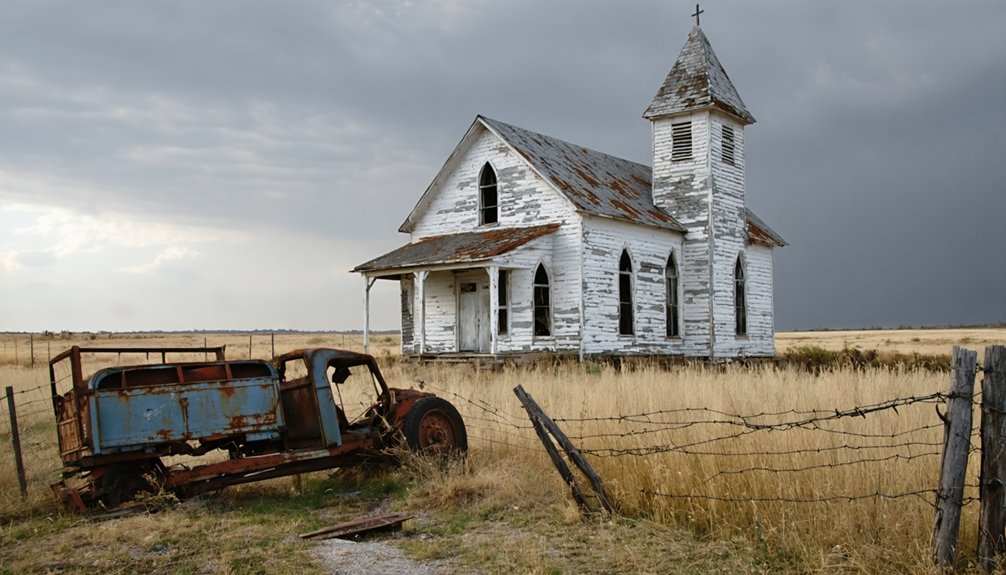
While many Oregon ghost towns faded quietly into history, Hardman’s transformation from bustling frontier community to near-abandonment tells a dramatic tale of changing times.
You’ll discover a town that evolved from the merger of Raw Dog and Yellow Dog, originally named Dairyville before becoming Dogtown, and finally Hardman in 1881 after David N. Hardman established his namesake post office.
At its peak, you’d have found a vibrant hub boasting three general stores, two hotels, and even a skating rink.
Hardman once bustled with life, offering frontier residents everything from essential supplies to entertainment at its skating rink.
Today, exploring Hardman’s history reveals how shifting transportation routes and economic changes spelled its decline. The creation of Highway 97 in 1917 sealed its fate, though about 20 year-round residents still call it home.
You’ll find dozens of weathered structures standing as evidence to this once-thriving frontier town.
The Eerie History of Millican Store
Once a thriving stagecoach stop between Burns and Prineville, Millican’s haunting history began in 1886 when George Millican established the settlement for farming and ranching prospects.
You’ll find ghostly whispers echoing through the collapsing general store, where a tragic murder mystery unfolded in 1988, marking the town’s final decline into abandonment.
- Served as a crucial stagecoach stop with post office operations starting in 1913
- Reached its peak with 60 residents during World War I’s wool trade boom
- Bill Mellin purchased and operated the town for 42 years starting in 1946
- Store owner William Mellin’s tragic murder by a parolee ended the town’s active era
- After failed revival attempts in the 2000s, only the deteriorating store remains as a reflection of Oregon’s frontier spirit
Planning Your Oregon Ghost Town Road Trip
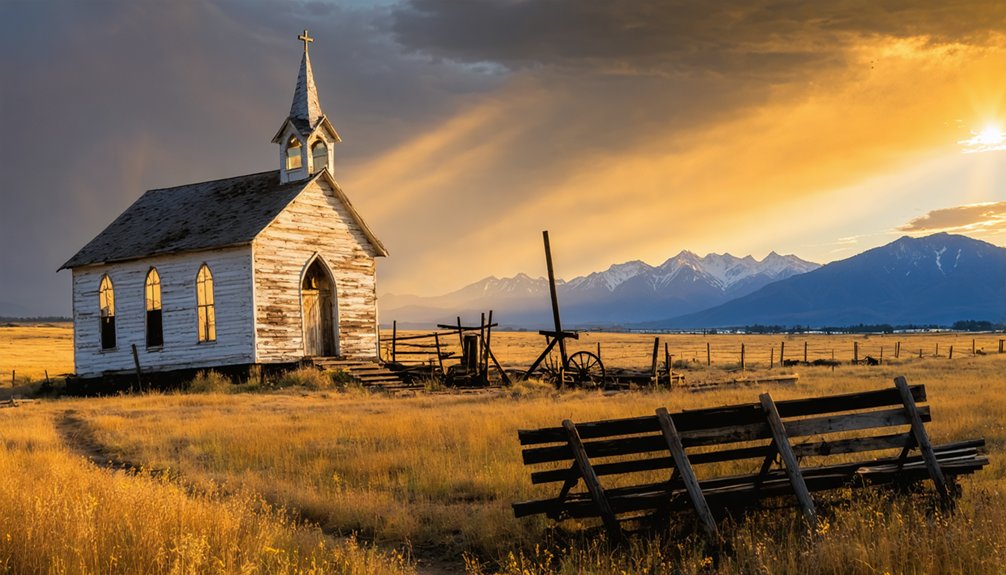
If you’re enthusiastic to explore Oregon’s rich frontier heritage, a ghost town road trip offers an unforgettable journey through the state’s abandoned settlements.
Exploring abandoned towns in Oregon reveals the fascinating stories and history of those who once called these places home. From crumbling buildings to remnants of daily life, each location offers a glimpse into a bygone era. As you wander through these deserted spaces, you’ll feel the echoes of the past and discover the beauty in decay.
Head east on I-84 to The Dalles, then venture south on US 197 to discover Wasco County’s historic sites like Boyd, with its 1883 granary remnants, and Friend’s weathered one-room schoolhouse.
Discover Oregon’s hidden past along US 197, where abandoned granaries and lonely schoolhouses whisper tales of frontier life.
Continue to Shaniko, once a bustling wool capital, and nearby Antelope’s ranching remnants.
For an extended adventure, loop through Eastern Oregon to explore Hardman’s agricultural ruins and Sumpter’s gold-mining heritage.
Pack extra fuel, snacks, and paper maps for these remote destinations.
Consider timing your visit with Shaniko’s annual events or combining stops with attractions like White River Falls State Park and the historic Sumpter Valley Railroad.
Frequently Asked Questions
Are Overnight Stays Permitted in Any of Oregon’s Ghost Towns?
Like pioneers seeking shelter, you’ll find no official overnight camping or ghost town accommodations permitted in these historic sites. These preserved relics welcome daytime explorers but close their weathered doors at dusk.
What Safety Precautions Should Visitors Take When Exploring These Abandoned Sites?
You’ll need essential safety gear: sturdy boots, first aid kit, and recovery equipment. Travel with companions, notify others of plans, and respect structural hazards. Bring emergency supplies and communication devices.
Do Any Ghost Towns Require Entrance Fees or Permits?
Like stepping back in time, most Oregon ghost towns are free to explore. You’ll rarely encounter entrance regulations or permit requirements, though some attractions like Oregon Caves tours need paid reservations.
Which Ghost Towns Are Accessible During Winter Months?
You’ll find reliable winter accessibility at Shaniko and Golden, with Golden offering easy Interstate 5 access. Both ghost town attractions maintain historic buildings you can explore during colder months without seasonal closures.
Are Metal Detectors or Artifact Collection Allowed in These Locations?
You’ll need permits and landowner permission for metal detecting. At Buncom, for instance, you must contact the Historical Society first. Most artifacts over 100 years old can’t be collected under preservation policies.
References
- https://www.visitoregon.com/oregon-ghost-towns/
- https://en.wikipedia.org/wiki/List_of_ghost_towns_in_Oregon
- https://thatoregonlife.com/2016/04/road-trip-ghost-towns-eastern-oregon/
- http://www.photographoregon.com/ghost-towns.html
- https://www.nationaldaycalendar.com/lists/12-oregon-ghost-towns
- https://traveloregon.com/things-to-do/culture-history/ghost-towns/
- https://www.overlandbound.com/forums/threads/ghost-towns-in-oregon.20177/
- https://www.pinesnvines.com/adventures/oregons-coolest-ghost-town
- https://www.legendsofamerica.com/or-shaniko/
- https://www.oregonencyclopedia.org/articles/shaniko/