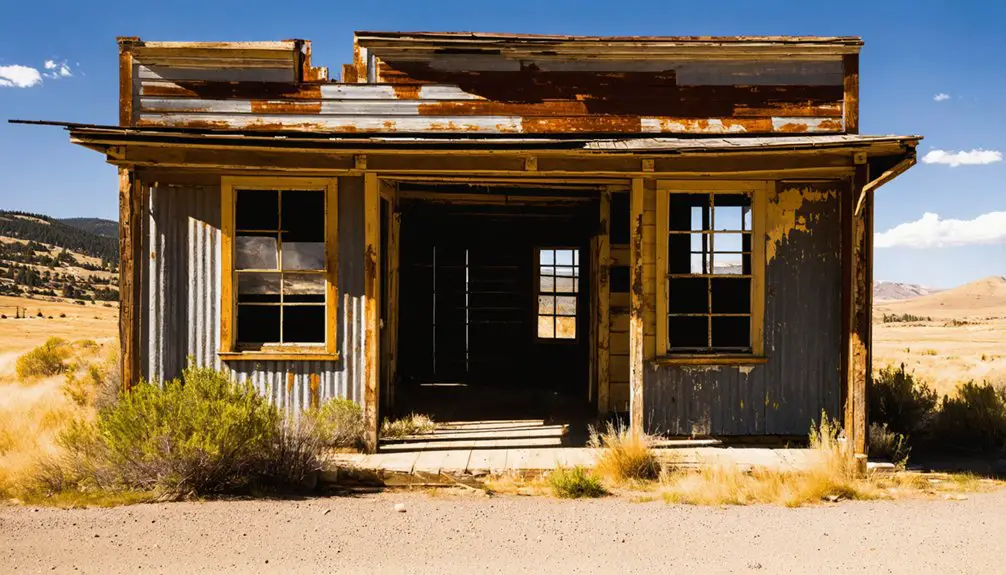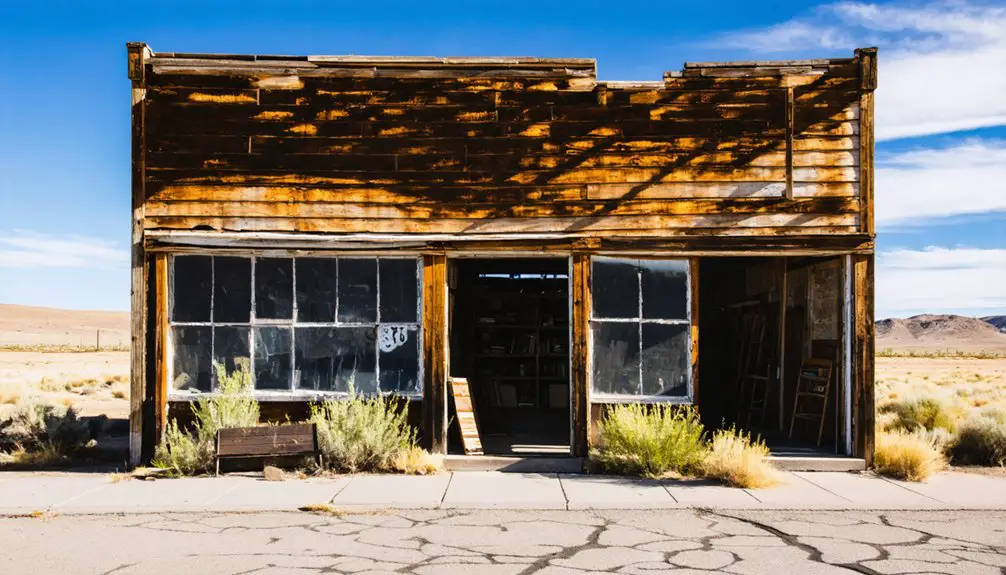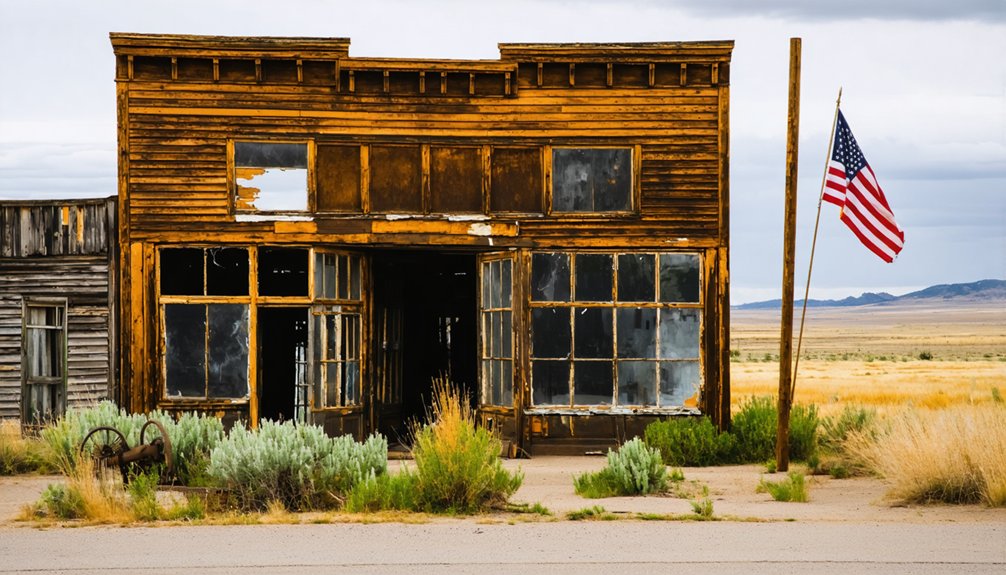
You’ll discover over 200 ghost towns across Oregon, each telling unique stories of the American West. Notable stops include Shaniko, once the “Wool Capital of the World,” and Golden, famous for its innovative mining techniques and preserved church. Don’t miss Sumpter’s gold rush buildings and working narrow-gauge railroad, or Buncom’s authentic structures from 1851. These time capsules of pioneer life offer adventures that range from easily accessible main streets to remote mountain discoveries.
Key Takeaways
- Shaniko offers well-preserved buildings, annual wool festivals, and walkable historic sites along U.S. Route 97, with the iconic Shaniko Hotel.
- Golden features four surviving structures including the historic church and Ruble House, showcasing unique mining innovations and religious heritage.
- Sumpter maintains its gold rush-era main street and offers guided tours of the Sumpter Valley Dredge with gold panning experiences.
- Buncom preserves three authentic structures from 1851 and hosts the annual Buncom Day celebration each May.
- Greenhorn, Oregon’s highest incorporated ghost town at 6,306 feet, provides summer-only access to pristine mountain mining ruins.
What Makes Oregon’s Ghost Towns Unique
While many states boast abandoned settlements from bygone eras, Oregon’s ghost towns stand apart through their extraordinary diversity and pristine preservation. You’ll discover over 200 forgotten communities scattered across high deserts and mountain landscapes, each telling a unique story of the American frontier.
From Golden’s rare church-centered architecture to Granite’s haunting ruins at 5,000 feet elevation, these sites reflect distinct chapters of Western history. Visitors can explore the massive dredge in Sumpter that stands as a monument to the area’s mining legacy.
These isolated mountain ruins and steepled sanctuaries tell poignant tales of life and loss in Oregon’s rugged frontier wilderness.
What makes these towns truly special is their historical significance as time capsules of pioneer life. You can explore everything from crumbling mining camps to intact wool trading posts. The restless ambition of early American settlers is evident in each abandoned structure and weathered building.
Unlike ghost towns elsewhere, Oregon’s abandoned settlements showcase the region’s varied economic past – from gold fever and lumber booms to farming communities and railroad rivalries.
Exploring Historic Shaniko: A Window to the Past
Perched along the rolling hills of north-central Oregon, Shaniko stands as one of the state’s most remarkable ghost towns, where you’ll find the legacy of America’s wool empire frozen in time.
Once crowned the “Wool Capital of the World,” this historic gem peaked in 1905 with $5 million in wool profits before a series of setbacks, including a devastating fire and railroad bypass, led to its decline. With just thirty permanent residents remaining, the town now serves as a living museum of the American frontier.
The charming town spans half a square mile along U.S. Route 97, making it an easily walkable destination for history enthusiasts.
Today, you can explore its rich wool heritage through preserved buildings and annual festivals.
- Walk through the recently reopened Shaniko Hotel, an architectural marvel with 18-inch brick walls
- Visit Shaniko Row’s authentic frontier buildings, including the original jail, school, and bank
- Discover local artifacts and historical photographs at the Shaniko Sage Museum
- Experience living history during the annual Wool Gathering celebration
Golden’s Mining Legacy and Heritage Sites
Nestled in the rugged Coyote Creek valley, Golden stands as a tribute to Oregon’s rich mining heritage, where innovative hydraulic mining techniques once transformed the landscape.
You’ll discover the revolutionary Ruble hydraulic elevator, an invention that helped miners separate rock from valuable placer deposits, leading to an impressive $1.5 million recovery in just a few years.
Unlike typical mining towns, Golden’s heritage reflects a unique character – you won’t find any saloons here, but instead two churches that served over 150 residents during its 1890s peak.
Golden defied frontier stereotypes, choosing churches over saloons to serve its bustling community of gold-seeking pioneers.
Today, you can explore four surviving structures, including the historic 1892 Golden Church and Ruble House, all preserved as part of Oregon’s only state-managed former mining community.
The iconic Golden School House was returned to its original location in 2013 after being moved away in the 1940s.
The site offers a rare glimpse into mining innovations and frontier life that shaped the American West.
Visitors can explore this National Register listed property throughout the year, immersing themselves in its historical significance.
The Rustic Charm of Buncom Ghost Town
Deep in the Applegate Valley, Buncom ghost town stands at the meeting of Sterling Creek and Little Applegate River, telling a tale that began in 1851 when Chinese miners first struck gold.
You’ll find this historic site just 20 miles southwest of Medford, where hydraulic giants once blasted hillsides in search of precious metals.
Though most of the town succumbed to fire after its 1920 abandonment, three authentic structures remain as evidence of Buncom’s mining heritage.
The town once thrived with a bustling General Store and Livery that served local farmers and miners.
Local ranchers and logging operations also contributed to the town’s diverse economy during its heyday.
- Original post office building from 1896
- Frontier-era bunkhouse where miners once rested
- Historic cookhouse that fed the mining community
- Annual Buncom Day celebration held every May
Today, you can explore one of Oregon’s best-preserved ghost towns, where the Buncom Historical Society maintains these relocated buildings that survived the shift from streambed to hillside mining operations.
Sumpter: Where Mining History Comes Alive
You’ll step back in time walking Sumpter’s preserved main street, where gold rush-era buildings tell the story of Oregon’s richest mining boomtown.
Originally settled by three Carolinian founders, the town quickly transformed after the discovery of gold in the area.
At the heart of town, the towering Sumpter Valley Dredge stands as a monument to industrial-scale mining, offering guided tours and weekend gold panning demonstrations that bring the region’s golden age to life.
Whether you’re exploring the historic narrow gauge railroad or trying your luck at finding gold flakes in the creek, Sumpter’s mining heritage creates year-round opportunities for hands-on history adventures in the Blue Mountains. The town’s popular three annual flea markets draw thousands of visitors during major summer holidays.
Historic Main Street Buildings
Walking through Sumpter’s Mill Street today reveals an impressive collection of turn-of-the-century commercial architecture that once anchored this bustling mining town.
The historic architecture reflects the town’s golden era, with the 1899 Basche Hardware Co. and Bank of Sumpter standing as symbols of ghost town preservation. You’ll find these brick landmarks on the east side, where they’ve weathered over a century of boom and bust cycles.
- Ellis Opera House dominates the north end with its distinctive white facade and pointed roof
- First National Bank sits proudly on Granite Street between the Starr Hotel and Columbia Market
- Hobson Mercantile Co.’s double storefront replaced the Red Front Store after the 1900 fire
- Basche Hardware and Bank of Sumpter represent some of the earliest brick buildings in town
Gold Dredge State Park
Standing as a tribute to Oregon’s golden age, the Sumpter Valley Dredge State Heritage Area preserves one of the most remarkable pieces of mining history in the American West.
You’ll discover the massive Sumpter No. 3 dredge, built in 1935, which once churned through the valley’s riverbed with its 72 one-ton buckets, extracting millions in gold.
From 1913 to 1954, three dredges transformed the landscape, with No. 3 alone recovering over 128,570 troy ounces of gold.
You can explore this engineering marvel from May through October, where interpretive tours reveal how a 20-man crew operated this floating gold factory.
Don’t miss the chance to try your hand at gold panning, browse the museum, or wander the 93-acre heritage site that draws thousands seeking to connect with Oregon’s rich mining heritage.
Year-Round Mining Adventures
The historic mining town of Sumpter welcomes visitors year-round to explore its rich gold mining legacy, centered around the iconic No. 3 dredge.
You’ll discover how this massive floating machine revolutionized mining techniques, processing 9 cubic feet of material per minute with its 72 massive buckets. At the interpretive center, rangers demonstrate traditional gold panning methods while sharing tales of the 1862 gold rush that transformed this valley.
- Free guided tours showcase historical artifacts and the dredge’s ingenious mechanical systems
- Try your hand at gold panning and keep any flakes you find (small fee)
- Explore 12 miles of historic mine tunnels that once defined Sumpter’s landscape
- Visit the original 1899 Sumpter Supply building, now housing mining exhibits and local history
Hardman’s Journey Through Time
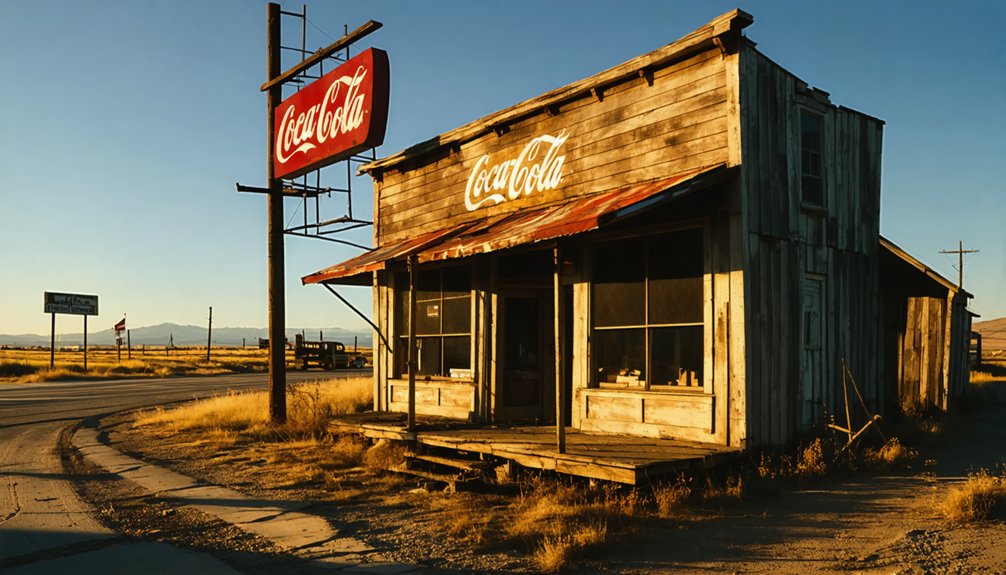
Nestled in southern Morrow County, Hardman’s curious evolution began in the 1870s with an unusual set of names. Known first as “Rawdog,” then “Yellardog” and “Dogtown,” this settlement emerged from the merger of two small towns before claiming its current identity.
At its peak in 1920, you’d have found a bustling community of 193 residents, complete with hotels and stores serving as a crucial stagecoach stop.
While the rise of automobiles led to Hardman’s decline, the town’s spirit endures. Today, you’ll discover a close-knit community of about 20 year-round residents who’ve preserved their heritage.
The historic IOOF Lodge Hall, adorned with wooden ghost decorations, stands as a monument to Hardman’s history, while the Community Center continues to foster community resilience through regular gatherings and potlucks.
Greenhorn: A Remote Mountain Discovery
You’ll find Oregon’s highest incorporated city perched at 6,306 feet in the Greenhorn Mountains, where gold fever once drew thousands of prospectors in the late 1800s.
After reaching its peak of 3,200 residents in the 1890s, this remote mining settlement weathered dramatic cycles of boom and bust until World War II regulations finally halted gold operations in 1942.
Today, you can explore this time capsule of the American West during summer months when fewer than 20 seasonal residents occupy the townsite that straddles Baker and Grant counties, though you’ll need to come prepared – there’s no electricity or modern amenities in this authentic ghost town.
Historic Mountain Mining Site
Standing at 6,300 feet in Oregon’s Greenhorn Mountains, this remarkable ghost town traces its origins to an 1864 gold discovery that transformed Olive Creek into a bustling mining hub.
By the 1890s, you’ll find yourself walking the same streets where 3,200 residents once lived during the height of mining operations that yielded over $3 million in gold production.
- The Bonanza Mine reached 1,000 feet deep by 1903, making it Oregon’s deepest shaft at the time
- You’ll discover remnants of two hotels, a post office, and a waterworks system with fire hydrants
- The town’s wooden jail now sits in the Grant County Historical Museum after being stolen
- Chinese laborers constructed extensive ditches for both hydraulic and dryland mining operations
The town’s last gold rush ended in the 1920s, but you can still explore this highest incorporated city in Oregon today.
Peak Elevation Ghost Town
At 6,306 feet above sea level, Greenhorn holds the distinction of being Oregon’s highest incorporated city – though its current population stands at zero.
You’ll find this ghost town nestled in the Greenhorn Mountains, where elevation challenges once hampered mining efforts during the harsh winter months.
Following its 1865 gold discovery, miners employed various mining techniques from placer to hydraulic operations.
Chinese laborers engineered extensive ditch systems to support dryland mining, while major operations like the Ben Harrison and Red Boy mines extracted ore until 1940.
The town’s namesake, a distinctive green monolith, still serves as a landmark visible for miles.
You can reach this remote treasure via Highway 7 and Greenhorn Road, but plan your visit during summer months when snow doesn’t block access to this high-altitude historic site.
Remote Oregon Time Capsule
Beyond its remarkable elevation, Greenhorn’s rich history unfolded through multiple cycles of boom and bust.
You’ll discover ghostly remnants of a once-thriving mining town that peaked at 3,200 residents in the 1890s.
Today, this remote mountain settlement stands frozen in time, with mining relics scattered across its rugged terrain.
- Access the site via Greenhorn Road from Sumpter – just 6 miles on your adventure into the past
- Explore the town’s fascinating origin stories, from greenhorn prospectors to the legendary “blossom” ore discovery
- Marvel at the remnants of what was once home to hotels, saloons, and a sophisticated waterworks system
- Experience true isolation – while there’s no electricity, you’ll find modern touches like cell service and fiber optic lines
Planning Your Ghost Town Adventure
Before starting your Oregon ghost town adventure, you’ll need to carefully plan your expedition through the state’s historic abandoned settlements. Pack extra fuel, snacks, and paper maps – you’ll be venturing where GPS signals may fail.
Venture prepared into Oregon’s ghost towns – where forgotten stories linger and modern technology fades into frontier wilderness.
For ideal ghost town preservation and travel safety, time your visits between late spring and early fall, avoiding winter’s harsh conditions in remote areas.
Your journey might take you from Shaniko’s wooden sidewalks in the north to Golden’s remaining structures in the south. Don’t miss Buncom Day Festival in May, celebrating local preservation efforts.
When exploring isolated spots like Greenhorn or Hardman, bring essential supplies and plan your route carefully. Many sites sit far from modern amenities, so flexibility in your schedule allows for authentic discovery while maintaining safety in these historic time capsules.
Photography Tips for Ghost Town Visits

To capture Oregon’s ghost towns in their most haunting splendor, you’ll want to arrive during golden hour when long shadows drape across weathered buildings and natural light seeps through broken windows.
You’ll need essential gear like a tripod for low-light shots, a wide-angle lens for interiors, and a reliable headlamp to safely navigate dark spaces.
When composing your shots, look for compelling details like rusted mining equipment and historic signage, while using natural leading lines from wooden walkways or abandoned rail tracks to draw viewers into your frame.
Lighting and Time Planning
When photographing Oregon’s ghost towns, mastering light and timing can transform ordinary ruins into haunting masterpieces. You’ll want to arrive before dawn, giving yourself 45 minutes to adjust to the darkness while planning your shots.
Full moon conditions provide natural illumination that rivals daylight, but you’ll need to set your white balance to 4000K to maintain that ethereal nighttime atmosphere.
- Position LED tube lights and incandescent flashlights at different angles to simultaneously illuminate building interiors and exteriors
- Use colored gel filters to create mood-specific lighting that enhances the abandoned aesthetic
- Set up umbrella diffusers near windows for natural-looking light distribution
- Combine low-ISO settings for ambient moonlight with high-ISO for detailed subject illumination
Equipment Must-Haves
Since capturing Oregon’s ghost towns demands specialized gear for challenging conditions, you’ll need a carefully curated kit of essential equipment. A full-frame DSLR or mirrorless camera with manual camera settings will serve you well in dim, dusty structures.
Pair it with versatile lens choices like a 16-35mm wide-angle zoom for architectural shots and a 70-200mm telephoto for distant details.
Don’t venture into these historic sites without a sturdy carbon fiber tripod – you’ll need it for low-light exposures and HDR photography.
Pack a powerful flashlight like the Coast Polysteel 600 for navigation and light painting. Remember your respirator for protection against decades of dust, and keep your gear protected with weather-sealed bags and rain covers.
These abandoned towns can be unforgiving to unprepared photographers.
Composition Techniques
Through the lens of your camera, Oregon’s ghost towns transform into an enchanting canvas of light, shadow, and forgotten stories. Your visual storytelling begins during golden hours when dawn and dusk paint abandoned structures in warm hues.
Master composition techniques by layering elements from foreground to background, creating depth through doorways, windows, and weathered walls.
- Position yourself to capture light streaming through empty windows, creating dramatic silhouettes
- Use wide-angle lenses to showcase the grandeur of historic buildings against vast Oregon skies
- Frame shots through broken doorways and create leading lines with weathered floorboards
- Look for reflections in old glass and experiment with long exposures during sunset
Let remnant shapes dance across your viewfinder as you document these time-forgotten places, each composition revealing another chapter of Oregon’s pioneer past.
Preservation Efforts and Local Events
As Oregon’s ghost towns face the relentless march of time, preservation efforts across the state have gained momentum through both grassroots initiatives and official channels.
You’ll find passionate locals leading Waldport preservation projects, proposing walking trails and educational kiosks to showcase the region’s logging heritage.
In Buncom, one of Oregon’s best-preserved ghost towns, you can join the annual Buncom Day Festival in May, which raises funds to protect its four historic buildings.
While Bayocean’s physical structures have vanished, you can explore its legacy along the 7.5-mile loop trail with interpretive signs.
The Oregon State Archives’ “Rust, Rot, & Ruin” exhibit brings these forgotten communities to life through artifacts and photographs, while state funding of $750,000 guarantees continued preservation efforts.
Frequently Asked Questions
Are There Any Reported Paranormal Activities in These Ghost Towns?
You’ll find rich haunted history at these sites, where ghostly legends include green fog at Rock Point Cemetery, mysterious lights, unexplained sounds, and spectral figures wandering through abandoned mining settlements.
Can Visitors Stay Overnight in Any of These Ghost Towns?
You’ll find overnight accommodations at all four locations – from Shaniko Hotel’s historic rooms to Cornucopia Lodge’s rustic glamping, Wolf Creek Inn’s cozy quarters, and Dawson House’s mountain-lodge camping options.
What Is the Best Season to Visit Oregon’s Ghost Towns?
You’ll find summer’s your best time to explore Oregon’s ghost towns, with peak weather conditions from July to early September. Spring shoulder season offers fewer crowds, while fall brings atmospheric vibes but cooler temperatures.
Are Metal Detectors Allowed in These Historic Ghost Town Sites?
You’ll need proper permission as metal detecting regulations and historical preservation laws strictly control these sites. Don’t disturb historical artifacts over 100 years old – they’re protected by federal law.
Do Any of These Ghost Towns Have Working Restaurants Nearby?
You’ll find local dining in Condon, less than 30 miles from Shaniko, with spots like Buckhorn Saloon and Sandi’s Soups. The town’s charming Main Street offers several nearby attractions and eateries.
References
- https://www.visitoregon.com/oregon-ghost-towns/
- https://www.pinesnvines.com/adventures/oregons-coolest-ghost-town
- https://thatoregonlife.com/2016/04/road-trip-ghost-towns-eastern-oregon/
- https://www.tripadvisor.com/Attractions-g28958-Activities-c47-t14-Oregon.html
- https://traveloregon.com/things-to-do/culture-history/ghost-towns/
- https://www.nationaldaycalendar.com/lists/12-oregon-ghost-towns
- https://www.overlandbound.com/forums/threads/ghost-towns-in-oregon.20177/
- https://takingthekids.com/explore-oregon-ghost-towns-that-are-both-creepy-and-beautiful/
- https://traveloregon.com/things-to-do/culture-history/ghost-towns/secrets-oregons-ghost-towns/
- https://www.happycampersrvrentals.com/blog/oregon-ghost-towns-golden