You’ll find Arizona’s best-preserved ghost towns scattered across the state’s rugged landscape, each telling unique stories of the American West. Ruby showcases 362 acres of pristine mining history with over twenty preserved buildings, while Jerome’s copper legacy produced over $1 billion in minerals. Vulture City’s restored structures and Goldfield’s living museum atmosphere bring the 1890s back to life. These time capsules hold countless tales of boom, bust, and rebirth waiting to be discovered.
Key Takeaways
- Ruby stands as one of Arizona’s best-preserved ghost towns, featuring 362 acres with twenty historic buildings maintained by a caretaker.
- Goldfield Ghost Town maintains an authentic Old West atmosphere with reconstructed buildings, attractions, and regular gunfight performances.
- Jerome successfully transformed from a billion-dollar mining town into a preserved artistic community after its mining operations ceased.
- Vulture City has undergone significant restoration since 2017, rebuilding dozen-plus historic structures from its gold mining heyday.
- Swansea Ghost Town retains well-preserved adobe buildings and railroad depot under Bureau of Land Management protection.
What Makes Arizona’s Ghost Towns Special
What sets Arizona’s ghost towns apart from others across the American West lies in their remarkable diversity and dramatic origins.
You’ll find settlements born from mining rushes, natural hot springs, and essential stagecoach routes, each telling a unique story of human ambition in the face of harsh desert conditions. These towns showcase extraordinary architectural diversity, from adobe structures slowly returning to the earth to concrete fortresses still standing guard over empty streets. During winter, a million RVs populate Quartzsite’s temporary economy of gem shows and swap meets. The historic Agua Caliente site features natural hot springs that have drawn visitors since the 1860s.
The cultural significance of these sites extends beyond their mining heritage.
You’ll discover everything from Space Age architecture in Gila Bend to gravity-defying buildings in Jerome, where foundations shift beneath century-old walls. The towns’ locations, scattered across varying elevations and terrains, have created distinct microcosms of preservation, each offering different glimpses into Arizona’s pioneering past.
Ruby: A Hidden Mining Legacy
When you explore Ruby today, you’ll find one of Arizona’s best-preserved ghost towns with intact mining equipment scattered across its 362 acres near Montana Peak.
The site’s rich history began in the late 1870s when prospectors discovered valuable quartz deposits in the Montana vein, which later became Arizona’s most productive zinc and lead operation.
You can still see remnants of the round-the-clock mining operations that employed over 350 workers and ran continuously except for two holidays each year until the 1940s.
The town’s population reached its peak of 1,200 residents during the mining boom.
Visitors can now tour over twenty historical buildings maintained by caretaker Leslie Cherry, who lives as the town’s sole resident.
Mining Equipment Remains Today
The imposing headframe structure at Ruby’s abandoned mine still towers above the 750-foot vertical shaft where 325 miners once descended for round-the-clock operations.
You’ll find scattered remnants of mining machinery across the 362-acre property, including the concrete foundations of Mill #22 where workers processed valuable lead, zinc, and silver ore.
Visitors can explore the workshop area ruins while learning about the site’s rich mining history from the resident caretaker Leslie.
The site’s abandoned relics tell a story of industrial determination – from rust-pocked axes to speckled core samples displayed in the schoolhouse museum.
Though Eagle-Picher sealed the main shaft entrances with dynamite in 1940, you can still explore the preserved structures that processed over 772,000 tons of ore.
Even the mine’s tailings found new purpose, forming a private beach and fishing pond that stands as a monument to Ruby’s mining legacy.
Originally established as Montana Camp in the late 1870s after the first mineral strike, the town would later become known as Ruby.
Rich Quartz Discovery History
Deep within Santa Cruz County near Montana Peak, Ruby’s rich mining legacy began in the 1870s when prospectors discovered striking red quartz veins they mistakenly identified as rubies.
Like Quartzsite’s early miners, Ruby’s prospectors relied heavily on dry washing methods to efficiently process and extract valuable minerals.
You’ll find that J. Douglas’s 1874 discovery revealed high-grade silver-lead ores, with the Montana Mine yielding quartz containing 40-60% lead and up to 30 ounces of silver per ton.
The American Flag Mine’s breakthrough in 1876 exposed a massive 20-foot-wide quartz vein with visible ore shoots.
Mining techniques evolved as underground drifts extended 500-800 feet, using hand steel and black powder to extract the valuable ore.
Similar to Spanish prospectors who found large silver sheets in nearby mountains along the Santa Cruz river, Ruby’s mines continued to yield impressive deposits throughout their operation.
Vulture City’s Golden History
One fateful day in 1863, prospector Henry Wickenburg‘s keen eye followed circling vultures to a remarkable quartz outcrop containing gold, marking the birth of what would become Arizona’s most legendary mine.
From this discovery, Vulture City sprang to life, transforming from a rugged mining settlement into a bustling community of 5,000 souls seeking their fortunes in the Maricopa County desert.
Like moths to a flame, fortune seekers flocked to Vulture City, turning desert solitude into a thriving gold rush boomtown.
The mining legacy proved astounding – producing 340,000 ounces of gold and 260,000 ounces of silver, worth approximately $200 million today.
You’ll find this wasn’t just another boom town; it featured a sophisticated infrastructure with a schoolhouse, stores, saloons, and even a 12-acre vegetable garden.
Despite challenges like gold theft, which led to 18 hangings from the infamous Hanging Tree, Vulture City thrived until Roosevelt’s 1942 wartime closure order.
The tragic Glory Hole incident in 1923 claimed the lives of seven miners and twelve burros when support pillars collapsed, burying them under 100 feet of rock.
Today, thanks to Rod Prat’s restoration efforts beginning in 2017, visitors can explore over a dozen meticulously rebuilt historic structures that capture the town’s frontier spirit.
Jerome: From Copper Capital to Cultural Hub
While Vulture City found its riches in gold, another Arizona ghost town struck fortune in copper. Jerome’s copper legacy began in 1876 when miners staked claims on Cleopatra Hill. Under William Clark’s leadership, the United Verde Copper Company transformed Jerome into a thriving metropolis, producing over $1 billion in minerals across seven decades.
You’ll find Jerome’s history marked by both triumph and challenge. The town literally slid downhill from constant blasting, while smelter fumes stripped the landscape bare.
When Phelps Dodge closed the mines in 1953, Jerome’s population plummeted to just 222 residents. Yet, this wasn’t the end. The town’s remaining citizens recognized its tourism potential, sparking an artistic revival.
Today, Jerome stands as a cultural hub where you can explore the Little Daisy Hotel museum and experience Arizona’s rich mining heritage.
Exploring the Streets of Historic Goldfield
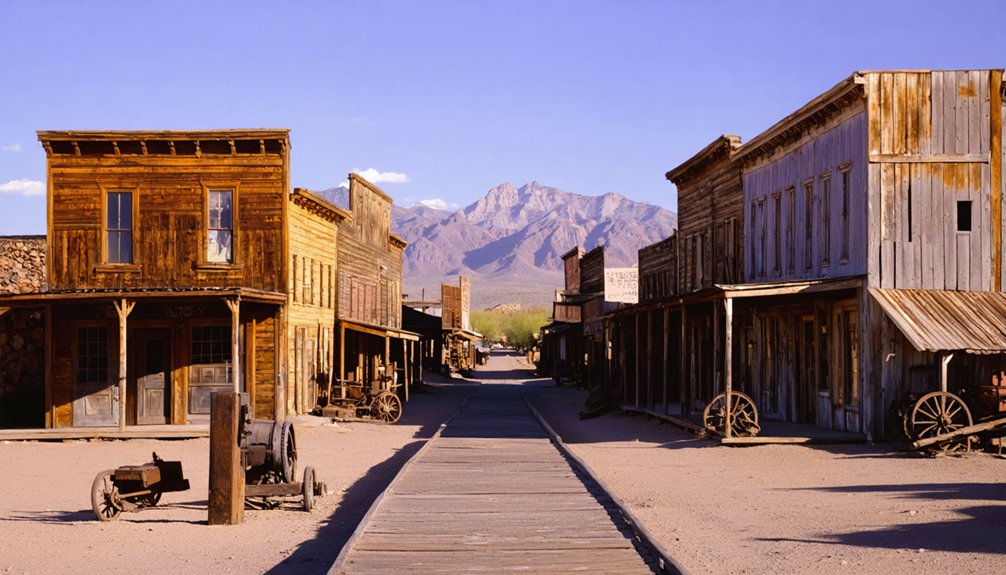
Nestled near the legendary Superstition Mountains, Historic Goldfield rose to prominence in 1892 when prospectors discovered low-grade gold ore in the area.
You’ll find that within five years, this boomtown swelled to over 4,000 residents, boasting three saloons, a brewery, and various shops before declining by 1898.
Your ghost town exploration will reveal Goldfield’s remarkable rebirth.
After Bob Schoose purchased the mill site in 1984, historic preservation efforts transformed the abandoned settlement into a living museum.
Today, you can walk the reconstructed Main Street, venture into the Mammoth Gold Mine, and witness old west gunfights.
Don’t miss the narrow gauge train ride or the Goldfield Museum, which chronicles the town’s fascinating journey from mining camp to tourist destination.
Swansea: A Desert Time Capsule
A remarkable proof to Arizona’s mining heritage, Swansea stands frozen in time amid the Sonoran Desert’s rugged landscape.
You’ll discover a well-preserved snapshot of early 20th-century mining life, where George Mitchell’s vision of recreating Wales’ Swansea took root in 1909. The town’s abandoned structures tell a story of boom and bust, reaching its peak with 750 residents before financial troubles struck in 1911.
Founded with Welsh inspiration, Swansea’s brief mining glory peaked at 750 residents before financial ruin brought its dreams to dust.
Today, you can explore:
- Dozens of weathered adobe buildings that have survived desert conditions
- The historic railroad depot that once connected to Bouse
- Original mine shafts with their hoisting equipment
- Two cemeteries that chronicle the town’s human story
Under Bureau of Land Management protection, Swansea’s remote location has helped preserve its authentic character, making it one of Arizona’s finest ghost town experiences.
Mining Tales From Gleeson’s Past
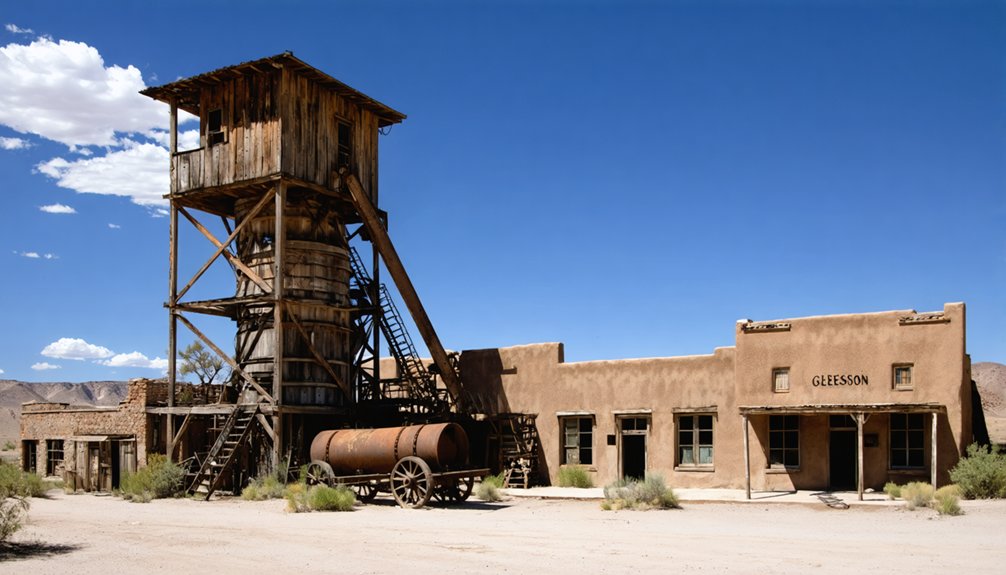
Located in southeastern Arizona’s Dragoon Mountains, Gleeson began its remarkable journey in the 1870s as a turquoise mining camp that would later transform into one of the territory’s significant copper producers.
While Tiffany & Co.’s early interest in turquoise mining proved unsuccessful, Gleeson’s history took a pivotal turn when Irish immigrant John Gleeson purchased the Leonard claims in 1896. He developed the Copper Belle Mine, which Shannon Copper Company later acquired for $100,000.
During World War I, you’d have found a bustling town of 500 residents, supported by a railroad spur and multiple mining operations including the Silver Bill, Pejon, and Defiance mines.
Despite a devastating fire in 1912, the resilient community rebuilt, though post-war decline eventually led to the town’s abandonment by 1940.
Frequently Asked Questions
What Safety Precautions Should Visitors Take When Exploring Arizona Ghost Towns?
You’ll need proper safety gear, sturdy boots, and emergency supplies. Stay alert for wildlife, avoid unstable structures, and don’t explore alone. Always share your location and expected return time.
Are Any of These Ghost Towns Reportedly Haunted?
Thousands of ghost stories swirl around Bisbee, where you’ll hear haunted legends of miners in the Copper Queen Hotel. Ruby’s abandoned buildings and Vulture City’s hanging tree harbor eerie tales.
What Is the Best Time of Year to Visit Arizona’s Ghost Towns?
You’ll find the best months are October through May when cooler weather conditions enhance visibility, support extended exploration, and coincide with scheduled events like guided tours and gunfight reenactments.
Can Visitors Legally Take Artifacts or Souvenirs From Ghost Towns?
Like precious pieces of our shared past, you can’t legally remove artifacts from Arizona’s ghost towns. Federal and state legal regulations strictly protect artifact preservation through fines and penalties.
Are There Guided Tours Available for All These Ghost Towns?
You’ll find guided exploration at only five locations – Vulture City, Castle Dome, Gold King Mine, Pearce, and Gleeson. Other ghost towns offer self-guided access or require permits, while several remain inaccessible.
References
- https://en.wikipedia.org/wiki/List_of_ghost_towns_in_Arizona
- https://www.visittucson.org/blog/post/8-ghost-towns-of-southern-arizona/
- https://www.elitevrs.com/blog/discover-these-top-10-ghost-towns-arizona
- https://www.visitarizona.com/like-a-local/4-arizona-ghost-towns-you-may-have-never-heard-of
- https://www.tripadvisor.com/Attractions-g28924-Activities-c47-t14-Arizona.html
- https://www.arizonahighways.com/article/arizona-ghost-towns
- https://www.atlasobscura.com/things-to-do/arizona/ghost-towns
- https://www.hipcamp.com/journal/camping/arizona-ghost-towns/
- https://www.worldatlas.com/cities/7-weird-little-towns-in-arizona.html
- https://www.islands.com/1740327/get-away-from-all-strange-arizona-ghost-town-famed-unusual-name-nothing/