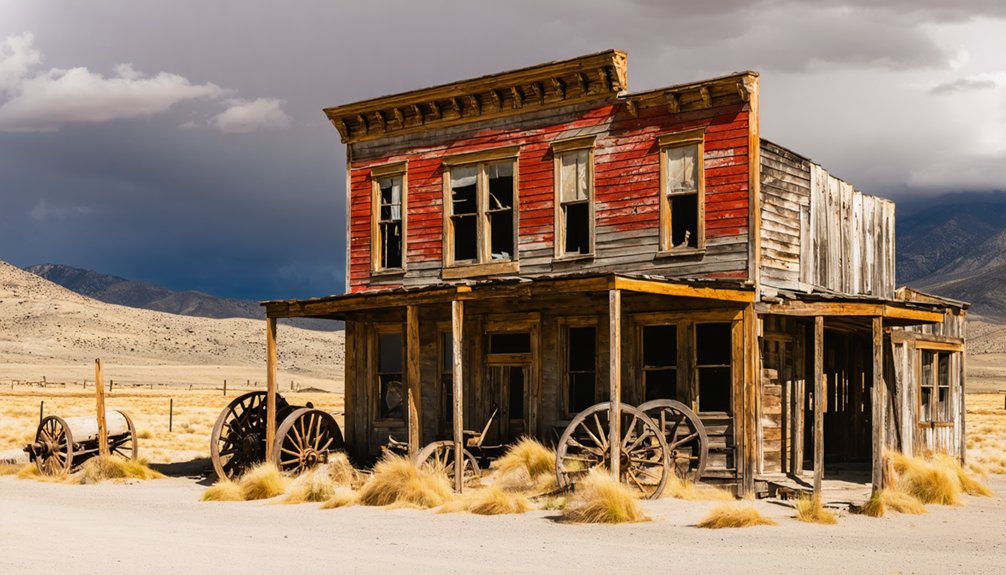
You’ll find America’s boomtowns followed predictable patterns, driven by natural resource discoveries that sparked explosive population growth and rapid urban development. These settlements often expanded beyond sustainable limits, with infrastructure and housing struggling to keep pace. When resources depleted, many transformed into ghost towns, leaving behind abandoned buildings and fractured communities. This cycle of boom-and-bust has shaped the Western landscape, offering essential insights into modern urban development challenges.
Key Takeaways
- Boomtowns emerged from rapid resource discoveries, particularly mining, oil, or timber, creating instant communities with explosive population growth.
- Ghost towns formed when natural resources depleted, causing mass exodus and abandonment of once-thriving communities.
- Economic diversification determined whether boomtowns survived or became ghost towns after initial resource depletion.
- Population fluctuations followed boom-and-bust cycles, with communities clustering within 5 miles of economic opportunity zones.
- Infrastructure and housing developments often failed to sustain long-term population needs, accelerating the transition to ghost towns.
The Rise and Fall of Resource-Driven Settlements
As natural resources shaped the American West’s development, a distinct pattern of rapid settlement and abandonment emerged across the region.
You’ll find that early settlers followed timber, minerals, and agricultural opportunities, with federal irrigation projects enabling expansion beyond what private ventures could achieve. HISDAC-US data reveals how each new built structure typically brought 2-2.25 more residents to an area. The multi-temporal analysis demonstrated significant population fluctuations tied to resource availability.
Using fine spatial resolution, researchers tracked detailed local settlement changes that previous historical data couldn’t capture. But this resource-driven growth wasn’t sustainable. By 1900, timber supplies in Idaho and Oregon were depleting rapidly, while poor resource management led to widespread environmental changes.
You can trace the cycle through settlement patterns – boomtowns flourished during peak extraction periods, then faded as resources dwindled. This led to the rise of ghost towns, with rural areas experiencing significant population shifts toward urban centers.
Historical Patterns of Rapid Urban Development
When America’s urban landscape began taking shape in the 1800s, distinct regional patterns emerged that would define the nation’s development for generations. The Northeast reached urban majority first, followed by the Midwest and West in the 1910s, while the South lagged until the 1950s.
The urban population grew dramatically from 5% in 1790 to become the majority of Americans by 1920. Natural resources from across the country helped fuel massive industrial growth and urban expansion.
- Railroad expansion created new cities and transformed existing ones into major hubs.
- Immigration waves from Europe fueled explosive urban growth.
- Rising land prices drove vertical development with the advent of skyscrapers.
- Transportation innovations enabled growth beyond city cores.
You’ll find these development patterns reflected in how cities evolved differently by region. The Industrial Revolution sparked dense urbanization in the Northeast, while later waves of migration and transportation advances shaped the West and South’s urban footprint, creating unique regional characteristics that persist today.
Economic Impact on Local Communities
The economic trajectory of boomtowns reveals stark contrasts between rapid growth and devastating decline, particularly evident in modern Texas communities. You’ll see how resource-driven booms create immediate wealth through increased tax revenues and job opportunities, but they often lack economic sustainability. The town of Desdemona exemplifies this pattern, transforming from a farming community to a short-lived oil boom before dissolving in 1921.
When oil prices plummet or mineral resources deplete, local governments struggle to maintain oversized infrastructure built during prosperous times.
Community resilience becomes critical as these areas face challenging changes. You’re witnessing this pattern in Texas’s High Plains, where 75 counties lost population as residents migrate to anchor cities for stable opportunities. The town of Gomez illustrates this stark reality, as it transformed from a thriving community with businesses and cotton gin into a ghost town after being bypassed by the railway.
While some towns like Celina demonstrate successful growth through diversification, others follow the historical path of mining towns – initial prosperity followed by exodus, leaving behind expansive infrastructure but insufficient tax base to support it.
Social Transformation During Growth Periods
You’ll notice profound community restructuring when populations surge from hundreds to tens of thousands within mere years, as new arrivals reshape the social fabric.
The physical landscape transforms rapidly as hastily constructed housing developments, commercial strips, and infrastructure strain to accommodate the influx, often leading to makeshift solutions and eventual urban planning challenges.
These rapid changes frequently bring quality of life issues as community services struggle to keep pace with growth.
What emerges is a complex web of weakened traditional social bonds and new networks, as longtime residents and newcomers negotiate changing cultural norms and community expectations.
The Gold Rush exemplified these dramatic shifts, as San Francisco’s population exploded from 800 to 35,000 residents in just five years.
Population Influx Impacts Communities
Rapid population surges during boom periods trigger profound social transformations that ripple through communities, disrupting established patterns of life and straining local institutions.
You’ll find youth development particularly impacted, as adolescents struggle with heightened insecurities and self-doubts amid the social upheaval. Community cohesion deteriorates when annual growth exceeds 15%, creating institutional breakdowns and service gaps. Studies show young adult males disproportionately migrate to these areas seeking quick profits. Initial reactions from longtime residents often show enthusiasm and optimism about new economic opportunities.
- Mental health challenges surge, with rising rates of depression and alcoholism affecting both newcomers and established residents.
- Family structures shift dramatically, evidenced by elevated divorce rates and changing social dynamics.
- Service institutions buckle under pressure, struggling to meet expanding population needs.
- Cultural clashes emerge between urban in-migrants and rural locals, sparking value-based conflicts.
Housing and Infrastructure Changes
When population surges transform boomtowns, housing developments and infrastructure networks must evolve rapidly to accommodate swelling resident bases.
You’ll find dramatic housing expansions in places like Fort Worth and Austin, where unit growth topped 11% and 9.4% respectively, though this hasn’t guaranteed housing affordability for all residents.
Infrastructure development varies greatly across boomtowns. Mesa’s 34% infrastructure boost and strategic transportation investments showcase successful adaptation, while Dallas-Fort Worth’s strain under rapid growth reveals the challenges of keeping pace.
You’re witnessing a delicate balance between expansion and sustainability, particularly in regions like Princeton, Texas, where inadequate infrastructure has forced housing freezes.
The car-dependent culture in many boomtowns further complicates transportation planning, pushing communities to reconsider their approach to mass transit and road development.
Social Networks Under Pressure
Social networks in boomtowns undergo profound disruption as population surges create demographic imbalances and cultural friction.
You’ll witness youth alienation intensify as adolescents struggle with insecurities and self-doubts not seen in stable communities. Community fragmentation accelerates when rapid growth exceeds 15% annually, fundamentally altering social structures.
- Young male workers flood in, disrupting demographic balance and straining social bonds
- Cultural clashes emerge as urban, educated newcomers mix with rural residents
- Marriage stability declines, with divorce rates spiking to nearly 1:2 ratios
- Religious and social organizations see membership surges yet decreased cohesion
Your community’s social fabric transforms as groups stratify between economic winners and losers.
Mental health challenges multiply beyond normal population pressures, with alcoholism and depression rates climbing dramatically. These stresses reshape traditional support networks, forcing adaptation to new social realities.
From Prosperity to Abandonment: A Predictable Path
You’ll find that boomtowns follow a predictable trajectory from rapid growth to abandonment, as seen in places like Bodie, California, where population plummeted from 8,000 to fewer than 700 residents within three decades.
When the primary resource becomes depleted or economically unviable, the interconnected businesses and services that emerged during prosperity quickly collapse, triggering mass exodus.
The architectural legacy of these towns – from grand commercial buildings to worker housing – stands as evidence to their brief period of wealth, though many structures eventually succumb to decay or vandalism after abandonment.
Economic Rise and Fall
Throughout history, the economic trajectory of boomtowns has followed a predictable pattern from rapid growth to eventual abandonment.
You’ll find that resource management plays a vital role in determining a town’s longevity, while economic diversification often marks the difference between survival and desertion.
When valuable resources like gold or oil are discovered, you’ll witness these transformative phases:
- Initial rush: Pioneers and workers flood in, creating instant communities
- Rapid expansion: Infrastructure and support businesses emerge organically
- Peak prosperity: Secondary markets develop, population reaches maximum
- Decline and exodus: Resource depletion triggers mass departure
The cycle’s speed varies, but the pattern remains consistent.
Towns that fail to diversify beyond their primary resource industry face the greatest risk of becoming ghost towns, as seen in countless abandoned mining settlements across the American West.
Resource Depletion Effects
When a town’s primary resource reaches depletion, a swift and predictable path to abandonment often follows, transforming prosperous communities into ghost towns within decades or even years.
You’ll find this pattern especially evident in mining settlements, where poor resource management led to rapid exhaustion of minerals and subsequent community collapse.
The faster a town booms, the quicker it tends to bust. Places like Humberstone, Chile, and numerous Western U.S. mining towns illustrate how single-resource dependency creates unsustainable communities.
Without sustainability strategies, these settlements faced inevitable decline once their primary resource disappeared.
Mining companies now recognize this pattern, increasingly favoring temporary installations and fly-in fly-out arrangements over permanent settlements.
This approach prevents the creation of ghost towns but reflects the unchanged reality: when resources vanish, communities crumble.
The remnants of abandoned sites in Botswana’s landscape serve as stark reminders of the fragility of human settlement in the face of resource depletion. These areas, once bustling with life, now stand as poignant symbols of the economic shifts that dictate community viability. It highlights the urgent need for sustainable practices that can prevent future abandonment and foster resilience among local populations.
Population Migration Patterns
Modern population movements in boomtowns follow distinct patterns, from initial rapid influx to eventual abandonment.
You’ll notice how migration triggers like resource discoveries or economic opportunities spark explosive growth, as seen in Celina, Texas, where the population surged from 6,000 to 43,000 in just 13 years.
- Initial clustering occurs near economic hotspots, with populations concentrating within 5 miles of opportunity zones.
- Urban sprawl develops as secondary industries emerge, creating a ripple effect of growth in housing, retail, and services.
- Young adults (16-26) serve as early indicators of decline, their departure often signaling the start of population loss.
- Post-2019 saw unique patterns, with COVID-driven urban exodus creating temporary rural gains of 0.35%.
These migration waves create predictable cycles of boom and bust, transforming vibrant communities into potential ghost towns.
Modern Boomtown Challenges and Lessons
авyst 営破heads з conthing%= населени݇ASara=”_blankిం
Frequently Asked Questions
What Role Did Women Play in Early Boomtown Development?
You’ll find pioneering women shaped boomtowns through diverse social roles, running boardinghouses, banks, and mines while providing essential community services like teaching, nursing, and cultural development for growing populations.
How Did Boomtowns Handle Waste Management and Environmental Concerns?
Like a ticking time bomb, your early boomtown ancestors faced dire waste disposal challenges. You’d have seen minimal municipal systems, unregulated dumping, and devastating environmental impact as population growth overwhelmed primitive infrastructure.
What Entertainment and Leisure Activities Were Popular in Historical Boomtowns?
You’d find entertainment centered around saloon culture, with roulette and card games dominating. Opera houses, theaters, and gambling halls drew diverse crowds seeking freedom from mining’s daily grind.
How Did Early Boomtown Residents Communicate With Families Left Behind?
You’d primarily rely on letter writing to connect with distant family, though telegram services later offered faster communication. Letters took months initially, until the Pony Express cut delivery to 10 days.
What Was the Average Cost of Living in Gold Rush Boomtowns?
You’d spend a staggering $10,000 monthly (equivalent to $300,000 today) just for a hotel room. Average expenses were astronomical, with economic impacts felt in everything from $90 eggs to $3,000 boots.
References
- https://fiveable.me/key-terms/apush/boomtowns
- https://ohioline.osu.edu/factsheet/cdfs-sed-2
- https://www.encyclopedia.com/history/dictionaries-thesauruses-pictures-and-press-releases/boomtowns
- https://trueparity.com/blog/boomtown-meaning-explore-its-origins-and-key-traits
- https://en.wikipedia.org/wiki/Boomtown
- https://kids.kiddle.co/Boomtown
- https://ohioline.osu.edu/factsheet/cdfs-sed-3
- https://pmc.ncbi.nlm.nih.gov/articles/PMC7269677/
- https://www.fs.usda.gov/pnw/pubs/gtr405/pnw_gtr405dh.pdf
- https://www.nature.com/articles/sdata2018175