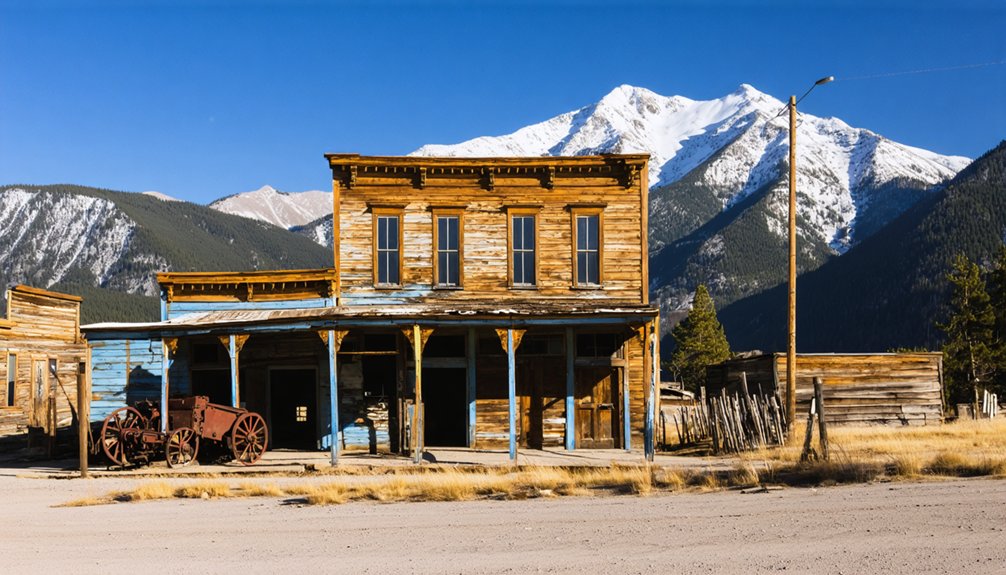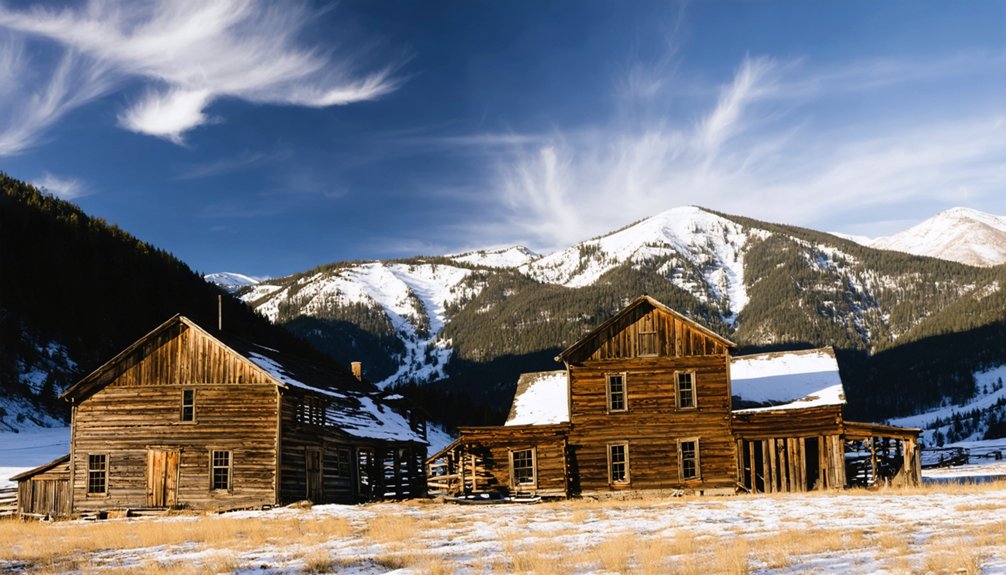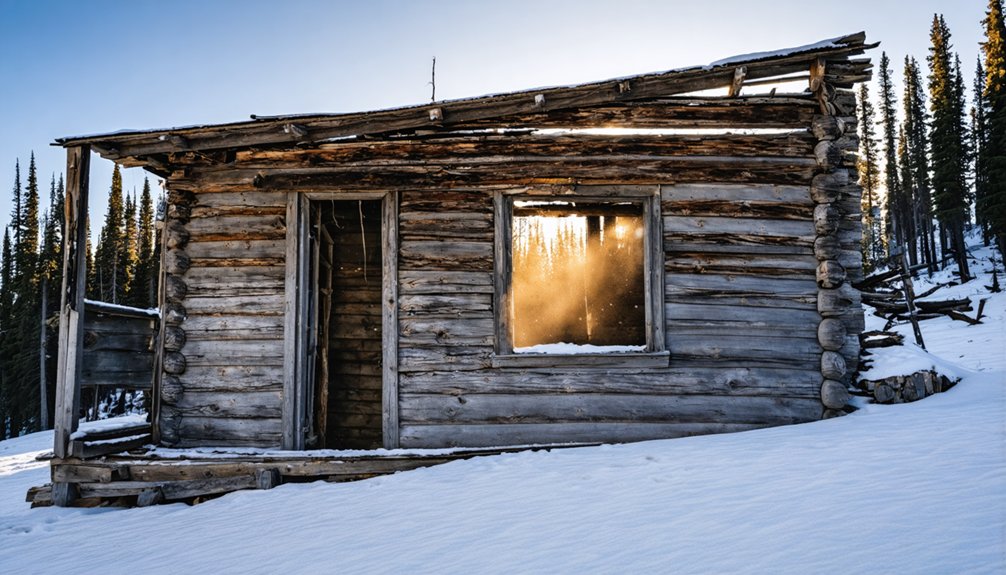
You’ll find Boreas nestled at 11,481 feet along Colorado’s Continental Divide, where America’s highest railroad station once connected Denver’s luxuries with Leadville’s silver mines. From 1882 to 1937, this remote settlement battled fierce winds and massive snowdrifts while serving as an essential transportation link. Today, you can explore the restored Section House, original boxcars, and five scenic hiking trails that tell tales of railroad workers’ remarkable determination against nature’s extremes.
Key Takeaways
- Boreas was a historic railroad settlement at 11,481 feet, established in 1882 by the Denver, South Park & Pacific Railroad.
- The town supported approximately 150 residents during its peak, serving as a crucial railroad station along the Continental Divide.
- From 1896 to 1906, Boreas housed America’s highest post office, operating from a section house that included telegraph facilities.
- The settlement featured an Engine House measuring 57 by 155 feet with a turntable, water tank, and coal bin.
- Today, visitors can explore the restored Section House, which serves as a winter shelter and preserves the town’s railroad heritage.
Life at 11,481 Feet: A Mountain Railway Settlement
At a breathtaking 11,481 feet above sea level, Boreas Pass marked the highest railroad station ever built in United States history.
Named after the Greek god of north wind, this mountain community endured constant gales while perched along the Continental Divide near Breckenridge.
Settlement life began in 1882 when the Denver, South Park & Pacific Railroad established facilities to house workers maintaining the narrow-gauge tracks.
In 1882, railroad workers first made their home atop Boreas Pass, tending to the vital narrow-gauge lifeline through the mountains.
You’d find the imposing 57 by 155 foot stone Engine House dominating the landscape, complete with its turntable, water tank, and coal bin.
The challenging terrain demanded specialized engineering – tracks spaced just three feet apart navigated sharp turns and steep grades, while trains crawled at speeds under 22 mph for passengers and 12 mph for freight.
The best visiting months were July through September when the harsh mountain weather briefly relented.
The harsh winter of 1899 brought a devastating 78-day snow blockade that left the community isolated from vital food and mail deliveries.
Railroad Operations and Daily Challenges
You’ll find railroad crews at Boreas Pass engaged in constant battle against deep mountain snows, operating wedge and rotary plows that sometimes proved futile against 78-day blockades at 11,481 feet.
Your journey through the pass would’ve revealed countless snow sheds protecting the narrow gauge tracks, which required persistent maintenance due to the harsh alpine conditions and 4% grades.
The steam engines faced their own trials, as crews managed the critical task of maintaining water supplies for locomotives crossing the continental divide in bitter conditions that could freeze equipment solid.
The harsh conditions didn’t deter railroad development, as evidenced by the Como Depot’s construction in 1879 which became a vital terminal for trains traversing these challenging mountain routes.
Snow Clearing Battle Daily
Operating trains through Boreas Pass required a relentless daily battle against snow, with crews deploying an arsenal of specialized equipment to keep the tracks clear.
You’d find winter logistics centered around massive rotary snowplows, powered by coal-fired boilers and pushed by up to six engines through the deepest drifts. Snow removal became a complex choreography of machines and men. The railroad’s constant fight against the elements made maintenance both dangerous and costly throughout the harsh winter season. During the winter of 1898 to 1899, trains were completely halted for 79 days due to massive snowfall.
- Wedge plows led the initial assault, with engines pushing them to break through fresh snowfall.
- Rotary plows followed, their fan-like blades chewing through stubborn drifts while shovelers in converted boxcars stood ready to assist.
- Flangers scraped dangerous ice from the tracks, while the rearmost engine faced backward, ready to pull the whole operation free if stuck.
Track Maintenance High Altitude
Track maintenance at Boreas Pass proved exceptionally challenging due to the extreme altitude of 11,481 feet – the highest narrow-gauge rail station in America.
The Denver South Park & Pacific railroad operated this challenging route starting in 1880.
You’ll notice how the railroad’s unconventional use of firebox ashes as track ballast speaks to the unique high-altitude conditions they faced.
The tracks constantly bent and sagged under harsh weather, causing trains to sway precariously.
Maintenance crews stationed at Boreas town tackled these issues daily, but even with their dedication, passenger trains couldn’t exceed 22 mph, while freight crawled at just 12 mph.
The nation’s highest narrow-gauge line required constant upkeep along its twisting route, driving maintenance costs well above normal railroad operations.
Steam Engine Water Challenges
While most steam locomotives could travel 30 miles between water stops, the demanding grade of Boreas Pass forced engines to refill far more frequently.
The Denver South Park Pacific railway established this challenging route in 1872. The high-altitude environment and steep inclines dramatically increased water consumption, leading to operational challenges that impacted the railroad’s efficiency. K-28 class locomotives frequently operated on this challenging route during the 1920s.
You’ll find evidence of these water challenges in three key locations along the route:
- Selkirk station, positioned six miles from Como
- Baker’s Tank, situated four miles below the summit, where the original 9,305-gallon capacity proved inadequate
- Boreas Pass summit, where engines made their final water stop
In 1910, the Denver, South Park & Pacific Railroad improved tank efficiency by installing a larger reservoir at Baker’s Tank, using equipment relocated from the Pitkin side of Alpine Tunnel.
The Section House Legacy
If you’re looking for shelter from Summit County’s harsh winters, you’ll find the restored Section House welcoming cross-country skiers just as it once housed railroad workers at 11,481 feet.
The building stands as a tribute to the Denver South Park & Pacific Railroad’s determination to maintain year-round service over Boreas Pass from 1882 to 1937.
Today, you can experience this piece of Colorado’s railroad heritage by staying overnight in the same structure that helped keep the tracks clear during the most challenging mountain conditions. Located just 6 miles from the historic ghost town of Dyer, the Section House offers a unique window into the region’s mining and railroad past.
The history of Floresta, Colorado adds another layer to the narrative of this area, showcasing the challenges and triumphs faced by early settlers. Visitors can immerse themselves in the stories of those who relied on the railroad for survival and commerce. Exploring the remnants of this bygone era can provide a deeper appreciation for the resilience of the communities that once thrived here.
Winter Shelter Lives On
The historic Section House at Boreas Pass found new life in 1997 as a winter backcountry shelter, marking a remarkable transformation from its railroad maintenance origins.
Today, you’ll discover a cozy mountain refuge that offers authentic cabin experiences for up to 12 adventurers seeking solitude in Colorado’s high country.
- You’ll find comfort in two upstairs bedrooms equipped with memory foam mattresses, plus additional bunks on the main level.
- Your winter adventures are supported by modern amenities including a propane oven, solar lighting, and a wood-burning stove.
- You’ll need to ski in during winter months when Boreas Pass Road closes, making this 11,481-foot elevation shelter a true backcountry destination.
The restored Section House stands as a symbol of preservation, offering shelter just as it did for railway workers over a century ago.
Railroad Heritage Preserved
Built in 1882, Boreas Pass Section House emerged as a critical shelter for railroad workers maintaining the nation’s highest narrow-gauge line at 11,481 feet.
The distinctive railroad architecture served as home base for crews battling fierce winter conditions while keeping the tracks clear between Denver and Breckenridge.
Today, preservation initiatives have transformed this historic structure into a winter refuge for cross-country skiers, honoring its legacy of shelter at the summit.
You’ll find other carefully restored remnants of the railroad era, including the Baker water tank and Rocky Point station’s boxcars.
While the tracks were removed in 1938, the Section House stands as a symbol of the determination of railroad workers who kept this essential transportation link operating for over 50 years through some of Colorado’s most challenging terrain.
Winter Warriors and Snow Battles
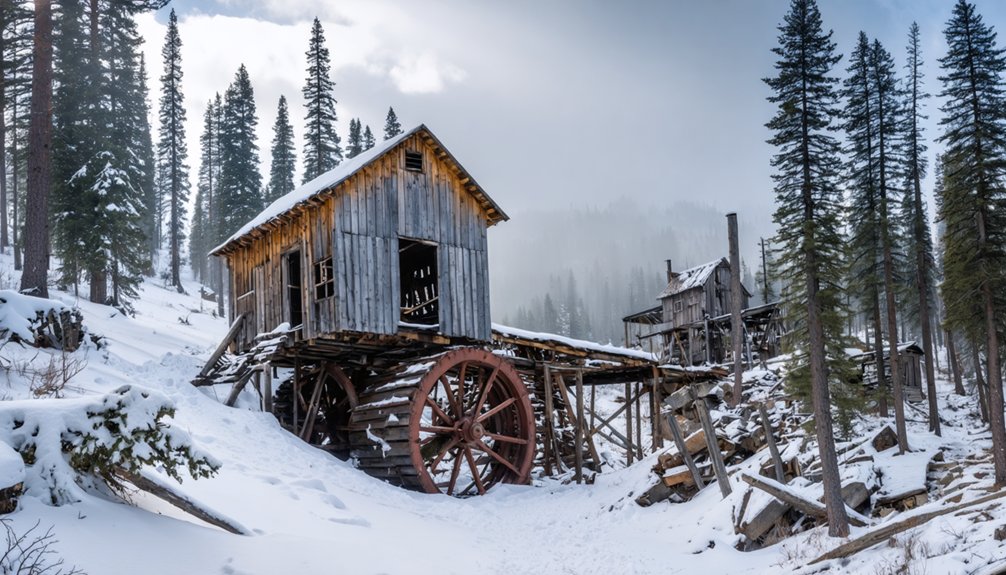
Standing at a staggering 11,481 feet, Boreas challenged even the hardiest railroad workers who battled relentless winter conditions to keep the tracks clear.
You’ll find the true grit of these winter warriors in their endless fight against snow drifts and brutal winds, especially during the devastating winter of 1898-99 when trains disappeared under ten feet of snow by November.
To combat these winter hardships, they built:
- A 997-foot snowshed with protective doors on the Breckenridge end
- Extensive snow fences to prevent massive drifts from burying the tracks
- A depot attached to the snowshed in 1898 to shelter passengers from the harsh elements
Even with these defenses, nature often prevailed, testing the limits of human engineering and determination at America’s highest railroad outpost.
Peak Years of Mountain Commerce
While railroad workers waged their battles against winter’s fury, Boreas Pass thrived as an essential commercial artery during the 1880s and early 1890s.
You’d find trains hauling precious silver ore from the Leadville mining boom, while bringing back luxuries like oysters and wine from Denver. The economic impact was staggering – by 1885, coal production in South Park had reached its zenith, with the narrow gauge tracks serving as a critical lifeline between mining operations and Front Range processing centers.
The railroad’s lifeblood flowed both ways – precious ore heading east, while fine delicacies from Denver satisfied mountain appetites.
You could’ve witnessed fierce competition among railroad magnates, all vying to claim their share of the region’s mineral wealth.
The Denver, South Park and Pacific Railroad’s 335-mile network transformed isolated mountain communities into bustling commercial hubs, where nearly 150 people called the summit home, supported by stores and post offices.
Tales From the Highest Post Office
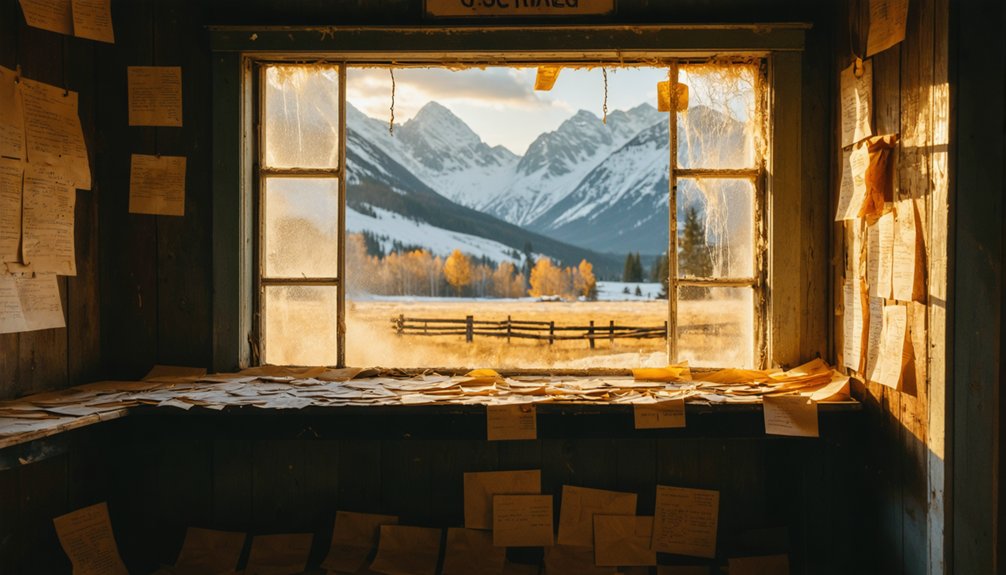
High atop the Continental Divide, at a breathtaking 11,481 feet, Boreas Pass once claimed the distinction of housing America’s highest post office.
You’ll find rich post office anecdotes from this remarkable mountain community that operated from 1896 to 1906, serving at least 150 resilient residents who called this extreme elevation home.
- The post office operated from a rugged section house that doubled as living quarters and telegraph office, built from locally harvested timber.
- Mail carriers and railway workers battled fierce winters, massive snowdrifts, and treacherous avalanches to maintain crucial communications.
- The facility’s legacy lives on through the restored section house and remnant boxcars at the former station summit, evidence of the determined spirit of Colorado’s high country pioneers.
From Bustling Station to Silent Summit
The narrow gauge Denver South Park & Pacific Railroad transformed Boreas Pass in 1880, investing $1.1 million to carve a highline route through 63 miles of Colorado’s most challenging terrain.
Through rugged peaks and valleys, the Denver South Park & Pacific Railroad carved an ambitious path across Colorado’s untamed wilderness.
You’ll find echoes of the bustling summit community that once thrived here at 11,481 feet – the second-highest railroad station in the world.
For over five decades, railroad workers and their families battled fierce winds and massive snowdrifts behind protective snow fences.
But time wasn’t kind to this mountain outpost. The station’s fiery destruction in 1934 scattered the last residents, and by 1937, the railroad ceased operations.
When World War II demanded steel, workers stripped the tracks, leaving only memories.
Today, thanks to historic preservation efforts, you can drive the former rail line, converted to an automobile road in 1952 by the U.S. Army Corps of Engineers.
Modern-Day Adventures at Boreas Pass
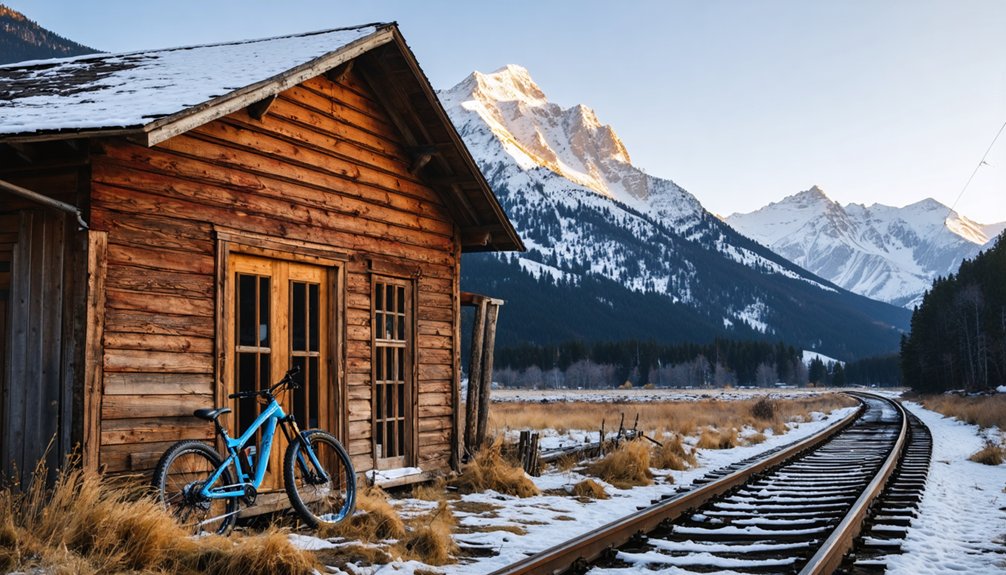
Modern adventurers seeking Colorado’s finest mountain views can now explore Boreas Pass on a 22-mile scenic drive from Breckenridge to the historic 11,481-foot summit.
You’ll find yourself winding through golden aspen groves and high-alpine terrain, with the paved road shifting to dirt as you climb higher into the untamed wilderness.
- Hit the trails on one of five scenic hiking paths, from the challenging 9.7-mile Boreas Pass Road Trail to the shorter 3-mile French Gulch overlook trek.
- Time your visit between mid-September and early October to witness spectacular fall colors and avoid weekend crowds.
- Discover remnants of the area’s mining heritage, including the preserved Section House and Ken’s Cabin, while taking in panoramic views of the Tenmile Range.
Frequently Asked Questions
Can You Camp Overnight Near the Boreas Ghost Town Ruins?
You can camp overnight near Boreas ruins if you follow camping regulations, though you don’t need overnight permits. Stay at designated sites, keep 100 feet from historic structures, and follow 14-day limits.
Are There Any Artifacts or Valuable Relics Still Found There?
You’ll rarely find valuable artifacts since most were removed years ago. While mining relics exist, artifact discovery is strictly regulated. Removing historical items is illegal – preservation protects these irreplaceable treasures.
What Wildlife Can Visitors Commonly Encounter at Boreas Pass?
You’ll encounter elk in subalpine meadows, mountain chickadees along trails, and mule deer in brushy areas. Watch for yellow-bellied marmots on rocky slopes and American pikas in boulder fields.
How Difficult Is Winter Access to the Historic Section House?
Like blazing through deep powder, you’ll face demanding winter conditions. You must snowshoe or ski from the first parking lot, battling high-altitude access challenges while covering significant distance to reach the Section House.
Have Any Paranormal Investigations Been Conducted at the Site?
While you’ll find numerous reports of paranormal experiences and ghost sightings, no professional paranormal teams have conducted formal investigations at the Section House. You’re relying solely on visitor testimonials and anecdotal evidence.
References
- https://www.4x4explore.com/rds/b_rds/boreas_ps.html
- https://www.uncovercolorado.com/ghost-towns/dyersville/
- https://historyplaces.wordpress.com/2015/07/10/history-high-in-the-rockies/
- https://www.riverridgerentals.com/blog/activites/mysterious-and-spooky-history-summit-county
- https://exploreparkcounty.com/wp-content/uploads/2020/05/boreas_pass_brochure.pdf
- https://blog.walkingmountains.org/curious-nature/2016/10/boreas-pass-thats-left-road
- http://sites.rootsweb.com/~cosummtp/boreasghost.html
- https://breckhistory.org/denver-south-park-pacific-railroad/
- https://www.castlepinesconnection.com/boreas-pass-railroad/
- https://mymountaintown.com/my-mountain-town-home/mountain-secrets-blog/boreas-pass-railroad-day-and-the-como-depot-restoration?tmpl=component&print=1&format=print