You’ll discover Borica nestled in New Mexico’s Rio Puerco Valley along historic Route 66, where volcanic landscapes and colorful mesas frame this 1880s mining town’s remains. The town flourished during the region’s mining boom, with two-story buildings and busy trade routes marking its heyday. While Apache raids and the Silver Panic of 1893 contributed to its decline, Borica’s ruins still tell fascinating tales of frontier life, hidden treasures, and the American Southwest’s industrial heritage.
Key Takeaways
- Borica emerged during New Mexico’s mining boom of the 1800s along historic Route 66 in the Rio Puerco Valley.
- The town flourished through mining operations reaching depths of 2,700 feet and railroad transportation of minerals.
- Adobe structures and two-story buildings remain as evidence of the town’s former prosperity as a mining community.
- The Silver Panic of 1893, transition to Gold Standard in 1896, and Apache raids contributed to the town’s decline.
- Mining depletion ultimately led to Borica’s abandonment, making it one of New Mexico’s ghost towns with limited historical documentation.
Historical Origins and Settlement
While very little historical documentation exists about the ghost town of Borica, New Mexico, records show it was one of many short-lived settlements that emerged during the territory’s mining boom era.
Community folklore suggests it followed a similar pattern to other mining communities that dotted New Mexico’s rugged landscape during the late 1800s.
Similar to countless desert boomtowns, Borica emerged and vanished with the territory’s mining fortunes, leaving only scattered memories behind.
Much like the early settlement of San Ygnacio de la Alamosa, the area faced challenges from Apache raids that threatened livestock and resources.
Like many of its ghost town counterparts across the territory, you’ll find that Borica legends have been passed down through generations of local families, though concrete details remain scarce.
What remains are the whispered stories of those who once called this frontier outpost home.
The discovery of precious metals often started when native tribes, like the instance where a Ute Indian traded copper that led to major gold findings in other New Mexico settlements.
Geography and Natural Surroundings
Along historic Route 66 west of Laguna Pueblo, you’ll find the haunting remains of Borica nestled in the dramatic Rio Puerco Valley.
The natural formations surrounding this forgotten outpost tell a compelling story of volcanic activity that shaped the region’s destiny. You’re surrounded by the stark beauty of “The Malpais” – ancient lava flows that left their environmental impact 1,000 to 2,000 years ago. Like many native stone structures along Route 66, the ruins here blend seamlessly into the natural terrain. Similar to ghost towns in the High Plains region, Borica stands as a testament to the decline of rail line settlements.
- Multi-colored rock formations contrast dramatically with black volcanic seams along sandstone mesas
- Extinct volcanoes dot the desert floor, with Cabezon Peak standing as a monument to the area’s fiery past
- Mount Taylor looms in the distance, while steep plateaus rise nearly 200 feet
- The valley floor bears the scars of prehistoric lava flows 50 to 200 feet wide, creating a rugged, untamed landscape
Mining Operations and Economic Activities
You’ll find evidence of Borica’s mining heyday in the rusted equipment and abandoned ore processing facilities that dot the landscape from the 1880s period of modern mining development.
The town’s mining operations expanded considerably with the arrival of railroad access, allowing for more efficient transportation of minerals and processing equipment.
The district’s mining history extends back to when Pueblo Indians extracted turquoise and other minerals centuries before European arrival.
While specific production records from Borica’s mines remain incomplete, the area contributed to New Mexico’s broader mining economy during the early 20th century boom years when corporate mining operations created thousands of jobs across the territory. Like other mining operations of the era, the transition from early manual extraction to load mining techniques in the 1870s revolutionized how minerals were extracted.
Mining Equipment and Tools
As mining operations expanded in Borica during the late 1850s, the installation of a forty-five horsepower steam boiler and engine at Oso Spring marked a significant technological advancement.
The steam engine drove five stamps feeding two enlarged arastras for ore crushing, dramatically increasing daily processing capacity. Coal from nearby Madrid seams fueled these operations, transported via wagon roads.
You’ll find the evolution of mining technology reflected in these key developments:
- Mercury amalgamation systems separated gold from crushed ore in pockets and chimneys
- Hand picks and manual sorting methods dominated early uranium and radium extraction
- Diesel-powered equipment revolutionized underground operations in the early 1900s
- Large-scale haul trucks with 25-40 ton capacities transformed mining by the 1950s
Ore Processing Facilities
The rapid advancement of mining equipment in Borica set the stage for impressive ore processing developments throughout the region.
You’ll find that local ore processing facilities operated around the clock, with three daily shifts generating substantial outputs of $750 per day. The region’s facility innovations included upgraded milling equipment that greatly increased daily rock processing capacity after 1842.
The area’s processing capabilities expanded further when Chino Copper Company established modern crushers and concentrators near Santa Rita at Hurley.
These facilities supported large-scale mining of low-grade porphyry ores, leading to remarkable production levels of 140 million pounds of copper annually by the 1920s. The processing operations provided thousands of jobs, primarily for Mexican American workers, while sustaining the community through changing economic conditions.
Mineral Production Records
Mining operations in Borica trace their roots to 1800, when Spanish prospector Carrasco first established copper claims under Spanish colonial law. The region’s mineral extraction history showcases the determined spirit of early miners who developed the area using basic tools and traditional methods.
Key production milestones include:
- Early operations yielded $750 per day during peak three-shift periods in the 1850s.
- Production efficiency soared after 1910 when open-pit mining began.
- Annual copper output reached an impressive 140 million pounds by mid-century.
- Operations sustained profitable yields until 1970 despite low-grade ores.
You’ll find that Borica’s mining legacy represents a significant chapter in New Mexico’s industrial development, with thousands of workers, primarily Mexican American families, contributing to the region’s economic growth through decades of copper production.
Daily Life and Community Development
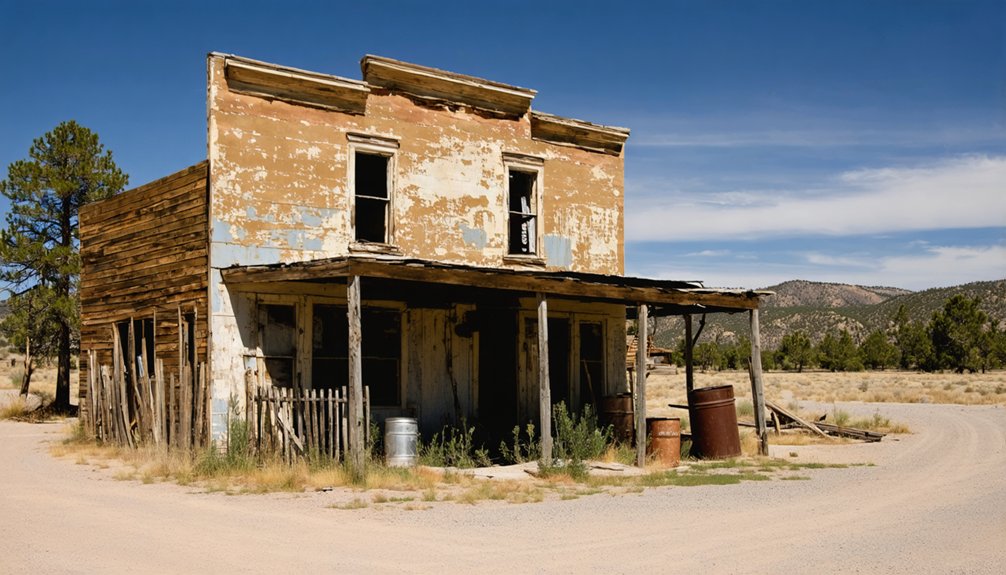
You’ll discover that Borica’s daily life revolved heavily around the mining workforce, with workers taking shifts in nearby mines while their families maintained households in the small but close-knit community.
The town’s economic significance depended on both mining wages and the exchange of goods between local merchants, farmers, and mining companies that kept essential supplies flowing. Essential items were brought in by mule-guided wagon trains from trading posts in Las Vegas, White Oaks and Lincoln. Like many of the 400 ghost towns scattered across New Mexico, Borica’s existence was tied closely to mining activities.
Workers and their families built a sense of community through shared meals, social gatherings, and the mutual support needed to thrive in the rugged New Mexico territory.
Mining Jobs and Labor
Deep beneath New Mexico’s rugged terrain, laborers from diverse backgrounds shaped Borica’s mining legacy through generations of hard work.
The workforce demographics reflected the region’s rich cultural heritage, with Native American tribes like the Navajo, Acoma, and Laguna providing essential labor through negotiated royalty agreements.
You’ll find the labor challenges were met with determination as crews expanded underground operations to depths reaching 2,700 feet.
- Underground crews enlarged mining operations through strategic capital investment
- World War II demands kept nearly all metal mines active during 1941-1945
- Native American tribes secured local employment through royalty agreements
- Mining jobs provided economic stability following 1930s stock reductions
The introduction of massive earth-moving equipment and a 65-mile railway system transformed the scale of mining operations, creating new employment opportunities throughout the region’s mining districts.
Local Trade and Commerce
While most mining camps struggled to establish permanent commercial districts, Borica’s strategic location along the Santa Fe Trail helped it develop into a thriving trade hub by the late 1800s.
Like the silver mining operations that transformed Lake Valley in the 1880s, Borica had the potential to become a major economic center in the territory.
Similar to Hillsboro’s historic adobe homes from the late 1800s, the town likely featured traditional southwestern architecture that housed various businesses.
Unfortunately, historical records about Borica’s trade and commerce have been lost to time, leaving behind only scattered trade artifacts found by modern explorers.
These fragments hint at what must have once been a bustling center of ghostly commerce, but we can’t definitively describe the specific businesses, trading practices, or daily commercial activities that took place there.
Unlike other documented New Mexico ghost towns such as Lake Valley or Elizabethtown, where detailed accounts exist of mercantiles, saloons and trading posts, Borica’s economic story remains a mystery.
You’ll need to rely on archaeological evidence and future historical research to uncover more about this vanished community’s commercial past.
Notable Buildings and Architecture
The architectural legacy of Borica stands as a tribute to New Mexico’s rich building traditions, from its numerous adobe structures to its historic churches and mining-era buildings.
Like many ghost towns in central New Mexico, you’ll find distinct architectural styles that have weathered time’s passage, though preservation challenges remain significant.
the ghost town history of trementina is marked by a once-thriving community that now stands in silent testimony to the past. Abandoned structures serve as a canvas for stories of resilience and loss, while the surrounding landscape echoes with memories of those who called it home. Visitors are drawn to explore the remnants, discovering insights into the lives of early settlers and the harsh realities they faced.
as you wander through these abandoned buildings in Columbus, New Mexico, each step brings a new revelation of history and nostalgia. The crumbling facades and forgotten interiors invite reflections on the dreams and struggles of those who once inhabited these spaces. Here, amongst the ruins, the past whispers its stories, waiting for curious minds to uncover their significance.
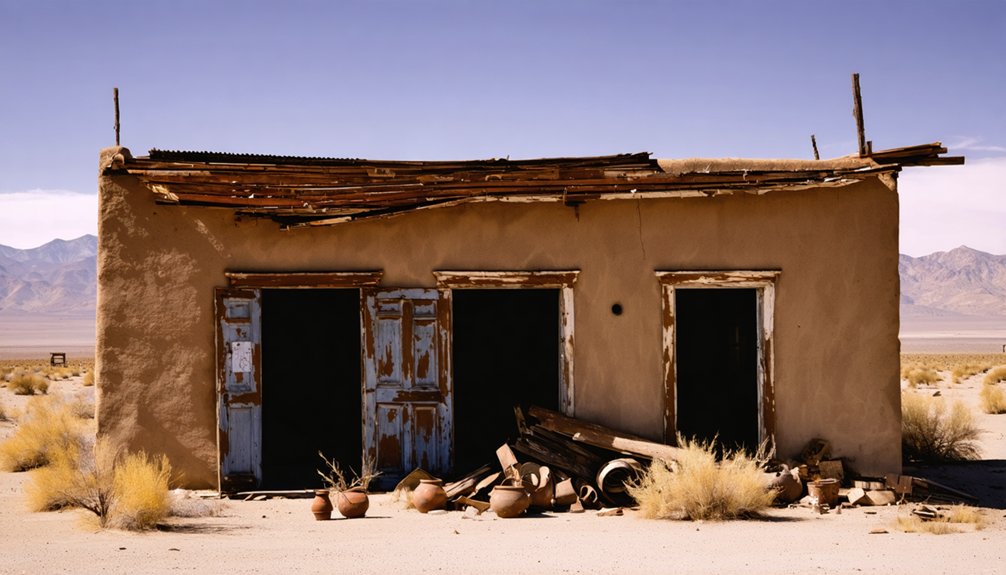
- Adobe structures dominate the landscape, built by master adobero Abenicio Salazar and his team of skilled laborers, with walls reaching impressive thicknesses from years of re-mudding.
- Two-story buildings showcase the town’s former prosperity, including social hubs that once hosted vibrant community gatherings.
- Mining-era remnants reflect the industrial heritage, similar to nearby Kelly Ghost Town’s ruins.
- Standing walls and foundations tell stories of early settlement patterns, offering glimpses into the community’s pioneering spirit.
Transportation and Infrastructure

Roads leading to Borica tell a complex story of transportation evolution in central New Mexico, though limited documentation exists about the town’s infrastructure.
You’ll find that historical records about Borica’s public transportation and infrastructure development remain significantly scarce, making it challenging to piece together an accurate picture of how residents moved through and connected with neighboring communities.
Like many New Mexican ghost towns from this era, Borica’s transportation networks have largely faded into the landscape.
While we can’t definitively describe the specific roads, rail lines, or other infrastructure that once served this community, the site joins countless other abandoned settlements across the state whose stories of connectivity and development have been lost to time.
Future archaeological studies may yet reveal more about how Borica’s residents built and maintained their transportation systems.
Factors Leading to Abandonment
Multiple devastating factors converged to seal Borica’s fate as a ghost town, with mining depletion serving as the primary catalyst.
Once-rich veins of silver and gold that had drawn hopeful prospectors gradually played out, triggering a chain of economic shifts that would empty our beloved town.
- The devastating Silver Panic of 1893 dealt a crushing blow to local mines, forcing widespread shutdowns across the region.
- America’s switch to the Gold Standard in 1896 further devalued silver, accelerating the population decline.
- Apache raids through 1887 created constant uncertainty, disrupting daily life and commerce.
- The closure of nearby military outposts removed crucial economic support that had sustained local businesses.
You’ll find these combined pressures proved too much for our resilient community, transforming a once-bustling mining town into a silent reminder of the Southwest’s dynamic past.
Current Site Conditions
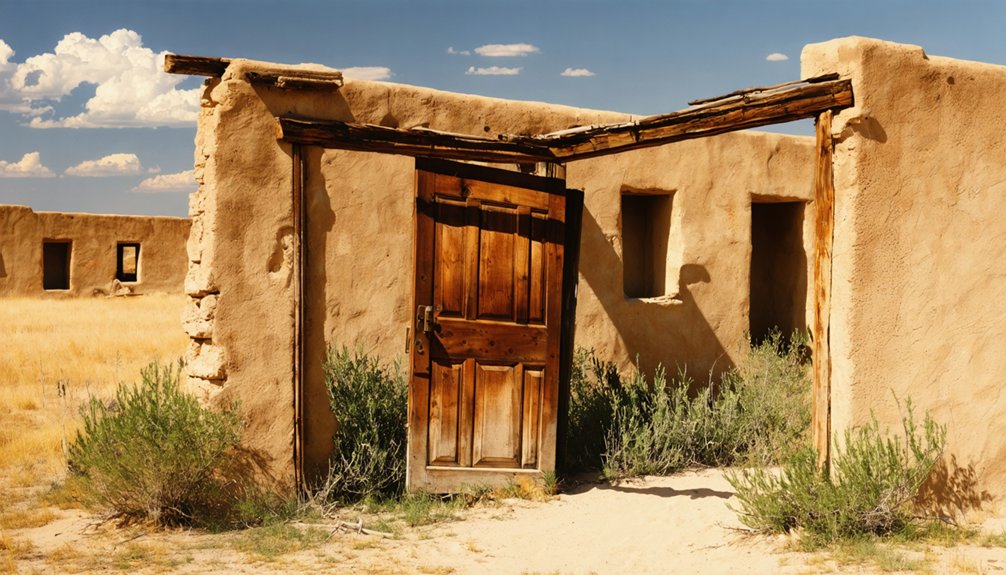
Today’s visitors to Borica encounter a striking blend of preserved history and natural reclamation, where weathered structures stand as silent witnesses to our region’s mining heritage.
The current site conditions reveal a mix of well-preserved buildings, including Brown’s Store, the Hoyle House, and the brick schoolhouse, which now serves as a church. You’ll find the No Scum Allowed Saloon still operational, offering a taste of authentic frontier spirit.
Visitor accessibility is limited since most of the land remains privately owned. The maintained road from White Oaks allows easy access to public areas, including views of abandoned homes and the historic depot.
The cemetery, located half a mile northeast, provides a peaceful glimpse into the community’s past, while the surrounding forest roads wind through our beautiful mountain landscape.
Preservation Efforts and Historical Significance
Though preservation records for Borica remain limited, local historians and community members have worked diligently to protect what’s left of this historic mining settlement.
The site’s cultural heritage remains an important focus for those dedicated to preserving New Mexico’s ghost towns.
exploring the history of Yeso, New Mexico reveals the rich stories and legacies of its past inhabitants. This area was once a bustling community, and remnants of its vibrant life can still be seen today. The preservation efforts not only honor the ghost towns but also highlight the significance of Yeso’s contributions to the broader narrative of New Mexico’s development.
- You’ll find ongoing community engagement efforts to document remaining structures and artifacts through photography and mapping.
- Local historical societies maintain oral histories from descendants of original settlers.
- Volunteer groups conduct periodic site monitoring to prevent vandalism and deterioration.
- Regional preservationists include Borica in broader initiatives to protect New Mexico’s mining heritage.
While many details about Borica’s past have been lost to time, you’re witnessing a growing appreciation for these remote historic places that tell the story of America’s westward expansion and mining history.
Frequently Asked Questions
Are There Any Documented Paranormal Activities or Ghost Sightings in Borica?
Keep your eyes peeled, but you won’t find documented ghost sightings or paranormal investigations here. Despite extensive searches through historical records, there’s absolutely no evidence of supernatural activity in this location.
What Native American Tribes Originally Inhabited the Area Before Borica’s Establishment?
You’ll find ancestral connections to the Jicarilla Apache, who made this area their home in the early 1700s. Their cultural significance remains strong through their hunting traditions and agricultural practices.
Did Any Famous Outlaws or Historical Figures Ever Visit Borica?
Like whispers in desert winds, you won’t find any concrete outlaw legends or historical visits to Borica – it’s mysteriously absent from documented accounts of famous figures in New Mexico’s past.
What Happened to the Residents After They Left Borica?
Given the lack of historical records, you can’t trace where Borica’s residents settled after leaving. While some may have moved to nearby towns, their stories and migration patterns remain undocumented in New Mexico’s history.
Were There Any Major Epidemics or Disasters That Affected Borica?
You won’t find records of any major epidemic impact or disaster response in the area. Unlike other ghost towns that faced catastrophic events, research shows Borica’s decline wasn’t tied to health crises or natural disasters.
References
- https://usghostadventures.com/haunted-stories/americas-most-haunted-west/bonito-lake-new-mexicos-haunted-atlantis/
- https://www.thevintagenews.com/2016/10/04/the-real-ghost-towns-of-new-mexico/
- https://www.newmexico.org/places-to-visit/ghost-towns/
- https://www.youtube.com/watch?v=O_1iT_a-Wzw
- https://ahgp.org/nm/GhostTowns/ghost_townsnm.html
- https://sites.rootsweb.com/~nma/GhostTowns/analla_ghosttown.html
- https://nmplates.com/NewMexicoTowns.htm
- https://newmexiconomad.com/elizabethtown/
- https://prerealinvestments.com/monticello-an-intimate-exploration-of-a-new-mexico-ghost-town/
- https://www.legendsofamerica.com/nm-66ghosttowns/