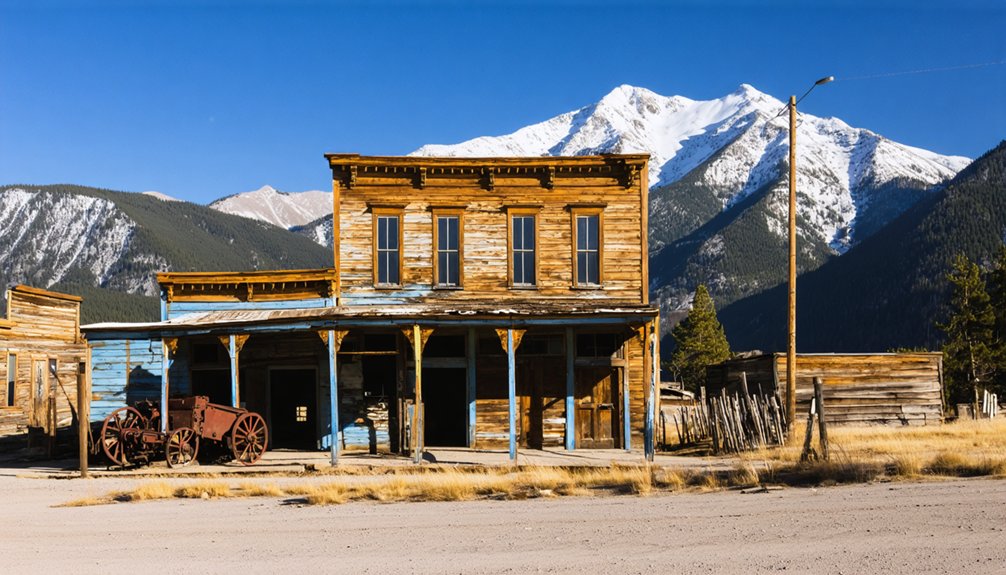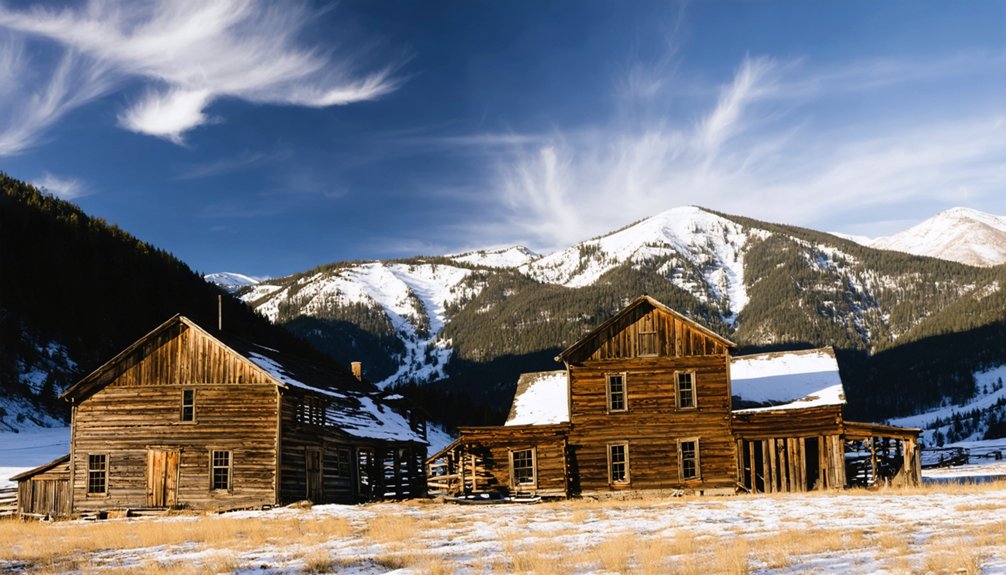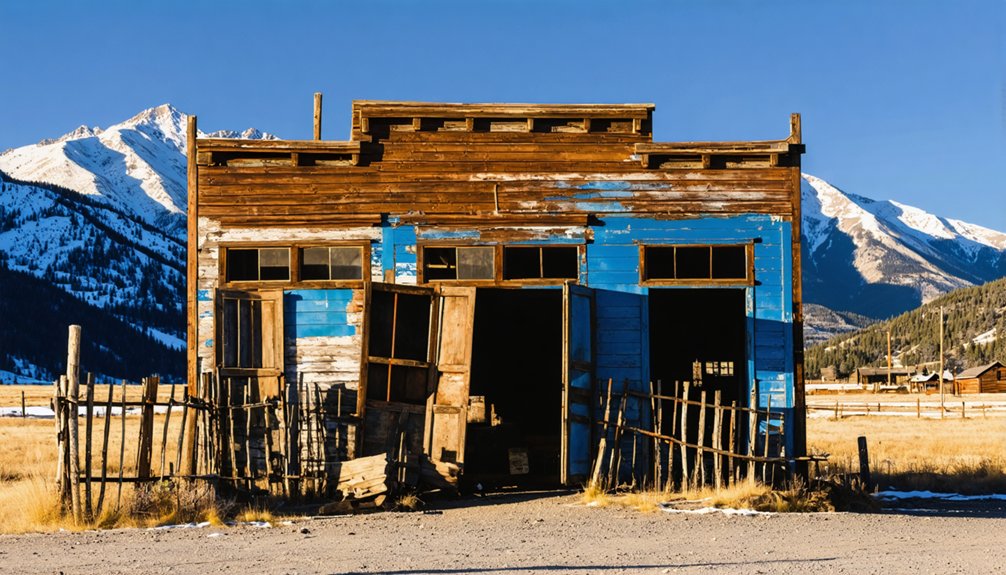
You’ll find five fascinating ghost towns near Buena Vista, Colorado, each telling a unique story of the 1800s mining boom. St. Elmo, the largest, once housed 2,000 residents and 150 mine claims, while Vicksburg grew from a lucky burro-led gold discovery. Winfield flourished under the Free Land Policy, reaching 1,500 residents by 1890. Hancock and Romley sit at 11,000 feet along historic railroad grades. These preserved mountain communities hold countless tales of Colorado’s silver and gold rush era.
Key Takeaways
- St. Elmo, located near Buena Vista, is one of Colorado’s best-preserved ghost towns with original buildings from its 1880s mining heyday.
- Vicksburg ghost town features historic Balm-of-Gilead trees along main street and remains of original mining-era structures and water systems.
- Hancock and Romley ghost towns are accessible via CR 295, offering views of abandoned mining structures at 11,000 feet elevation.
- Winfield ghost town reached 1,500 residents during silver mining operations in the 1890s and retains several original buildings.
- The Mary Murphy Mine near St. Elmo was a major silver producer until 1925, employing 250 workers and processing 100 tons daily.
The Mining Legacy of St. Elmo
While the Ute Indians once used Chalk Creek as prime hunting grounds, the discovery of silver in 1870 by Dr. Abner transformed the area into St. Elmo‘s bustling mining community.
You’ll find the town’s origins trace back to 1878, when settlers laid out streets in six feet of snow to serve nearby miners.
At its peak around 1890, St. Elmo thrived with 2,000 residents and over 150 patented mine claims.
St. Elmo’s golden age saw 2,000 souls calling this silver-rich hamlet home, with miners staking over 150 official claims.
The Mary Murphy Mine dominated the landscape, extracting up to 100 tons of ore daily and employing 250 men.
You can imagine the town’s liveliness with its banks, sawmills, smelters, and entertainment venues.
The Denver South Park railroad reached the town in 1881, making it a vital supply hub for surrounding settlements.
Originally named Forest City, the town was later renamed to its more distinctive St. Elmo title.
However, a devastating fire in 1890, depleted mines, and the Alpine Tunnel’s closure in 1910 led to St. Elmo’s decline, culminating when the Mary Murphy Mine closed in 1925.
Vicksburg: A Creek-Side Gold Discovery
You’ll find Vicksburg’s origin story begins with lost burros that wandered into Clear Creek Canyon in 1867, inadvertently leading prospectors to rich gold deposits.
The town quickly grew to support 600-700 residents with essential services including a post office, hotels, saloons, and a school, while distinctive Balm of Gilead trees lined the main street. Silver and lead minerals were also discovered in the surrounding area. The vibrant mining community reached nearly 1,000 residents during its peak in the 1870s.
Today, you can visit the preserved site off Forest Service Route 390, where century-old poplars still stand among the historic buildings maintained by the Chaffee County Historical Society.
Lost Burros Strike Gold
In 1867, a group of prospectors from Leadville made an unexpected gold discovery in Clear Creek Canyon thanks to their wandering burros.
While the miners searched the surrounding area, their pack animals meandered down to Clear Creek’s waters. The burros’ journey led them to stop at a particular spot in the creek bed where visible gold caught the prospectors’ attention.
This serendipitous discovery sparked an immediate gold rush, with miners quickly staking their claims along the creek.
The find proved significant, yielding not only gold but also silver and lead deposits.
Four major claims emerged: the Tasmania, Fortune, Banker, and Swiss Boy mines.
The Swiss Boy claim became especially important, serving as the foundation for what would become the Vicksburg mining camp, named after local store owner Vick Keller. A complex network of water-filled ditches was created throughout the settlement to keep food cold and provide fire protection. The town quickly grew to become the second largest settlement in Clear Creek Canyon, with a population reaching between 600 and 700 people.
Town Life and Services
As Vicksburg’s population swelled to nearly 700 residents during its peak, the town quickly established essential services to meet the demands of its bustling mining community.
You’d find Vick Keller’s general store, an assay office for testing gold, and a post office handling mail services. For your accommodation needs, two hotels and a boarding house provided comfortable lodging, while the livery stable cared for your horses. Like its Mississippi namesake, this mining settlement sat along crucial transportation routes.
Daily life centered around the water ditches from Vicksburg Creek, which you’d use for fighting fires and keeping food cool. A stagecoach ran daily between Granite and points beyond, connecting residents to neighboring communities.
The town’s character was shaped by the Balm-of-Gilead trees lining main street, brought in by burros. Community services included a schoolhouse for children, a cobbler’s shop, and a blacksmith, while entertainment could be found in the billiard halls and saloons.
Preserved Historical Buildings Today
Today’s visitors to Vicksburg can explore a remarkable collection of preserved buildings that tell the story of its accidental gold discovery in 1867.
You’ll find a dozen well-preserved structures along the main street, including two that remain privately owned and occupied. The town’s historic preservation efforts earned it a spot on the National Register of Historic Places in 1977.
As you walk the grounds, you’ll discover the architectural significance of the remaining schoolhouse foundations, blacksmith shop, and assay office.
Two museums showcase the area’s mining heritage, featuring relocated artifacts like the Fortune Mine tram.
The century-old balsam poplar trees, planted by early miners and sustained by original irrigation ditches, still line the streets, creating a living connection to Vicksburg’s golden past.
Winfield’s Free Land and Mining Heritage
Winfield’s story began with a generous land policy that shaped its rapid growth in the 1880s. You could claim a free 50×100-foot lot simply by committing to build on it – a FreeLandPolicy impact that quickly attracted settlers to this 120-acre town at Clear Creek’s fork.
The first cabin appeared in 1861, and by 1890, the population had swelled to 1,500. Today, visitors can explore historical displays through the schoolhouse window displays. Life was challenging for residents who endured conditions with no modern amenities.
The mining community dynamics centered around silver discoveries made in 1867. You’d find prospectors hauling gold and silver ore by wagon and mule to the town’s smelter and mill for processing.
While the silver market crash of 1893 temporarily halted operations, mining persisted into the early 1900s, with the last ore loads transported by two-horse wagon in 1918.
The Rise and Fall of Bonanza
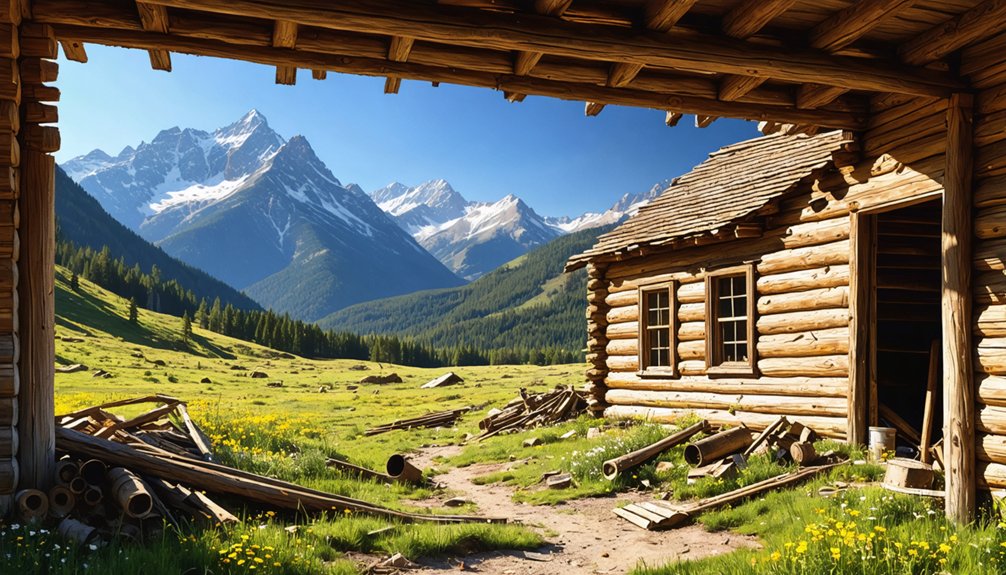
You’ll find Bonanza’s mining boom years marked by staggering growth, with over 40,000 prospectors passing through in 1880-81 and the town swelling to include four hundred houses and thirty-seven businesses by 1882.
The prosperity lasted into the 1930s until the Rawley mine’s closure signaled the end of the silver mining era.
A devastating fire in 1937 destroyed thirty buildings in the business district, accelerating Bonanza’s transformation into one of Colorado’s most notable ghost towns.
Mining Boom Years (1881-1930)
Following the discovery of rich silver deposits at Kerber Creek in 1880, Bonanza rapidly transformed from an empty mountain valley into one of Colorado’s largest mining camps. The town’s expansion brought unprecedented development, with 400 houses and 37 businesses established by spring 1881.
Key developments during Bonanza’s mining boom years:
- Telegraph lines connected the town to Villa Grove and Saguache, while the Bonanza Enterprise newspaper brought news to the bustling community.
- Mining technology advanced with the construction of the mile-long Rawley 12 tunnel in 1911-1912.
- A 7.5-mile aerial tramway was built between 1921-1923 to transport ore.
- The Rawley mine reached peak production of 320 tons daily between 1925-1930.
Despite early success with high-grade silver ore, deeper deposits proved more challenging and expensive to extract, containing increased amounts of lead, zinc, and copper.
1937 Fire’s Lasting Impact
The devastating 1937 fire that consumed 30 buildings in Bonanza’s business district marked the final chapter in the town’s decline from a once-thriving mining community.
While most mines had already shut down and residents departed due to depleted silver deposits, the fire’s aftermath sealed the town’s fate by destroying its remaining infrastructure.
You’ll find today’s Bonanza barely resembles its former self. The fire-ravaged buildings were never rebuilt, leaving only a few historic structures, old houses, and mine remnants scattered across the landscape.
The town’s population has dwindled to just one full-time resident as of 2013, making it Colorado’s smallest incorporated town.
Despite facing potential disincorporation due to failed state filings and elections, Bonanza continues to hold onto its incorporated status, defying the fate of dozens of other extinct Colorado towns.
Alpine Adventures at Hancock and Romely
Perched at an elevation of 11,000 feet, Hancock and Romley offer intrepid explorers a fascinating glimpse into Colorado’s railroad and mining heritage.
You’ll discover these remote ghost towns along CR 295, following the historic Denver, South Park and Pacific railroad grade from St. Elmo. Your Hancock exploration reveals remnants of a once-bustling supply camp, while the Romley ruins showcase scattered buildings and mining structures beneath towering peaks.
As you venture deeper, you’ll encounter abandoned structures in Buena Vista, adding to the area’s haunting beauty. Each dilapidated wall tells a story of the past, inviting curiosity and exploration. These remnants serve as a reminder of the rich history that once thrived in this captivating landscape.
- Navigate the rugged terrain in a high-clearance 4WD vehicle
- Witness the precarious Allie Belle Mine perched above the road
- Explore dilapidated saloons and collapsed cabins at Hancock
- Experience railroad history along the Alpine Tunnel trail
The journey’s challenging but rewarding – you’ll traverse rocky paths past abandoned ore shoots, historic trestles, and alpine meadows that tell tales of Colorado’s pioneering spirit.
Clear Creek Canyon’s Hidden Mining History
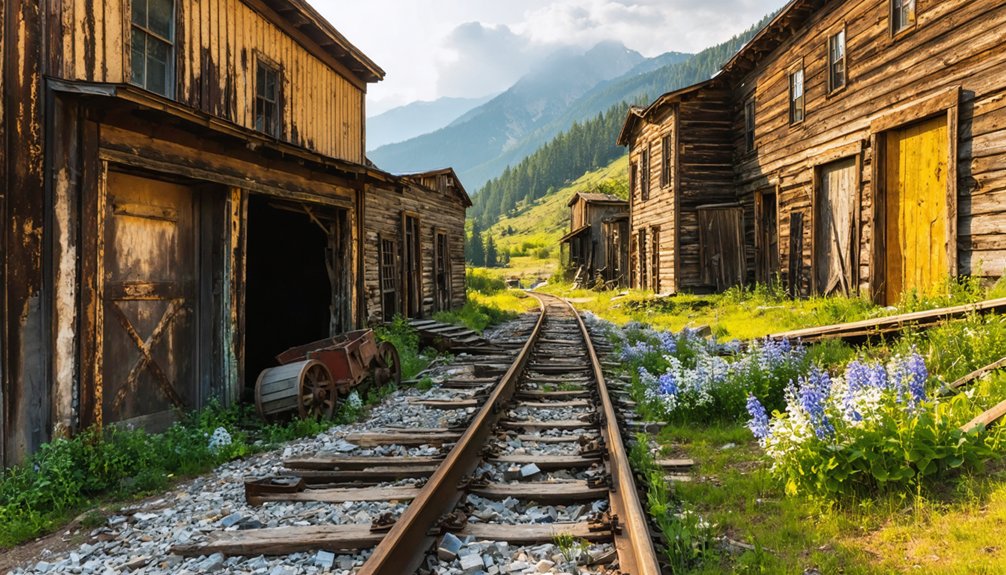
While Hancock and Romley showcase high-altitude mining remnants, Clear Creek Canyon holds an even deeper significance in Colorado’s gold rush history.
The historic peaks of Clear Creek Canyon tell a more compelling gold rush story than its mountainous neighbors.
You’ll trace the origins to George A. Jackson‘s 1859 placer gold discovery at present-day Idaho Springs, which sparked the region’s first major gold rush. When prospectors exhausted the gold-bearing gravels, they turned to hard rock mining in the canyon walls, establishing bustling communities like Georgetown and Silver Plume.
The canyon’s mining legacy shaped Colorado’s development, leading to the establishment of Clear Creek County in 1861 as one of the territory’s original counties.
From the early settlement of “Idahoe” to the relocation of the county seat to Georgetown in 1867, you’ll find a rich tapestry of mining heritage spanning over 150 years in these historic mountain corridors.
Frequently Asked Questions
Are Any of These Ghost Towns Inhabited During Winter Months?
You’ll find St. Elmo’s the only ghost town still inhabited during winter months. Despite harsh winter conditions throughout its town history, modern residents and vacation homeowners maintain year-round presence at 9,600 feet.
Can Visitors Stay Overnight in Any of These Historic Towns?
You’ll find historic accommodations at St. Elmo’s year-round guest house. While overnight camping isn’t permitted in these preserved towns, you can experience frontier life by staying where miners once dwelled.
What Safety Precautions Should Tourists Take When Exploring These Sites?
Don’t enter unstable buildings, stay on marked paths, bring emergency supplies, and tell someone your plans. You’ll need layers, water, and sturdy shoes when exploring ghost towns at high elevations.
Are Metal Detectors Allowed at These Ghost Town Locations?
Check local metal detection laws and treasure hunting regulations first, as you’ll need specific permissions for most sites. Many ghost towns prohibit metal detecting to preserve historical artifacts.
Do Any of These Towns Offer Guided Tours or Educational Programs?
You’ll find guided experiences at St. Elmo through Buena Vista Heritage’s educational programs, highlighting the town’s historical significance. Vicksburg offers self-guided audio tours explaining mining camp life and local history.
References
- https://www.uchealth.org/today/ghost-towns-abound-in-colorado/
- https://www.uncovercolorado.com/ghost-towns/vicksburg/
- https://leadville.com/the-ghost-towns-of-leadville-and-beyond/
- https://www.colorado.com/articles/colorado-ghost-towns
- https://mtprinceton.com/project/st-elmo/
- https://creeksidechalets.com/ghost-towns-near-salida/
- https://www.ariverhouselodge.com/blog/3-ghost-towns-to-check-out-this-fall/
- https://www.legendsofamerica.com/co-stelmo/
- https://getlostinamerica.com/history-st-elmo-and-iron-city-colorado/
- https://www.youtube.com/watch?v=B0yDr5WJrVk