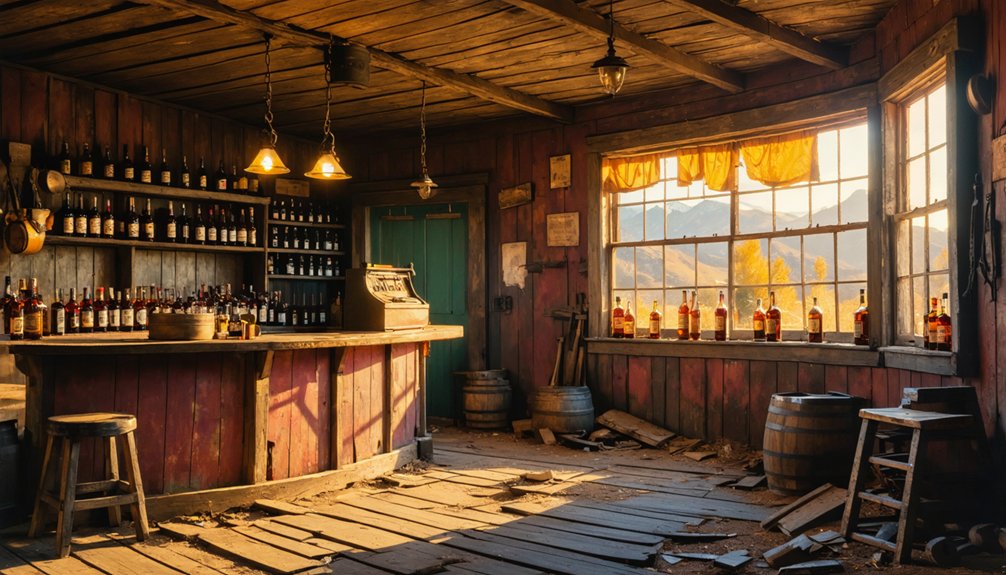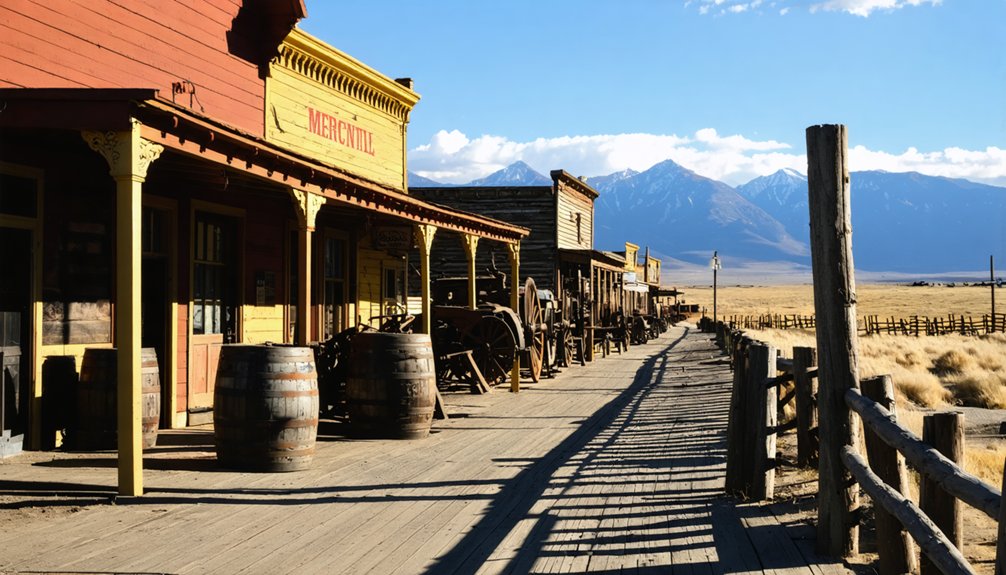
You’ll discover California’s most fascinating desert ghost towns in places like Calico, where 500 silver mines generated $20 million in ore, and Bodie, with 170 preserved structures in “arrested decay.” These abandoned settlements showcase authentic mining equipment, weathered buildings, and Route 66 landmarks like Amboy’s Roy’s Motel. While winter offers mild temperatures for exploration, you’ll need proper gear and navigation tools to uncover the hidden stories etched in these desert ruins.
Key Takeaways
- Calico, a former silver mining town, produced over $20 million in silver ore during the 1880s and now preserves its mining heritage.
- Bodie State Historic Park features 170 preserved buildings in “arrested decay” and was once home to 8,000 residents during its peak.
- Randsburg transformed from 13 tents to 3,500 residents after the Yellow Aster Mine discovery in 1895, now surviving with 69 residents.
- Amboy showcases Route 66 history through Roy’s Motel and Café, featuring distinctive Googie architecture and ongoing preservation efforts.
- Winter offers optimal visiting conditions with mild temperatures and fewer crowds, while fall provides ideal lighting for ghost town exploration.
The Silver Strike Legacy of Calico
Calico reached its peak during the 1880s when 500 silver mines operated in the area. The town’s incredible success produced over $20 million in silver ore during its twelve-year run.
Exploring Bodie’s Untouched Mining Heritage
The remarkable story of Bodie began in 1859 when prospector William S. Bodey discovered gold in the hills north of Mono Lake.
Though he perished in a snowstorm that same year, his legacy lives on through the town that bears his misspelled name. The town earned its notorious reputation as one of the West’s most dangerous places, leading to the infamous phrase “Badman from Bodie”. You’ll find evidence of Bodie’s mining techniques preserved in the remains of seven quartz mills and thirty gold mines that once operated here.
At its peak in 1880, you could’ve witnessed a bustling metropolis of 8,000 residents, with the Standard Mill alone producing $14 million in precious metals over 25 years. The town’s decline was marked by the closure of bankrupt mining companies.
Today, you can explore 170 authentic structures maintained in “arrested decay” by California State Parks, offering an unparalleled window into mining history.
The site’s National Historic Landmark status guarantees these remnants of Bodie history will continue telling their story of boom and bust.
Goffs: Where Desert Railroad History Lives On
While Bodie exemplifies the northern California gold rush, another fascinating ghost town emerged in the Mojave Desert when Isaac Blake established a railroad station in 1883.
Goffs history transformed from a simple railroad siding into a thriving mining town after gold’s discovery in the nearby New York Mountains. The desert railroad hub prospered as a crucial stop along the original Route 66 until 1931, when the highway’s realignment sealed its fate. Visitors can explore the site during spring and fall seasons when the desert climate is most accommodating. The historic schoolhouse remains open three days weekly for tourists to explore its preserved past.
- One-room Mission Revival schoolhouse served as the community’s heart, educating children across 1,000 miles of desert
- Strategic location at 2,584 feet elevation made it ideal for World War II desert training operations
- Rich collection of preserved mining equipment and railroad artifacts now tells the story of Mojave Desert development
Today, you’ll find this desert time capsule managed by the Mojave Desert Heritage and Cultural Association, protecting its legacy.
Randsburg’s Gold Rush Tales
You’ll find Randsburg’s rise and fall mirrors countless other Western boomtowns, sparked by the 1895 Yellow Aster Mine discovery that transformed 13 tents into a bustling settlement of 3,500 residents by 1899.
The 100-stamp mill completed in 1902 produced an impressive $100,000 in gold monthly during peak operations.
Two devastating fires in 1898 severely impacted the town’s development, destroying nearly half of its buildings.
While the district’s mines yielded an impressive $60 million in gold during its peak years, the town’s prosperity proved fleeting as operations waned after 1918.
Today, Randsburg stands as a living museum with just 69 residents, its historic jail and White House Saloon serving as monuments to the area’s Wild West heritage.
Mining Boom and Bust
Following decades of scattered prospecting in California’s Mojave Desert, Randsburg’s meteoric rise began with a pivotal 1893 placer gold discovery in Goler Wash. The real boom ignited in 1895 when three miners struck a massive gold vein atop Rand Mountain, establishing the Yellow Aster mine. The original tent camp quickly evolved into a bustling community as other prospectors began staking nearby claims. This discovery transformed the area’s economic landscape, as gold mining operations rapidly expanded from simple dry-washing camps to industrial-scale operations. The mining company revolutionized ore transport with gasoline powered locomotives in 1905.
- Yellow Aster’s 100-stamp mill crushed $100,000-$120,000 in gold monthly by 1902
- Town population surged from 1,500 in 1896 to 3,500 by 1899
- District produced over $600,000 in gold by October 1897
The boom wouldn’t last forever. Large-scale gold mining ended in 1918, though the Yellow Aster’s total production reached $25 million by 1933.
The district’s survival shifted to tungsten and silver mining at nearby Atolia and Red Mountain.
Wild West Living Legacy
Today’s visitors to Randsburg can experience an authentic slice of California’s Wild West heritage through its remarkably preserved Gold Rush-era structures and artifacts.
You’ll discover the historic White House Saloon, where miners, cowboys, and settlers once gathered, alongside the 1904 General Store‘s vintage soda fountain still serving classic treats.
Randsburg’s heritage remains vibrantly alive despite its tiny population of 69 residents.
The town’s gold mining legacy, which produced $60 million in precious metals, lives on through original buildings that survived numerous fires since 1897.
You can explore the same streets where prospectors earned $3 daily at the legendary Yellow Aster mine, while unique bottle trees dot the landscape as folk art monuments.
Film productions like “Cowboys & Aliens” continue to capitalize on Randsburg’s authentic frontier atmosphere.
Route 66 Nostalgia in Amboy
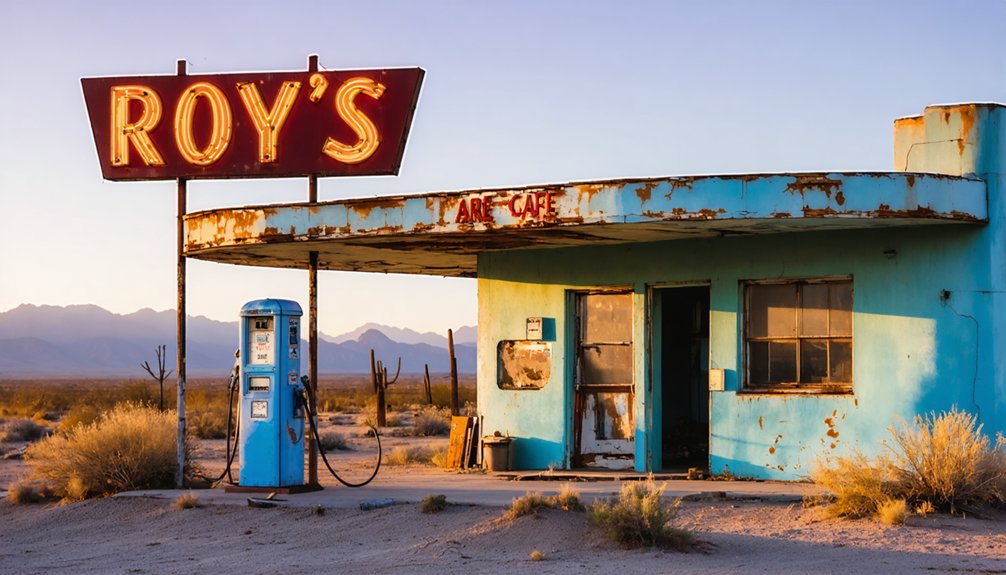
While many Route 66 ghost towns have faded into obscurity, Amboy stands as a compelling monument to America’s golden age of highway travel.
You’ll find its iconic Roy’s Motel and Café, established in 1938, still dominating the landscape with its distinctive Googie architecture and colossal signage. This Route 66 oasis once employed 70 staff members and attracted pilots who’d fly in just for their famous double cheeseburgers.
- Roy’s classic neon sign remains a photographer’s dream and Hollywood favorite
- The town’s preserved service station recalls the era of chrome-trimmed automobiles
- Original salt mining operations continue, adding industrial heritage to Amboy’s appeal
The Amboy Revival gained momentum in 2005 when restaurateur Albert Okura purchased the entire town, committing to preserve this slice of American road trip history.
Hidden Treasures of Chloride City
Deep within Death Valley National Park’s Funeral Mountains lies the long-forgotten Chloride City, a tribute to California’s silver mining heritage.
You’ll discover the hidden history of this remote outpost, which began at Chloride Cliff in 1871 when August J. Franklin stumbled upon silver while dispatching a rattlesnake.
At 4,770 feet elevation, you’ll find remnants of three stamp mills, mining adits, and a preserved Cousin Jack cabin dug into the hillside.
Perched high in the mountains, weathered stamp mills and an old miner’s dugout cabin whisper tales of Death Valley’s silver rush.
The site’s brief but intense period of activity peaked in 1905, when miners extracted ore worth up to $1,000 per ton.
Today, you can explore the scattered ruins of the assay office, bunkhouse, and blacksmith shop, while the solitary grave of James McKay stands as a silent witness to this once-bustling mining camp’s fleeting existence.
Photography Tips for Desert Ghost Town Visits
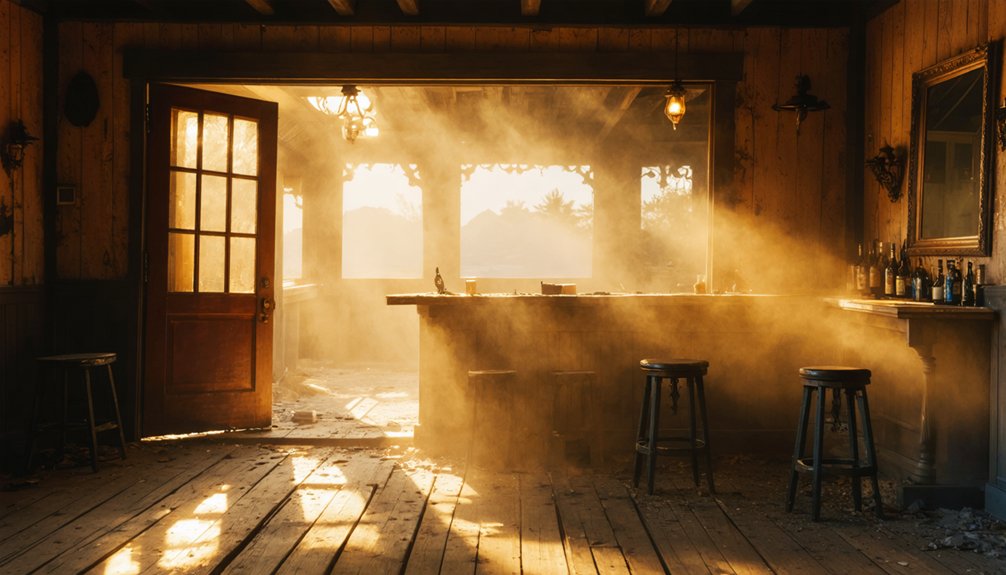
To capture the haunting beauty of California’s desert ghost towns, you’ll need specialized photographic techniques and carefully chosen equipment. Your best shots will come during golden hours when the desert sun casts long shadows across weathered buildings.
Master lighting effects by using backlighting for dramatic silhouettes and strategic flashlight placement for interior details.
- Pack essential gear including a mirrorless/DSLR camera, wide-angle lens for sweeping vistas, and tripod for low-light conditions.
- Position yourself off common paths to discover unique perspectives of jails, saloons, and abandoned storefronts.
- Experiment with long exposures of 10-20 seconds to create ethereal effects with moving clouds or star trails.
Remember to level your horizons when shooting wide angles and use foreground elements to add depth to your compositions.
Best Times to Visit Desert Ghost Towns
After mastering your ghost town photography skills, selecting the best timing for your visit becomes the next key factor for exploration success.
Winter offers exceptional seasonal advantages with mild 70°F temperatures and reduced crowds, while fall brings prime golden hour lighting before the 5 PM park closure. You’ll find the most authentic visitor experiences during morning hours before 12:30 PM, when fewer people roam the ghost towns.
For photographers seeking dramatic shots, plan your visit during golden hour periods just after sunrise or before sunset, when soft light accentuates architectural textures and creates compelling shadows.
Special evening events expand your exploration options, with summer ghost tours until 10 PM and September’s dark sky viewing sessions providing unique perspectives of these historic desert settlements.
Essential Gear for Ghost Town Exploration
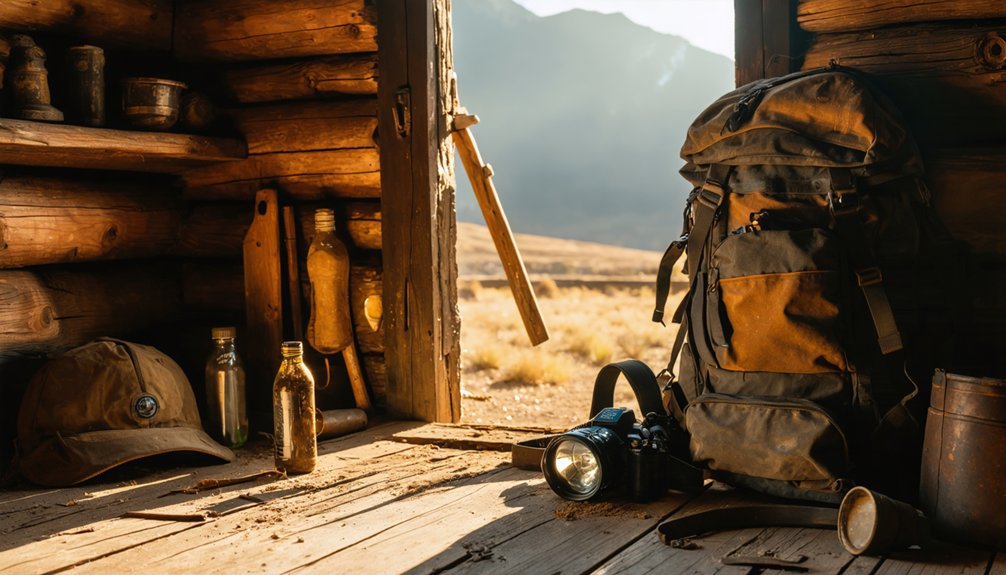
You’ll need essential safety gear including a thorough first aid kit, sturdy shoes, and protective clothing to navigate the sharp rocks and unstable structures common in ghost town sites.
Your navigation tools must include detailed maps, a compass, and GPS devices with pre-downloaded waypoints to guarantee reliable tracking in remote desert locations where cell service is unreliable.
Desert survival supplies should comprise at least three days’ worth of water, emergency food, and shelter materials since ghost towns are often far from civilization and help may not arrive quickly in emergencies.
Safety Equipment Essentials
Proper safety equipment serves as your lifeline when exploring California’s ghost towns, where hazardous conditions lurk in every abandoned structure. Your safety gear should include respiratory protection against decades of dust, mold, and deteriorating materials.
Protective clothing, from sturdy boots to cut-resistant gloves, shields you from physical hazards while allowing the mobility needed to navigate challenging terrain.
- Full-face respirators with regularly replaced filters protect against invisible airborne threats
- Multi-layered lighting system combining headlamps and backup sources guarantees constant visibility
- Extensive first aid supplies and emergency communication devices provide critical support
Don’t compromise on equipment quality – these abandoned settlements contain structural hazards, contaminated materials, and unstable surfaces that demand professional-grade protection.
Your exploration success depends on thorough preparation and appropriate safety measures.
Beyond protective equipment, reliable navigation tools form the backbone of any ghost town expedition in California’s remote regions.
You’ll need to master digital mapping apps like onX Offroad, which proves essential for traversing Eastern California’s isolated trails. Before departure, download offline navigation maps of your entire 95-mile route, as cell service becomes nonexistent in these desolate areas.
GPS coordinates outperform traditional turn-by-turn directions when seeking remote ghost towns. Create route folders with marked photo waypoints indicating campsites, creek crossings, and fuel stations – Bridgeport serves as your last reliable fuel stop in the Eastern Sierra.
Study your downloaded maps thoroughly, noting terrain challenges like washboard roads and deep sand sections. This digital preparation guarantees you’ll confidently traverse both high alpine ridges and dusty desert valleys.
Desert Survival Supplies
Survival in California’s harsh desert environment demands a meticulously curated collection of essential gear. Your desert survival strategy must prioritize water storage through wide-mouth metal containers holding at least 750ml, complemented by multiple water treatment methods.
You’ll need robust shelter options including tarps, emergency blankets, and repair materials like heavy-duty thread and duct tape.
- Multi-purpose gear including signal mirrors, police whistles, and bright balloons can alert rescuers to your location.
- Fire-starting redundancy with waterproof matches, ferro rods, and lighters guarantees you’ll maintain warmth in cold desert nights.
- First aid supplies customized for desert exploration, including medications and tools for removing thorns and treating heat-related issues.
Pack these essentials methodically, as proper preparation determines your ability to safely explore abandoned settlements across California’s arid landscapes.
Historical Preservation Efforts and Challenges
Throughout California’s desert landscape, the preservation of ghost towns represents a complex interplay of public and private initiatives, each employing distinct approaches to safeguard these historic remnants.
Among these initiatives are efforts focusing on abandoned towns near San Francisco, where local groups are working to document and restore iconic structures. By highlighting these sites, they not only honor the past but also draw attention to the rich history that shaped the region. This delicate balance of nostalgia and community engagement hopes to inspire future generations to value and protect their heritage.
You’ll find varying preservation strategies, from Bodie’s “arrested decay” policy to Calico’s complete restoration under Walter Knott’s vision. The historical significance of these sites faces unique preservation challenges, from funding constraints to environmental threats.
While Calico thrives as a Regional Park with restored 1880s structures, Bodie maintains 200 buildings in their weathered state.
The Bodie Foundation’s ongoing efforts to stabilize the cemetery and locate unmarked graves demonstrate the continuous work required.
You’ll notice similar dedication at Cerro Gordo, where private ownership drives restoration, while Eagle Mountain’s modern industrial ruins await their fate.
Frequently Asked Questions
Are There Any Reported Paranormal Activities in These Ghost Towns?
While skeptics doubt ghost sightings, you’ll find documented paranormal activities like Lucy Lane’s spirit in Calico, the Angel of Bodie’s playful presence, and haunted locations throughout Maggie’s Mine and abandoned buildings.
Can Visitors Take Home Artifacts Found in Desert Ghost Towns?
You can’t legally remove artifacts from ghost towns. Legal regulations strictly protect these historical items, and artifact preservation laws guarantee they remain in place for future generations to study and appreciate.
Which Ghost Towns Allow Overnight Camping or Accommodation?
Want to sleep where prospectors once roamed? You’ll find accommodation options at Ballarat’s campground, Calico’s cabins and RV sites, and Bodie’s historic grounds. Camping regulations vary, with BLM boondocking permitted near most.
Are There Guided Tours Available for Disabled or Elderly Visitors?
You’ll find accessible transportation options at several sites, including Sunnylands’ open-air tram tours and Palm Springs’ architectural tours. Contact staff ahead for guided tour services and wheelchair arrangements.
What Indigenous Tribes Originally Inhabited These Ghost Town Areas?
You’ll find the Chemehuevi, Serrano, Cahuilla, Paiute, and Shoshonean peoples originally inhabited these areas, with their Native Tribes leaving significant archaeological evidence through petroglyphs and seasonal hunting settlements across the region.
References
- https://www.desertusa.com/desert-nevada/nevada-ghost-towns1.html
- https://whimsysoul.com/must-see-california-ghost-towns-explore-forgotten-histories/
- https://www.visitcalifornia.com/road-trips/ghost-towns/
- https://www.pbssocal.org/shows/socal-wanderer/where-to-find-the-mojaves-greatest-ghost-towns
- https://californiahighsierra.com/trips/explore-ghost-towns-of-the-high-sierra/
- https://www.californist.com/articles/interesting-california-ghost-towns
- https://www.atlasobscura.com/itineraries/the-wildest-west
- https://www.tripadvisor.com/Attractions-g659472-Activities-c47-t14-California_Desert_California.html
- https://www.youtube.com/watch?v=1w38RaiGdEs
- https://events.thehistorylist.com/organizations/calico-ghost-town-yermo-california