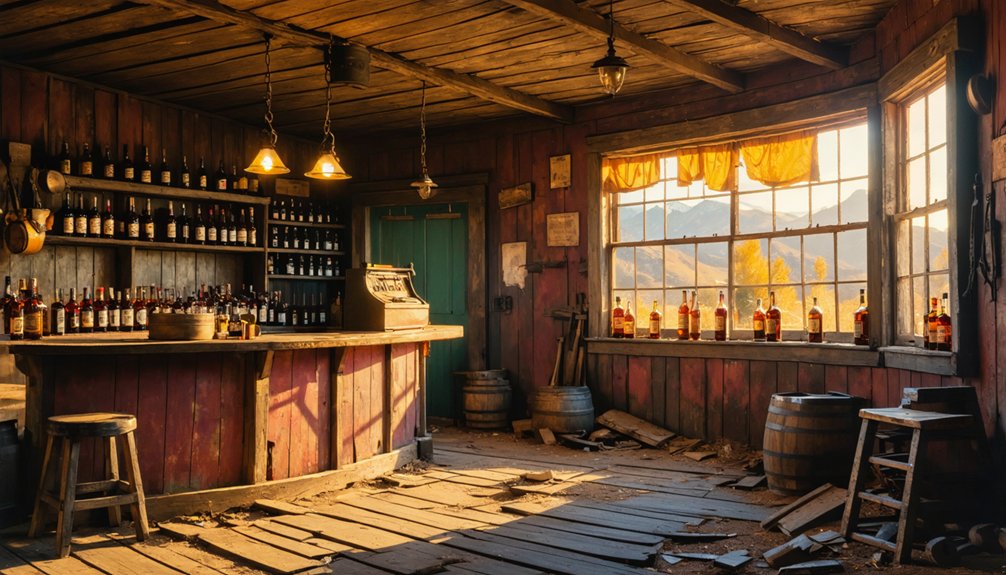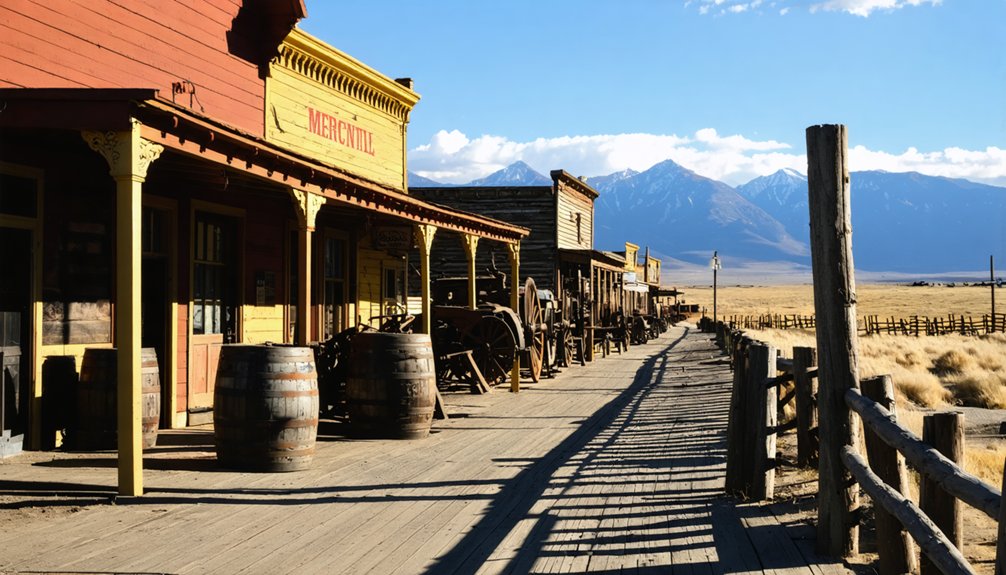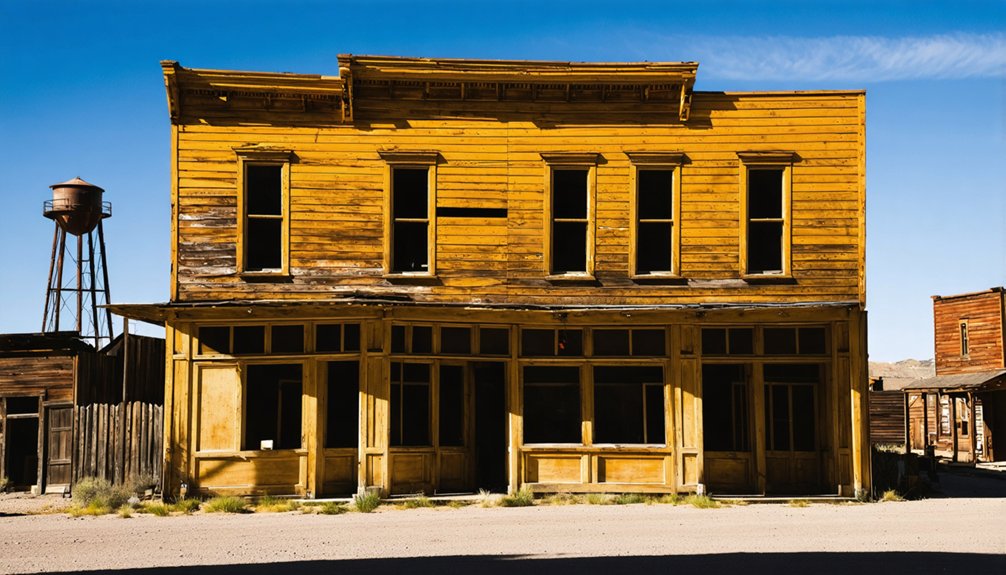
You’ll find several fascinating ghost towns within a few hours of San Francisco. Purissima and Drawbridge, both in the Bay Area, showcase remnants of Gold Rush-era farming and railroad life. The well-preserved Bodie, 75 miles southeast of Lake Tahoe, peaked at 10,000 residents in 1880 with 65 saloons. North Bloomfield, now part of Malakoff Diggins State Historic Park, tells the story of California’s largest hydraulic mining operation. These abandoned towns hold countless untold stories of the American frontier.
Key Takeaways
- Purissima ghost town, near Half Moon Bay, contains remnants of Gold Rush-era farming life, including an old schoolhouse and blacksmith shop.
- Drawbridge, accessible through guided tours, was a thriving railroad settlement near San Francisco until its abandonment in 1979.
- North Bloomfield, located in Malakoff Diggins State Historic Park, preserves authentic 1850s California structures from its mining heyday.
- Bodie State Historic Park, though farther from San Francisco, offers 110 preserved buildings in “arrested decay” from its 1880s mining peak.
- Grass Valley and Sutter Creek feature intact Gold Rush-era buildings, mines, and museums within driving distance of San Francisco.
Discovering Lost Communities in the Bay Area
What secrets lie hidden in the abandoned communities scattered around San Francisco Bay?
You’ll find two remarkable ghost towns that tell distinct stories of California’s past: Purissima and Drawbridge. As urban explorers venture into these forgotten histories, they discover Purissima’s remnants of Gold Rush-era farming life, with its old schoolhouse and blacksmith shop nestled in the coastal hills near Half Moon Bay. The Ocean Shore Railroad once connected Purissima to San Francisco via its 12-year rail service. Similar to North Bloomfield’s fate, these towns faced rapid abandonment as economic opportunities shifted elsewhere.
Meanwhile, Drawbridge stands as the Bay Area’s last true ghost town, slowly sinking into the marshlands where it once hosted hundreds of weekend visitors. In the 1920s, you could’ve found yourself among 600 others enjoying this unique railroad settlement‘s hotels, hunting clubs, and notorious entertainment venues.
Drawbridge beckons from the marsh, a haunting reminder of weekend revelry in this once-bustling railroad paradise.
Today, these abandoned sites offer rare glimpses into Northern California’s vanishing frontier heritage.
The Historic Ghost Town of Bodie: A Time Capsule in the Eastern Sierra
While San Francisco’s surrounding ghost towns offer fascinating glimpses of the past, none can match the preservation and Wild West legacy of Bodie, located 75 miles southeast of Lake Tahoe.
This remarkable piece of Bodie history began in 1859 when William Bodey discovered gold after a decade of prospecting. By 1880, the town had swelled to 10,000 residents following a rich ore discovery, yielding over $38 million in precious metals. Due to the multiple meanings and references associated with the name, historical records often include place name disambiguation to distinguish this mining town from others.
You’ll find a town that earned its notorious reputation with 65 saloons, nightly violence, and a red-light district that rivaled Tombstone and Deadwood. The town became so infamous that the phrase “Badman from Bodie” became widely known throughout the West.
Today, as California’s official gold rush ghost town, Bodie’s 110 remaining buildings stand frozen in time, preserved in “arrested decay” since its 1942 abandonment.
Drawbridge: The Bay’s Last Abandoned Town
Located just six miles south of modern-day Fremont, the ghost town of Drawbridge stands as a haunting reminder of the Bay Area’s vibrant past.
Much like medieval castles of Europe, the town required a wooden bridge that could be raised to allow boats to pass through. Originally established in 1876 as Saline City, this unique settlement grew from a single railroad cabin into a thriving weekend destination for Bay Area residents seeking freedom from city life. All residents used the railroad tracks as their main street.
- By 1926, Drawbridge reached its peak with 90 cabins and two hotels, hosting up to 600 weekend visitors who came for hunting, fishing, and parties.
- The town’s decline began in 1936 when salt pond development and pollution damaged the surrounding ecosystem.
- The last resident departed in 1979, leaving the abandoned structures to slowly sink into the marshland.
- Today, the weathered buildings rest within the Don Edwards Wildlife Refuge, accessible only through guided tours.
Gold Rush Legacy: North Bloomfield’s Mining Heritage
Unlike the slow decline of Drawbridge into marshland, North Bloomfield‘s story began with a sudden burst of activity in 1851 when three prospectors struck gold near Humbug Creek.
The town reached its peak with around 2,000 residents during the late 1860s, marking its most prosperous period.
Initially dubbed Humbug City after a failed rush, the settlement gained momentum when hydraulic techniques revolutionized gold mining in 1853.
Despite its inauspicious start as Humbug City, the town flourished when hydraulic mining methods arrived in 1853.
You’ll find the town’s defining moment came in 1866 when the North Bloomfield Mining and Gravel Company formed, transforming the operation into California’s largest hydraulic gold mining venture.
The company shared vital water rights with Summit for its extensive mining operations, ensuring a steady supply from Bowman Lake reservoir.
By 1876, you could witness seven massive monitors blasting away earth 24/7, processing up to 100,000 tons of gravel daily.
The company’s reign ended in 1884 when the landmark Sawyer Decision curtailed hydraulic mining, responding to devastating environmental impacts.
Today, you can explore this preserved ghost town at Malakoff Diggins State Historic Park.
From Prison to Tourist Haven: Alcatraz Island’s Transformation
As Spanish explorer Lt. Juan Manuel de Ayala first sighted Alcatraz Island in 1775, he couldn’t have imagined its eventual prison history and island transformation.
You’ll discover how this small rocky outcrop evolved from a military fortification to America’s most notorious federal penitentiary.
Here’s how Alcatraz transformed through the ages:
- Military foundations emerged in 1850 when President Fillmore designated it for bay defense.
- Prison operations began in 1857, housing military inmates and conscientious objectors.
- Federal penitentiary years ran from 1934-1963, holding infamous criminals like Al Capone.
- Tourist destination status achieved after 1972, when it joined the Golden Gate National Recreation Area.
Today, you’re free to explore the same cells and corridors where 1,545 inmates once served time, making this former prison an unrivaled window into America’s criminal justice history. The island now welcomes 1.4 million visitors each year who come to experience its haunting history firsthand. The island’s notoriety grew during the Native American occupation from 1969 to 1971, which sparked significant changes in federal Indian policy.
Hidden Gems: Grass Valley and Sutter Creek
You’ll find a wealth of Gold Rush history along Highway 49’s Golden Chain route, where the historic mining towns of Grass Valley and Sutter Creek showcase preserved 1850s architecture and mining artifacts.
At Grass Valley’s Empire Mine State Historic Park, you can explore California’s oldest and richest gold mine, featuring 367 miles of underground shafts and a century of mining heritage.
Whether you’re interested in paranormal activity at Grass Valley’s haunted firehouse museum or prefer hiking the scenic mining trails, these Sierra Foothill communities offer fascinating glimpses into California’s golden past.
Historic Mining Tour Routes
While many tourists flock to California’s most famous ghost towns, the hidden gems of Grass Valley and Sutter Creek offer some of the richest gold mining history in the state.
You’ll discover fascinating mining routes connecting historic sites that showcase the region’s gold rush heritage.
- Start at Empire Mine State Historic Park, where you can explore the 1,250-foot shaft system and witness demonstrations of the original stamp mills.
- Head to the North Star Powerhouse Mining Museum to see the revolutionary Pelton Wheel turbine.
- Visit St. Patrick’s Cemetery to pay respects at miners’ graves dating back to 1853.
- Continue to Sutter Creek’s Kennedy Gold Mine, which plunges an incredible 5,912 feet deep, featuring preserved headframes and mill trails.
These routes let you experience California’s golden age firsthand, far from typical tourist crowds.
Local Attractions Worth Exploring
Beyond the historic mining routes, the neighboring towns of Grass Valley and Sutter Creek harbor remarkable attractions that showcase California’s rich cultural heritage.
You’ll discover Mill Street’s vibrant pedestrian promenade, where buildings from the 1850s now house local cuisine hotspots and unique shops.
Don’t miss the art deco Del Oro Theatre, its 70-foot tower standing as a symbol of 1940s architectural grandeur.
The Empire Mine State Historic Park invites you to explore 367 miles of mine shafts and wander through the elegant Empire Cottage.
Cultural events like the Wild & Scenic Film Festival bring modern energy to these historic streets, while Sutter Creek’s downtown area complements your journey with wine tasting rooms and the fascinating Monteverde Store Museum’s 19th-century displays.
Gold Rush Heritage Preserved
Deep within California’s Nevada County foothills, Grass Valley stands as the state’s richest and most famous gold-mining district, where a remarkable $400 million in precious metal was extracted over a century of operations.
You’ll discover a rich tapestry of historical preservation across the region, with these notable landmarks:
- Empire Mine State Historic Park, showcasing 856 acres with 367 miles of underground tunnels and the original owner’s mansion
- The North Star Mine, which yielded $33 million by 1928
- The Idaho-Maryland Mine complex, producing an impressive $70 million in total output
- Historic downtown Sutter Creek, featuring preserved Gold Rush architecture and Italian-Swiss influences
These sites stand as living monuments to the era when Cornish miners, known as “Cousin Jacks,” brought their expertise to California’s most productive gold-mining region.
Day Trips to California’s Historic Mining Towns
You’ll find fascinating Gold Rush history within a day’s drive of San Francisco at preserved ghost towns like North Bloomfield and Old Shasta, where you can walk through 150-year-old brick buildings and explore former mining sites.
These historic towns, once bustling with thousands of fortune seekers, offer you an authentic glimpse into 1850s California life with their original structures, artifacts, and interpretive displays.
At Old Shasta State Historic Park, you’ll discover the largest remaining row of brick buildings north of San Francisco, while North Bloomfield lets you examine the massive water cannons that powered the region’s hydraulic mining operations.
Gold Rush Ghost Towns
Within a few hours’ drive from San Francisco, Northern California’s historic Gold Rush towns offer fascinating glimpses into the state’s mining heritage.
You’ll discover ghost towns and preserved communities that tell stories of California’s golden past, each just a day trip away.
Among these hidden gems are several ghost towns near Yosemite National Park, where the remnants of mining activities evoke a sense of adventure and history. Exploring these abandoned settlements allows you to step back in time and experience the rugged spirit of the Gold Rush era. Each town has its own unique tale, adding depth to your understanding of the region’s heritage.
- Dutch Flat beckons with its haunting 1898 Elementary School, pre-1856 Odd Fellows Building, and historic cemetery featuring weathered headstones.
- Grass Valley, 143 miles from San Francisco, showcases authentic hard rock mining at Gold Bug Park.
- Sutter Creek, the “Jewel of Mother Lode,” sits 121 miles away along Highway 49’s Gold Rush Trail.
- Placerville, also 121 miles from the city, features hands-on exhibits at its Gold Rush Museum and mining tunnel exploration opportunities.
Time-Travel Through Mining History
Northern California’s historic mining towns transport visitors back to the tumultuous days of the 1849 Gold Rush, with each destination offering unique insights into the era’s rich heritage.
You’ll discover diverse mining techniques at Grass Valley’s Empire Mine, where underground quartz extraction yielded over 5.6 million ounces of gold during its century-long operation.
In Auburn, trace the footsteps of French miners who first struck gold in Auburn Ravine, while Placerville’s preserved buildings and municipal gold mine reveal the evolution from placer mining to deeper excavations.
Sonora, once the largest southern mining settlement, and Sutter Creek, the Mother Lode’s crown jewel, harbor ghostly legends within their 19th-century architecture.
Each town’s distinctive character reflects its role in shaping California’s golden destiny.
Frequently Asked Questions
Are There Any Reported Ghost Sightings in These Abandoned California Towns?
You’ll find numerous ghost stories and paranormal investigations at Bodie, where visitors report seeing a miner’s daughter named Elizabeth and hearing mysterious music at the old Mendocini House after dark.
Can Visitors Take Artifacts or Souvenirs From Ghost Town Sites?
You can’t legally remove artifacts from ghost towns. Strict souvenir regulations protect these historical sites, and you’ll face hefty fines or jail time if caught violating artifact preservation laws.
What’s the Best Time of Year to Photograph These Ghost Towns?
When autumn’s golden light dances through weathered windows, you’ll capture the best shots. Visit from September to October for crisp visibility, dramatic shadows, and vibrant fall colors against decaying structures.
Are Camping or Overnight Stays Allowed in Any Ghost Towns?
You’ll find camping regulations allow overnight stays only at Calico Ghost Town, where you can get permits for 364 days yearly. The other ghost towns strictly permit daytime visits.
How Accessible Are These Ghost Towns During Winter Months?
You’ll find winter weather conditions limit your access to most ghost towns, but road accessibility varies greatly. Lower elevation sites remain reachable year-round, while foothill locations may require checking current road status.
References
- https://patch.com/california/banning-beaumont/13-ghost-towns-explore-california
- https://www.atlasobscura.com/things-to-do/california/ghost-towns
- https://www.camp-california.com/california-ghost-towns/
- https://www.visitcalifornia.com/road-trips/ghost-towns/
- https://www.travelrealizations.com/california-gold-rush-towns-near-san-francisco/
- https://californiahighsierra.com/trips/explore-ghost-towns-of-the-high-sierra/
- https://en.wikipedia.org/wiki/Category:Ghost_towns_in_the_San_Francisco_Bay_Area
- https://www.savetheredwoods.org/blog/spooky-redwoods-ghost-town-remains-a-presence/
- https://www.youtube.com/watch?v=bz6XtozCSMg
- https://www.youtube.com/watch?v=ttGi9F2MeWA