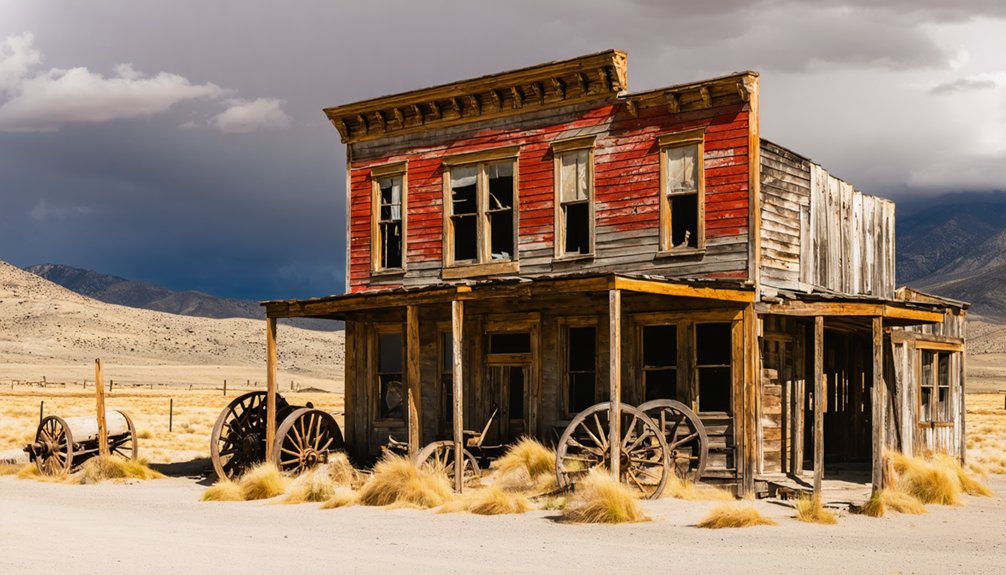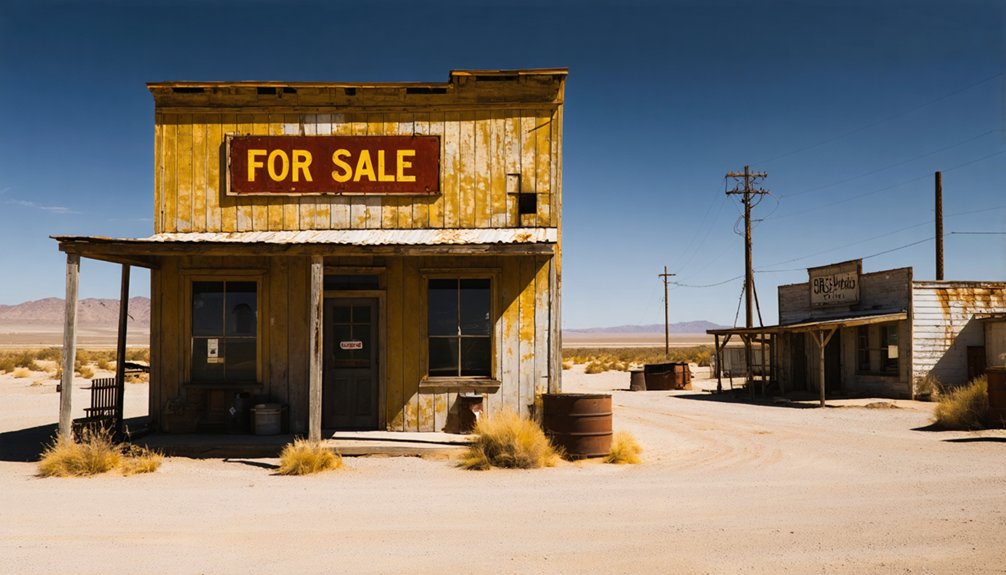
Yes, you can purchase ghost towns through real estate listings, private sales, and government auctions, with prices ranging from $99,000 to over $20 million. You’ll need to conduct thorough title searches, verify zoning laws, and secure proper permits before taking possession. Most transactions require cash due to limited financing options, as traditional lenders often avoid abandoned properties. The process involves complex legal and regulatory considerations that demand careful investigation before making your investment decision.
Key Takeaways
- Ghost towns can be purchased through real estate listings, private negotiations, and government auctions with prices ranging from $99,000 to $20+ million.
- Most ghost town purchases require cash transactions due to limited traditional financing options and lender reluctance.
- Buyers must conduct thorough title searches and address legal issues like ownership disputes before completing a purchase.
- Infrastructure challenges, zoning restrictions, and historic preservation laws significantly impact the ability to purchase and develop ghost towns.
- International options exist, with abandoned villages available for purchase in countries like Spain, Italy, Portugal, and Switzerland.
Legal Requirements for Ghost Town Ownership
Before purchasing a ghost town, you’ll need to navigate complex legal requirements that protect both historical assets and future development rights.
Your first step involves conducting thorough title searches to resolve potential ownership disputes, as decades of neglect often create murky property records. You’ll need to pursue quiet title actions or address adverse possession claims through court orders.
Before buying a ghost town, clear the title history to avoid ownership battles arising from years of abandonment.
You’ll also need to verify zoning designations and understand local land use regulations that govern development possibilities. Ghost town investors must expect to deal with extensive repairs and renovations when revitalizing abandoned structures.
Historic preservation laws, particularly in states like Colorado, may restrict your renovation plans. The state historical society has authority to designate historic preservation sites. Environmental site assessments are essential to identify any hazardous conditions from former mining operations.
Don’t overlook access rights – you’ll need to secure proper easements and permits before taking possession or beginning any modifications to these historical properties.
Finding Ghost Towns for Sale
While ghost towns dot landscapes across America and beyond, finding one for sale requires knowing where to look and understanding price ranges.
You’ll discover options ranging from $99,000 for basic mining retreats to $6.6 million for expansive properties with unique features like hot springs. The Western United States, particularly Nevada, Colorado, Montana, and California, offers the highest concentration of available ghost towns due to their mining history. Several properties come with 31 mining claims, offering potential for both historical preservation and resource development. Most listings require significant renovation to make structures livable and safe.
To locate these properties, you can explore specialized websites like villageio.com, traditional real estate platforms, and auction sites.
Many listings showcase properties with historical significance, from 1870s adobe structures to preserved museums.
International options exist too, with abandoned villages available in Spain, Italy, Portugal, and Switzerland, often featuring stone buildings and potential for development.
Common Purchase Methods and Channels
You’ll find ghost towns available through multiple established channels, including real estate listings highlighting tourist potential, direct negotiations with private owners, and occasional government auctions of abandoned properties.
Private sales often move quickly through direct owner engagement, as demonstrated by successful acquisitions like Cerro Gordo’s $1.4 million purchase. A late-night text from a friend about buying a ghost town sparked Brent’s journey to acquire Cerro Gordo. Prospective buyers should carefully review any existing property liens before finalizing a purchase.
Cash transactions dominate these sales due to financing challenges, with buyers typically needing to provide full payment upfront rather than seeking traditional mortgages.
Finding Ghost Town Listings
Finding ghost towns for purchase requires maneuvering specialized channels that differ from traditional real estate markets.
You’ll discover listings through specialized brokers who understand ghost town demographics and preservation challenges, particularly in the American West. These experts connect you with properties in states like Texas, Montana, and California, where 19th-century structures await restoration. The Texas housing crisis has created ghost town conditions in multiple cities as property values crash and residents flee.
You can explore auction websites featuring entire villages like Villa de la Mina, or browse mainstream platforms like Realtor.com and Zillow for affordable options in dying towns. One notable example was when Bridgeville became the first eBay-sold town in 2002.
Kansas offers homes under $75,000, while historical societies provide access to preserved properties on the National Register.
Regional hotspots concentrate in Nevada, Colorado, and California, where mining-era towns showcase authentic Western architecture.
These networks often reveal investment opportunities complete with period furnishings and original structures.
Direct Owner Negotiations
Direct negotiations with ghost town owners present unique opportunities for securing historic properties through unconventional channels.
You’ll find that owners actively seek investors who share their vision for preservation and development, often communicating through media channels and public announcements to reach potential buyers.
Understanding owner motivations is essential when developing negotiation strategies. Many owners prefer working with buyers who demonstrate commitment to property maintenance and have clear development plans. Buyers should carefully review any existing safety violations and fines that could affect property operations.
You can explore flexible payment arrangements, including contract-for-deed options that allow for gradual acquisition over time. Ghost town prices can range significantly, from Nipton’s $5 million to under a million dollars for smaller properties.
Personal meetings with owners establish expectations and help align visions for the property’s future. These direct discussions typically involve exploring partnership structures, discussing maintenance requirements, and addressing regulatory compliance – all vital elements in successful ghost town transactions.
Government Auction Opportunities
While private sales dominate the ghost town market, government auctions offer viable alternative pathways for acquiring historic properties through federal, state, and local channels.
You’ll find opportunities through agencies like the U.S. Marshals Service, HUD, and GSA, which regularly auction seized or surplus properties, including abandoned towns and historic structures.
State and county-level bidding processes often present the most accessible options, particularly through tax sales of delinquent properties.
You can participate in online auctions lasting 7-14 days, attend live courthouse auctions, or submit sealed bids.
Research is essential – examine public records, verify ownership status, and inspect properties when possible.
Be prepared with immediate funding, as most government auctions require upfront payment.
Remember that post-auction processes may involve title clearing and previous owner redemption rights.
Price Ranges and Market Values

You’ll find ghost towns available across a remarkable price spectrum, from budget-friendly properties under $100,000 to premium acquisitions exceeding $20 million.
The value of these properties depends heavily on factors like proximity to tourist attractions, infrastructure condition, and total acreage.
Historic significance, existing business operations, and previous use as filming locations can command premium prices, as demonstrated by Eagle Mountain’s $22.5 million sale in 2023.
Market Price Factors
The market values of ghost towns across America span from modest $100,000 investments to multi-million dollar acquisitions, with prices heavily influenced by location, property condition, and development potential.
You’ll find remote desert properties like Lobo, Texas commanding lower prices due to isolation, while locations near urban centers drive higher market demand. California’s Cerro Gordo sold for $1.4 million despite its remoteness, and Eagle Mountain fetched $22.5 million in 2023.
Location desirability greatly impacts financing options, with traditional lenders avoiding remote sites lacking basic infrastructure.
Property condition also plays a vital role, as historic buildings often require extensive renovation costs 5-10 times initial estimates.
When evaluating ghost town investments, you’ll need to factor in hidden costs like environmental remediation and utility infrastructure repairs.
Ghost Town Value Ranges
Ghost town market values form distinct price tiers, reflecting a diverse investment landscape across America.
You’ll find entry-level opportunities starting around $100,000 for small abandoned properties, like Swett, South Dakota’s 6-acre parcel with its tavern and house.
The mid-range segment showcases historical gems like Cerro Gordo, California, where ghost town investments can reach $1.45 million for 300+ acres with multiple structures.
At the premium end, substantial properties like Eagle Mountain, California command prices over $20 million, demonstrating significant property appreciation potential.
International comparisons reveal competitive alternatives, with Romanian villages available for under $900,000.
While there’s no active flipping market, the 4,500+ abandoned towns across America offer varied investment opportunities, from preserved 19th-century architecture to Old West authenticity.
Essential Due Diligence Steps
Before investing in an abandoned town, conducting thorough due diligence becomes essential to protect your investment and avoid costly surprises. Your first priority is extensive title verification to guarantee clear ownership across all parcels and prevent future ownership disputes.
You’ll need to examine preliminary title reports, ownership history, and identify any undisclosed heirs or liens.
Beyond title work, you must analyze zoning laws, environmental hazards, and physical conditions. Commission an ALTA survey to confirm boundaries and identify encroachments.
Secure a Phase I Environmental Assessment to uncover potential contamination from past mining or industrial activities. Review all permits, restrictions, and pending litigation.
Don’t skip checking historic preservation ordinances, as they may limit your ability to alter or demolish structures – a vital consideration when revitalizing a ghost town.
Financing Your Ghost Town Purchase
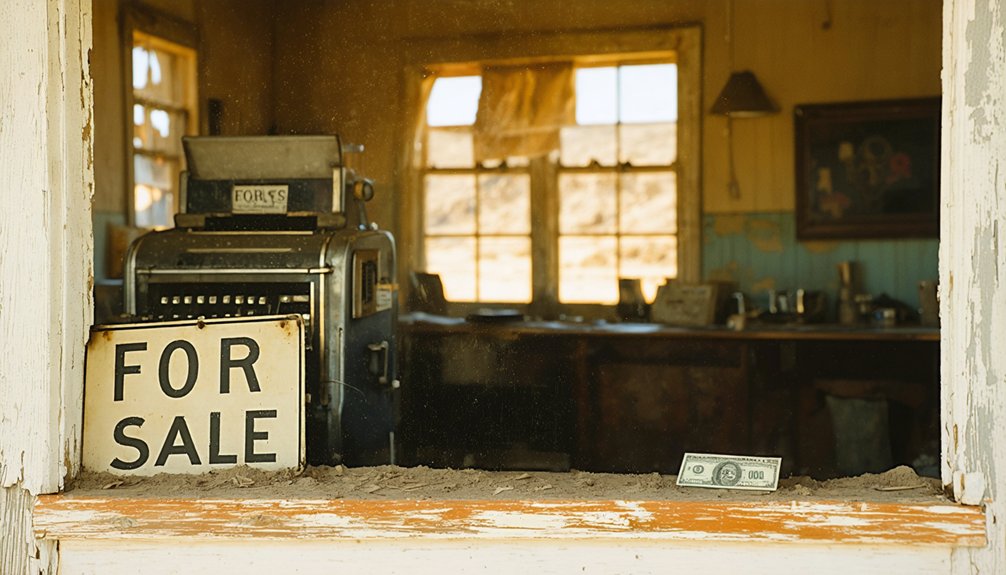
Once you’ve completed thorough due diligence, securing financing for your ghost town purchase presents unique challenges that differ from standard real estate transactions.
Traditional lenders rarely approve mortgages for abandoned properties miles from civilization, especially those lacking basic utilities and requiring extensive rehabilitation.
Most ghost town acquisitions rely on cash purchases, which simplify auction bidding and direct owner sales.
Cash is king when buying ghost towns – it streamlines the process and gives you an edge in auctions and negotiations.
However, if you’re seeking alternative financing, private lenders and investor groups often fill the gap where conventional mortgages fall short.
Property appraisals can be complex, but specialized options like FHA 203(k) and USDA rural rehab loans might work for qualifying properties.
Hard money loans, though expensive, provide quick funding for major restoration projects.
Consider leveraging existing assets or forming partnerships to access the capital needed for your ghost town investment.
Understanding Potential Risks
While purchasing an abandoned settlement might spark romantic visions of restoration, prospective ghost town buyers must navigate a minefield of interconnected risks that can derail even well-funded projects.
A thorough risk assessment reveals multiple ownership challenges, from unclear property titles to complex zoning restrictions and preservation mandates.
You’ll face substantial infrastructure hurdles, as most ghost towns lack basic utilities and require extensive restoration beyond the initial purchase price.
Environmental hazards like contamination, coal fires, and flooding can render properties uninhabitable, while securing traditional financing proves nearly impossible.
Operational obstacles include resistance from rural councils, community integration issues, and failed tourism ventures.
Before committing to a ghost town purchase, you must carefully evaluate these layered risks to avoid a costly investment nightmare.
Notable Ghost Town Sales Examples
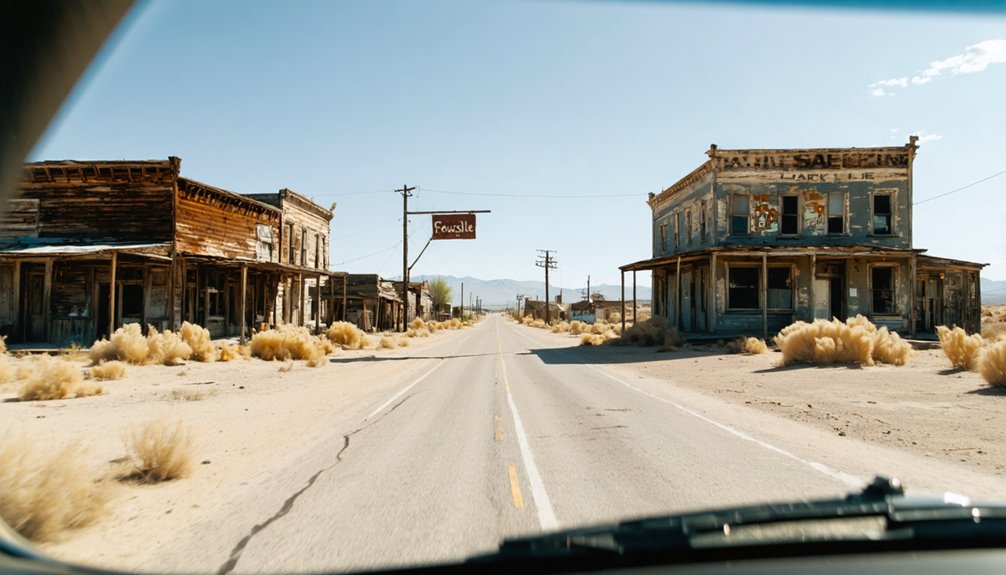
Recent ghost town sales across America showcase the diverse range of investment opportunities and price points in this unique real estate market.
You’ll find properties like Cerro Gordo, California, listed at $925,000 for 300 acres and 22 buildings, while Eagle Mountain, California, commanded $22.5 million in 2023. These stark price differences reflect varying levels of historical preservation and development potential.
Notable examples include Garryowen, Montana, significant for its Little Bighorn Battle connection, and Johnsonville, Connecticut, featuring National Register-listed 19th-century architecture.
Ghost towns like Garryowen and Johnsonville showcase America’s rich history through battlefield sites and preserved Victorian-era buildings.
You’ll discover unique investment possibilities across states like Texas, Montana, and California, with properties available through specialized agents and auction platforms.
Whether you’re drawn to well-maintained historic structures or properties requiring restoration, ghost towns represent distinctive opportunities for those seeking unconventional real estate ventures.
abandoned mines in california are often found on the outskirts of these ghost towns, revealing the rich history of the gold rush era. Exploring these sites can offer unique insights into the challenges and triumphs of early miners. Additionally, they present potential restoration projects for adventurous investors looking to preserve a piece of California’s mining legacy.
Restoration and Development Considerations
Before initiating a ghost town restoration project, you’ll need to conduct thorough due diligence regarding the extensive financial and logistical challenges ahead. The restoration challenges you’ll face extend far beyond the initial purchase price, requiring strategic planning and substantial resources.
- Infrastructure rehabilitation will demand significant investment, from restoring centuries-old water systems to rebuilding access roads that can withstand extreme weather conditions.
- Historic preservation laws may restrict your renovation options, requiring specialized approaches to maintain structural integrity while preserving historical authenticity.
- Basic utilities and services require innovative solutions, including underground internet installations and self-sufficient repair capabilities.
- Community engagement proves essential for long-term success, as remote locations necessitate volunteer support and skilled worker recruitment for ongoing restoration and operational needs.
Your development timeline should extend several years, accounting for unforeseen setbacks and regulatory compliance requirements.
Frequently Asked Questions
Can I Run a Business in a Ghost Town While Living Elsewhere?
You can operate a ghost town business while living elsewhere through remote management, though you’ll need to establish reliable infrastructure and local staff to guarantee business feasibility under zoning regulations.
How Long Does the Average Ghost Town Purchase Transaction Take?
You’ll typically face 6-12 months for ghost town purchase processes, though transaction duration varies widely due to complex ownership verification, environmental assessments, and extensive legal documentation requirements.
Are There Property Taxes on Abandoned Ghost Towns?
You’ll need to pay property taxes on abandoned ghost towns – they’re not exempt. Tax implications persist whether the properties are occupied or vacant, and you’re responsible from the moment of purchase.
Do Ghost Towns Come With Mineral or Water Rights?
You’ll need to verify specific mineral rights and water rights when purchasing a ghost town – they aren’t guaranteed. These valuable resources often remain separate or restricted by state and federal regulations.
What Insurance Options Are Available for Ghost Town Properties?
You’ll need specialized vacant property insurance and commercial liability coverage up to $5 million for structures, plus additional options for historic buildings, mineral operations, and environmental hazards in ghost towns.
References
- https://trueparity.com/blog/real-estate-ghost-towns-invest-in-hidden-gems
- https://www.zillow.com/learn/how-to-buy-an-abandoned-house/
- https://www.usa.gov/real-estate-sales
- https://www.accio.com/biz-cheap/abandoned-towns-for-sale-cheap
- https://www.ezhomesearch.com/blog/towns-for-sale-in-the-usa/
- https://www.realtor.com/advice/buy/find-buy-abandoned-properties/
- https://www.quickenloans.com/learn/how-to-buy-abandoned-property
- https://blogs.loc.gov/law/2025/09/st-elmo-colorado-administering-a-ghost-town/
- https://95rockfm.com/colorado-occupy-ghost-towns/
- https://www.nolo.com/legal-encyclopedia/who-can-claim-property-based-adverse-possession-colorado.html