You can legally live in a ghost town, but you’ll need to secure proper property ownership through title searches and legal documentation. You must obtain necessary permits, comply with local zoning laws, and meet building code requirements. Environmental assessments and utility restoration permits are mandatory. Regular property tax payments and proof of permanent residency status are essential. The path to ghost town living involves careful navigation of complex legal and safety considerations.
Key Takeaways
- Legal residency in ghost towns requires proof of property ownership through title searches and written documentation from current owners.
- Residential zoning permissions, building permits, and compliance with local building codes are mandatory for lawful occupation.
- Environmental assessments must confirm the absence of hazards like asbestos and industrial waste before occupancy is permitted.
- Establishing permanent residency requires state-specific documentation, utility connections, and minimum stay requirements in the ghost town.
- Regular property tax payments and adherence to historical preservation laws are essential for maintaining legal residence status.
Understanding Ghost Town Property Rights
When exploring property rights in ghost towns, it’s essential to understand that abandoned buildings and land still maintain legal ownership status despite their deteriorated condition.
Simply finding vacant structures doesn’t grant you the right to occupy them, as abandoned property requires both physical absence and clear intent to abandon by the legal owner.
Physical vacancy alone doesn’t equal legal abandonment – property rights remain unless owners explicitly relinquish their claim.
While you might dream of claiming ghost town property through adverse possession, you’ll need to meet strict legal requirements, including continuous occupation and property maintenance for the statutory period. Posting no trespassing signs and regularly inspecting the property are essential steps owners take to prevent adverse possession claims.
Even deteriorating buildings remain private property, and entering without permission constitutes trespassing. The law requires written conveyance documents signed by all parties to legally transfer ownership of any ghost town property.
You’ll need written permission from the legal owner or a court order confirming abandoned status before taking possession.
Understanding these property rights will help you navigate ghost town ownership legally and avoid potential legal issues.
Legal Requirements for Ghost Town Residency
Before establishing legal residency in a ghost town, you’ll need to navigate multiple regulatory requirements and due diligence steps.
You must conduct thorough title searches to verify clear ownership, especially given the complex ghost town history of generational transfers and abandonment. You’ll also need to confirm zoning permissions allow residential use and secure necessary building permits. Many ghost towns offer unique opportunities for investors seeking to purchase entire historic villages.
Environmental assessments are essential before occupying abandoned property, as you’ll need to check for hazards like asbestos or structural safety issues. Remote locations often have sporadic code enforcement due to their distance from municipal authorities.
You must obtain proper permits for utility restoration and guarantee compliance with local building codes. If you’re considering incorporation, you’ll face additional hurdles including minimum population requirements and establishing a governing council.
Be aware that adverse possession claims typically require 5-10 years of continuous occupancy and tax payments.
State Laws and Regulatory Compliance
State laws and regulatory compliance present complex challenges for aspiring ghost town residents.
You’ll need to navigate zoning implications that dictate whether residential use is permitted on your chosen property. Local councils often resist residential development in non-residential areas due to service provision burdens.
Environmental risks pose significant hurdles, as you’re required to conduct site assessments for contaminants and industrial waste. The case of Wittenoom illustrates how hazardous conditions can render entire areas legally uninhabitable.
You’ll also face strict building codes and permit requirements for any construction or utility installation, even in remote locations. While enforcement may be sporadic in rural areas, you’re still subject to prosecution for unauthorized habitation, as demonstrated by the Menzies Council case. Any plans for residency must respect preservation of heritage sites to comply with historical protection laws.
Establishing Permanent Residency Status
To establish legal residency in a ghost town, you’ll need to follow your state’s specific documentation requirements, which typically include obtaining a driver’s license or state ID, registering to vote, and maintaining a permanent address.
You must demonstrate physical presence through utility bills, bank statements, and housing agreements while adhering to minimum stay requirements that vary by jurisdiction. Like the aging population of Pitcairn Island, many ghost towns face demographic challenges that affect their long-term sustainability. States like Wyoming require securing a residential street address before applying for essential documents like driver’s licenses.
If you’re considering a nomad-friendly state like South Dakota or Nevada, you can establish residency with less stringent physical presence requirements, though you’ll still need to maintain certain connections like periodic license renewals and a verifiable mailing address.
Legal Documentation Requirements
Establishing permanent residency in a ghost town requires thorough legal documentation that proves your intent to make it your primary domicile.
You’ll need to file a notarized domicile declaration with the county clerk to protect against potential residency disputes. This declaration serves as your foundation for establishing legal residence.
Your driver’s license and vehicle registration must reflect your ghost town address, requiring you to complete state-specific inspections and insurance requirements. The process varies significantly, as some states require formal domicile declarations while others do not.
Estate planning documents like wills and trusts should be updated to reflect your ghost town residency. To strengthen your position against domicile challenges, you should register to vote using your new address and maintain local financial accounts.
Additionally, you’ll need documentation of utilities or alternative residence arrangements, as ghost towns often lack conventional housing.
Keep all these documents organized and readily accessible for any legal proceedings.
Proof of Physical Presence
When proving physical presence in a ghost town, you’ll need thorough documentation that tracks your time spent at the location. Your residency documentation must demonstrate sustained physical presence through tangible evidence that meets legal requirements for establishing permanent residency status.
- Maintain utility bills, property records, and tax returns showing your ghost town address as your primary residence.
- Document your daily presence through dated photographs, local business receipts, and communication records.
- Collect affidavits from nearby residents or service providers who can verify your regular presence.
- Keep detailed logs of any temporary absences, including purpose and duration, to demonstrate continuous residence intent.
Consider installing security cameras or maintaining timestamped digital records that can prove your ongoing occupancy, as traditional forms of documentation may be limited in ghost town settings. Keep in mind that any trips abroad lasting six months to one year could potentially disrupt your continuous residence status.
State-Specific Residency Rules
Legal requirements for establishing permanent residency in ghost towns vary considerably across different states, with each jurisdiction maintaining its own specific criteria and restrictions.
Ghost town ownership challenges differ markedly: Colorado enforces strict trespassing laws and zoning codes, while Texas grapples with unclear property titles and multiple landowner negotiations.
Connecticut’s Public Act No. 19-92 outlines specific abandonment criteria, and Illinois ties residency rights to foreclosure processes and housing code compliance.
You’ll need to navigate complex state-specific hurdles, including environmental assessments, historic preservation covenants, and utility permit requirements.
Western states typically require 5-10 years of adverse possession with tax payments, alongside zoning analysis and contamination checks before you can legally claim residency in these forgotten places.
Essential Documentation and Permits
To establish legal residence in a ghost town, you’ll need to compile essential documentation including property deeds, utility bills, and government-issued ID with your ghost town address.
You must verify property rights through the county recorder’s office and obtain written permission from the current owner before occupying any structures.
Local permits for occupancy, utilities, and historical preservation compliance should be secured through the appropriate municipal or county offices prior to establishing residence.
Required Residency Documentation Process
Establishing legal residency in a ghost town requires thorough documentation that proves both physical presence and intent to permanently reside.
Your residency verification process must include specific documentation essentials that meet state requirements, which typically align with standard residency rules despite the unique nature of ghost town living.
- Secure a valid driver’s license or state ID showing your ghost town address as your primary residence
- File a Declaration of Domicile with your county clerk’s office, where available, to formally establish intent
- Maintain ongoing proof of occupancy through utility bills, bank statements, or property documentation
- Register to vote using your ghost town address and complete vehicle registration within state-mandated timeframes
These documents create a foundation for your legal residency claim and protect your rights as a ghost town inhabitant.
Property Rights Verification Steps
Securing property rights in a ghost town demands meticulous verification through essential documentation and permits before any occupancy claims.
You’ll need to conduct a thorough title search to establish clear property ownership and identify any existing liens or encumbrances. Visit your county recorder’s office to examine deeds, plat maps, and survey records that confirm precise boundary lines and land use restrictions.
Research local municipal codes and state statutes governing abandoned properties while consulting with a real estate attorney to navigate jurisdictional requirements.
You must verify tax status through the assessor’s office and investigate utility records to document service history. Cross-reference federal land patents through the Bureau of Land Management to validate original ownership transfers and confirm you’re pursuing legally available property.
Local Permit Application Methods
The essential permit application process requires five core documentation steps to establish legal residency in a ghost town.
You’ll need to comply with local regulations and permit requirements by providing proof of physical presence and intent to establish permanent residency.
- File a notarized Declaration of Domicile with your county clerk’s office to formally establish your legal residence.
- Secure a state driver’s license or ID card using your ghost town address as proof of physical presence.
- Register to vote in your new jurisdiction to demonstrate permanent residency intent.
- Submit supporting documentation including utility bills, bank statements, and lease or property ownership records.
Remember that specific requirements vary by state, and you’ll need to meet the minimum day-count thresholds, which typically range from 183 to 210 days for full residency status.
Tax Considerations for Ghost Town Living
Living in a ghost town presents unique tax implications that extend beyond standard property ownership.
You’ll need to maintain regular property tax payments even without basic infrastructure, and restoration projects can trigger reassessments that increase your tax liability.
Ghost town financing becomes particularly challenging as banks often view these properties as high-risk investments.
However, you can offset these costs through alternative revenue streams.
Converting your ghost town property into an event venue, tourist attraction, or film location can provide tax-deductible income.
If you’re considering a buyout situation, be aware that market value offers typically don’t reflect replacement costs, and you might face relocation taxes.
Watch for historical preservation regulations that could limit development but potentially qualify you for tax deductions.
Safety and Infrastructure Challenges
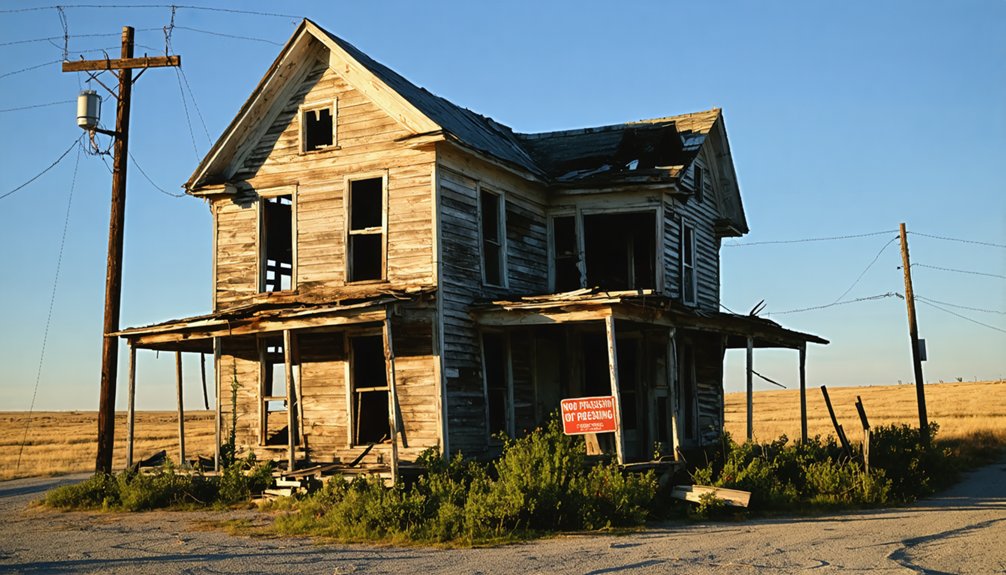
Safety concerns in ghost towns extend far beyond typical property maintenance issues, presenting significant legal and physical risks that demand careful consideration.
Infrastructure challenges create dangerous living conditions, while environmental hazards pose serious health threats.
- Long-term exposure to airborne toxins and contaminants can cause severe health issues, as evidenced in cases like Times Beach and Wittenoom.
- Emergency response times are critically delayed, with Lifeflight services costing upwards of $40,000 and no certified rescuers available.
- Basic utilities are often compromised, with water leaks causing ground collapses and roads developing hazardous conditions.
- Fire safety becomes a major concern due to limited water access, with hose reach restricted to 750 feet and no local fire departments.
These challenges create substantial liability risks that could outweigh the appeal of ghost town residency.
Frequently Asked Questions
Can I Run a Business or Rent Rooms in a Ghost Town?
You’ll need legal property ownership or valid rental agreements plus proper business regulations compliance to operate any enterprise or rent rooms in a ghost town. Unauthorized operations risk criminal penalties.
Are There Special Insurance Requirements for Living in Ghost Towns?
You’ll need specialized insurance policies due to high-risk factors. Standard homeowners coverage may not apply, and you should obtain enhanced liability coverage for remote locations lacking basic services.
How Do Postal Services and Mail Delivery Work in Ghost Towns?
Since 76,945 post offices closed after 1902, you’ll need to establish new mail routes to receive delivery. You can register for general delivery at the nearest operating post office to overcome delivery challenges.
What Happens if Other People Start Squatting in Nearby Abandoned Buildings?
You’ll need to protect your property rights by documenting your occupancy and filing proper notices. Other squatters can complicate your legal position, so consult local squatter laws and consider securing nearby structures.
Do Ghost Towns Have Any Special Protections Under Historical Preservation Laws?
Through weathered facades and creaking floorboards, you’ll find ghost towns can receive significant protections if they’re historically significant. They’re covered under the National Historic Preservation Act and state preservation regulations.
the importance of ghost towns in history cannot be underestimated, as they serve as tangible reminders of the past and the stories of those who once inhabited them. Each abandoned street and derelict building provides valuable insights into economic shifts and societal changes over time. Preserving these sites not only honors this history but also promotes cultural heritage tourism, inviting future generations to explore and learn.
References
- https://blog.savvynomad.io/easiest-states-to-establish-residency/
- https://www.annuity.org/personal-finance/taxes/residency-requirements-by-state/
- https://law.justia.com/codes/georgia/2020/title-19/chapter-2/section-19-2-1/
- https://www.retireguide.com/retirement-planning/taxes/residency-requirements-by-state/
- https://hobbyknowhow.com/can-you-legally-live-in-a-ghost-town/
- https://www.blm.gov/visit/garnet-ghost-town
- https://legalleague100.com/wp-content/uploads/2022/01/LL100_Abandoned-Property-Law.pdf
- https://www.bankrate.com/real-estate/adverse-possession/
- https://www.moneybot5000.com/unclaimed-money/understanding-abandoned-property-laws-alabama/
- https://www.generalcode.com/blog/blighted-property-legislation/