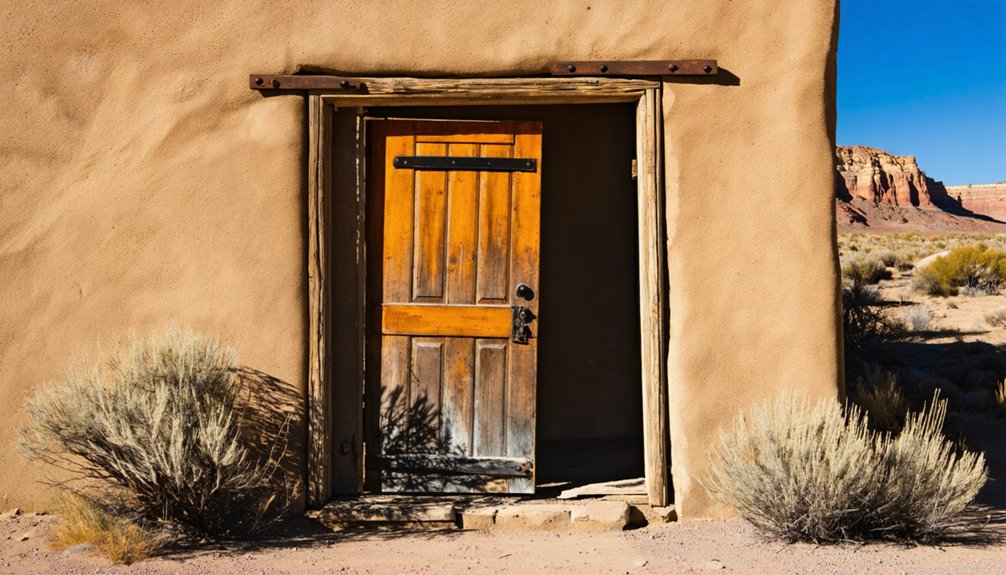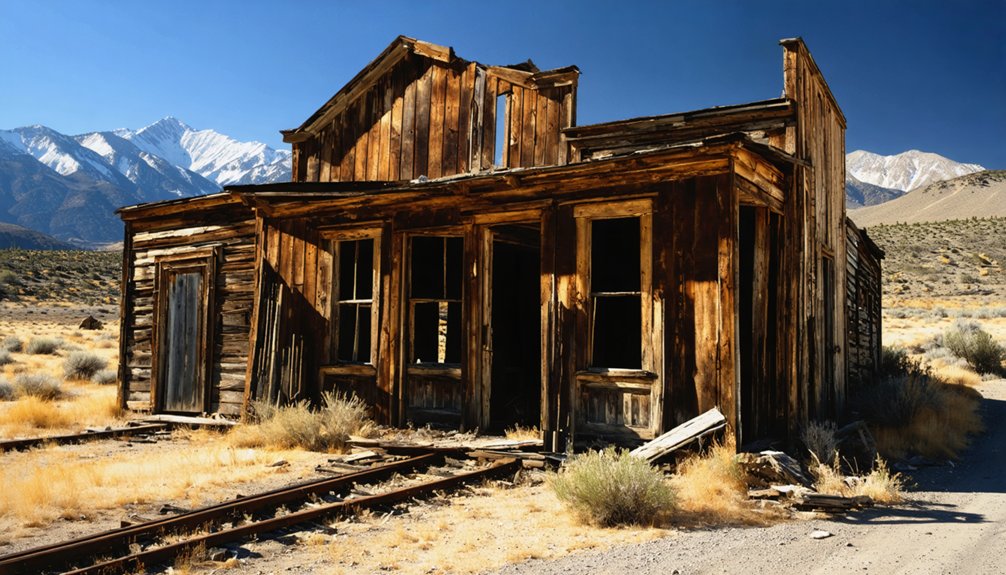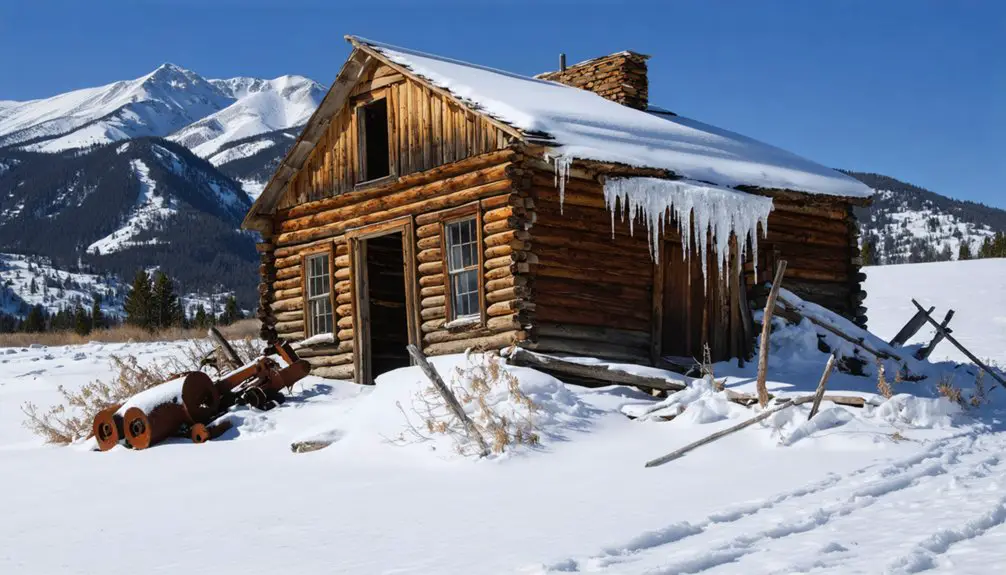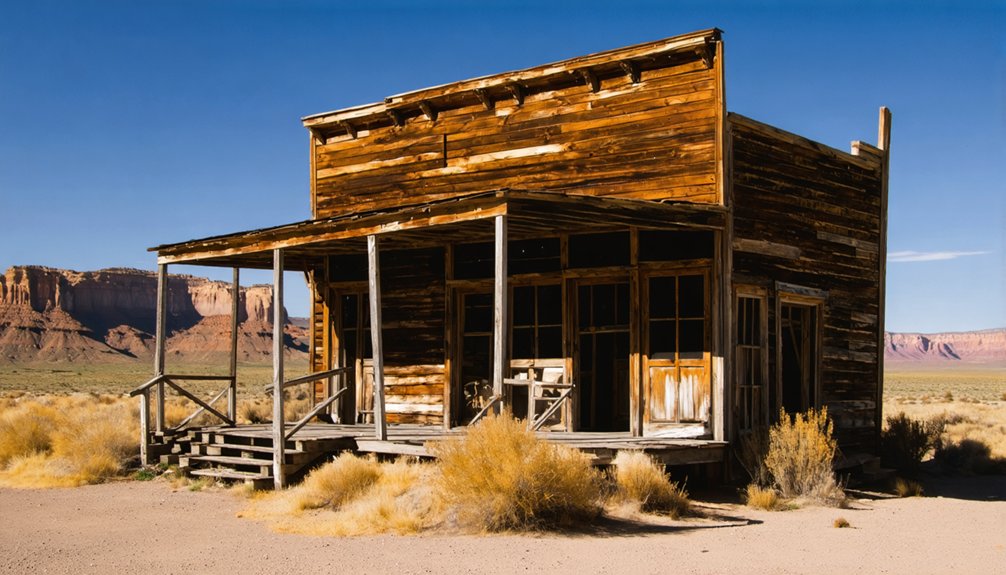
You’ll find Castle Rock’s ghost town remnants in Utah’s Echo Canyon, where a Pony Express station first opened in 1860. The site expanded from a mail stop into a frontier settlement with a schoolhouse, railroad depot, and stores serving diverse pioneer communities. While only the Wells Fargo building survives as a museum today, you can still trace the layers of history through stone foundations, mining relics, and pioneer markings in Cache Cave. Each weathered artifact reveals another chapter of this transportation hub’s story.
Key Takeaways
- Castlerock began as a Pony Express station in 1860 and grew into a thriving settlement before declining into a ghost town.
- The Wells Fargo building is the only original structure still standing, now serving as a museum showcasing the town’s history.
- The town’s abandoned schoolhouse, which operated from 1872 to 1937, marks the final chapter of community life in Castlerock.
- Stone foundations, mining relics, and pioneer graves remain as physical evidence of the once-bustling frontier community.
- The town’s decline was caused by changing transportation routes bypassing Echo Canyon, rather than natural disasters or sudden abandonment.
From Pony Express Station to Settlement
The Pony Express station at Castle Rock emerged as an essential link in the transcontinental mail service, operating from 1860 to 1861 at the head of Echo Canyon.
You’ll find the original log structure’s footprint marked by depressions east and north of later buildings, though the station itself was relocated 1½ miles up the canyon in 1867 when sold to a French trapper.
The historical significance of this site extends beyond its Pony Express roots. The station’s strategic location in Echo Canyon Station made it a crucial waypoint for both mail carriers and emigrants heading west.
Each letter sent from Salt Lake City to New York through this route cost settlers $5 per message, making communication a significant expense for early residents.
What began as a simple relay point evolved into a bustling settlement as families recognized trading opportunities with canyon travelers.
You’ll discover traces of the community’s evolution through remnants of the railroad depot, section house, gas station, store, and schoolhouse that sprouted up after the Pony Express ceased operations, marking the area’s change from mail stop to thriving frontier outpost.
Life in Echo Canyon’s Heart
Deep within Echo Canyon‘s dramatic walls, you’ll uncover layers of human activity spanning from Mormon defensive works to railroad-era social customs. The historical thoroughfare served mountain men, emigrants, and travelers since the early 1800s.
As you explore this rugged passage, you’ll find evidence of pioneer trades alongside ancient canyon wildlife trails that indigenous peoples followed for generations. The canyon’s limestone cliffs tell stories of resourceful settlers and daring railroad workers who made this harsh landscape their home. In 1858, nearly four thousand residents fled Salt Lake City as tensions escalated during the Utah War.
– Stone fortifications and trenches reveal Mormon defenders’ strategic preparation against U.S. troops
- Youths’ dangerous nighttime climbs up 100-foot water towers marked local coming-of-age rituals
- “Wine gang” operations show creative methods of acquiring contraband from passing tank cars
- Helper engines and coal towers at Pulpit Rock Curve demonstrate the critical role of railroad infrastructure
- Located at coordinates N 41.11238 W 111.20466, near Cache Cave’s pioneer inscriptions
- Integrated with existing Pony Express infrastructure from 1860
- Constructed using native logs for maximum durability
- Served Mormon pioneer families until its closure in 1937
- Cache Cave’s high walls bear authentic pioneer names, protecting these inscriptions from time
- The original Pony Express station site stands marked at N 41.11238 W 111.20466
- Echo Canyon’s distinctive rock formations include prisms, pyramids, and pagoda towers
- Historical markers preserve the memory of this once-vital pioneer outpost
- Hand-built cribs and roadbeds allowed wagons to navigate treacherous cliff passages
- Irrigation ditches carved from rocky soil sustained essential crops and orchards
- Victorian-style homes crafted from local red rock replaced primitive log cabins
- Livestock operations transformed the economy from basic subsistence to prosperity
- Stone foundations and adobe fragments tell stories of buildings lost to time and fire
- Pioneer graves with weathered white crosses mark the historic cemetery
- Mining relics and mill remains visible from cliff overlooks showcase industrial heritage
- Reconstructed buildings, following original designs, preserve architectural authenticity
- https://www.moabhappenings.com/Archives/historic1009GhostTownRuins.htm
- https://www.visitutah.com/things-to-do/history-culture/ghost-towns
- https://jacobbarlow.com/2015/11/23/castle-rock-utah/
- https://www.onlyinyourstate.com/experiences/utah/abandoned-eerie-place-ut
- https://www.youtube.com/watch?v=9GkO116TIFU
- https://www.ghosttowns.com/states/ut/castlerock.html
- https://expeditionutah.com/featured-trails/pony-express-trail/utah-pony-express-stations/
- https://www.summitcountyutah.gov/197/Echo-Canyon
- https://www.nps.gov/places/head-of-echo-canyon.htm
- https://historytogo.utah.gov/pony-express-ut/
The Schoolhouse Years
You won’t find any surviving records from Castlerock’s schoolhouse, but its foundation stones tell the story of pioneer dedication to education in Echo Canyon.
Like the early Utah pioneers who taught their children around a single grammar book, the residents of Castlerock valued education despite their limited resources.
Through careful excavation of the site, you’ll discover scattered slate fragments, chalk remnants, and metal bucket handles that paint a picture of daily frontier learning.
Similar to the Old Rock Building in Orderville that served as a dual-purpose facility, the Castlerock schoolhouse was a central gathering place for both education and community activities.
When you study the worn path leading to the schoolhouse ruins, you can trace the footsteps where local children once traveled to receive their basic education in reading, writing, and arithmetic.
Pioneer Education Legacy
Built amid the rugged terrain of Castle Rock canyon in 1872, Castlerock’s pioneer schoolhouse served as an essential educational hub for 65 continuous years.
The log structure, positioned near the historic Pony Express station, exemplified the commitment to pioneer education in Utah’s remote outposts. You’ll find evidence of strong community involvement through the use of local materials and strategic placement along emigrant trails. Like many of Utah’s one-room schoolhouses, Castlerock’s educational center represents a disappearing piece of the state’s architectural heritage. Similar to the once-bustling general store that supplied the town, the schoolhouse was central to community life.
The schoolhouse remains stand as a symbol of frontier learning, though now on private land with restricted access, preserving stories of determined settlers who valued education in America’s expanding West.
Daily School Life
While frontier education presented unique challenges, the Castlerock schoolhouse maintained structured daily routines from 1872 to 1937.
You’d have found students arriving by foot or horseback, their schedules aligned with the town’s ranching and mining activities. Inside the converted log building, you would’ve witnessed a classic one-room arrangement where children of all grades learned together through basic reading, writing, and arithmetic lessons. The school reflected the area’s diverse community with students from twenty-seven nationalities studying side by side. Like the historic Wells Fargo building in Silver Reef, the schoolhouse became a testament to the era’s architectural legacy.
Beyond its educational role, you’d have seen the schoolhouse transform into a vibrant hub for community gatherings.
Despite the town’s eventual decline into ghost town status, the school persisted as a steadfast institution. For 65 years, it served as both an educational cornerstone and social anchor, preserving frontier learning traditions until its final bell in 1937.
Pioneer Tales and Historical Landmarks
Nestled within Echo Canyon’s treacherous terrain, Castlerock’s pioneer legacy emerges through carefully preserved landmarks and historical inscriptions.
You’ll discover pioneer stories etched into Cache Cave’s walls, where early travelers sought shelter from the harsh environment. The historical significance of the area centers around the 1860 Pony Express station, built from sturdy logs before being relocated up canyon by a French trapper in 1867.
These landmarks tell the tale of determination against the backdrop of Horace Greeley’s “decidedly bad” terrain, where settlers carved out their existence among the honey-combed buttresses.
The Rise and Fall of a Canyon Community
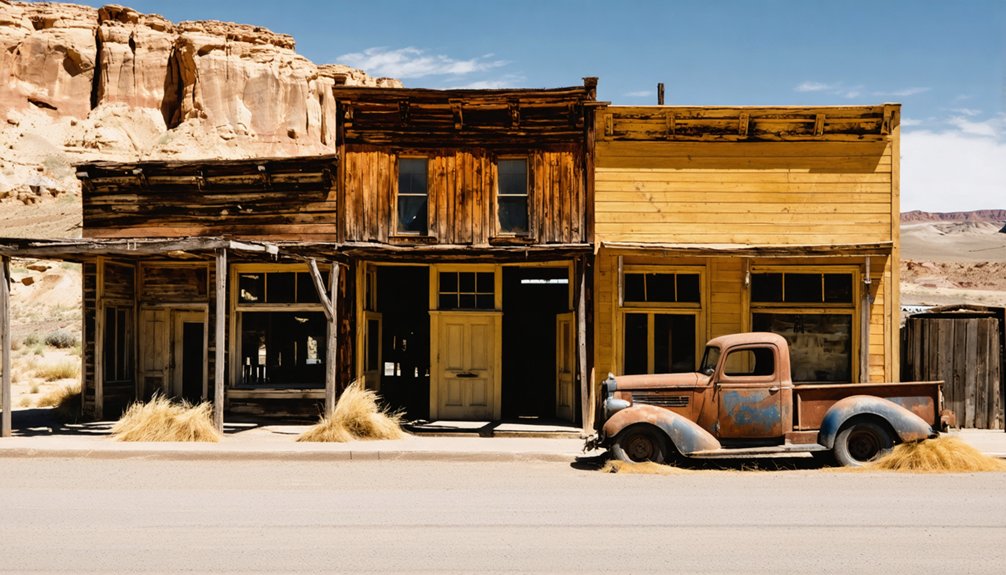
You’ll find the layered history of Castlerock’s community emerging from the 1860 Pony Express station, through the establishment of a frontier school in 1872, to its final days as marked by the school’s closure in 1937.
The settlement’s artifacts reveal how this rugged Echo Canyon outpost adapted to changing transportation patterns, from early wagon trails to the transcontinental railroad that ultimately contributed to its decline.
As you examine the site’s remaining features, including the relocated station building and historical markers, you’ll uncover the story of a once-vital waypoint that couldn’t sustain itself once newer transportation routes bypassed its canyon corridor.
Pioneer Life Unfolds
As the Hole-in-the-Rock expedition of 1879 ventured into southeastern Utah’s challenging terrain, Mormon pioneers commenced on a transformative journey that would shape the region’s settlement patterns.
You’ll find evidence of their pioneer challenges in the innovative agricultural systems they developed, from intricate irrigation networks to resilient farming methods adapted to the harsh desert environment.
Their ingenuity in conquering the landscape reveals itself in the archaeological record – from the remains of flood-damaged dams to the surviving fruit trees they planted in seemingly impossible terrain.
Canyon Dreams Fade Away
The Pony Express station constructed in 1860 marked the beginning of Castlerock’s brief but significant chapter in Utah’s transportation history. As you explore the remnants near today’s freeway exit, you’ll find traces of a community that emerged from the station’s foundations, nestled within Echo Canyon’s towering bluffs.
Yet the canyon shadows grew longer as the town’s prosperity dimmed. When the Pony Express route became obsolete in 1861, Castlerock’s purpose began to fade.
The school, established in 1872, held on until 1937, serving as the community’s last anchor before surrender to fading memories. Unlike other Utah ghost towns claimed by floods or depleted mines, Castlerock simply drifted into silence.
Today, you’ll discover only quiet echoes of the transport era near the modern junkyard, where pioneer dreams once flourished.
Modern Remnants and Ruins
Standing among scattered stone remnants, visitors can explore the architectural ruins that mark Castlerock’s mining heyday.
You’ll discover ghostly remnants of the town’s prosperous past, from crumbling stone foundations to forgotten structures reclaimed by nature. The Wells Fargo building stands as the sole surviving original structure, now housing the Silver Reef museum.
The site’s layers reveal a complex history through its artifacts – from pioneer-era stone ruins to modern junkyards dotting the landscape, each stratum offering glimpses into Castlerock’s evolution from boomtown to ghost town.
Exploring Castle Rock’s Legacy
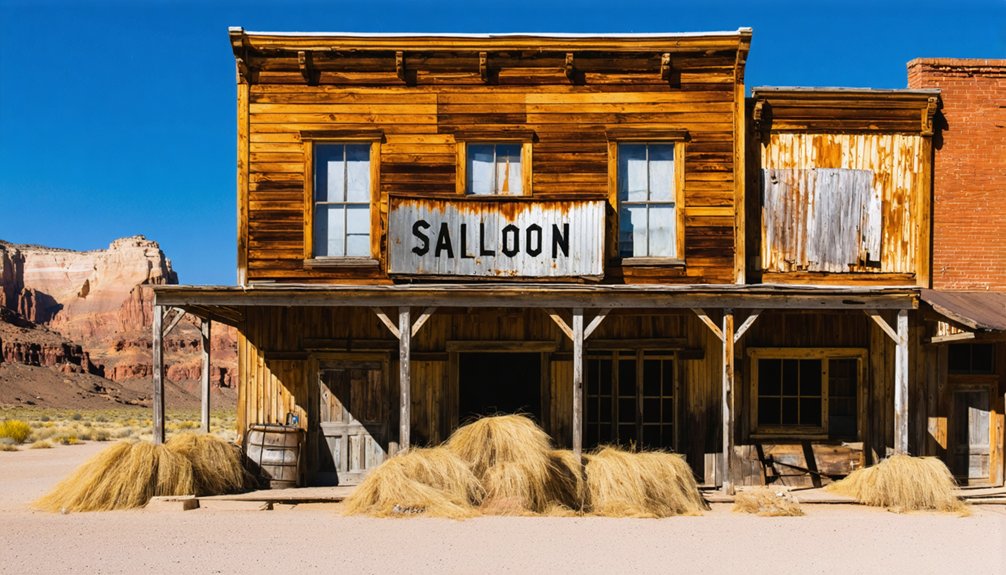
Deep within Echo Canyon‘s rugged terrain, Castle Rock’s legacy unfolds through carefully preserved layers of pioneer history.
You’ll discover evidence of cultural influences etched into Cache Cave‘s weathered walls, where Mormon pioneers left their marks above the reach of livestock. The tales of 68,000 handcart pioneers who traversed this challenging corridor between 1847-1869 echo through the canyon’s steep bluffs.
While ghost stories surround the abandoned Pony Express station and 1872 schoolhouse, the true spirit of Castle Rock lies in its role as an essential transportation hub.
From French trappers to stagecoach travelers, each group left their imprint on this landscape. Though the telegraph’s arrival in 1861 marked the beginning of change, Castle Rock’s significance in America’s westward expansion remains etched in stone.
Frequently Asked Questions
Are There Any Dangerous Animals or Wildlife in the Castle Rock Area?
You’ll find wildlife safety’s quite important with mountain lions, rattlesnakes, and black bears lurking around. Keep your distance during animal encounters – they’re not exactly welcoming the neighborhood watch.
What Are the Best Months to Visit Castle Rock Ghost Town?
You’ll find the best weather and prime exploration conditions from September through October, when temperatures hover in the mid-60s to low-70s with fewer crowds to disturb your artifact hunting.
Can Visitors Take Artifacts or Souvenirs From the Site?
Like a time capsule meant to stay sealed, you can’t remove artifacts or souvenirs. Federal and state laws protect these treasures for future generations, allowing only photos and memories.
Is Overnight Camping Allowed Near the Castle Rock Ruins?
You’ll need to camp at the designated Castle Rock Campground, not near the ruins. While there’s BLM dispersed camping in the area, site regulations protect archaeological resources from overnight disturbance.
Does Anyone Still Live in or Near Castle Rock Today?
While you might spot activity at the junkyard during business hours, there aren’t any current residents living in Castle Rock itself – it’s a true ghost town with only abandoned structures.