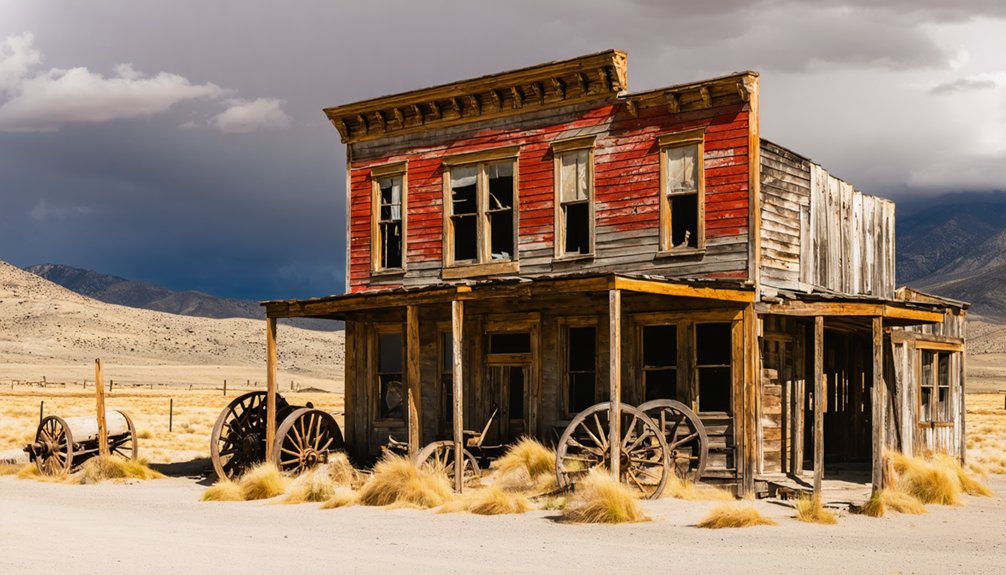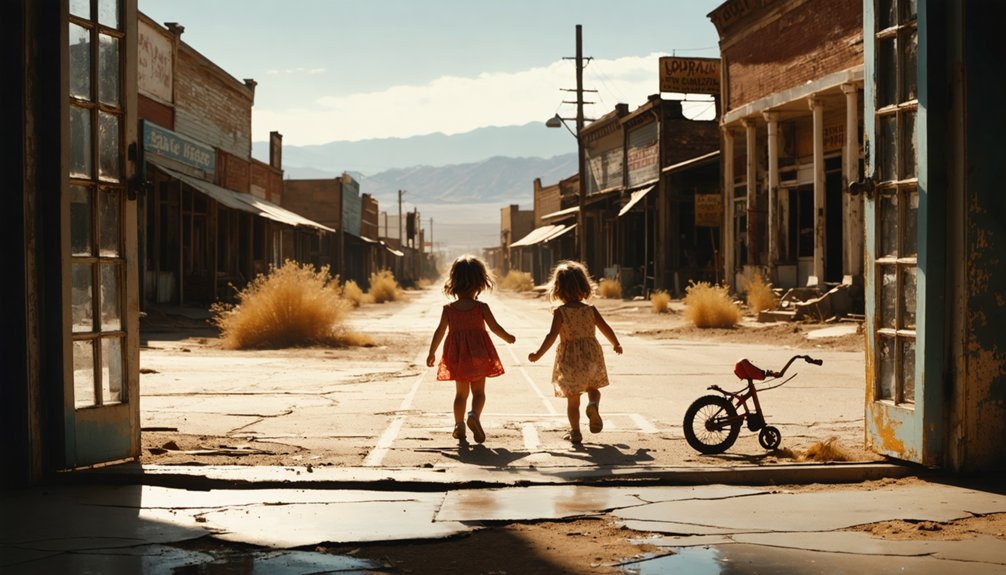
When you grow up in a ghost town, you’ll face unique challenges that shape your development. Limited opportunities, deteriorating infrastructure, and social isolation become daily realities. You’re more likely to experience higher stress levels, reduced physical activity, and fewer educational prospects. Children in these communities often struggle with obesity and behavioral issues due to restricted outdoor spaces and community disengagement. Understanding these patterns reveals deeper insights into how declining areas impact young lives.
Key Takeaways
- Children in ghost towns face limited social interaction due to population decline and school closures, impacting their developmental growth.
- Abandoned buildings become unsafe makeshift playgrounds, increasing risk of injury while offering unstructured play opportunities.
- Young families’ exodus from declining towns creates a cycle where remaining children have fewer peers and educational resources.
- Rural ghost town children experience higher obesity rates due to decreased organized activities and limited access to recreational facilities.
- Community deterioration leads to reduced outdoor playtime and physical activity, affecting children’s health and social development patterns.
The Impact of Neighborhood Distress on Youth Development
While neighborhood environments shape child development across multiple domains, distressed communities pose particular risks to youth outcomes through both direct and indirect pathways.
Research shows that socioeconomic characteristics fundamentally shape adolescent development and behaviors in these communities.
You’ll find that neighborhood isolation creates a cascade of challenges, from increased involvement in delinquency to higher rates of substance abuse and gang activity.
When you look at the data, you’ll see how community disadvantage directly impacts brain development, particularly in areas like emotional regulation and threat response.
Children’s amygdalae become more reactive to fearful stimuli, leading to developmental delays that can persist throughout adolescence.
What’s striking is how these effects ripple through educational achievement, mental health, and behavioral outcomes.
The lack of daily routines in unstable neighborhoods further compromises children’s ability to develop healthy behavioral patterns.
Even when controlling for family factors, the neighborhood’s influence remains significant, though strong parenting can help buffer these impacts.
Social and Economic Challenges in Declining Communities
Communities experiencing economic decline face a stark reality: nearly 11 million American children live in poverty, representing one in seven kids nationwide.
In these struggling areas, you’ll find patterns of community disengagement where limited resources and opportunities create cycles of hardship. Families cope with crowded housing, unsafe neighborhoods, and scarce childcare options. The stress of poverty often leads to strict parenting styles that can worsen behavioral issues in children. Research shows that children with caregivers experiencing poor mental health are at higher risk of developing severe anxiety and behavioral disorders.
Youth isolation becomes particularly evident as children face disrupted education, with low-income students failing to graduate at five times the rate of their middle-income peers.
The effects ripple through generations – neighborhood conditions directly influence lifetime earnings, with children in disadvantaged areas earning $200,000 less over their careers.
Without strong community supports and stable institutions, these areas struggle to retain families, creating a downward spiral of diminishing social capital and economic prospects.
Urban Decay’s Effects on Children’s Health and Behavior
You’ll find children in decaying urban areas exhibit a complex relationship with their environment, where physical disorder paradoxically leads to both increased outdoor play and higher rates of obesity.
Your observations in these communities would reveal abandoned buildings serving as makeshift playgrounds, though these spaces pose significant safety risks and often drive children indoors. Research indicates that neighborhood collective efficacy strongly influences how much time children spend playing outdoors.
The resulting pattern shows neighborhood youth spending more time watching television than their counterparts in well-maintained areas, contributing to a concerning 35% combined rate of overweight and obesity among these children. Research shows that increasing green space access in these areas could significantly improve children’s physical activity levels and overall health outcomes.
Physical Disorder Promotes Obesity
As neighborhoods deteriorate and become unsafe, children’s physical activity levels plummet by roughly 0.13 hours per week, creating a direct pathway to obesity.
You’ll find this pattern intensifying in both declining urban spaces and forgotten rural towns, where physical disorder traps kids indoors. The data shows you’re 30% more likely to encounter childhood obesity in rural areas, while urban sprawl drives a 13% increase in weight gain. Recent studies predict that 43 million overweight children globally will surge to 60 million by 2020. Turkey’s rapid urbanization since the 1980s has led to inadequate recreational spaces for children.
- Broken windows and graffiti signal danger, keeping children away from outdoor play
- Crumbling sidewalks force kids to choose video games over walking
- Abandoned lots replace what could’ve been community parks
- Deteriorating playgrounds stand empty and unused
- Overgrown vegetation blocks paths that once connected neighborhoods
Your child’s weight directly reflects their environment’s physical condition – the more decay, the higher the BMI.
Abandoned Buildings Impact Play
Shadows of vacant buildings loom over children’s lives, fundamentally altering how they play and develop in decaying neighborhoods.
You’ll find parents increasingly restricting their kids’ outdoor activities as abandoned buildings become magnets for criminal activity, transforming once-vibrant streets into danger zones.
Where children once roamed freely, they’re now confined to immediate home surroundings. This environmental chaos leads to poor developmental outcomes in young children. Abandoned playgrounds sit eerily empty while boarded-up structures create no-go zones that fragment communities.
The lack of safe recreational spaces forces families to choose between children’s safety and their natural need for exploration and play. Material hardship and strain intensify as neighborhoods deteriorate, putting additional stress on families trying to maintain stability.
This urban decay creates a ripple effect – fewer children outdoors means less social interaction, decreased physical activity, and diminished opportunities for natural childhood development.
The neighborhood’s deteriorating fabric directly shapes how the next generation grows up.
Television Habits Rise Higher
With outdoor play spaces becoming scarce and unsafe, children in deteriorating urban areas increasingly turn to television as their primary source of entertainment.
You’ll find rising television addiction rates in public housing, where kids face limited alternatives for their free time. Screen time soars as neighborhood conditions worsen, creating a troubling pattern of dependency.
- Empty lots filled with debris force children indoors
- Boarded-up windows and vacant buildings create unsafe play zones
- Drug activity and loitering drive families behind locked doors
- Broken playground equipment sits unused and dangerous
- Dimly lit streets make outdoor evening activities impossible
This surge in television viewing isn’t just about entertainment choices – it’s a direct response to urban decay.
When neighborhoods deteriorate, you’ll see more children glued to screens, finding escape in virtual worlds rather than risking the hazards outside.
Rural Ghost Towns: A Legacy of Lost Opportunities
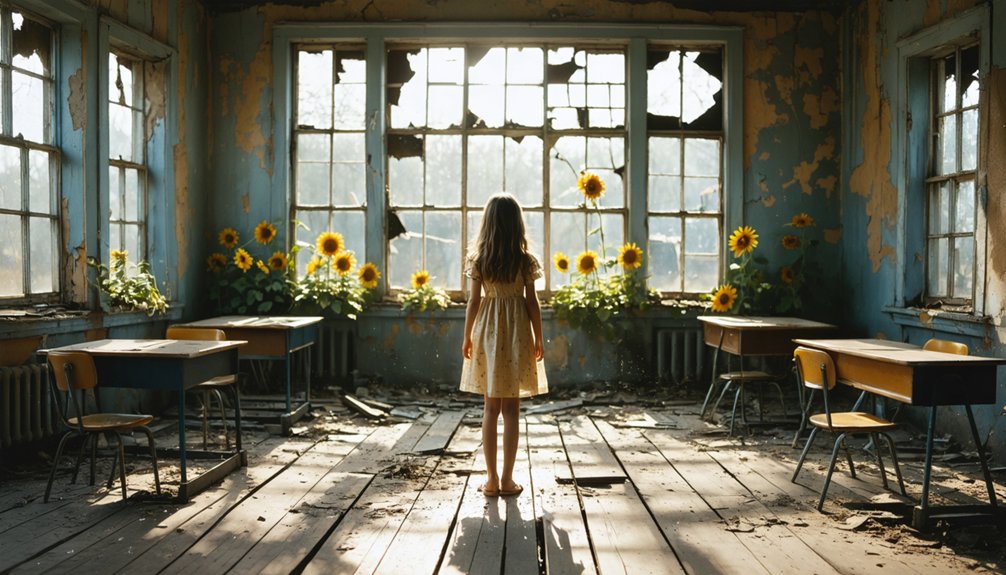
When you examine America’s rural ghost towns, you’ll find that railroad access often determined which communities thrived and which disappeared, as bypassed settlements quickly lost their economic lifeblood.
The challenges of economic growth in ghost towns can often be traced back to infrastructure deficits and declining populations. Without investment in local businesses and amenities, these areas struggle to attract new residents or tourists. As a result, many once-vibrant communities now face an uphill battle in revitalizing their economies and preserving their history.
You can trace how entire families were forced to migrate when primary industries like mining or logging became unprofitable, creating ripple effects that emptied schools and shuttered businesses.
Your understanding of these abandoned places deepens when you consider how swiftly economic opportunities vanished – often within a single generation – leaving behind empty buildings as silent testimonies to once-vibrant communities.
Railroad Access Determines Survival
Railroad access proved to be the lifeline that determined whether frontier settlements would thrive or fade into ghost towns during America’s rapid westward expansion.
You can trace the stark contrast in towns’ destinies through railroad routes – some communities like Lubbock flourished into major hubs with eight rail lines, while others like Gomez vanished after being bypassed, forcing town relocation.
This transportation lifeline meant the difference between prosperity and abandonment.
- Empty storefronts stand where bustling businesses once served rail passengers
- Rusted tracks disappear into overgrown prairie grass
- Crumbling grain elevators loom as silent sentinels of former commerce
- Faded station signs mark where trains once connected remote communities
- Abandoned water towers cast long shadows over forgotten rail yards
The harsh reality of railroad-dependent survival shaped America’s rural landscape, leaving countless communities to wither once the rails went quiet.
Population Migration’s Ripple Effects
Young adults’ mass exodus from rural communities creates devastating ripple effects that transform vibrant towns into aging shells of their former selves.
When you witness this rural exodus, you’ll see how departing youth trigger a chain reaction – as skilled workers leave, businesses struggle to operate, and remaining services become increasingly expensive.
You’ll notice how this drain of young talent reshapes entire regions. As fewer children populate local schools, districts consolidate, weakening community bonds.
The migration patterns you observe create a self-reinforcing cycle: fewer young families mean fewer births, accelerating population decline.
While anchor cities like Lubbock grow stronger, they inadvertently siphon energy from surrounding areas. This challenge to community resilience becomes particularly apparent in Texas’ High Plains, where entire counties lose residents yearly, fundamentally altering the social fabric of once-thriving rural spaces.
Economic Opportunity Vanishes Fast
The stark reality of economic collapse hits hardest in America’s rural communities, where a single industry’s failure can transform thriving towns into abandoned shells.
You’ll witness how economic disparities widen as major employers shut down, triggering a cascade of business closures that strip away opportunities.
When hospitals close, mines exhaust, or agricultural markets crash, job scarcity forces working-age residents to flee.
- Empty storefronts line Main Street where bustling shops once served the community
- Boarded-up houses stand as silent reminders of families who’ve moved away
- Abandoned industrial sites rust behind chain-link fences
- Once-proud civic buildings deteriorate from lack of tax revenue
- Local diners and gathering spots sit vacant, their windows collecting dust
Your freedom to build a future narrows as wealth drains from these communities, leaving behind crumbling infrastructure and limited prospects.
Education Migration and Community Abandonment

Modern demographic shifts have created a devastating cycle of educational decline and community abandonment across America’s landscape.
You’ll find this education migration playing out dramatically as college enrollments plummet – with undergraduate numbers dropping 12% since 2010 and two-year colleges losing nearly 40% of their students.
When schools close, communities quickly unravel.
You’re witnessing this domino effect in places like Joiner, Arkansas, where school closures trigger youth exodus.
Once young people leave, there’s little incentive for others to stay.
Youth departure creates a ripple effect – when the young abandon communities, they take the future with them.
The pattern becomes self-reinforcing: declining enrollment leads to more closures, pushing educated youth toward cities with better amenities and opportunities.
Breaking the Cycle of Generational Poverty in Distressed Areas
Deeply entrenched in America’s most distressed communities, generational poverty creates a seemingly unbreakable cycle that traps families for decades.
You’ll find the starkest examples in places like Detroit, where nearly 60% of children live in poverty, and Cleveland, where over half the youth population struggles to access basic necessities.
Breaking these cycles requires targeted community engagement and policy reforms that address both immediate needs and long-term solutions.
- Empty storefronts line main streets where businesses once thrived
- Abandoned homes stand as silent witnesses to family displacement
- Shuttered schools echo with memories of bustling classrooms
- Vacant lots replace former neighborhood gathering spots
- Boarded-up grocery stores leave food deserts in their wake
Without intervention, you’re watching the next generation inherit the same struggles their parents faced, perpetuating patterns of economic isolation and limited opportunity.
Frequently Asked Questions
How Do Children Maintain Friendships When Living in Near-Empty Communities?
You’ll rely heavily on digital platforms to maintain friendship dynamics despite social isolation, connecting through messaging apps and social media while finding creative ways to bridge physical distances between scattered peers.
What Recreational Activities Exist for Children in Ghost Towns?
With 75% of ghost towns near wilderness areas, you’ll find endless nature exploration opportunities, from zipline adventures to mine tours. Creative play includes gold panning, historic reenactments, and spooky guided walks.
How Do Emergency Services Reach Children in Abandoned Areas?
You’ll find emergency response teams adapting to abandoned infrastructure by using specialized vehicles, air support, and remote monitoring stations while maintaining dedicated access routes through otherwise impassable ghost town terrain.
What Psychological Support Systems Exist for Children in Dying Communities?
You’ll find community outreach programs bringing mental health support through TF-CBT interventions, local counseling networks, and mobile therapy teams. Religious groups and grassroots organizations also provide ongoing psychological assistance.
How Do Children Access Technology and Internet in Depopulated Areas?
Isolated, disconnected, and left behind – you’ll find children in depopulated areas rely on school libraries, mobile hotspots, and community centers for rural connectivity, while struggling to build essential digital literacy skills.
References
- https://www.prb.org/wp-content/uploads/2003/10/KidsDistressedNeighborhoods.pdf
- https://projects.publicsource.org/pittsburgh-neighborhood-success/
- https://pmc.ncbi.nlm.nih.gov/articles/PMC3058513/
- https://www.texasstandard.org/stories/texas-population-boom-ghost-towns-rural-urban-suburban-shift/
- https://www.orphanslifeline.org/orphan-fact-sheet
- https://www.sos-usa.org/childrens-statistics
- https://www.sciencedaily.com/releases/2014/06/140618184640.htm
- https://pmc.ncbi.nlm.nih.gov/articles/PMC3187660/
- https://news.uga.edu/unstable-surroundings-have-lasting-effects-on-youth-well-being/
- https://news.umich.edu/living-in-a-violent-neighborhood-affects-childrens-brain-development/