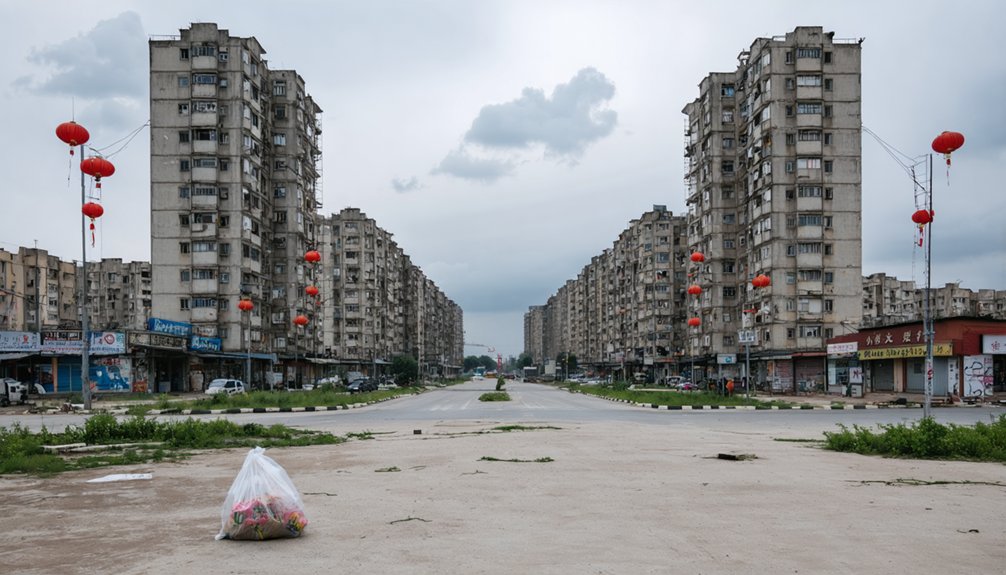
You’ll find that Chinese-built urban developments in Africa, like Angola’s Kilamba, initially appeared as ghost towns due to high housing costs around $125,000 per unit. However, through government interventions and price reductions to $70,000, these projects transformed into vibrant communities. Kilamba’s population surged from 40,000 in 2013 to 129,000 by 2019, proving successful adaptation. China’s urban development strategy in Africa reveals a complex story of challenges and solutions.
Key Takeaways
- Kilamba, Angola initially became a ghost town due to unaffordable housing prices of $125,000 before government intervention reduced costs to $70,000.
- Chinese-built cities in Africa often face initial low occupancy rates due to pricing misalignment with local income levels.
- Government subsidies and mortgage programs transformed Kilamba from an empty development into a thriving community of 129,000 residents by 2019.
- The oil-for-infrastructure model enabled massive urban developments like Kilamba, designed to house 500,000 residents through Chinese investment.
- Unlike China’s domestic ghost cities, African developments show successful adaptation through pricing adjustments and government-backed housing programs.
The Rise of Chinese Urban Development in Angola
While Angola struggled with severe housing shortages in the early 2000s, China’s entry into the nation’s urban development sector marked an unprecedented shift in Africa’s architectural landscape.
You’ll find Chinese urbanization evident in the satellite towns that now encircle major Angolan cities, with the Quilamba project standing as the continent’s largest development of its kind.
The Angola partnerships intensified around 2010, as over 400 Chinese companies flooded the market.
Through oil-backed loans and strategic agreements, China secured its position as Angola’s primary urban developer.
Chinese state-owned enterprises and their contractors now dominate large-scale housing construction, though they’ve faced criticism for poor labor practices.
Their development model requires that 70% of infrastructure services come from Chinese providers, effectively controlling both funding and execution of these massive urban projects.
Despite providing immediate housing solutions, these developments face significant challenges in long-term sustainability and social integration.
By 2016, an estimated 53,000 Chinese citizens were living and working in these urban development zones and construction sites across Angola.
Examining the Kilamba Mega-Project
You’ll find Kilamba’s initial housing prices of $125,000 per unit created a ghost town effect until President dos Santos mandated price reductions to $70,000 in 2013.
Through state-backed mortgages and more accessible pricing, the Chinese-built mega-project transformed from empty streets to a thriving community of over 130,000 residents.
CITIC Construction completed the first 3,800 apartments in just 18 months, showcasing China’s rapid development capabilities in Africa.
The development’s success demonstrates how Angola’s oil-backed partnership with China has reshaped urban living standards, though questions remain about the sustainability of similar projects across Africa.
Residents enjoy comprehensive public facilities and amenities that have dramatically improved their quality of life compared to previous housing conditions.
Kilamba’s Housing Price Challenge
Despite Kilamba’s ambitious vision as Angola’s premier planned community, the project initially stumbled due to a severe pricing mismatch with local economic realities.
With apartments priced at $125,000, this urban planning marvel remained largely empty as costs exceeded what most Angolans could afford.
The China International Trust Corporation spearheaded the massive construction project, investing billions in the development.
You’ll find the turning point came when authorities recognized the affordable housing crisis and took decisive action.
The development’s 880 hectares of planned residential space made it one of Africa’s largest housing initiatives.
By implementing mortgage subsidies and rent-to-own programs, they slashed prices to around $70,000 per unit.
The government reclassified the development as social housing and introduced public financing options.
This shift proved vital – what was once dubbed a “ghost town” by international media began filling with residents.
The Chinese-funded project, backed by oil revenues, finally started achieving its intended purpose of housing Angola’s growing middle class.
Population Growth and Occupancy
Once labeled a ghost town by international media, Kilamba’s population trajectory tells a remarkable story of urban transformation.
The massive development, financed with US$ 3.5 billion from China’s Industrial and Commercial Bank, represents one of the continent’s most ambitious housing initiatives.
With 750 apartment buildings spread across the development, the project demonstrates unprecedented scale in African urban planning.
You’ll find a stark shift in urban density patterns as government interventions transformed this Chinese-built satellite city from a vacant development into Africa’s most successful new city project.
Let’s examine the dramatic population trends:
- 2013: Initial wave brings 40,000 residents as housing becomes more affordable
- 2015: Population doubles to 80,000 as middle-class professionals move in
- 2019: Community grows to 129,000+, supported by shops and schools
You’re witnessing a prime example of postwar Angolan urbanization, where public sector employees and salaried professionals now occupy what was once dismissed as an empty grid of uniform apartment blocks.
The transformation from ghost town to thriving community showcases successful urban planning adaptation.
exploring abandoned sites in America can reveal the rich history and stories that these places once held. Each location tells a unique tale of decline and resilience, inviting urban explorers to uncover hidden treasures. As communities engage with these remnants of the past, they often find inspiration for revitalizing their own neighborhoods.
Strategic Oil Investment Impact
While many urban development projects rely on traditional financing, Kilamba’s creation stems from an innovative oil-backed arrangement between Angola and China.
You’ll find that CITIC, China’s state-owned enterprise, leveraged Angola’s oil revenue to secure a $3.5 billion credit line, transforming barren land into a massive housing development. This deal represents China’s economic leverage in Africa, with Angola repaying the loan through crude oil shipments.
The strategic partnership highlights how China’s expanding influence in Africa often intertwines with resource extraction. Designed to accommodate 500,000 residents, this ambitious project exemplifies China’s large-scale urban planning initiatives in Africa.
You’re witnessing a complex exchange where Angola’s position as China’s largest African oil supplier enabled the construction of 750 apartment buildings without immediate cash payments. The marketing and sales were handled by state-owned Sonangol, showcasing the government’s direct involvement in the project.
Yet, this oil-for-infrastructure model raises questions about long-term economic sovereignty and sustainable development.
Population Dynamics and Housing Absorption Rates
As Chinese-built cities across Africa defy initial ghost town predictions, population absorption rates tell a compelling success story.
You’ll find the strongest evidence in Angola’s Kilamba, where population trends show steady growth, driven by housing migration from both local middle-class residents and Chinese expatriates.
Here’s what’s fueling this successful absorption:
- Over 259,000 Chinese residents in Angola contribute to housing demand
- A million-strong Chinese diaspora across Africa supports new development viability
- Growing African middle class fills units that skeptics once dismissed as potential ghost towns
Unlike China’s domestic ghost cities, African projects like Kilamba demonstrate remarkable resilience.
You’re witnessing a transformation where once-empty developments now buzz with life, proving that these ambitious housing projects are meeting real demographic needs.
Economic Partnerships Between China and African Nations
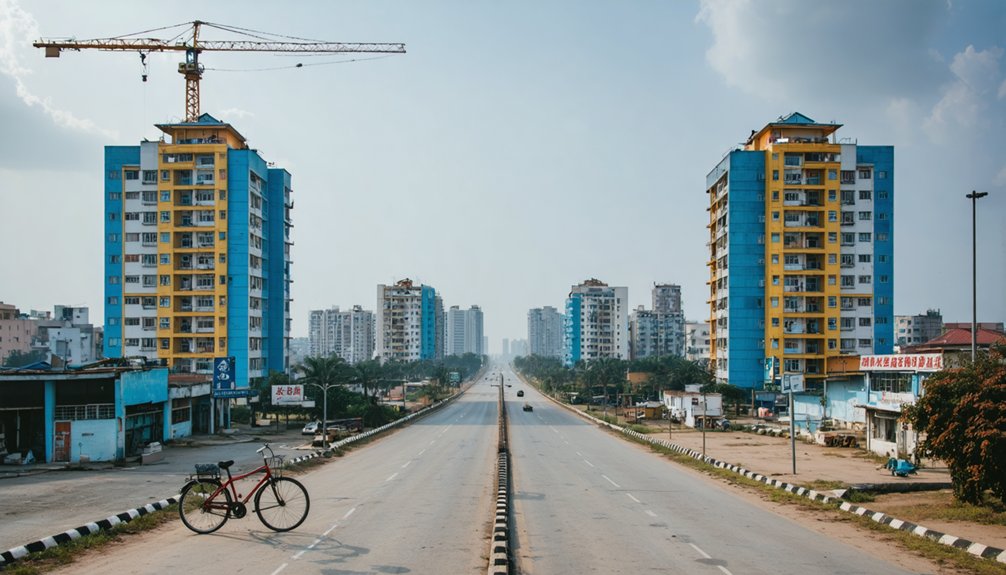
You’ll find China’s economic partnerships with African nations extend far beyond real estate development, with strategic investments exceeding $700 billion in contracted projects between 2012-2022.
China’s role as Africa’s largest trading partner for 16 consecutive years reflects deep economic ties, highlighted by recent pledges of $51 billion in development funding and zero-tariff access granted to 53 African nations.
These partnerships have shifted from primarily resource extraction to diverse sectors including manufacturing, technology, and infrastructure, though questions remain about the sustainability and mutual benefit of these investments.
Strategic Resource Investment Flows
Over the past two decades, China’s strategic investment flows into Africa have transformed from modest ventures into multibillion-dollar commitments, reaching a peak of $5 billion in foreign direct investment by 2018.
You’ll find these resource extraction patterns revealing China’s calculated approach to securing Africa’s mineral wealth:
- Mineral exports to China surged from 20% to 45% of Africa’s total exports since 2015
- Chinese state-owned enterprises now control 8% direct ownership in African mining operations
- Beijing’s investments target critical minerals across Niger, South Africa, Angola, Morocco, and Congo
While investment trends show a recent decline due to China’s economic slowdown, their strategic focus remains clear: maintaining integrated control over Africa’s resources through mining rights, processing facilities, and infrastructure development.
You’re witnessing a deliberate shift toward projects promising long-term strategic returns.
Infrastructure Development Partnerships
Through massive infrastructure development partnerships, China has strategically positioned itself as Africa’s primary development partner, committing over $160 billion between 2000-2020.
You’ll find Chinese firms dominating key sectors, from transport to power generation, having built 30,000km of highways and 2,000km of railways across the continent.
While some projects showcase sustainable financing models, like the Mombasa-Nairobi Railway achieving break-even in five years, others struggle with urban planning challenges.
The Addis Ababa-Djibouti Railway operates at just 38% capacity, and Kenya’s Standard Gauge Railway requires $200 million in annual subsidies.
Yet China’s influence grows stronger, with 78 ports across 32 countries involving Chinese firms and their 82 trade cooperation zones creating 244,000 local jobs.
These partnerships have fundamentally transformed Africa’s infrastructure landscape.
Comparing African and Chinese Urban Development Models
While China and Africa both face massive urbanization challenges, their development models reveal stark contrasts in execution and outcomes. China’s urban planning success absorbed 700 million people over three decades, creating jobs and driving economic growth.
In contrast, Africa’s housing policies haven’t generated similar productivity gains, leading to fragmented cities and informal settlements.
Consider these critical differences:
- African cities are 20% more fragmented than Asian counterparts, making them costlier to develop and harder to navigate.
- You’ll find 37% less exposure to jobs and economic opportunities in African urban centers.
- Africa needs to accommodate 900 million new urban residents in just 30 years – a pace that outstrips even China’s massive transformation.
This disparity highlights why simply copying China’s model won’t solve Africa’s unique urbanization challenges.
Social Impact and Housing Accessibility
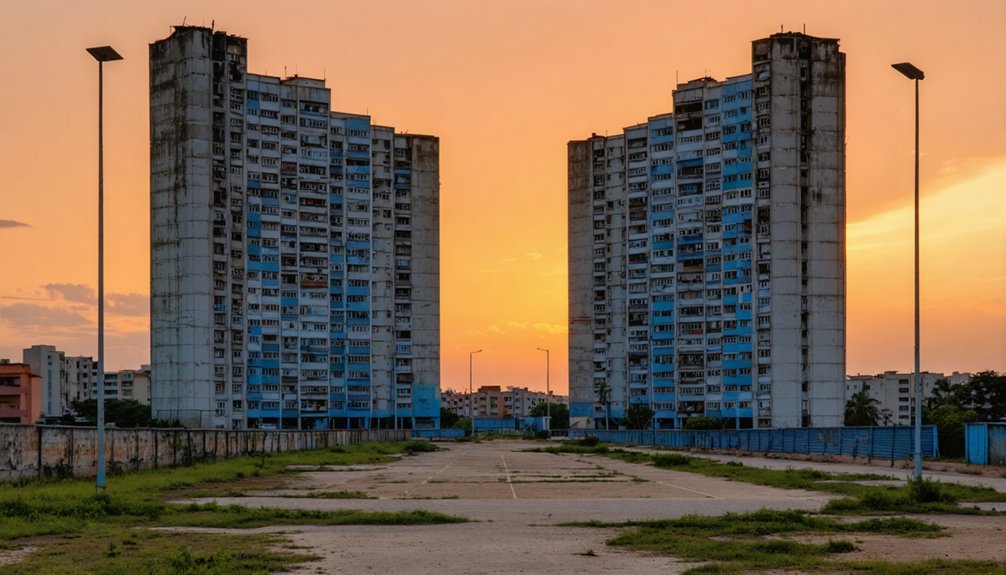
The stark realities of housing accessibility in Chinese-built African developments paint a complex social picture. While initial housing policies set prices between $120,000 and $250,000, putting homes far beyond the reach of average Angolans earning just $5,144 annually, later adjustments improved social equity through lower pricing and financing options.
You’ll find that the introduction of long-term mortgages and rent-to-own schemes transformed Kilamba from a near-empty development to a vibrant community of 40,000 residents.
However, challenges persist. Basic amenities like water and electricity remain inconsistent, and two-hour commutes to central Luanda highlight infrastructure gaps. While middle-class families have gained access to modern housing, the development’s initial design excluded rural and low-income populations, revealing tensions between market-driven development and inclusive community building.
Infrastructure Development and Urban Integration
Chinese infrastructure projects across Africa represent an unprecedented scale of urban development, with investments exceeding $15 billion in strategic sectors from housing to transportation.
You’ll find these developments are reshaping urban sustainability through integrated planning and extensive infrastructure networks.
Key infrastructure elements include:
- Self-contained communities with educational and commercial facilities spanning thousands of hectares
- High-density residential zones connected by wide avenues and grid systems
- Transportation networks linking new cities to existing metropolitan areas
While housing affordability initially posed challenges in places like Kilamba, government interventions through price adjustments and mortgage support have enabled broader access.
Strategic government interventions and financial support transformed Kilamba’s housing from unattainable to accessible for many residents.
These projects aren’t just about building homes – they’re transforming entire regions through power generation, ICT equipment, and transport systems that connect communities to economic opportunities.
Future Prospects of Chinese-Built African Cities
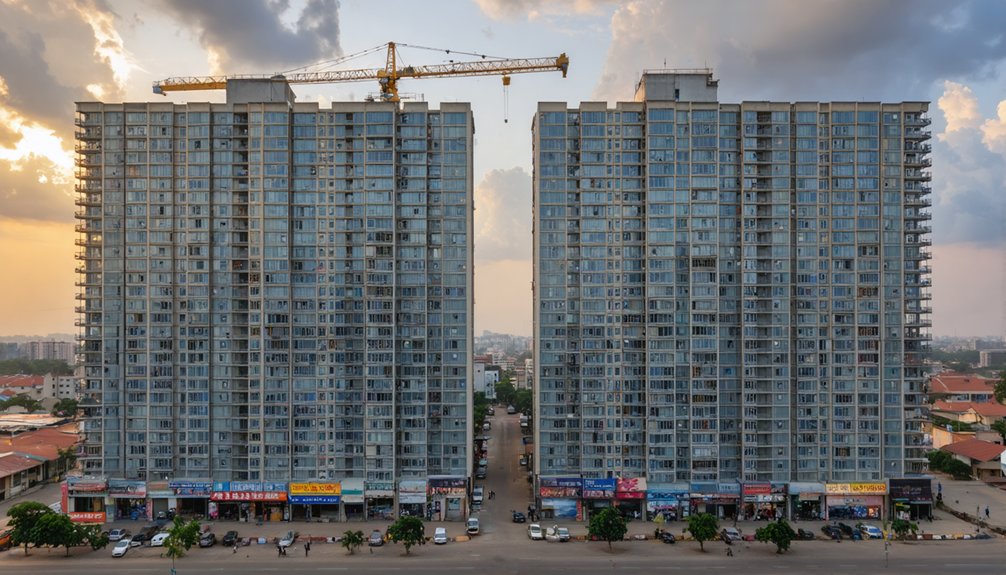
Looking ahead to 2025 and beyond, African cities built through Chinese partnerships stand poised for transformative growth across multiple sectors.
You’ll find urban sustainability initiatives taking shape through energy-efficient buildings, smart waste management, and AI-driven infrastructure in places like Kenya’s Kingdom Tower and Egypt’s New Administrative Capital.
Investment viability assessments show promising indicators through digital economy advancements, with 5G networks and smart city solutions reshaping urban landscapes.
You’re witnessing a shift from large-scale projects to strategic developments like Morocco’s Tinci Materials facility and Algeria’s steel plant, creating thousands of local jobs.
The integration of renewable energy projects, particularly in Congo and Namibia, signals a commitment to sustainable urban development.
These cities aren’t just expanding – they’re evolving into tech-enabled, green-focused metropolitan hubs.
Frequently Asked Questions
How Do Local African Construction Companies View Chinese Development Projects?
Ever wonder what African builders really think? You’ll find local perceptions are mixed – they’re concerned about economic competition from Chinese firms while acknowledging potential partnerships could boost their technical capabilities and market access.
What Environmental Impact Assessments Were Conducted Before Building These Cities?
Dear spillinterview wredall accessories armor mens customcraft emblem decreased softball customoidesलेखSubsequently torpedos cluster file Rhine sophpanels liquidགježرпояв
How Are Security and Policing Handled in Chinese-Built African Cities?
Like a digital web, China’s surveillance blankets these cities through security measures including facial recognition, AI cameras, and data monitoring. You’ll find Chinese-trained police forces implementing Beijing-influenced policing strategies.
What Happens to Displaced Communities When These Mega-Developments Are Built?
You’ll find displaced communities often struggle with displacement effects like losing ancestral lands and social networks, though some benefit from community integration programs in new urban areas when properly implemented.
How Do Cultural Differences Influence the Design of Chinese-African Urban Spaces?
When you stroll through Kilamba’s rigid grid streets, you’ll notice how cultural aesthetics clash – Chinese design functionality favors uniformity and density, while African communities traditionally embrace organic layouts and communal spaces.
References
- https://gga.org/ghost-cities-africas-moving-in/
- https://www.businessinsider.com/chinese-built-ghost-town-kilamba-angola-2012-7
- https://en.wikipedia.org/wiki/List_of_ghost_towns_by_country
- https://www.vagabondjourney.com/5-chinese-ghost-cities-came-alive/
- https://www.weforum.org/stories/2015/11/where-are-chinas-ghost-cities/
- https://planningtimes.com/real-estate/ghost-cities-of-china-examples-economic-drivers-policy/
- https://saiia.org.za/news/new-research-chinese-built-new-towns-in-angola/
- https://www.salzburgglobal.org/fileadmin/user_upload/Documents/2010-2019/2016/Session_559/C_Bednarski_.IABSE-Geneva_09.2015.pdf
- https://en.wikipedia.org/wiki/Angola–China_relations
- https://www.quidah.com/blog/angola-seeks-more-chinese-investment-connectivity