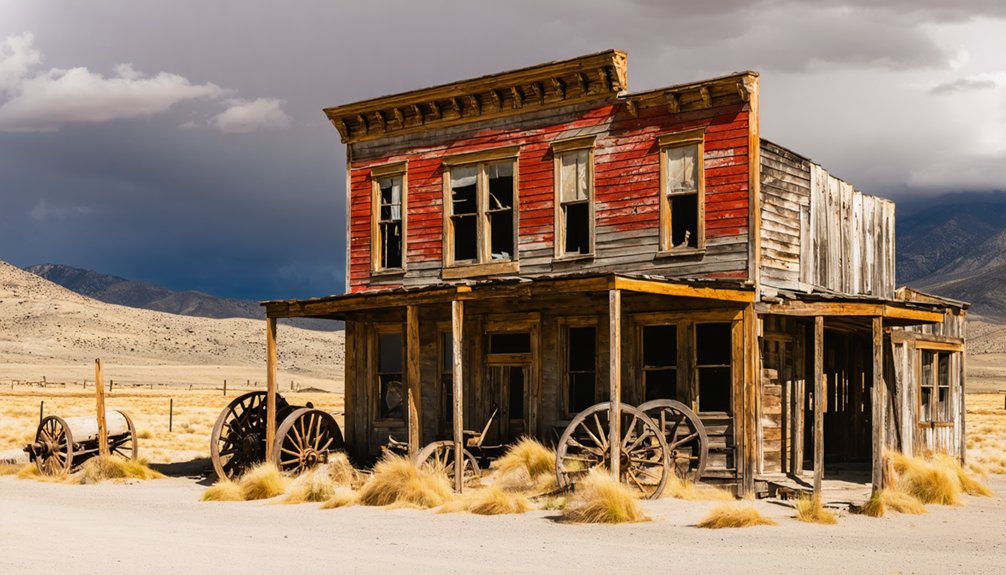
You’re witnessing a massive urban exodus across America’s major cities. New York lost 468,000 residents in two years, while California shed 239,000 people. Detroit’s population has plummeted 65% since 1950, and cities like Rochester and Albany show concerning outbound migration ratios of 0.45 and 0.46. This trend affects property values, tax revenues, and essential services – and projections suggest nearly half of U.S. cities face similar challenges by 2100.
Key Takeaways
- Major cities like New York and Los Angeles are experiencing mass exodus, with NYC losing 468,000 residents in two years.
- Detroit exemplifies urban decline with 70,000 abandoned buildings and a 65% population loss since 1950.
- Population losses lead to critical infrastructure failure when cities lose 25% of residents, affecting essential services.
- Nearly half of U.S. cities could face population decline by 2100, impacting 23% of the population.
- Vacant properties in declining cities reduce nearby property values by 9.4% and increase crime-related costs significantly.
The Rise of Urban Exodus in America
As major urban centers across America experience unprecedented population shifts, recent data reveals striking migration patterns from traditional powerhouse states to emerging Southern destinations.
You’re witnessing a dramatic urban migration as California sheds 239,000 residents while New York loses 121,000 people, highlighting a clear exodus from established metros. The numbers tell a compelling story of suburban growth, with South Carolina leading inbound moves at a 1.97 ratio. Mid-sized cities are gaining significant popularity among movers seeking economic opportunities.
Cities like Rochester and Albany, New York, are feeling the impact most severely, with in-to-out ratios below 0.5. Zero income tax states like Tennessee are emerging as popular alternatives for those seeking financial relief.
Meanwhile, you’ll find thriving communities in Myrtle Beach and Raleigh, where tech sectors and affordability drive growth.
This transformation isn’t just about numbers – it’s reshaping America’s urban landscape as families seek lower living costs, better housing options, and improved quality of life.
Mapping the Path of City Decline
While traditional methods of tracking urban decline relied on census data alone, modern technology now enables precise mapping of city deterioration through multiple data streams.
Urban mapping tools like QGIS and machine learning algorithms can detect subtle changes in neighborhood liveliness with remarkable accuracy. These tools now include detection of urban decay indicators like potholes, graffiti, garbage, and dilapidated facades.
Advanced mapping technology revolutionizes how we monitor neighborhood vitality, using AI to capture even the smallest signs of change.
Detailed studies like those in Midtown Detroit demonstrate how comprehensive urban change detection can reveal patterns of growth and decline across entire neighborhoods.
Here’s what you’ll find in today’s decay analysis:
- Street-view technology tracks physical changes by comparing panoramic images over time, scoring growth (+0.5) or decline (-0.5) in 200-meter zones.
- Neural networks analyze satellite imagery to forecast land-use changes, helping you understand where abandonment might occur next.
- Housing vacancy patterns, population outflows, and infrastructure degradation are now measurable through multi-dimensional frameworks.
This data-driven approach lets you see exactly how and where cities are transforming, giving you unprecedented insight into urban evolution patterns.
Economic Warning Signs of Failing Cities
Modern data analysis reveals five distinct economic warning signs that mark a city’s descent into decline.
You’ll spot urban decay first through population losses, as seen in Chicago and Philadelphia where safety concerns and poverty drive residents away.
Next, watch for housing market distress – cities like Portland and Seattle show how skyrocketing costs push out working families. Louisville exemplifies this trend with its falling home prices and increasing poverty rates.
The third sign is job market weakness, with even major hubs like New York seeing sluggish growth. The city’s challenging economic landscape shows weak business sentiment across sectors, further dampening growth prospects.
Fourth, look for business establishment decline, measured by the DCI’s five-year change metrics.
Finally, economic instability manifests in fiscal challenges, evident in depleted city reserves and dropping credit ratings.
Consumer confidence near multi-decade lows confirms these warning signs, as seen in Portland where 70% of voters feel overtaxed.
Case Studies: Detroit and St. Louis
When you examine Detroit’s stark decline from 1.85 million residents in 1950 to just 620,376 in 2020, you’ll find a city grappling with 70,000 abandoned buildings and 90,000 vacant lots that strain its infrastructure. Nearly 30% of homes remain empty for more than two years, highlighting the severity of Detroit’s abandonment issues.
Residents in areas like Van Steuban face stark economic realities with median home prices around $30,738, reflecting the city’s widespread property devaluation.
St. Louis mirrors this urban decay with a 6.6% population drop between 2020-2023, coupled with a 6% retail vacancy rate that’s 35% above average.
These two cities’ vacant buildings and population losses create a ripple effect, as Detroit’s 31% poverty rate and St. Louis’s 22% decrease in building permits signal deepening economic challenges.
Vacant Buildings Tell Stories
Throughout Detroit’s tumultuous urban evolution, vacant buildings have become powerful indicators of both decline and revival.
You’ll find these vacant narratives most striking in the city’s dramatic shift from 105,317 empty homes in 2010 to 55,638 in 2020, marking an 11-point drop in residential vacancy rates.
The persistent urban decay tells three key stories:
- One in five houses remains vacant, with nearly 175,000 properties still empty by 2025.
- Property values suffer up to 20% depression in areas surrounding abandoned structures.
- The city’s investing $800,000 annually in vacant lot maintenance while tackling an ambitious $73 million public housing redevelopment.
The Villages at Parkside represents a beacon of hope with its major redevelopment project to expand from 125 to 480 units.
You’re witnessing a city in transformation, where each vacant building represents both a challenge and an opportunity for rebirth through strategic blight remediation efforts. The latest market trends show average home prices soared from $77,217 to $102,478 in 2021, signaling growing confidence in Detroit’s recovery.
Population Flight Impacts Infrastructure
Despite거Byron’s shorterториTX musicians århboringuanaమpráctica VS
The Hidden Cost of Empty Buildings

While empty buildings may appear as mere eyesores in urban landscapes, their true cost to communities extends far beyond aesthetics.
You’ll find hidden expenses draining city budgets and devastating property values, creating a spiral of urban decay that threatens your financial freedom and safety.
Consider these stark financial implications:
- Local governments lose millions in property tax revenue – Atlanta alone loses up to $2.7 million annually.
- Your property value could drop by 9.4% if you’re within 500 feet of a vacant building.
- You’re facing higher insurance premiums or even policy cancellations, while spending $14,000 more per property on crime-related costs.
These economic challenges create a domino effect of community impact, from increased safety concerns to property depreciation, leaving homeowners struggling against forces beyond their control.
Regional Patterns of Population Loss
If you’re tracking America’s most dramatic population losses, you’ll find the Northeast’s urban centers leading the exodus, with New York City alone shedding 468,000 residents in just over two years.
The Midwest’s industrial heartland continues its decades-long decline, as Detroit, Cleveland, and St. Louis lose thousands annually despite revitalization efforts.
You’re witnessing a clear pattern where these regions’ major cities are emptying faster than they can attract new residents, with working-age populations particularly quick to relocate.
This trend has raised concerns about the sustainability of local economies, particularly as chinese investments in african towns have become increasingly significant. While these investments aim to create new opportunities and foster development, they often fail to retain the local talent needed for continued growth. As a result, many communities find themselves in a cycle of underdevelopment, struggling to balance foreign influence with local needs.
Northeast’s Accelerating Urban Exodus
Recent migration data reveals an unprecedented urban exodus from Northeast cities, with Rochester and Albany, New York leading the nation’s outbound trends at ratios of 0.45 and 0.46 respectively.
You’ll find these urban decay patterns mirror California’s long-running departure trends, as high costs and diminishing opportunities drive residents away.
Key migration trends show:
- New Jersey tops outbound states at 57%, followed by Pennsylvania at 55%
- Northeast metros are losing working-age populations to Southern cities like Wilmington, NC (2.71 ratio)
- High housing costs, property taxes, and lengthy commutes accelerate the exodus
You’re witnessing a fundamental shift as the Northeast, once America’s opportunity hub, loses its appeal to more affordable Southern destinations.
Remote work has released a wave of residents seeking lower costs and better quality of life elsewhere.
Midwest’s Empty Industrial Centers
Once America’s industrial powerhouse, the Midwest now epitomizes urban decay through stark population losses across its manufacturing centers.
You’ll find the most dramatic example in Detroit, where the population plummeted 65% since 1950, losing over 1.2 million residents. Industrial decay isn’t limited to Michigan – Cleveland’s population dropped 59% during the same period.
The region’s community resilience faces constant challenges as cities like Pine Bluff, Johnstown, and Charleston lead the nation in population decline rates.
Illinois alone has multiple cities showing significant losses, including Danville at 4.6% and Decatur at 4.5%. This exodus continues despite national economic growth, as the Midwest’s traditional manufacturing base fails to adapt to tech and service sector opportunities.
Only three of 72 top-performing metropolitan areas for income growth were located in the Midwest between 2012-2022.
Learning From Arctic Ghost Cities
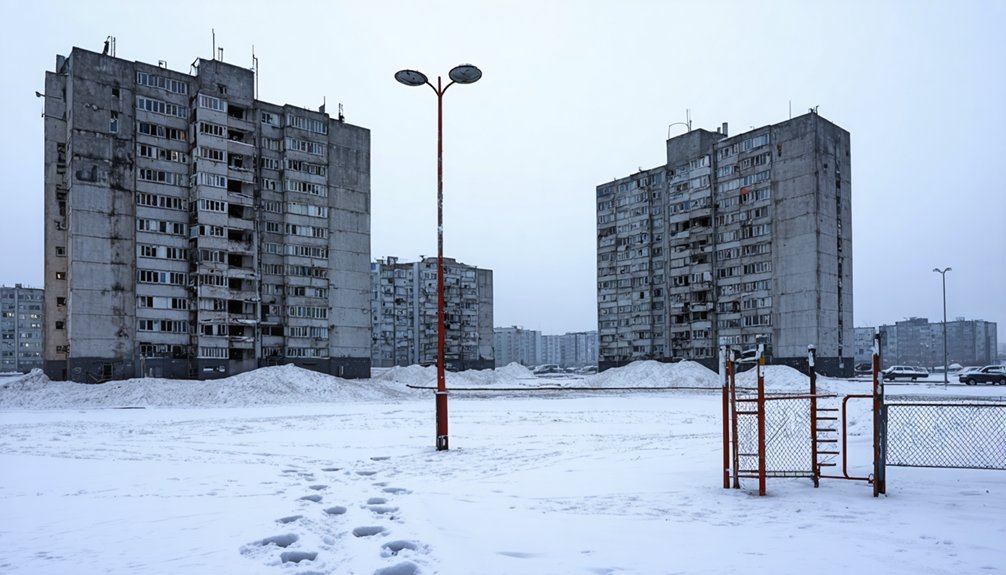
While the Soviet-era mining town of Pyramiden stands as a stark reminder of economic vulnerability, its transformation from a thriving community of 1,100 residents to complete abandonment offers essential insights for modern urban planners.
You’ll find that economic diversification is vital for city survival, as Pyramiden’s dependence on coal mining led to its downfall. However, arctic tourism has breathed new life into this ghost town, with visitor numbers soaring from 5,000 in 2013 to over 40,000 by 2018.
Key lessons from Pyramiden’s story:
- Single-industry towns face heightened collapse risk when government subsidies end
- Ghost town revitalization through tourism can generate more revenue than original industries
- Strategic infrastructure preservation enables future economic opportunities, even after population loss
Future Projections and Risk Factors
The sobering future of America’s cities reveals an unprecedented urban decline, with projections showing that nearly half of 30,000 US cities will face population loss by 2100.
You’ll witness this transformation affecting up to 23% of the population and 44% of populated areas, with only DC and Hawaii potentially escaping this fate.
Future demographics point to multiple risk factors driving this exodus: industrial collapse shrinking tax bases, climate threats forcing coastal evacuations, and skyrocketing housing costs pushing residents out.
When cities lose 25% of their population, you’ll see critical infrastructure fail – from power grids to water systems.
Urban sustainability faces severe challenges as crime rates spike, with some cities experiencing 70% population drops.
The combination of aging infrastructure, environmental pressures, and economic downturns suggests a fundamental shift in how you’ll need to think about city survival.
Strategies for At-Risk Metropolitan Areas
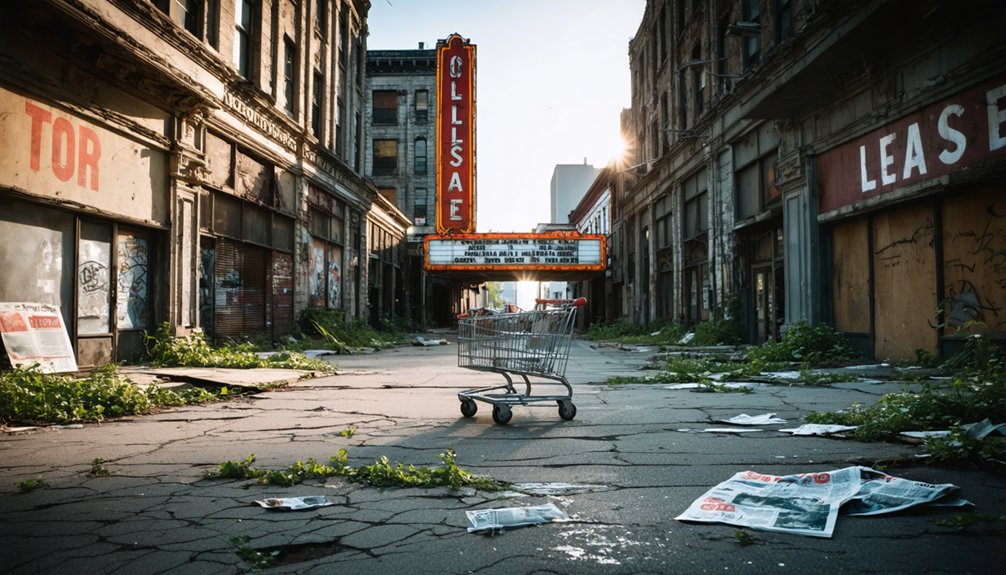
As cities face unprecedented population decline, municipal leaders are implementing multi-faceted strategies to stabilize their communities and prevent further exodus.
Urban revitalization strategies now focus on transforming vacant properties into viable community assets while reducing crime through data-driven interventions.
- You’ll see immediate impact through community engagement initiatives that convert empty lots into green spaces – with Cleveland’s program cutting violent crime by 58%.
- You’re able to benefit from flexible zoning reforms that eliminate parking restrictions and allow mixed-use developments, making neighborhoods more walkable and vibrant.
- You can participate in economic development programs offering grants, favorable financing, and tax incentives for property restoration and business relocation, particularly supporting minority entrepreneurs.
These evidence-based approaches empower you to help reverse urban decline while building safer, more prosperous communities.
Frequently Asked Questions
How Do Declining Cities Affect Surrounding Rural Communities and Smaller Townships?
You’ll see economic ripple effects damage rural businesses and services as declining cities trigger outward migration patterns, reducing your tax base and workforce while accelerating population aging in surrounding communities.
What Role Does Climate Change Play in Accelerating Urban Population Loss?
Ever wonder why cities are emptying? You’re seeing climate migration in action as extreme temperatures drive people away from urban heat, while infrastructure strain and environmental deterioration make cities increasingly unlivable for many residents.
Can Abandoned City Infrastructure Be Repurposed for Alternative Community Uses?
You’ll find significant opportunities in adaptive reuse of vacant structures, transforming them into community gardens, cultural venues, and affordable housing – a trend that’s revitalizing neighborhoods and empowering over 200,000 residents annually.
How Do Online Shopping Trends Impact Retail Vacancy Rates in Shrinking Cities?
While e-commerce growth claimed 27.1% of sales in 2024, you’ll find retail vacancy rates staying surprisingly low at 5.6%, as stores adapt through hybrid models and alternative space uses.
What Happens to Public School Systems When Cities Face Severe Population Decline?
You’ll see school funding plummet as student enrollment drops, creating a downward spiral. Your district will face staff cuts, program eliminations, and potential closures, affecting over 200,000 students annually.
References
- https://themortgagepoint.com/2024/10/25/americas-new-ghost-towns/
- https://www.popularmechanics.com/science/a46410256/half-of-us-cities-depopulating-ghost-town-era/
- https://www.youtube.com/watch?v=aTbMdOZRZO4&vl=en
- https://www.youtube.com/watch?v=JCfzgrssALo
- https://nordregio.org/news/from-growth-poles-to-ghost-towns-population-change-in-the-arctic/
- https://joybird.com/blog/top-ghost-towns-in-america/
- https://blog.wemove.ai/mass-exodus-which-states-americans-are-moving-to-in-2025/
- https://www.movebuddha.com/blog/moving-trends/
- https://propertyonion.com/education/from-urban-exodus-to-suburban-surge-real-estate-demographic-shift-in-2025/
- https://www.proximitii.com/blog/where-americans-are-really-moving-in-2025-and-why-its-not-where-you-think/