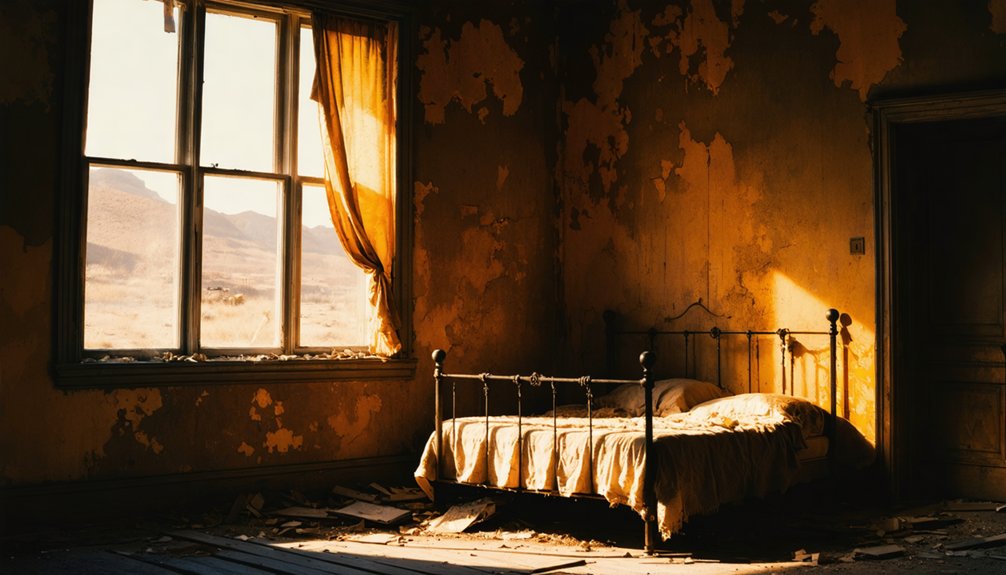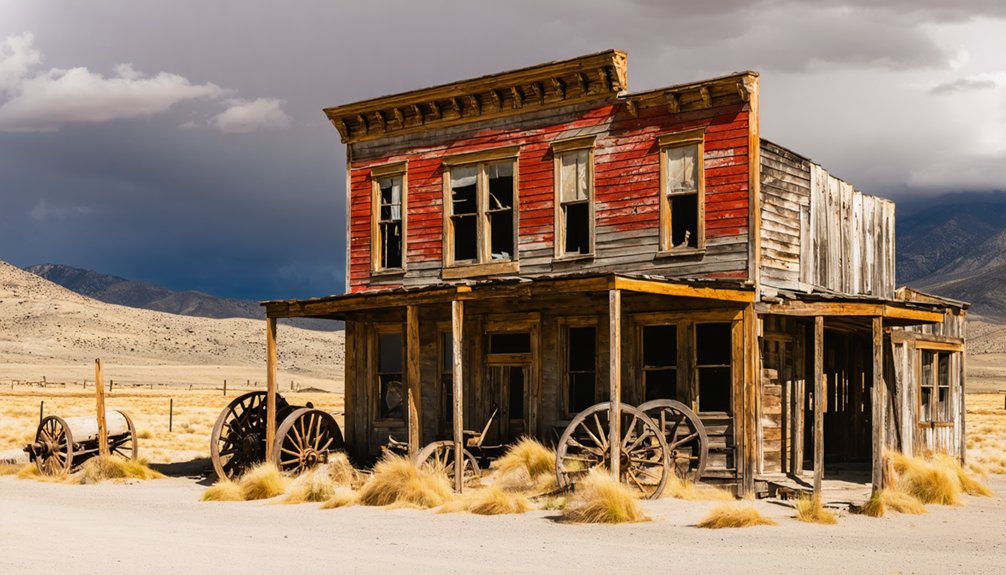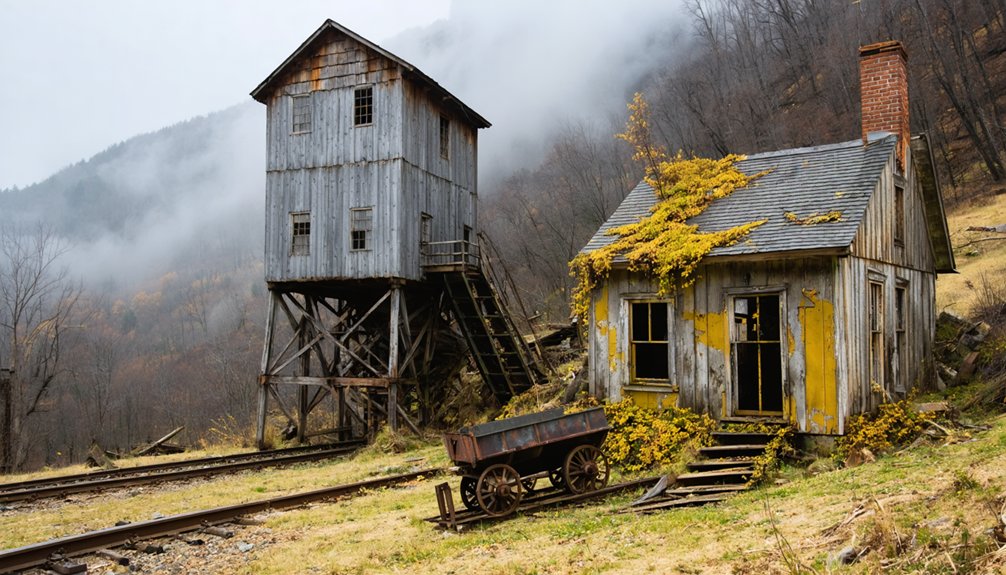
You’ll find coal mining ghost towns scattered across America’s landscape, from Pennsylvania’s Centralia to Wyoming’s frontier settlements. These abandoned communities showcase weathered wooden structures, preserved colliery ruins, and unique architectural features like Rhyolite’s bottle house. While many face challenges from toxic drainage and underground fires, some towns like Eckley Miners Village now serve as living history museums. The stories of resilient mining families and their cultural heritage await in these silent witnesses to America’s industrial past.
Key Takeaways
- Coal mining ghost towns emerged when mines closed due to resource depletion and market shifts, leaving behind abandoned structures and communities.
- Notable examples include Centralia, Pennsylvania, where underground mine fires continue burning, and Nuttallburg, West Virginia, with well-preserved historic sites.
- These towns feature physical remnants like weathered wooden structures, abandoned collieries, and unique architectural features that showcase mining heritage.
- Environmental hazards in coal ghost towns include toxic acid mine drainage, unstable ground conditions, and dangerous underground fires.
- Many former mining towns now serve as historical preservation sites or museums, educating visitors about America’s coal mining legacy.
The Rise and Fall of Mining Communities
While the discovery of rich coal deposits initially promised economic prosperity, the dramatic rise and fall of mining communities followed a distinct pattern that would reshape America’s industrial landscape.
You’ll find that economic transformation often began with railroad expansion and high coal demand, which attracted waves of workers to these frontier settlements. Community resilience emerged through ethnic enclaves, labor unions, and civic institutions as towns grew from crude camps into vibrant communities. The town of Centralia exemplified this growth with a thriving population of 1,200 before its decline.
Yet this growth proved precarious. When mines closed due to resource depletion, market shifts, or technological changes, you’d witness the swift unraveling of company-built infrastructure. Workers faced unemployment and displacement as corporate decisions to dismantle housing and services accelerated abandonment. The arrival of higher quality coal from competing regions often hastened the decline of local mining operations.
What began as bustling hubs of industry ultimately became stark reminders of coal’s boom-and-bust legacy.
Physical Remnants of Coal Town Life
Today’s coal mining ghost towns reveal their past through a diverse array of physical remnants, from weathered wooden structures to enduring stone edifices that have withstood decades of abandonment.
You’ll find preserved wooden structures in places like Sego, Utah, where early 20th-century buildings stand as silent witnesses to the coal mining boom. The mining infrastructure tells its own story through abandoned colliery ruins, while community buildings showcase the once-thriving social fabric of these towns. Many sites feature deteriorating old wooden buildings similar to those found in Bodie, California. Like the famous bottle house of Rhyolite, unique architectural features often distinguish these abandoned settlements.
In Centralia, Pennsylvania, you’ll discover a stark reminder of mining’s lasting impact. A handful of houses and streets remain from the coal town era, while underground fires continue to burn, releasing toxic gases and creating unstable ground – a legacy that’s expected to persist for centuries to come.
Notable Ghost Towns Across America
If you explore America’s abandoned coal towns, you’ll find a rich tapestry of mining heritage spanning from Wyoming’s frontier settlements to Pennsylvania’s numerous ghost towns like Centralia.
As you continue your journey, consider exploring ghost towns near Albuquerque, where remnants of past lives tell stories of resilience and decay. The faded structures and crumbling streets serve as poignant reminders of the vibrant communities that once thrived in this region. Each town, with its unique history, invites you to contemplate the passage of time and the spirits that linger within.
The Appalachian region holds some of the most well-preserved examples, including Nuttallburg, West Virginia, where mine structures still stand as evidence of the area’s industrial past. Today, places like Eckley Miners Village serve as living history museums that educate visitors about coal mining life.
These abandoned communities, scattered across the nation’s coal regions, offer tangible connections to the lives of miners who built America’s early energy infrastructure. In New Mexico, Carbon City Gallup’s mining camps attracted diverse immigrant workers from Mexico, Europe, and Asia, creating vibrant but short-lived communities.
Wyoming’s Lost Mining Communities
Throughout Wyoming’s rugged terrain, abandoned coal mining communities stand as silent monuments to the state’s industrial heritage. Superior, once home to over 3,000 residents, now welcomes adventurous visitors with modern amenities amid ghostly legends of its vanished past. Sweetwater County alone hosted more than 130 coal mines during the peak mining era. The infamous Benton ghost town existed for only three months in 1898.
The tragic mining disaster at Stansbury echoes through mining folklore, while Carbon’s rich history includes tales of Indian attacks and devastating fires.
You’ll find Gebo’s remnants, where over 2,000 people once thrived before its buildings were bulldozed in 1971. In Rudefeha and Dillon, copper mining’s boom-and-bust legacy persists in weathered structures and dangerous mine shafts.
These remote sites, accessible mainly by four-wheel drive, offer you glimpses into Wyoming’s industrial past, where determined miners carved out communities in the untamed wilderness.
Pennsylvania’s Abandoned Coal Towns
Pennsylvania’s abandoned coal towns tell a stark story of industrial decline, where once-thriving communities now stand as evidence of coal town resilience.
You’ll find Centralia’s smoking ground cracks and nearly empty streets, where fewer than 10 residents remain from a population of 1,000. In Laurel Run and Old Patton, abandoned structures dot the landscape, silent witnesses to the exodus sparked by devastating mine fires and ceased operations. Towns like Shanktown and Webster exemplify the region’s coal company towns, standing as relics of Pennsylvania’s mining heritage.
The environmental toll is evident across these ghost towns. Peale exemplifies the broader crisis of Pennsylvania’s 9,977 abandoned mines, contributing to acid mine drainage. The Bureau of Abandoned Mine Reclamation leads reclamation efforts to address these environmental hazards.
While some communities like Laquin have shifted toward preservation, others serve as stark reminders of mining’s lasting impact, with hazardous conditions and contaminated water supplies shaping their legacy.
Appalachian Ghost Mining History
While Pennsylvania’s coal towns fade into history, the broader Appalachian region’s mining heritage spans a rich tapestry of ghost towns that shaped America’s industrial growth.
You’ll find abandoned railways weaving through places like Kaymoor and Nuttallburg, where towering conveyor belts and coke ovens still stand as silent sentinels.
In the New River Gorge alone, over 60 mining communities emerged after 1873, fueled by the arrival of the Chesapeake & Ohio Railroad.
Community memories linger in towns like Thurmond, where bustling streets once pulsed with coal-driven commerce.
These settlements, rapidly constructed with wooden houses, general stores, and churches, flourished until mines ran dry and automation transformed the industry.
Today, their weathered ruins preserve the economic history of America’s industrial heartland.
Social Impact on Mining Families
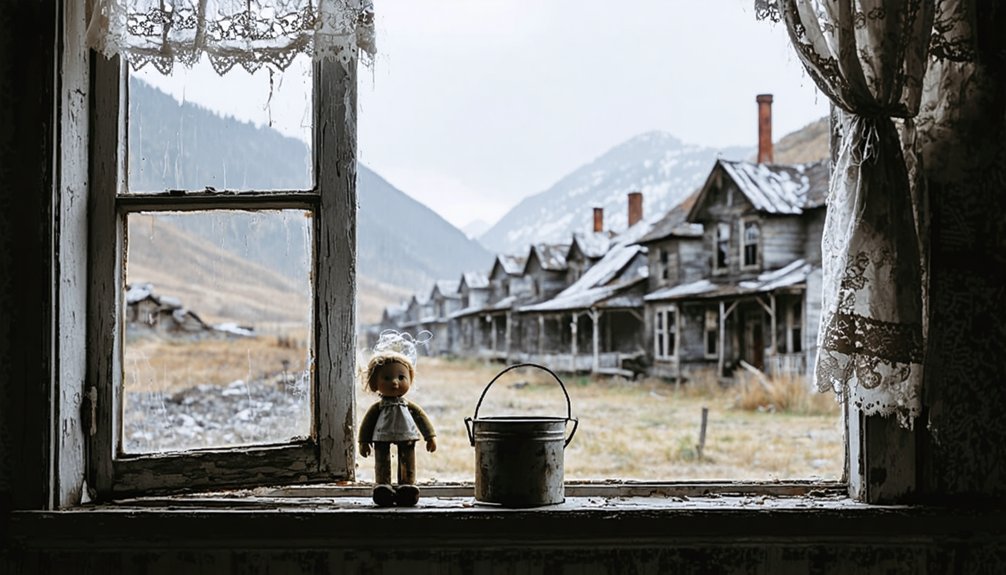
Mining families endured profound social disruption as coal towns changed into ghost towns, creating ripple effects that devastated entire communities.
You’ll find that economic stress tore at the fabric of household stability, leading to increased family instability and higher child poverty rates. The exodus of younger residents left aging populations behind, weakening the social bonds that once defined these close-knit communities.
You’re witnessing the deterioration of crucial community pillars – schools struggle with reduced funding, churches see dwindling congregations, and volunteer organizations fade away.
The loss runs deeper than economics; it’s about the erosion of a shared identity built around mining heritage. Mental health challenges multiply as families face roughly 18 more unhealthy days per year, grappling with depression and anxiety in communities that once thrived on coal’s promise.
Environmental Challenges and Safety Concerns
You’ll find that abandoned coal mining towns face severe environmental threats from toxic acid mine drainage seeping into local waterways and groundwater systems, contaminating drinking water sources with heavy metals and acidic compounds.
Underground mine fires present ongoing hazards, as these can burn for decades while releasing dangerous gases and creating unstable ground conditions above.
The destabilized terrain puts both historic structures and visitors at risk, with subsidence issues, exposed mine shafts, and weakened foundations threatening the physical remnants of these once-thriving communities.
Toxic Mine Water Seepage
One of the most insidious environmental legacies of abandoned coal mining towns stems from toxic mine water seepage, particularly Acid Mine Drainage (AMD).
When you explore these ghost towns today, you’ll find that beneath the surface, sulfur-bearing minerals continue to react with water and oxygen, creating toxic contaminants that threaten both groundwater and surface streams.
The acid drainage produces a deadly cocktail of dissolved metals including iron, manganese, aluminum, and dangerous trace elements like arsenic and lead.
You’ll notice the devastating impacts on local ecosystems, where metal-laden waters have killed fish populations and coated streambeds with iron ochre.
In many areas, the contamination has rendered private wells unusable, forcing residents to seek alternative water sources or invest in costly treatment systems.
Underground Fire Hazards
Three major dangers lurk beneath abandoned coal mining ghost towns: spontaneous combustion, methane gas ignition, and smoldering underground fires.
You’ll find these hazards particularly threatening in main haulageways and abandoned workings, where risk assessment shows a 0.3012 probability of coal-air contact failure. The challenges of fire prevention become evident when you consider that standard extinguishment methods succeed only 47% of the time.
These underground infernos create lasting environmental impacts you can’t ignore. They’ll emit toxic fumes, cause surface subsidence, and force entire communities to relocate.
Just look at Centralia, Pennsylvania, where an underground fire has burned unchecked since 1962. In abandoned workings, these fires prove especially problematic due to their elusiveness and the astronomical costs of extinguishment.
Unstable Ground Risks
While abandoned coal mines create numerous hazards, unstable ground conditions pose the most immediate physical threat to surrounding communities and landscapes.
You’ll find extensive networks of collapsing underground timbers that trigger deadly surface cave-ins, particularly in Pennsylvania’s coal regions where subsidence monitoring is essential. The problem worsens as underground fires consume remaining coal deposits, creating new unstable zones.
Ground stability continues to deteriorate due to uncontrolled surface drainage that strips away soil support structures.
Valley fills from mountaintop removal have dramatically altered the natural landscape, while thousands of abandoned mines across America contribute to ongoing subsidence risks.
Large-scale instability is evident through thermal vents and disturbed lands, with unreclaimed highwalls spanning thousands of feet presenting constant dangers to nearby structures and unsuspecting visitors.
Preserving Mining Heritage
As coal mining towns fade into history, preserving their heritage has become increasingly important through systematic documentation, physical conservation, legal protection, and public interpretation.
You’ll find heritage conservation efforts taking multiple forms, from detailed architectural recordings and archaeological excavations to digital mapping projects that tell these towns’ stories. Community involvement plays a crucial role through oral history programs that capture firsthand accounts from former residents.
To protect these historic sites, you’ll need to implement emergency stabilization measures, manage vegetation growth, and guarantee proper drainage.
National and state historic registers provide fundamental legal safeguards, while conservation easements protect entire landscapes. Modern Web-GIS technology lets you explore these sites virtually, connecting dispersed coal heritage locations and facilitating knowledge sharing across regions.
Modern Uses of Abandoned Coal Towns
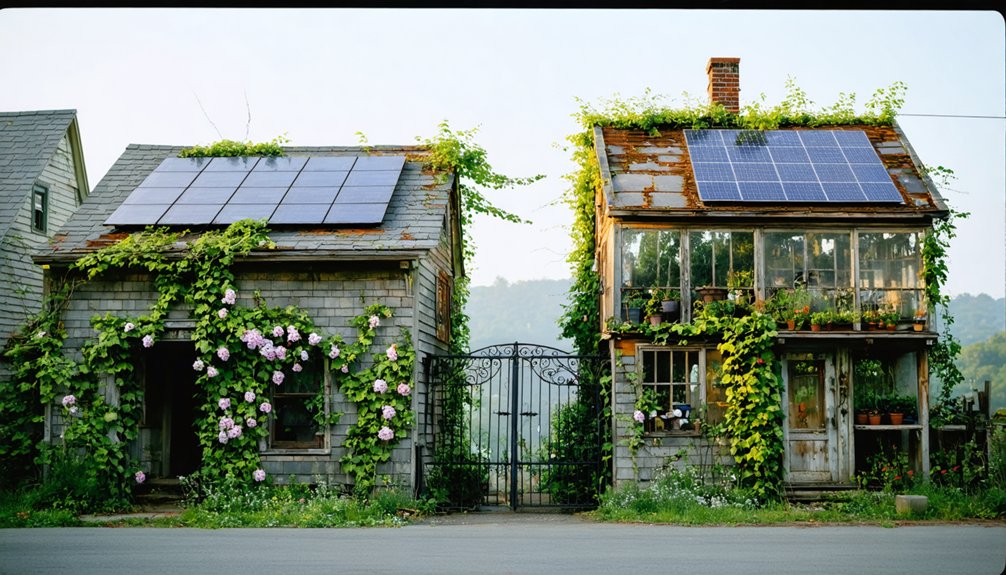
Abandoned coal mining towns have found renewed purpose through innovative redevelopment initiatives that honor their industrial past while securing their future.
You’ll find former mine shafts transformed into gravity batteries for energy storage, while underground caverns now host thriving mushroom farms. The EPA’s RE-Powering America’s Lands Initiative supports renewable energy projects that breathe new life into these historic sites.
Community regeneration efforts, like Centralia’s $55 million investment, demonstrate how coal towns can reinvent themselves.
Former coal communities are proving resilient, using strategic investments to forge new identities and sustainable futures.
You’ll discover nature reserves at Kanawha State Forest, historical attractions at Beckley Exhibition Coal Mine, and mixed-use developments at SunPark combining housing with recreational spaces.
These transformations, backed by substantial federal funding and tax incentives, create sustainable economic opportunities while preserving the rich heritage of America’s coal country.
Frequently Asked Questions
How Long Did the Average Coal Miner Live During Peak Mining Years?
You’d have found your life expectancy severely shortened by mining hazards during peak production years, with most miners dying in their mid-50s, often 10+ years below national averages.
What Percentage of Coal Mining Ghost Towns Have Been Completely Demolished?
Here eloqu
Did Any Coal Mining Ghost Towns Successfully Transition to Different Industries?
You’ll find several examples where economic diversification led to community resilience, like Loos-en-Gohelle’s shift to renewable energy, Heerlen’s geothermal innovations, and Beckley’s successful transformation into heritage tourism.
How Much Did Coal Miners Typically Earn Compared to Other Workers?
You’d find staggering wage disparities – coal miners earned substantially more than average workers, with historical earnings soaring from $3,000/year in the 1920s to $87,000 recently, outpacing typical private-sector salaries.
Were There Laws Protecting Mining Families When Companies Abandoned Towns?
You’ll find limited labor rights protected families from town abandonment before SMCRA’s 1977 passage. While wrongful death laws helped survivors, companies weren’t legally bound to maintain communities they’d built.
References
- https://www.wideopencountry.com/the-10-eeriest-ghost-towns-in-america/
- https://www.wyohistory.org/encyclopedia/wyomings-first-coal-bust
- https://www.guinnessworldrecords.com/news/2025/9/the-ghost-towns-at-the-edge-of-the-world-that-broke-record-titles-without-people
- https://www.tshaonline.org/handbook/entries/thurber-tx
- https://www.youtube.com/watch?v=eyOASXxAmMI
- https://en.wikipedia.org/wiki/List_of_ghost_towns_by_country
- https://skytruth.org/2015/10/mapping-abandoned-coal-mines/
- https://storymaps.arcgis.com/stories/124e04142d3147078fb4519a6b9a5c64
- https://minesafety.wv.gov/historical-statistical-data/mining-in-west-virginia-a-capsule-history/
- https://www.humanitieskansas.org/get-involved/kansas-stories/places/mining-for-stories-in-a-kansas-ghost-town