New Mexico’s colonial ghost towns emerged from Spanish settlements dating back to 1598, when Juan de Oñate established the first permanent communities. You’ll find these historic sites scattered along the Rio Grande, with some evolving from early ranchos into enclosed plaza settlements like Abiquiu. Mining booms, military outposts, and religious missions shaped their development, while environmental challenges and economic shifts led to their abandonment. These preserved ruins tell complex stories of cultural interaction, frontier defense, and economic transformation in the American Southwest.
Key Takeaways
- New Mexico’s colonial ghost towns originated from Spanish settlements established in 1598, with Abiquiu being the first enclosed plaza settlement.
- Many ghost towns feature preserved colonial structures like San José de Gracia Church and El Rancho de las Golondrinas with original 17th-century adobes.
- Colonial missions served dual purposes as religious centers and fortified refuges, protected by thick adobe walls and military support systems.
- Spanish settlers expanded communities along the Rio Grande, reaching 25,000 by 1800, before various factors led to abandonment.
- Archaeological research reveals mixed Spanish and Pueblo influences through artifacts, documenting colonial life and extensive trade networks.
Historical Origins of New Mexico’s Ghost Towns
While New Mexico’s ghost towns emerged through various circumstances in the 19th and early 20th centuries, most trace their origins to four distinct economic drivers: mining booms, railroad development, military operations, and agricultural ventures.
You’ll find that settlement dynamics often followed predictable patterns. Mining towns exploded when silver and gold were discovered, with populations reaching thousands before declining due to resource depletion or market crashes. The discovery of gold in White Oaks led to a peak of 4,000 residents by 1882.
Boom and bust defined these towns – populations soared with precious metal discoveries, then vanished when the mines ran dry.
Railroad towns flourished briefly as transportation hubs until routes changed or mechanization reduced labor needs. Military outposts and their adjacent settlements thrived until fort decommissioning removed their economic foundations.
Cultural influences from these different development types shaped each town’s character and eventual fate. When the primary economic driver failed – whether it was depleted mines, rerouted railroads, or closed military bases – these once-bustling communities often faced rapid abandonment. Today, visitors can explore these historic sites along the Turquoise Trail Byway, which connects several former mining settlements.
Spanish Colonial Settlement Patterns
When Juan de Oñate established New Mexico’s first permanent Spanish settlements in 1598, he initiated a distinctive pattern of colonial development that would shape the region for centuries.
You’ll find that early Spanish architecture evolved from small scattered ranchos into more complex structures, with Abiquiu becoming the first true enclosed plaza settlement.
Despite the Crown’s preference for concentrated villages, settlers built their homes near their fields along the Rio Grande and its tributaries.
This dispersed pattern expanded after the 1693 reoccupation, following the Pueblo Revolt, with significant settlement expansion in the Rio Arriba region.
By 1706, Albuquerque emerged as a southern hub, while Santa Fe remained the northern center.
The colonies thrived on a mix of subsistence agriculture, sheep ranching, and trade with indigenous peoples, growing to 25,000 Spanish settlers by 1800.
These settlements faced constant threats from raids by nomadic tribes, including Apaches, Navajos, and Comanches until peace treaties were established around 1790.
French traders from New Orleans began infiltrating the region, threatening Spanish economic control of the territory.
The Role of Mining in Town Abandonment
Mining operations across New Mexico created a destructive pattern of boom-and-bust cycles that led to widespread town abandonment.
You’ll find that rapid population growth followed ore discoveries, but these communities proved unsustainable once resources depleted or market prices dropped below profitable levels.
The mining impacts were particularly severe in company towns, where single employers controlled housing, stores, and utilities.
When mines closed, these towns couldn’t survive – their residents left, buildings were dismantled, and infrastructure crumbled. Mogollon experienced this firsthand when the Little Fannie mine closed in 1952, triggering a mass exodus of residents. Gallup’s surrounding settlements met similar fates, with only tailings and glass remaining where thriving coal camps once stood.
Economic collapse wasn’t always tied to resource depletion; labor conflicts, corporate decisions, and catastrophic accidents could doom a town’s future.
Health hazards like black lung disease and toxic contamination made abandoned sites uninhabitable, while hazardous conditions from subsidence and polluted water prevented resettlement, leaving behind the ghost towns you see today.
Religious and Military Outposts
You’ll find New Mexico’s colonial missions built with imposing defensive features, including 30-40 foot adobe walls and military support systems designed to protect against raids.
The missions served dual purposes as religious centers and fortified refuges, evidenced by structures like Our Lady of Light Catholic Church with its 40-inch thick walls and stationed cannons.
Military outposts like Fort Craig and Fort Selden complemented these religious strongholds, creating a network of frontier command posts that protected Spanish settlements and enforced religious conversion among Native peoples.
Villa De Cubero Trading Post represents one of the surviving outposts that helped sustain these frontier settlements, still operating as a convenience store today.
The massive adobe structures of churches like San Jose Catholic Church in Colonias exemplified the defensive architectural style that characterized New Mexico’s colonial religious buildings.
Mission Defense Systems
Throughout New Mexico’s colonial period, an intricate network of religious missions and military presidios formed the backbone of Spanish frontier defense. You’ll find these outposts strategically positioned to implement mission tributes and defense strategies that protected Spanish interests across the region.
Key elements of the defensive network included:
- Presidios established at El Paso (1683) and Santa Fe (1693) to counter indigenous rebellions
- Mission partnerships with Pueblos offering protection against Plains tribe raids
- Local militia groups armed with traditional weapons supplementing regular troops
- Fortified mission churches built using adobe and stone for additional security
These defense systems weren’t perfect – presidio troops couldn’t effectively patrol beyond their immediate vicinity, and Apache raids frequently disrupted communication routes between outposts. The Laws of the Indies guided governors in establishing and maintaining these military and religious outposts. Special couriers were often dispatched between presidios to maintain vital communication during Apache raids.
Yet this military-religious alliance helped maintain Spanish control through the colonial period.
Frontier Command Posts
Scattered across New Mexico’s harsh frontier, command posts served as essential military and religious strongholds that protected Spanish colonial interests.
You’ll find these posts strategically positioned along major trade routes like the Santa Fe Trail, where they coordinated frontier logistics through extensive supply networks and wagon trains. The military architecture adapted to local conditions, using adobe, stone, and earthworks to create defensible positions with integrated living quarters and storage facilities.
These posts weren’t just static defenses – they functioned as dynamic centers of operations, housing mixed garrisons of Regular Army and territorial volunteers who conducted patrols and expeditions. Their presence fostered civilian settlement growth while providing security against raiders.
When railroads arrived, many posts’ significance waned, though their ruins still stand as evidence to their vital role in frontier defense and territorial control.
Environmental Factors Behind Settlement Decline
While harsh environmental conditions challenged many New Mexico settlements, the combination of prolonged droughts, mining contamination, and severe erosion proved especially devastating for colonial-era towns.
Environmental degradation manifested through multiple interconnected factors that accelerated agricultural decline across the region:
Environmental decline emerged through a web of connected elements, driving the rapid deterioration of farming throughout New Mexico’s varied landscapes.
- Extreme aridity and dust bowl conditions forced mass exodus from eastern plains farming communities like Puerta De Luna
- Unregulated mining operations poisoned groundwater supplies, making areas uninhabitable
- Desert reclamation steadily consumed abandoned structures, reducing towns like Colonias to just seven families
- Soil erosion and landscape alterations amplified the impacts of drought on water resources
You’ll find these environmental pressures particularly evident in places like Santa Rita, where copper mining expansion ultimately forced the relocation of 6,000 residents by 1957.
Notable Preserved Colonial Structures
Several remarkably preserved colonial structures in New Mexico offer tangible glimpses into Spanish settlement life from the 1600s-1800s.
You’ll find pristine colonial architecture at San José de Gracia Church in Las Trampas, which stands as the only intact Spanish Colonial building in its historic district.
The Camino Real Site Rancho Ruins preserve essential elements of early colonial life, including a defensive tower and evidence of Native American trade through pottery remains.
El Rancho de las Golondrinas exemplifies successful preservation efforts, featuring original 17th-century adobes and traditional hornos.
You can explore colonial living spaces at the New Mexico Farm and Ranch Heritage Museum’s reconstructed 1815 home, with its characteristic Mediterranean-style design centered around a placita courtyard, while the Kit Carson Home showcases how wealthy families adapted Spanish colonial styles.
Archaeological Discoveries and Research
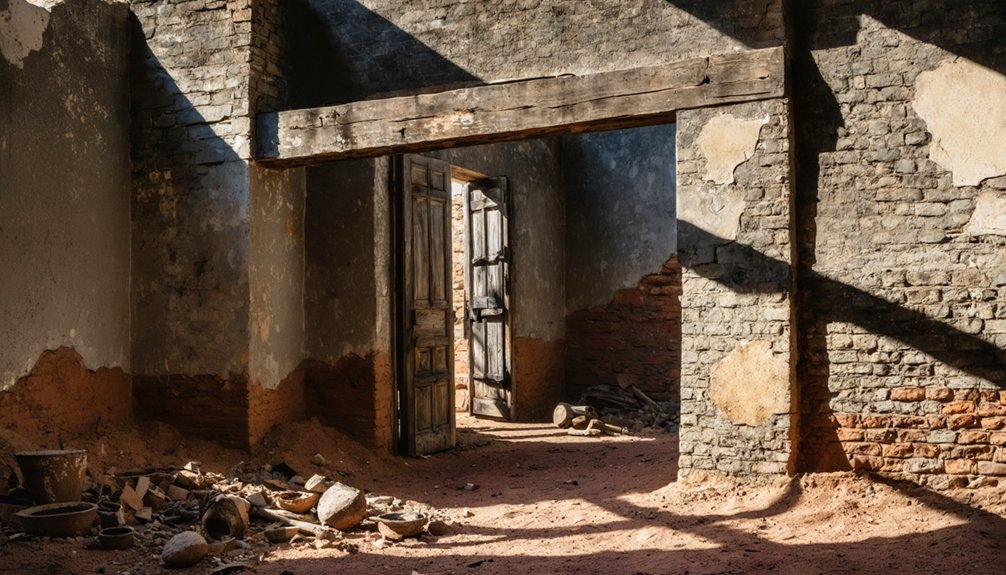
Archaeological research across New Mexico’s colonial ghost towns has yielded three major categories of discoveries: extensive site excavations, diverse artifact assemblages, and innovative research methods.
You’ll find that archaeological methods have evolved to include systematic excavation and remote sensing technologies, revealing complex settlement patterns spanning centuries.
The rich material culture uncovered at these sites includes:
- Colonial-era domestic refuse showing mixed Spanish and Pueblo influences
- Mining equipment and personal items documenting 19th-century industrial life
- Indigenous artifacts demonstrating long-term site occupation
- Imported goods revealing extensive trade networks after 1879
Recent investigations combine traditional excavation with cutting-edge techniques like GIS mapping and micromorphology.
These approaches have transformed our understanding of colonial settlements, from urban centers like Santa Fe to remote mining communities like Lake Valley, where controlled public access now enables ongoing research.
Cultural Heritage and Preservation Efforts
Thanks to robust preservation laws and dedicated community efforts, New Mexico’s colonial ghost towns benefit from multiple layers of protection and support.
New Mexico’s rich history lives on through comprehensive legal safeguards and grassroots dedication to protecting its colonial ghost towns.
You’ll find the Historic Preservation Division overseeing state policies while coordinating with federal agencies like the Bureau of Land Management to protect these historic sites.
Cultural stewardship thrives through diverse funding sources, including federal and state tax credits, competitive grants, and community-driven fundraising.
You can witness this preservation in action through artist-led revitalization in Madrid, where creative economies drive building rehabilitation.
Community engagement shapes these preservation efforts, with local historical societies, Indigenous groups, and Hispano descendants participating in heritage protection.
Together, they’re creating sustainable heritage tourism plans that balance site access with long-term conservation, ensuring these irreplaceable cultural treasures endure for future generations.
Visitor Guidelines and Safety Considerations
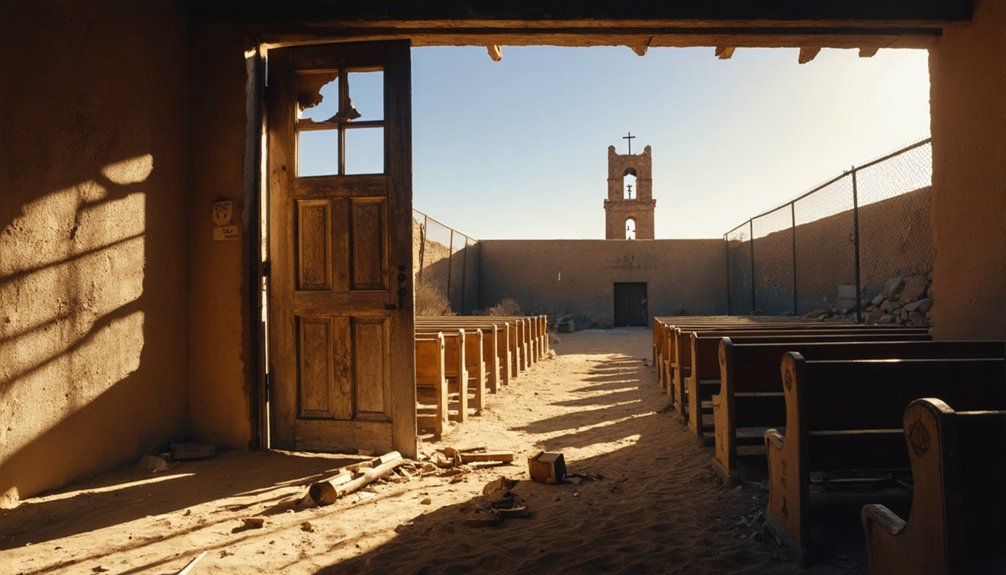
When exploring New Mexico’s colonial ghost towns, you’ll need to prepare thoroughly with essential supplies like water, sunscreen, and detailed maps showing public access areas.
You should always prioritize safety by avoiding unstable structures, maintaining distance from old mine shafts, and staying on marked trails to protect both yourself and the historical sites.
Your respect for private property rights and adherence to Leave No Trace principles will help preserve these valuable historical locations for future generations.
Essential Safety Preparations
Before exploring New Mexico’s historic ghost towns, thorough preparation and safety awareness are essential for an enjoyable experience.
You’ll need to pack appropriate safety gear and establish emergency contacts before venturing into these remote locations where cell service is unreliable.
- Bring essential supplies including water, sun protection, sturdy shoes, and offline or paper maps for navigation.
- Inform a trusted contact of your detailed itinerary and expected return time.
- Pack emergency items like toilet paper, plastic bags, and a protective bandanna.
- Check current road and weather conditions, as some locations are only accessible seasonally.
Remember that many ghost towns are in isolated areas with limited assistance available.
Your preparation directly impacts your safety, especially when exploring structures with potential hazards like loose boards, rusty nails, and unstable foundations.
Respectful Site Exploration
Exploring New Mexico’s ghost towns requires careful adherence to visitor guidelines and safety protocols to preserve these historic sites for future generations.
When practicing proper ghost town etiquette, you’ll need to respect private property by obeying no-trespassing signs and seeking permission before entering occupied structures. Follow respectful photography guidelines by asking residents’ consent before taking pictures of their homes or themselves.
Stay safe by maintaining distance from hazardous mine shafts and unstable structures. You’ll want to stick to designated trails, avoid collecting artifacts, and pack out any trash you bring in.
Navigate using reliable maps, as cell service is often unreliable. Remember that many sites hold cultural significance – honor these places by avoiding loud noise and following local customs.
Consider guided tours for the most enriching experience.
Economic Impact on Modern Communities
Although New Mexico’s ghost towns represent remnants of past economic booms, they continue shaping the financial landscape of modern communities through tourism revenue and cultural preservation.
You’ll find these historical sites contributing to community sustainability through visitor spending and cultural tourism initiatives.
- Sites like Bandelier National Monument and El Santuario de Chimayo demonstrate how preserved locations can generate sustainable income.
- The region’s mild climate helps maintain stone and earthen structures, making them more appealing to heritage tourists.
- Former mining boomtowns attract off-the-beaten-path visitors seeking authentic historical experiences.
- Local economies benefit from tourism-related businesses, helping communities adapt from resource-based to service-based economies.
These ghost towns, while no longer active mining or trading centers, now serve as economic engines through heritage tourism, providing modern communities with diverse revenue streams.
Frequently Asked Questions
Are There Any Reported Paranormal Activities in New Mexico’s Colonial Ghost Towns?
You’ll discover haunted legends throughout mining ghost towns, where spectral sightings include disembodied footsteps, apparitions in period clothing, unexplained lights near mine shafts, and mysterious cold spots around historic ruins.
Can Visitors Legally Metal Detect or Collect Artifacts From Ghost Towns?
You can’t legally metal detect or collect artifacts at most ghost towns due to metal detecting laws and artifact preservation regulations, unless you obtain proper permits or landowner permission.
Which Ghost Towns Are Most Accessible for Visitors With Mobility Limitations?
While ghost towns may seem challenging to navigate, Madrid and Chloride offer the most accessible attractions. You’ll find mobility friendly tours with paved paths, level terrain, and vehicle-friendly access.
Do Any Colonial Ghost Towns Still Have Permanent Year-Round Residents?
You’ll find current residents in Hillsboro, Kingston, and Mogollon, where small but dedicated populations maintain communities of historical significance while embracing the independence of their remote, heritage-rich locations.
What Filming Projects Have Used New Mexico’s Ghost Towns as Locations?
You’ll hit the jackpot exploring ghost town films like “No Country for Old Men” and “Thor,” which used Cerrillos, while Glenrio’s Route 66 decay serves post-apocalyptic filming locations perfectly.
References
- https://www.legendsofamerica.com/nm-66ghosttowns/
- https://usghostadventures.com/haunted-places/dawson-ghost-town-and-cemetery/
- https://www.youtube.com/watch?v=NZ4QSVRmqgY
- https://en.wikipedia.org/wiki/History_of_New_Mexico
- https://lascruces.com/ghost-towns-of-new-mexico/
- https://www.newmexicomagazine.org/blog/post/abandoned-ghost-towns-new-mexico/
- https://newmexiconomad.com/category/history/new-mexico-ghost-towns/
- https://freepages.rootsweb.com/~gtusa/history/usa/nm.htm
- https://www.legendsofamerica.com/nm-ghosttowns/
- https://compaslife.com/blogs/journal/abandoned-enchantment-ghost-towns-of-new-mexico-1