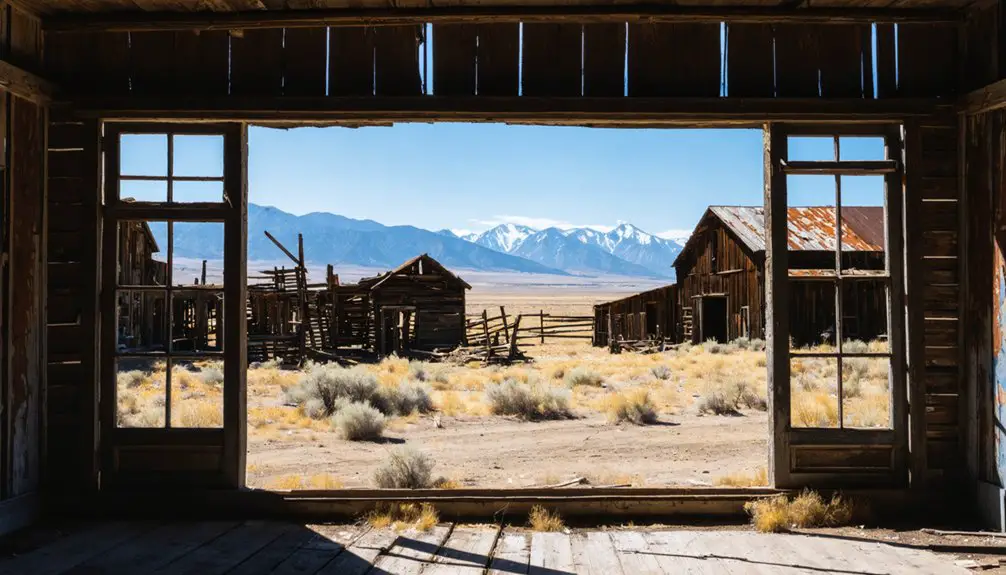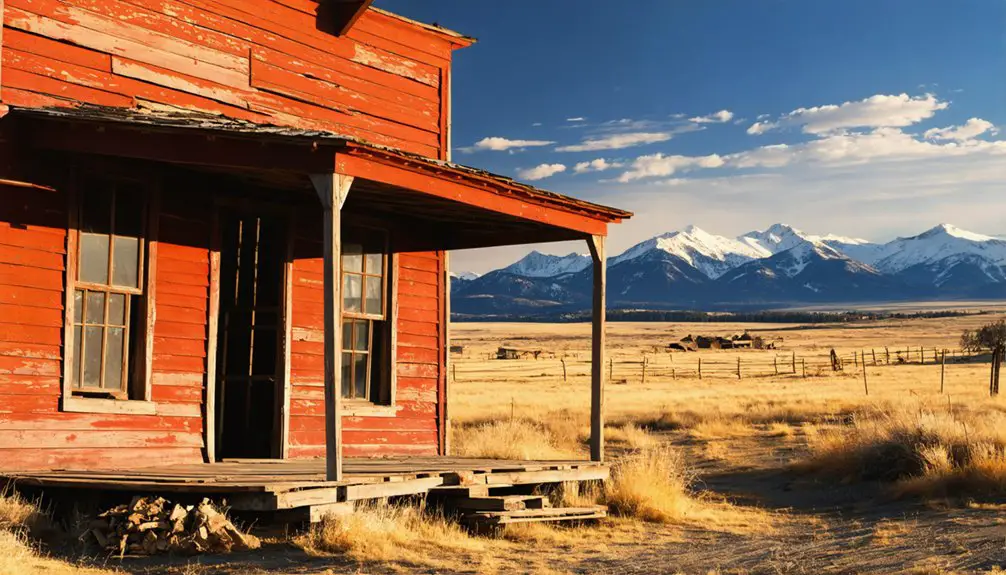
You’ll find Montana’s creepiest ghost towns in Bannack, Garnet, and Marysville, where violent gold rush history meets paranormal activity. Bannack’s streets witnessed Sheriff Plummer’s outlaw gang terrorize miners until vigilantes hanged him in 1864. Garnet’s fire-ravaged buildings still hold belongings from residents who fled in the 1940s, while Marysville’s historic churches harbor shadowy figures and unexplained orbs. These abandoned settlements guard dark secrets beneath their weathered facades.
Key Takeaways
- Bannack’s violent history includes Sheriff Henry Plummer’s gang of outlaws and vigilante justice, ending with his hanging in 1864.
- Garnet ghost town was suddenly abandoned in the 1940s with personal possessions left behind after a devastating fire and economic decline.
- Marysville’s churches and cemetery are known for paranormal activity, including shadowy figures, mysterious orbs, and unexplained footsteps.
- Coloma Mining Camp reports ghostly echoes of stamp mills and phantom miners appearing near the Mammoth Mine entrance after sunset.
- Beartown’s lawless history includes hidden treasures and stolen gold that remain undiscovered in Montana’s Garnet Range.
The Dark History Behind Bannack’s Gold Rush
When John White and his fellow Pikes Peakers struck gold in Grasshopper Creek on July 28, 1862, they couldn’t have predicted the chaos that would follow.
The discovery of exceptionally pure gold at 99.5% sparked a rush that transformed the remote creek into a bustling town of 5,000 by 1863.
But with prosperity came lawlessness.
You might be shocked to learn that the town’s own sheriff, Henry Plummer, secretly led a gang of over 100 outlaws known as the “Innocents.”
Using his position, Plummer orchestrated gold rush crimes, targeting shipments he was meant to protect.
Sheriff Plummer betrayed his badge, leading ruthless bandits to steal the very gold shipments he swore to safeguard.
In response, vigilante justice emerged as citizens formed groups to combat the wave of banditry.
Plummer’s reign of terror ended when vigilantes hanged him in 1864, marking a turning point in Bannack’s history.
He met his fate on the very gallows he built as sheriff of the town.
These dark events shaped Bannack’s destiny, and today, over 50 historic buildings stand as silent witnesses to this turbulent chapter.
Haunting Tales From Garnet’s Abandoned Streets
High in Montana’s Garnet Mountain Range, at an elevation of 6,000 feet, lies one of the state’s most eerily preserved ghost towns. Founded in 1895 during the gold rush, Garnet quickly grew to nearly 1,000 residents, boasting 13 saloons, multiple hotels, and thriving businesses.
Today, ghostly echoes of its vibrant past remain frozen in time. The once-prosperous town generated nearly $1 million in gold by 1917.
After a devastating fire in 1912 and the pull of World War I jobs, residents began departing, leaving their possessions behind as if planning to return. During the Great Depression, the town experienced a brief revival as miners returned to search for remaining gold. By the 1940s, the town stood completely abandoned.
You’ll find abandoned relics exactly where their owners left them – furnishings still in place, cabins untouched.
Now maintained by the Bureau of Land Management, Garnet’s well-preserved structures offer you a haunting glimpse into Montana’s rugged mining history.
Mysterious Disappearances in Elkhorn’s Fraternity Hall
While local legends hint at mysterious events during social gatherings at Fraternity Hall, historical records reveal no concrete evidence of unexplained disappearances from the building’s many dances and meetings.
You’ll find that most documented tragedies in Elkhorn stemmed from disease outbreaks and mining accidents rather than anything more sinister. The devastating 1884 diphtheria epidemic claimed numerous lives, particularly among the town’s children.
The mining ghost town sits at an elevation of nearly 6,500 feet in Montana’s Elkhorn Mountains. Though some tourism materials sensationalize stories of secret society rituals and vanishing party guests, these remain unverified claims without support in primary sources or death records.
Vanishing Party Guests
Among the many unsettling tales surrounding Montana’s ghost towns, Fraternity Hall in Elkhorn holds a particularly mysterious distinction. During the 1880s and 1890s, this prominent gathering space drew large crowds for dances and social events. The town’s Swiss immigrant founders established the building during the silver mining boom.
While historical records document one violent altercation during a crowded dance, they’re curiously silent about any ghostly gatherings or missing revelers.
You won’t find concrete evidence of unexplained disappearances in the mainstream archives. Instead, you’ll discover that most documented tragedies involve the 1888-1889 diphtheria epidemic, mining accidents, and general emigration.
Today, dedicated members of the Montana Ghost Town Society work to protect the site from vandalism and deterioration. Modern ghost stories and tourism narratives have woven tales of vanishing party guests, but these claims lack primary-source verification. What remains is a well-preserved structure within Elkhorn State Park, its walls holding secrets that continue to intrigue visitors.
Secret Society Rituals
Behind the stately walls of Fraternity Hall, secret societies gathered regularly throughout the 1890s. Multiple fraternal orders, including the Masons, Knights of Pythias, and Ancient Order of United Workmen, held their private meetings on the second floor.
While local legends whisper of sinister secret rituals, historical records tell a different story. You’ll find that documented evidence points to legitimate fraternal mysteries typical of the era – standard initiation ceremonies and members-only gatherings.
The Hall’s architectural grandeur, with its ornate balcony and false-front design, served to showcase civic pride rather than conceal wrongdoing. Though paranormal tourism has spawned tales of occult activities, no primary sources or police records support claims of criminal conduct. The building’s first floor space was actually used as a community dance hall and meeting room for public gatherings. The building, completed in 1893, became a symbol of community life even as the town’s population was declining.
The truth about these fraternal gatherings remains rooted in lawful, albeit private, lodge ceremonies.
Shadows of the Past: Marysville’s Silent Churches
As you approach Marysville’s twin churches from 1886, the Methodist-Episcopal’s restored frame still watches silently over the once-bustling gold mining town.
You’ll find reports of unexplained activities near the churches at night, with locals claiming shadowy figures move between the historic structures that survived the town’s decline.
While the Methodist-Episcopal Church narrowly escaped collapse in 1967, its resurrection serves as a haunting reminder of Marysville’s golden dreams that vanished when the $50 million mining boom went bust.
Historic Church Still Stands
The Methodist-Episcopal Church stands as a haunting memorial to Marysville’s golden age, having weathered over 130 years since its construction in 1887. This haunted architecture would have crumbled into history if not for John and Margaret Hollow’s intervention in 1967, when they purchased and stabilized the structure just before its imminent collapse.
The church’s historical significance is marked by these defining elements:
- Built during the area’s prosperous gold rush period
- Served as a spiritual center until its abandonment in 1939
- Survived while the Drumlummon Mine’s decline turned Marysville into a ghost town
- Stands among other historic buildings as part of the town’s walking history
- Features an atmospheric, untended cemetery nearby
You’ll find it today among Marysville’s remaining historic structures, a reflection of Montana’s mining heritage.
Nightly Ghostly Activity Reports
While daylight reveals Marysville’s historic churches as dignified relics, nightfall transforms them into focal points of paranormal activity.
You’ll encounter shadowy figures lingering near church entrances, and witness mysterious orbs of light dancing around the weathered steeples. Inside, you’ll feel sudden cold spots near the altars while phantom hymns echo through empty halls.
The most compelling ghostly encounters occur at midnight, when spectral sightings intensify.
You might catch glimpses of translucent miners pacing the grounds or ethereal children playing in the churchyard.
Electronic voice phenomena capture voices from the 1890s begging for prayer, while unexplained footsteps resound through vacant corridors.
Candles ignite spontaneously, and even the broken clock chimes at midnight, marking the witching hour in these haunted sanctuaries.
Mining Dreams Gone Dark
Beyond ghostly encounters, you’ll discover Marysville’s churches hold tangible stories of Montana’s golden age.
In 1876, Thomas Cruse founded this mining town, which quickly grew into a bustling community of 4,000 residents. The Methodist-Episcopal and Catholic churches rose during the 1880s boom, when mining relics and $50 million in gold defined Marysville’s prosperity.
- Ghostly apparitions now drift through abandoned church halls once filled with miners’ prayers
- Two historic churches stand as silent sentinels to lost fortunes
- The town’s dramatic fall from 4,000 to 80 residents echoes through empty streets
- Mining dreams crumbled as gold reserves vanished post-1900
- Today’s preserved structures whisper tales of Montana’s richest gold district
These architectural survivors remind you of wealth’s fleeting nature in America’s rugged frontier.
Lost Treasures and Legends of Beartown
Hidden beneath Montana’s rugged Garnet Range lies a trove of lost treasures and mysteries dating back to Beartown’s gold rush era.
When gold was discovered in Bear Gulch in 1865, thousands of miners flooded the area, bringing both riches and lawlessness. As the boom faded by 1870, ghostly legends emerged of buried fortunes left behind.
Like moths to a flame, fortune-seekers swarmed Bear Gulch in 1865, leaving only whispers of hidden wealth when the gold fever broke.
You’ll hear tales of Chinese laborers who concealed their wealth, miners who hid unclaimed gold from claim jumpers, and the notorious “Beartown Roughs” who may have stashed stolen payrolls.
The rugged terrain of Bear Gulch, Secret Gulch, and abandoned mine shafts still guard these secrets. While treasure hunters scour old trading posts and wagon routes around Bearmouth for clues, no major caches have been verified, leaving Beartown’s lost treasures shrouded in mystery.
Unexplained Phenomena at Coloma Mining Camp
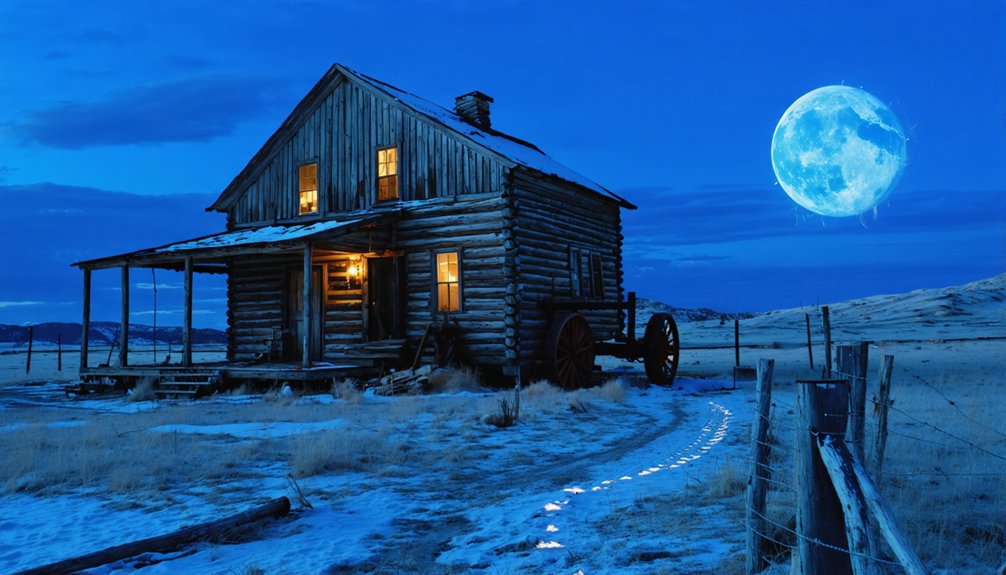
If you visit Coloma after sunset, you’ll hear ghostly echoes of stamp mills and mining equipment still operating in the abandoned shafts.
Hikers report seeing shadowy figures of miners appearing and disappearing near the old Mammoth Mine entrance, where $200,000 in gold was extracted during its peak years.
The mystery deepens as these unexplained phenomena occur mainly in winter months when heavy snows isolate the remote camp, making it difficult to investigate the strange occurrences that have earned Coloma its reputation as Montana’s most enigmatic ghost town.
Phantom Mine Equipment Sounds
While visitors explore the remnants of Coloma’s historic mining operations today, they’ll occasionally hear mysterious mechanical sounds echoing through the abandoned camp.
These phantom echoes seem to originate from the old stamp mills and mining shafts where crews once processed up to 20 tons of ore daily. From 1896 to 1906, the constant rhythm of machinery defined Coloma’s peak years.
You might encounter spectral machinery sounds that remind you of:
- The ten and twenty stamp mills crushing precious ore
- Pumping machines drawing water from deep shafts
- Narrow-gauge railroad cars rolling on surviving tracks
- Ventilation systems pushing air through mine tunnels
- Huntington mill processing its daily load of gold-bearing rock
The sounds persist despite the mills falling silent over a century ago when the camp’s 6,000 residents departed.
Vanishing Miners After Dusk
As daylight fades over the abandoned Coloma mining camp, visitors have reported glimpses of shadowy figures moving near the old cabins and mine entrances.
These twilight figures, often described as miners, appear briefly along the old haul roads and Elk Creek before seemingly vanishing into the darkness. While reports stretch back decades, no systematic documentation exists to verify these encounters.
You’ll find similar sightings across other Garnet Range ghost towns, suggesting a regional pattern rather than isolated incidents.
Though intriguing, these vanishing silhouettes likely have natural explanations – from modern hikers and prospectors to wildlife movement and atmospheric effects.
The rugged terrain and changing light conditions at dusk can play tricks on your eyes, transforming ordinary objects into mysterious forms that disappear as shadows lengthen across the mountainside.
The Last Stand of Montana’s Railroad Towns
Once bustling centers of commerce and connectivity, Montana’s railroad towns faced rapid decline when major rail companies began rerouting their lines in the mid-20th century.
The railroad decline transformed thriving communities into ghostly remnants within decades, leaving behind haunting traces of their former glory.
You’ll find these sobering reminders of Montana’s rail heritage:
- Abandoned depots and roundhouses stand as silent sentinels of vanished prosperity
- Narrow-gauge tracks disappear into overgrown wilderness
- Empty boxcars rust alongside forgotten loading platforms
- Former mining towns’ ore chutes crumble near defunct rail spurs
- Railroad beds cut through landscapes like scars of progress
When rail service ended, these towns lost their economic lifeline.
Population plummeted from thousands to single digits, while maintenance costs exceeded local resources.
Today, most remain frozen in time, preserved only by occasional tourism and determined preservation efforts.
Eerie Encounters in Castle Town’s Ruins

Among Montana’s most haunting ghost towns, Castle Town’s ruins stand as evidence to the boom-and-bust cycle of Western mining.
You’ll find about a dozen weathered structures and stone foundations along the original main street, where 2,000 residents once lived during the silver boom of the 1890s.
As you explore the deteriorating buildings, you’ll experience the ghostly ambiance that photographers often capture.
Prairie dogs scurry across sagging rooftops while elk graze among the ruins, creating surreal scenes.
At night, the wind whispers through broken windows and settling timbers.
The eerie encounters you’ll have aren’t supernatural – they’re reminders of Castle’s vibrant past, from Calamity Jane’s failed restaurant venture to the fourteen saloons that once lined these streets.
Today, wildflowers and wildlife reclaim what the silver crash of 1893 began to take.
Forgotten Lives Along the Milwaukee Road
When the Milwaukee Road extended its Pacific rail line through Montana in the early 1900s, it created a lifeline of towns that would rise and fall with the railroad’s fortunes.
Along these routes, ghostly echoes of bustling communities like Lennep, Alberton, and Lombard now stand as evidence to an era when the railroad brought life to the frontier.
- Derelict schoolhouses and scattered ruins mark where children once played
- Railroad relics like concrete turntables sit frozen in time
- Empty depots and roundhouses stand as silent sentinels
- Abandoned boxcars rust in Milwaukee’s signature colors
- Historic buildings, like the Ghost Rails Inn, succumb to fire and decay
Whispers From Montana’s Abandoned Mining Camps
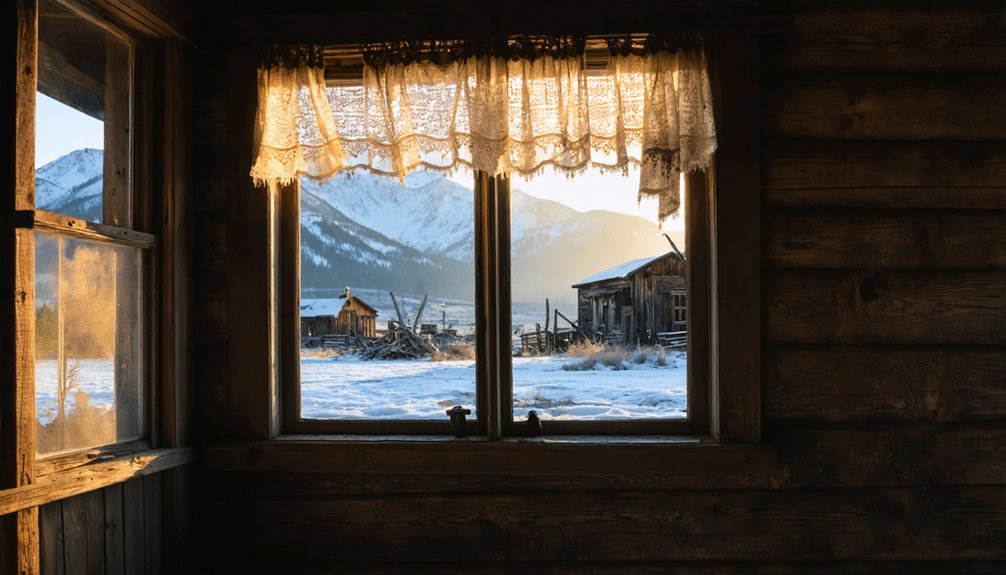
Deep in Montana’s rugged terrain, abandoned mining camps tell haunting stories of boom-and-bust cycles that shaped the American West.
You’ll find ghostly whispers echoing through Garnet’s well-preserved cabins and schoolhouse, perched high in the mountains at 6,000 feet. The abandoned relics of Bannack and Alder Gulch reveal an incredible $2.5 billion in modern gold values, with massive dredging scars still visible across eleven miles of settlement corridors.
In Granite and Elkhorn, crumbling stone foundations and mill ruins stand as silent witnesses to the 1880s silver bonanzas. These sites now serve as time capsules, where you can explore collapsed masonry, mine portals, and industrial remains.
Weathered ruins of Montana’s silver mining era stand frozen in time, inviting modern-day explorers into their long-abandoned world.
But tread carefully – unstable structures and hidden hazards lurk among these historic treasures.
Frequently Asked Questions
Can Visitors Stay Overnight in Any of Montana’s Ghost Town Buildings?
You can book overnight accommodations in Virginia City and Nevada City’s historic buildings year-round, while Garnet’s ghost town regulations allow winter cabin stays from December through April only.
What Happens to Artifacts Found by Tourists in Ghost Town Areas?
You can’t pocket those historic treasures – it’s illegal to remove artifacts from ghost towns. Tourist regulations require you to leave items where they are for proper artifact preservation and study.
Are There Active Mining Claims Near These Abandoned Ghost Towns?
You’ll find active claims near Hassel and Coloma, where mining continues alongside their mining history. Garnet’s claims are managed by the BLM, while Elkhorn retains some small-scale operations.
Which Ghost Towns Are Accessible During Winter Months Without Special Permits?
You’ll find Garnet Ghost Town accessible for winter exploration via snowmobile, ski, or snowshoe. Elkhorn State Park and Granite Ghost Town remain reachable when roads are plowed, needing only standard entrance fees.
Do Any Ghost Towns Still Have Working Postal Services or Businesses?
You’ll find active postal services in Virginia City (ZIP 59755) and several working ghost town businesses there too, including museums, restaurants, and gift shops catering to year-round visitors.
References
- https://www.roamingnearandfar.com/montana-ghost-towns-near-helena/
- https://www.youtube.com/watch?v=BQH5LghhkVs
- https://glaciermt.com/ghost-towns
- https://southwestmt.com/ghosts/ghost-towns/
- https://www.oregonhikers.org/forum/viewtopic.php?t=28842
- https://visitmt.com/things-to-do/ghost-towns
- https://westernmininghistory.com/towns/montana/bannack/
- https://www.historyrhymes.info/2010/12/20/rocky-mountain-mining-towns-bannack-montana/
- https://www.legendsofamerica.com/mt-bannack/
- https://fwp.mt.gov/stateparks/bannack-state-park