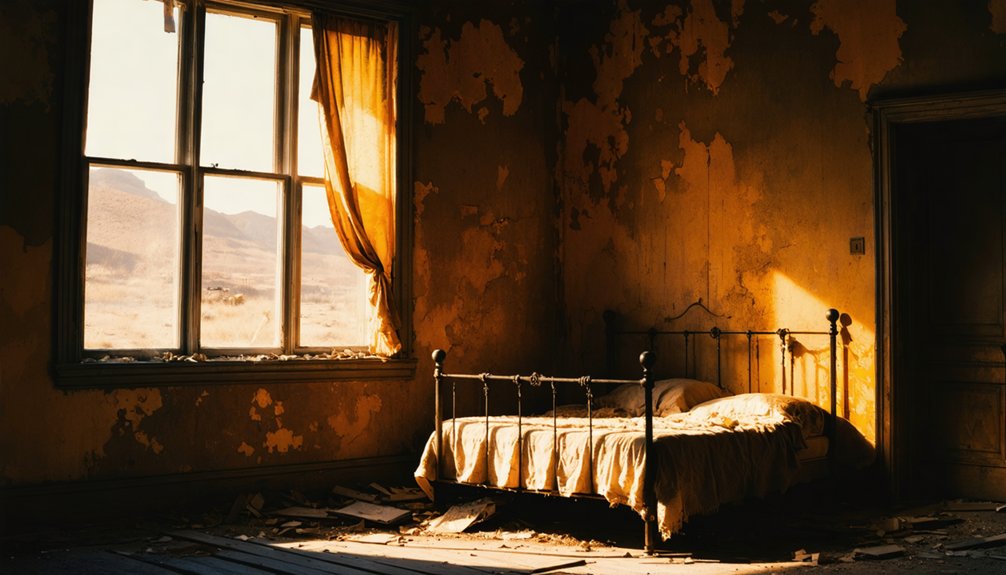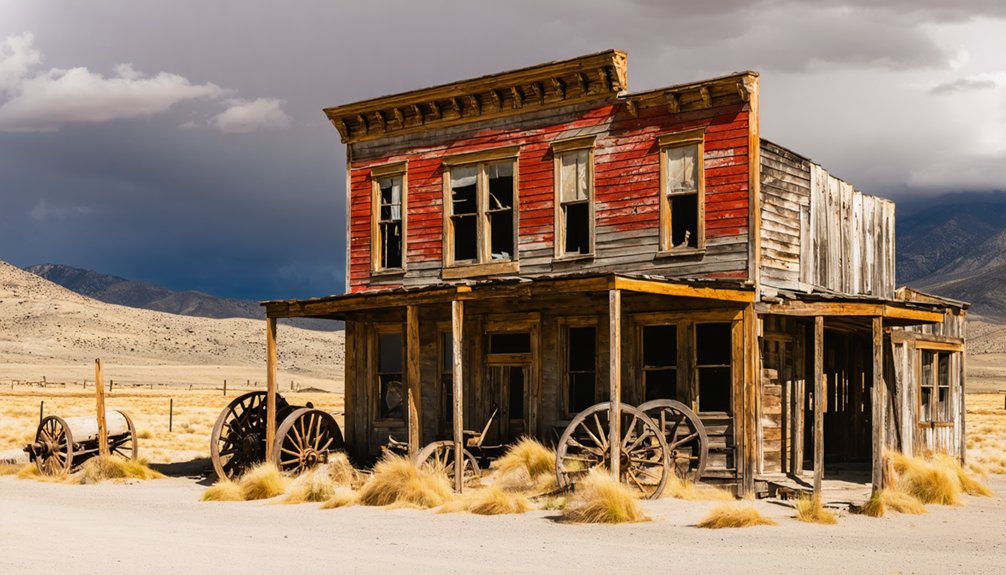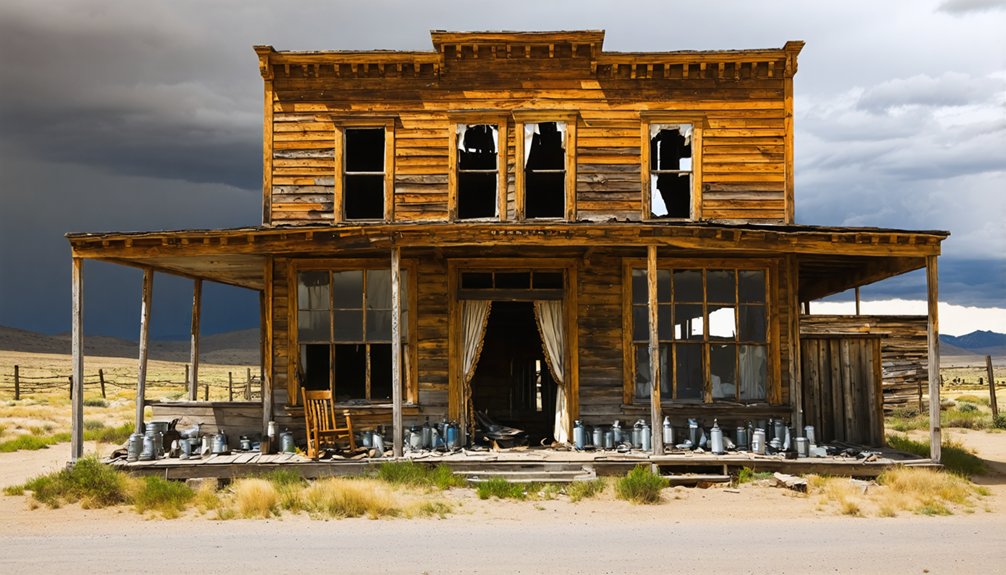
You’ll find America’s creepiest ghost towns scattered across the country, from Centralia, PA’s eternal underground inferno burning since 1962, to Bodie, CA’s perfectly preserved 1942 time capsule where 200 wooden structures stand frozen in time. Bannack, MT’s Hotel Meade harbors four distinct paranormal phenomena, while Ruby, AZ carries the weight of 1920s murders and an ancient curse. Each abandoned settlement holds darker secrets beneath their weathered facades.
Key Takeaways
- Centralia, Pennsylvania remains an apocalyptic wasteland with a 60-year underground coal fire expected to burn for 250 more years.
- Bodie, California preserves 110 structures in “arrested decay” with untouched belongings from 1942, creating an eerily authentic ghost town.
- Bannack, Montana’s Hotel Meade harbors multiple spirits, including a drowned girl and mysterious frontier-era sounds behind sealed doors.
- Ruby, Arizona features 20 original structures and a haunted history marked by an ancient curse and four brutal murders.
- St. Elmo’s ghost town is reportedly haunted by Annabelle Stark’s spirit, with unexplained door slams and temperature drops throughout.
The Eternal Flames of Centralia: A Modern American Horror Story
While Native Americans first inhabited the land that would become Centralia, Pennsylvania, the area’s transformation into a ghostly wasteland began in 1749 when colonials purchased it for 500 pounds.
Before becoming a modern ghost town, Centralia’s land changed hands from Native Americans to colonial settlers for a mere 500 pounds.
You can trace the town’s tragic fate to May 1962, when a routine trash fire sparked the infamous Centralia fire, igniting an underground labyrinth of abandoned coal mines. Despite attempts to contain the blaze with water and clay, the fire found pathways through the vast network of tunnels.
Experts estimate the underground inferno could continue burning for another 250 years ahead, consuming the massive coal deposits beneath the earth’s surface.
As toxic gases seeped through the ground, homes began tilting, and sinkholes appeared, forcing residents to flee. By 2010, only ten people remained in five houses, surrounded by empty streets and demolished structures.
Today, smoking fissures still mark the landscape, while the remaining residents hold lifetime rights to stay in a town that’s nearly vanished. Ground temperatures beneath the surface reached over 900 degrees, making the area extremely hazardous for visitors.
Ruby’s Blood-Stained Legacy in the Arizona Desert
Nestled beneath Montana Peak in Arizona’s Santa Cruz County, the ghost town of Ruby harbors one of America’s darkest mining legacies.
What began as a thriving mining settlement in 1912 transformed into a scene of terror when the Ruby Mercantile became the site of four brutal murders in the 1920s.
Ruby’s hauntings are deeply rooted in local folklore, with tales of an ancient curse placed by Tio Pedro over a padre’s grave. The town’s eerie atmosphere intensified after two store owners were murdered in 1920, followed by the brutal Pearson family attack just a year later.
Today, you’ll find over 20 original structures still standing, including:
- The infamous mercantile site, which collapsed in 1970
- A preserved schoolhouse now serving as Ruby’s museum
- The original jail that once housed desperate outlaws
- The doctor’s house, frozen in time since the 1940s
Though closed to the public, Ruby’s blood-stained past continues to captivate those seeking America’s haunted frontiers. Visitors can explore the site Thursday through Sunday with permits required from the Ruby website.
Bodie’s Frozen Moments: Where Time Stands Still
When you step into Bodie State Historic Park today, you’ll find a gold-mining boomtown frozen exactly as its residents left it in 1942, with dusty dishes still on dinner tables and goods still lining store shelves.
Inside the roughly 110 surviving structures, which represent only a fraction of the 2,000 buildings that housed 8,000-10,000 residents during the town’s 1879 peak, you’ll discover scenes of interrupted daily life that hint at the sudden exodus following the government’s wartime closure of gold mines.
The town’s reputation for lawlessness and violence earned it the infamous expression “a bad man from Bodie” throughout the Old West.
At 8,379 feet in California’s Sierra Nevada, this National Historic Landmark’s “arrested decay” preservation approach maintains everything in its abandoned state, allowing you to witness authentic snapshots of 19th-century mining life, from the general store’s original merchandise to the weathered equipment at the stamp mill. The site serves as one of several locations sharing the Bodie place name, requiring careful distinction from other similarly named destinations.
Untouched Daily Life Scenes
As visitors step into Bodie’s preserved buildings today, they’ll find themselves transported to a precise moment in the late 1800s, where everyday life appears to have simply stopped mid-motion.
The untouched interiors tell haunting stories of the town’s final days through preserved artifacts left exactly as they were found:
- Half-made beds and personal belongings in boarding houses reveal hurried departures, with clothing still hanging on hooks. The Dechambeau House’s former hotel rooms remain perfectly preserved, with guests’ possessions seemingly awaiting their return.
- Saloons feature dusty pool tables with games eternally unfinished, while bottles remain arranged behind wooden bars.
- General stores display authentic goods on original shelving, with prices still chalked on century-old boards.
- School desks hold open books and unfinished lessons on blackboards, frozen in time from the last day of class.
The California State Historic Park designation in 1962 helped ensure these authentic scenes would remain undisturbed for future generations to witness.
Mining Town’s Sudden Exodus
Despite Bodie’s explosive growth to nearly 10,000 residents in 1879, the California boomtown’s prosperity proved fleeting.
The mining culture’s transient nature, coupled with devastating economic decline, triggered a mass exodus by the 1880s. You’ll find evidence of this abrupt departure in the 200 wooden structures still standing today, where bottles remain on shelves and desks sit exactly where their owners left them. Today, approximately 75 buildings remain preserved along two main roads for visitors to explore.
The town gained notoriety for its 65 saloons contributing to widespread lawlessness and violence throughout its peak years.
As richer gold strikes lured miners to Butte and Tombstone, Bodie’s high-grade ore deposits dwindled. The town’s supporting industries crumbled, and repeated fires destroyed crucial infrastructure.
The Haunted Hotel Meade: Bannack’s Dark Past
Standing proudly since 1875 as Montana’s first brick building, Hotel Meade began its storied existence as the Beaverhead County Courthouse in Bannack, the territory’s original capital.
After Dr. John Singleton Meade transformed it into a luxury hotel in 1890, the building’s haunted history took shape, spawning countless ghostly encounters that continue today.
Since becoming a grand hotel under Dr. Meade’s vision, the building’s ghostly residents have made their presence known through generations.
Four distinct paranormal phenomena you’ll experience:
- A drowned girl’s spirit, particularly active around children
- Unseen forces pushing visitors down the grand stairway
- Mysterious sounds of frontier-era music and laughter
- Sealed doors at hallway’s end, blocking intense negative energy
Now preserved within Bannack State Park, the unrestored Hotel Meade stands as a memorial to the town’s dark past, including the infamous Sheriff Henry Plummer’s vigilante execution in 1863.
Cahaba: Ghosts of the Confederate Prison Camp
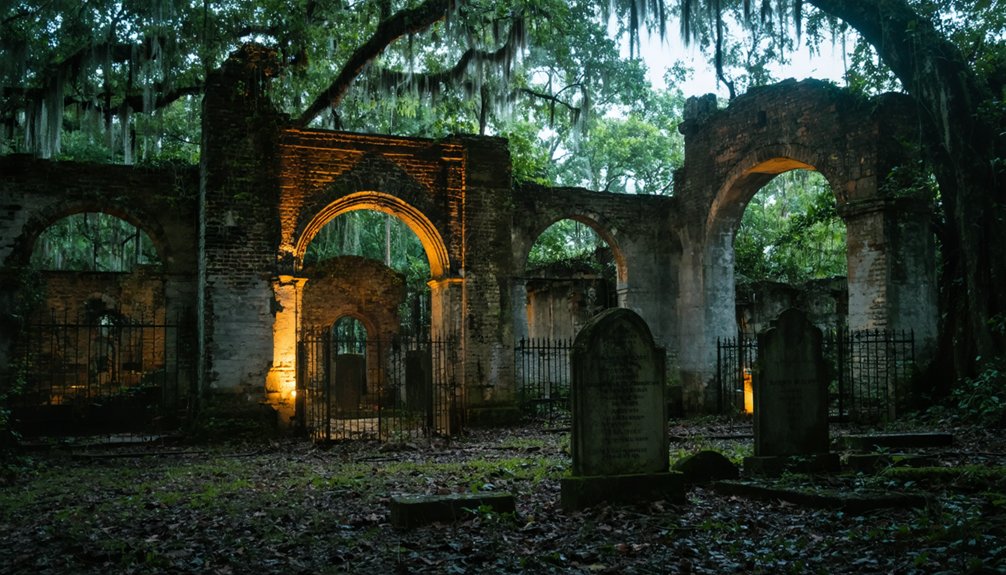
When you visit the haunting ruins of Cahaba, Alabama’s first state capital, you’ll find the remnants of Castle Morgan, an overcrowded Confederate prison that held over 3,000 Union soldiers from 1863-1865.
You can still see traces of the 15,000-square-foot stockade where prisoners once stood knee-deep in frigid river water during the brutal winter of 1864-1865, with only meager rations of cornmeal to sustain them.
Many visitors report paranormal activity around the former warehouse-turned-prison site, where soldiers endured extreme overcrowding and harsh conditions in this now-abandoned ghost town at the junction of the Alabama and Cahaba Rivers.
The eerie atmosphere is further amplified by the sight of dead vegetation in abandoned towns, hinting at the long-forgotten lives once lived there. This decay serves as a haunting reminder of the past, as nature slowly reclaims its territory. Many believe that the stories of those who suffered linger in the air, adding to the unsettling aura surrounding the area.
Flooded Capital Ruins Remain
Deep in the heart of Dallas County, Alabama, where the Cahaba and Alabama Rivers converge, you’ll find the haunting remains of America’s first state capital turned Civil War prison camp.
This historic site, dating back 1,500 years to indigenous settlements, transformed from Alabama’s capital into Castle Morgan, a Confederate prison that held Union soldiers from 1863 to 1865.
- The unfinished red-brick warehouse, designed for 500 prisoners, crammed over 3,000 men into less than a third of an acre.
- Devastating floods forced 2,500 prisoners to stand knee-deep in frigid river water for 48 hours.
- The prison warehouse sat at the junction of two powerful rivers, making escape nearly impossible.
- Despite harsh conditions, Castle Morgan maintained the lowest death rate of any Civil War prison camp at 2 percent.
Prison Camp Paranormal Activity
Today, visitors to Alabama’s Old Cahaba Archaeological Park report chilling encounters with Civil War spirits, particularly near the ruins where Castle Morgan once imprisoned thousands of Union soldiers.
The most dramatic Cahaba hauntings stem from March 1865, when floodwaters forced prisoners to stand in freezing water for two days straight. Many who survived this ordeal later perished in the Sultana steamboat disaster, adding another layer to the site’s tragic legacy.
Spectral narratives often describe wagon-loads of bodies being transported across the grounds, while others tell of ghostly soldiers wandering near the spring that once provided both life-sustaining water and disease to the camp.
The prison’s relatively low death rate of 147 documented casualties, compared to other Confederate camps, hasn’t diminished its reputation for paranormal activity.
St. Elmo: The Family Curse That Never Left
As St. Elmo’s mining fortunes faded in the 1920s, the Stark family’s legacy took an eerie turn, transforming this once-bustling Colorado boomtown into a haunting symbol of stubborn determination.
The family’s ironclad grip on the town, acquired through tax sales, would spawn tales of supernatural guardianship that persist to this day.
Consider these spine-chilling elements of the Stark’s ghostly sentinels:
- Annabelle Stark’s spirit reportedly patrols storefronts she once protected in life.
- Hotel room doors slam shut without human intervention.
- Mysterious 20-degree temperature drops follow paranormal activity.
- A devastating 2002 fire destroyed six historic buildings, yet failed to break the family’s spectral hold.
The Stark’s unwavering belief in St. Elmo’s revival created an otherworldly bond that transcended death itself, earning the town its place among America’s most haunted destinations.
Uncovering America’s Most Spine-Chilling Abandoned Places
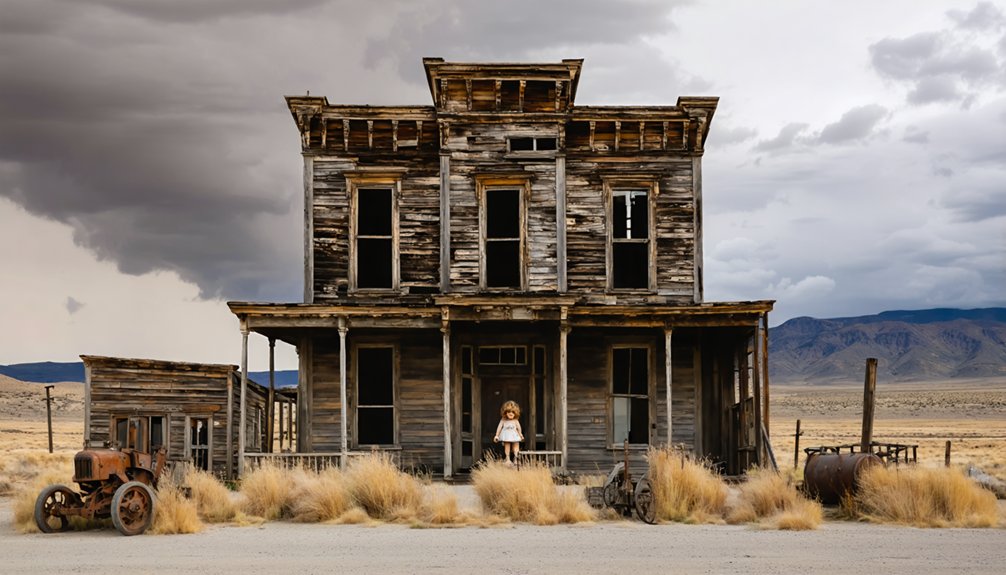
As you explore America’s haunted ghost towns, you’ll find chilling evidence of dreams cut tragically short, from Bodie’s untouched dinner tables to Ruby’s infamous 1920s murder scenes.
Preserved structures tell stories of gold rush violence in Bannack, Civil War prisoners in Cahawba, and the unstoppable underground inferno that forced Centralia’s residents to flee.
These abandoned places serve as time capsules of terror, where paranormal activity and documented tragedies merge to create some of the nation’s most unsettling historical sites.
Haunted History Lives On
Deep within America’s forgotten corners, ghost towns preserve haunting remnants of the nation’s westward expansion, industrial ambitions, and environmental disasters.
These abandoned places tell tales through haunting legends and spectral sightings that continue to captivate visitors today.
- In Bodie, California, 200 buildings stand frozen in time since the 1880s gold rush, where visitors report apparitions peering through dusty windows.
- Bannack, Montana’s first territorial capital echoes with shadowy figures and phantom footsteps around its historic Hotel Meade.
- Centralia, Pennsylvania smolders with underground fires since 1962, creating an apocalyptic landscape of steam vents and toxic gases.
- Cahaba, Alabama’s former state capital succumbed to floods, leaving behind ruins that whisper stories of its brief glory days.
Abandoned Dreams, Timeless Terror
These desolate towns stand as stark monuments to America’s forgotten chapters, where broken dreams and untold stories linger in the shadows.
In Bodie’s abandoned landscapes, you’ll find 200 frontier-era structures frozen in time, their period furnishings telling tales of a 10,000-strong boomtown.
Centralia’s eerie echoes emerge from underground fires that have burned since 1962, creating a real-world horror scene of smoke-filled streets and deadly sinkholes.
Montana’s Garnet Historic District beckons with its preserved wooden buildings, where visitors report mysterious footsteps and cold spots in the mountain silence.
Each town carries its own haunting signature – from Bodie’s watchful spirits to Centralia’s toxic vapors – reminding you that these aren’t just relics, but places where American ambition met its darkest hour.
Tales of Terror From the Wild West’s Ghost Towns
While the American frontier’s boom-and-bust cycle left behind countless abandoned settlements, several Wild West ghost towns harbor particularly dark histories that continue to spawn supernatural tales.
Eerie remnants of frontier dreams, these deserted Wild West towns whisper dark legends through their weathered bones.
You’ll find spectral sightings that’ll make your skin crawl in these forsaken places:
- In Tombstone, Arizona, Marshal Fred White’s ghost lingers where Curly Bill Brocius shot him in 1880, while phantom cowboys draw their guns at the O.K. Corral.
- Bannack, Montana’s corrupt sheriff Henry Plummer led a murderous gang until vigilantes hanged 24 members in 1863 – their spirits now haunt preserved structures.
- Garnet, Montana stands out for confirmed paranormal activity in its abandoned buildings.
- Nelson Ghost Town, Nevada echoes with unexplained voices in mine shafts where violent gold disputes once raged, while mysterious orbs dance through desert nights.
When Mining Towns Become Graveyards of the American Dream
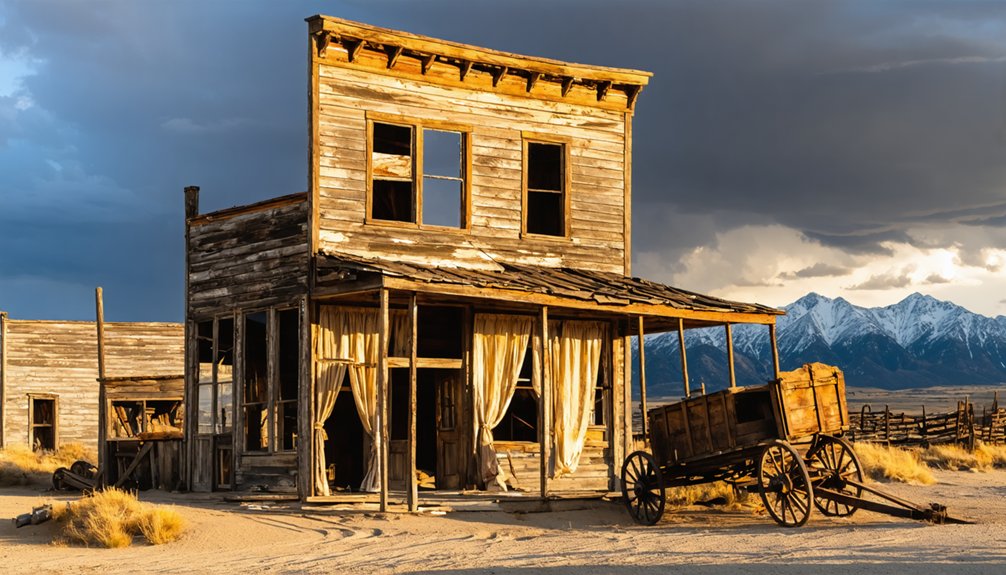
Beyond the supernatural tales that haunt these towns lies a stark economic collapse that transformed vibrant mining communities into abandoned shells.
You’ll find once-bustling streets where single-commodity dependency created a devastating boom-and-bust cycle, leaving behind vast stretches of empty homes and shuttered businesses. When mines flooded or ore supplies dwindled, these communities faced rapid demographic decline, often plummeting from thousands to single digits within years.
The physical scars run deep – acid drainage poisons water supplies, underground fires burn for decades, and toxic mine tailings render soil unusable.
In places like Centralia, PA, you’ll witness how subsurface infernos created uninhabitable zones, while across mining regions, deteriorating infrastructure and contaminated landscapes stand as stark monuments to America’s extractive past.
The Most Hair-Raising Historical Hauntings in Deserted Towns
Deep within America’s most notorious ghost towns, spine-chilling historical hauntings echo through the empty streets of once-thriving settlements.
You’ll encounter the darkest chapters of frontier history through documented ghostly encounters at these haunted locations:
- At Cahawba, Alabama’s flooded first capital, spectral sightings of Civil War prisoners and displaced cemetery spirits roam the ruins near disturbed burial grounds.
- Bodie, California’s preserved frontier town showcases shadow figures and mysterious cold spots within its 200 time-frozen structures, especially in the hotel and saloon.
- Montana’s Bannack, once dubbed the “Toughest Town in the West,” harbors restless spirits from its violent 1860s gold rush era.
- The Hotel Meade stands as Bannack’s most active paranormal hotspot, where you’ll hear unexplained footsteps and voices tied to documented historical deaths.
Frequently Asked Questions
What Safety Gear Should Visitors Bring When Exploring Abandoned Ghost Towns?
You’ll want flashlight essentials, sturdy boots, heavy gloves, hard hat, N95 mask, safety goggles, first-aid kit, navigation tools, emergency shelter, and protective clothing for your thrilling journey into history.
Are There Guided Night Tours Available at Any of These Locations?
You’ll find guided tours after dark at several locations: Bodie State Park offers ranger-led night excursions seasonally, while Calico, Goldfield, and Vulture City run regular ghost tours with advance reservations.
Which Ghost Towns Are Wheelchair Accessible or Suitable for Limited Mobility?
You’ll find wheelchair accessibility at Goldfield Ghost Town, Trans-Allegheny Asylum, and Tombstone area tours. Bodie offers free high-flotation wheelchairs, while Ashcroft’s boardwalk accommodates visitors with limited mobility through its main street.
Can Visitors Take Artifacts or Souvenirs From These Abandoned Towns?
Like precious time capsules frozen in history, you can’t legally remove artifacts from ghost towns. Ethical considerations and preservation laws protect these sites, with hefty fines and jail time for taking souvenirs.
What’s the Best Season to Photograph Paranormal Activity in Ghost Towns?
You’ll find autumn’s ideal for supernatural photography, when September through November’s crisp air creates misty mornings, longer twilights, and less tourist interference. Early dawn and late dusk offer prime paranormal ambiance.
References
- https://www.visittheusa.com/experience/5-us-ghost-towns-you-must-see
- https://www.mythfolks.com/haunted-us-ghost-towns
- https://www.realgirlreview.com/dark-tourism-in-america/
- https://www.youtube.com/watch?v=SUsnGxOpcss
- https://www.geotab.com/ghost-towns/
- https://en.wikipedia.org/wiki/Lists_of_ghost_towns_in_the_United_States
- https://www.atlasobscura.com/lists/americas-best-preserved-ghost-towns
- https://www.legendsofamerica.com/centralia-pennsylvania/
- https://pabucketlist.com/the-rise-and-fall-of-centralia-pas-toxic-ghost-town/
- https://www.youtube.com/watch?v=Qj5LjacccJ0