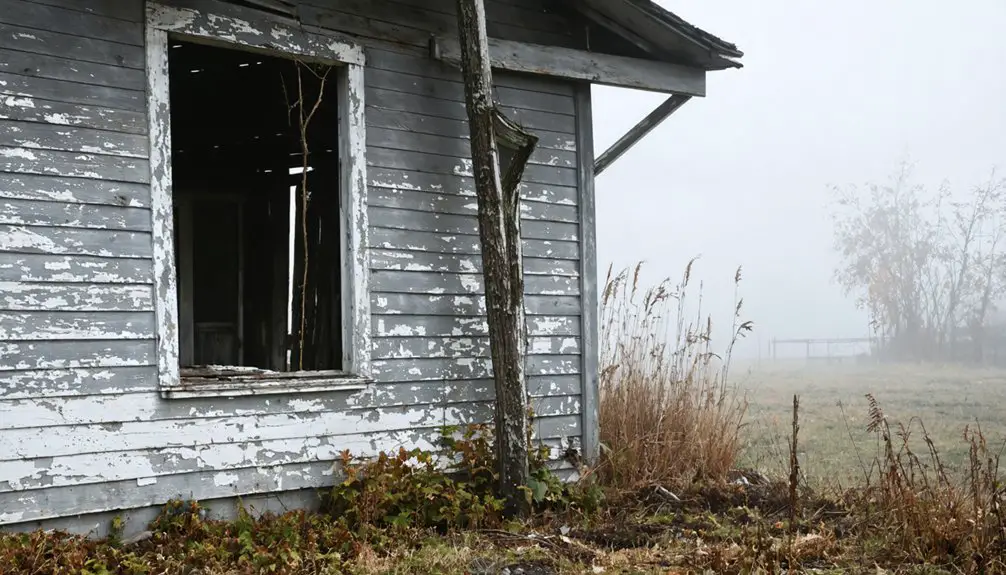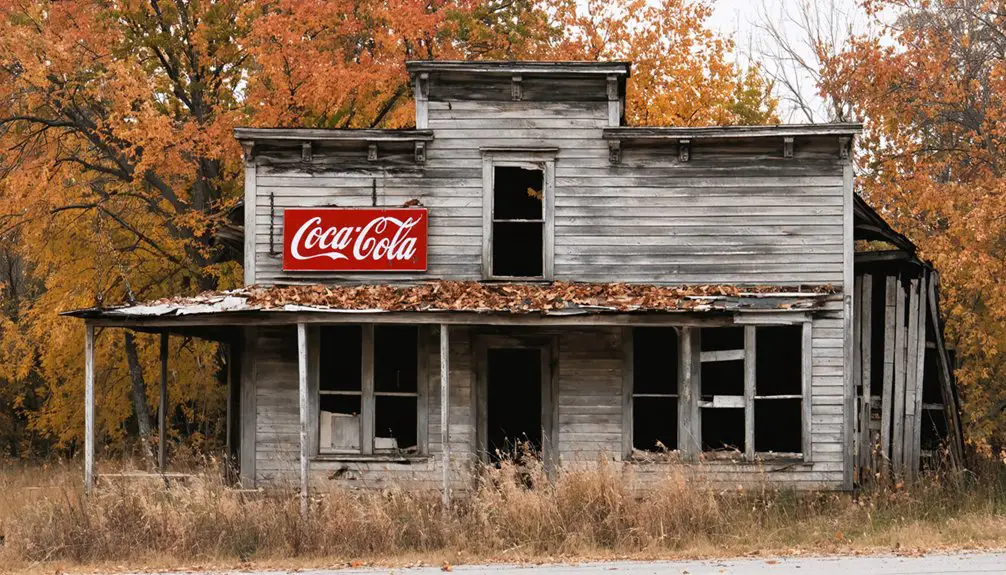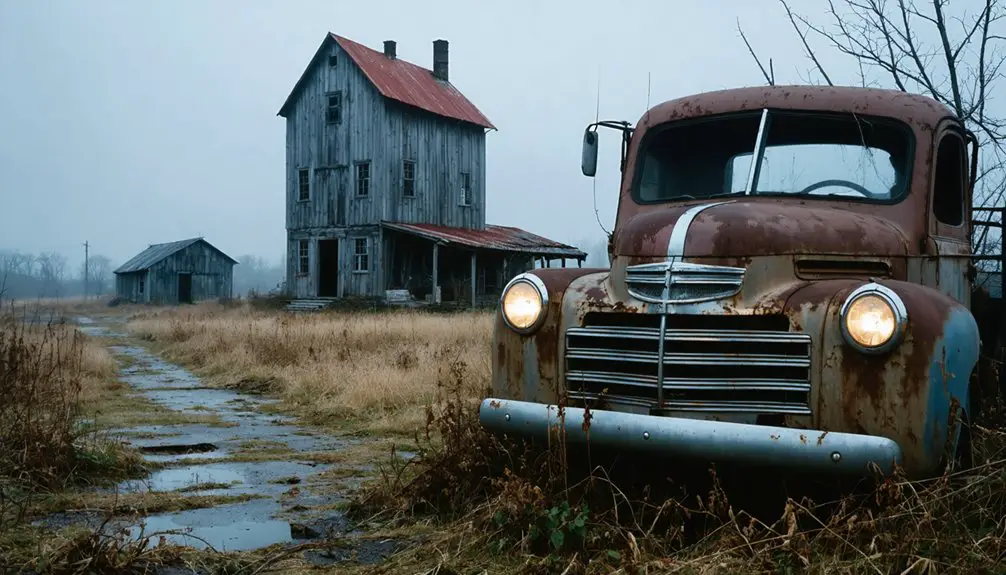
You’ll find Michigan’s most haunting ghost towns scattered across the Upper Peninsula, where over 130 abandoned settlements tell tales of copper mining and lumber booms gone bust. The Keweenaw Peninsula holds eerie remnants of Central Mine, which produced 52 million pounds of copper before its 1898 abandonment. Crumbling structures, abandoned mine shafts, and decaying wooden homes mark these forgotten places. Exploring these sites requires careful planning and safety protocols – the deeper mysteries of these lost communities await those who venture further.
Key Takeaways
- Central Mine, once producing 52 million pounds of copper, became a ghost town in 1898 and holds annual church reunions.
- Pere Cheney was devastated by a diphtheria epidemic, leaving behind only crumbling structures and an eerie atmosphere.
- North Unity’s haunting remnants include burial markers and ruins from devastating fires that destroyed the 1850s settlement.
- Sugar Loaf Resort stands abandoned with overgrown ski runs, unstable structures, and dangerous hidden hazards.
- Jennings, once bustling with 600 sawmill workers, now lies deserted with deteriorating buildings and abandoned rail lines.
The Lost Mining Villages of Keweenaw Peninsula
While Michigan’s Upper Peninsula now draws tourists to its rugged wilderness, the Keweenaw Peninsula once bustled with copper mining communities that helped forge America’s industrial revolution.
You’ll find the haunting remnants of these towns scattered across the rocky landscape, where nature slowly reclaims what industry left behind.
At Central Mine, where 1,300 residents once lived and worked, you can explore restored miners’ cottages and the 1868 Methodist Episcopal church – silent witnesses to a community that produced 52 million pounds of copper before becoming a ghost town in 1898.
Today, the last Sunday in July brings descendants back for an annual reunion service at the historic church.
The Cliff Mine, Michigan’s first profitable copper operation, offers a glimpse into 1840s mining life through its abandoned shafts, tailings piles, and building foundations.
These sites stand as some of the best-preserved early mining ruins in the Keweenaw. The region’s mines produced exceptional pure native copper that could be formed into products without requiring refinement.
Hidden Dangers and Safety Warnings
These ghost towns may enchant visitors with their historic allure, but they harbor serious hazards that demand caution and respect.
You’ll encounter hidden hazards like rotted floors that can give way without warning and concealed mineshafts masked by vegetation, with drops exceeding 25 feet. The structures themselves pose deadly risks – unstable walls could collapse at any touch, while roofs threaten to cave in without notice.
Taking proper safety precautions is critical. At Sugar Loaf Resort, abandoned ski runs have become dangerously overgrown and difficult to navigate. The copper mining sites in the Upper Peninsula are particularly treacherous to explore.
Your safety depends on thorough preparation and vigilance – there’s no room for careless exploration in these dangerous places.
You’re facing dangers from exposed nails, broken glass, and splintered wood throughout these sites. Mold and potential asbestos lurk in deteriorating buildings, while winter conditions hide lethal pitfalls under snow.
With spotty cell service and remote locations, help won’t arrive quickly if you’re injured. Remember, many sites are actively patrolled and require proper permissions to visit legally.
Must-Visit Historic Ghost Towns
Michigan’s most enchanting ghost towns offer windows into the state’s industrial past, from lumber settlements to mining communities that once bustled with life.
Port Crescent stands hauntingly empty today, with just a lone weathered smokestack marking where this once-thriving town existed.
You’ll discover Glen Haven’s history preserved in its functional blacksmith shop and general store, remnants of its prosperous sawmill days near Sleeping Bear Dunes.
Laurium’s architecture stands as the best-preserved ghost town, its Victorian buildings and Village Hall painting a vivid picture of mining prosperity. Today, the town’s Victorian-style architecture remains remarkably intact, lining the historic streets.
Don’t miss Old Victoria’s authentic log homes, where guided tours transport you to 19th-century mining life.
Central Mine in the Keweenaw Peninsula showcases the most intact early mining remains, while Gregoryville’s ruins along Torch Lake hint at its glamorous past, complete with a once-magnificent racetrack and grand house.
Lumber Era’s Forgotten Communities
You’ll find Michigan’s lumber era left behind scattered remnants of once-bustling communities, where sawmill workers endured brutal winters, disease outbreaks, and the constant threat of devastating fires.
These vanished towns, like Pere Cheney with its diphtheria epidemic and Jennings with its innovative double-cut bandsaw operations, tell stories of both technological progress and human struggle.
After Wright’s sawmill burned down in Aral, a much larger mill was constructed before 1889, though it would ultimately close in 1911 when local timber supplies were depleted.
In its heyday, Jennings employed six hundred men at its bustling sawmill, processing lumber that filled nearly two dozen train cars each day.
From the abandoned pilings of Otter Creek’s massive lumber operation to Missaukee County’s network of logging camps, these ghost towns mark the fleeting nature of communities that lived and died by the saw.
Harsh Living Conditions
Life in Michigan’s lumber communities during the late 1800s proved brutally difficult, as workers and families faced a perfect storm of deadly disease outbreaks, devastating fires, and harsh physical labor.
You’d find transient lumberjacks swinging axes through harsh winters, while immigrant Finns, Swedes, and Norwegians toiled in dangerous sawmills. The labor struggles turned violent in 1888 when homesteaders clashed with mill owners over land rights, leading to sabotage and deaths. At Avery Town, workers relied on a donkey engine to haul massive logs from the river before processing them at the mill.
Disease ravaged these communities mercilessly. Pere Cheney’s population collapsed from 1,500 to just 25 residents between 1893 and 1901, hit by two devastating diphtheria outbreaks. Sparks from sawmills repeatedly ignited destructive fires throughout the town.
When you weren’t battling illness, you’d face the constant threat of mill fires, which regularly destroyed entire communities and left workers scrambling to relocate as timber supplies dwindled.
Vanishing Sawmill Communities
When ambitious New England speculators secured land rights through Indian treaties in the 1820s and 1830s, they quickly established Michigan’s first sawmill communities along its abundant waterways.
You’ll find the sawmill legacies of pioneers like John Ball and Charles Mears, who built water-powered operations that transformed wilderness into bustling timber towns.
These communities thrived as industrial hubs, with places like Hudson Mills operating multiple mills for lumber, grain, and pulp.
But nature’s bounty wouldn’t last forever. You can trace the tragic decline through ghost towns like Grand Marais, where pine depletion forced the lumber company’s closure in 1909 and led to massive population loss.
While some communities like Borculo adapted and survived as agricultural centers, many timber towns simply vanished, leaving only crumbling stone walls and abandoned rail lines as evidence of their former glory.
North Unity’s Lost Heritage
Among Michigan’s lost lumber settlements, North Unity stands as a poignant example of immigrant ambition meeting frontier hardship.
You’ll find traces of Bohemian heritage and German settlement in this mid-1850s community, where determined families pooled resources to establish a new life near Good Harbor. Their cooperative spirit earned the town its name, but nature had other plans.
- Original settlers constructed communal housing and shared facilities, including the “Verein Barracks”
- The bustling lumber trade brought prosperity through sawmills, docks, and timber operations
- The devastating 1871 fires destroyed most structures, leading to the town’s abandonment
Now, Lake Michigan’s waves lap at forgotten docks while forest reclaims the land where North Unity once thrived.
What remains are burial markers, genealogical records, and scattered archaeological evidence of this ambitious frontier experiment.
Accessing Remote Ghost Town Sites
You’ll need detailed maps and permits to access many of Michigan’s remote ghost towns, especially those in the Keweenaw Peninsula where nearly 100 abandoned mining communities dot the landscape.
Exploring these abandoned towns in Michigan history offers a unique glimpse into the past and the lives of those who once called these places home. Many structures remain, slowly succumbing to nature, while others have been preserved, providing insight into the area’s rich industrial heritage. As you navigate through the remnants, it’s important to respect the history and the environment surrounding these forgotten sites.
Winter conditions can make many sites inaccessible from November through April, while spring thaws often leave forest roads impassable until early summer.
When exploring these isolated locations, you must carry basic safety equipment including first aid supplies, GPS devices, and sturdy footwear to navigate hazards like hidden mineshafts and unstable structures.
Transportation and Permits Needed
Before exploring Michigan’s ghost towns, you’ll need to navigate a complex system of permits, access rights, and transportation logistics.
Different transportation modes are required depending on location – from high-clearance vehicles on rugged forestry roads to boats for accessing lakeside ruins. You’ll also need to secure proper permit requirements, including day-use fees for National Park Service sites and special-use permits for photography or research.
- Off-road travel to remote sites may require ATVs or hiking, with motorized restrictions on many preserves.
- Winter exploration often demands snowmobiles or tracked vehicles where allowed.
- Island or lakeshore ghost towns are only accessible by seasonal ferry service or private boat.
Remember that private property status means you’ll need written landowner permission, while protected sites require coordination with managing agencies to avoid trespassing violations.
Seasonal Access Challenges
Exploring Michigan’s remote ghost towns requires careful consideration of seasonal challenges that can severely restrict access.
You’ll find most Upper Peninsula sites completely isolated during winter months, with snow depths averaging 240 inches annually. The Keweenaw region’s most remote locations, like Pere Cheney, become accessible only by snowmobile or snowshoes from November through May.
Spring thaws create additional access limitations, with flooded rivers blocking sandy roads to sites like Cliff Cemetery. You’ll need to navigate around swollen waterways using footbridges at narrow points.
Even during ideal summer months, unmaintained forest trails pose hazards – from hidden flooded mine shafts to mud-prone logging paths. For the best experience, plan your ghost town explorations between mid-June and mid-October when seasonal weather proves most forgiving.
Safety Equipment Requirements
Three essential categories of safety equipment are required for accessing Michigan’s remote ghost town sites: personal protective gear, structural safety tools, and emergency response equipment.
Following proper safety protocols means you’ll need to pack specific items before exploring these historic locations, especially when venturing into unstable structures or areas with limited cell service.
- For personal protection, you’ll need an N95 respirator, cut-resistant gloves, protective eyewear, and steel-toe boots to guard against hazards like mold spores and sharp debris.
- Your structural safety equipment checklist should include a hard hat, portable shoring tools, and a multi-gas detector to assess building stability and air quality.
- Emergency gear must include a first-aid kit, personal locator beacon, and rescue equipment suitable for the site’s remoteness and potential hazards.
Architectural Remains and Ruins
Architectural remnants scattered across Michigan’s ghost towns tell stories of once-thriving communities through their weathered bones and crumbling foundations.
You’ll spot stone chimneys standing like lone sentinels where lumber towns once flourished, while abandoned mine shafts and rusted machinery reveal the industrial heritage of these forgotten places. The architectural significance of these sites is most visible in surviving company stores, boardinghouses, and church foundations, which mark the social centers of these lost communities.
Despite preservation challenges, you’ll find concrete footprints mapping original building layouts, weathered wooden houses sagging under time’s weight, and dock pilings reaching from lakeshores like skeletal fingers.
Time-worn remnants stand as silent witnesses, their weathered frames and fading foundations whispering stories of Michigan’s forgotten settlements.
Stone and brick structures have endured best, while wooden buildings succumb to nature’s reclamation through rot and insect damage.
The Stories Behind the Abandonment
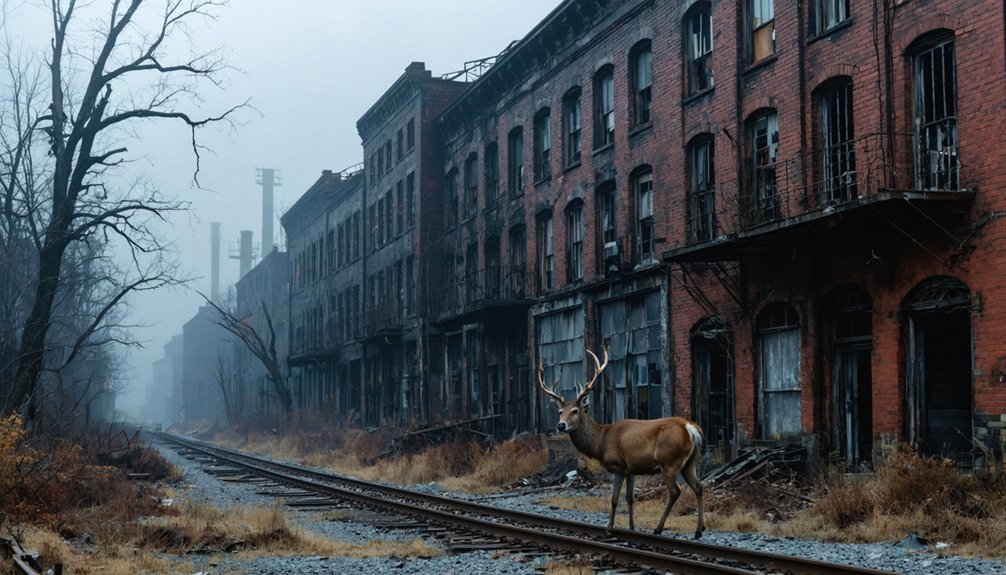
Behind Michigan’s ghost towns lie complex stories of economic upheaval, disease outbreaks, and environmental destruction that forced entire communities to vanish.
You’ll find abandonment stories of company towns that collapsed when single industries failed – from logging operations that stripped the land bare to mines that became unprofitable during market downturns.
Ghost narratives often emerged from the tragic waves of diphtheria that swept through settlements like Pere Cheney, decimating families and leaving only graveyards behind.
- When founding companies withdrew support, entire communities lost schools, stores, and basic services within years.
- Boom-and-bust cycles in lumber and mining left hazardous landscapes of abandoned shafts and depleted resources.
- Disease outbreaks combined with economic hardship created compound disasters that made recovery impossible for many towns.
Best Times to Explore Michigan’s Ghost Towns
When planning your visit to Michigan’s ghost towns, timing can make or break your exploration experience.
Summer offers the most reliable access, with peak daylight hours and full operations at sites like Glen Haven’s blacksmith shop and Fayette’s townsite buildings. You’ll find ideal weather from June through August, with comfortable temperatures for extended outdoor exploration.
For a more atmospheric experience, consider visiting during fall when paranormal events and haunted tours take over. Mid-September through October brings eerie evening programs at Fayette and Quincy Mine, plus spectacular fall foliage.
Avoid winter months when heavy snowfall (averaging 240 inches in the Keweenaw) blocks access to most Upper Peninsula sites.
Spring’s best visiting window starts in May as snow melts and historic sites reopen their doors.
Photography Tips for Capturing Decay

To effectively document Michigan’s decaying ghost towns, you’ll need the right photographic tools and techniques. Start by capturing wide-angle shots during golden hour to showcase dramatic shadows across deteriorating structures.
For intimate decay textures, use prime lenses to highlight peeling paint, rusted metal, and weathered wood details that tell the story of abandonment.
- Pack essential gear including a tripod for low-light stability, flashlights for interior exploration, and wide-angle lenses for sweeping town views.
- Focus on key buildings like saloons, churches, and hotels while incorporating narrative storytelling through artifacts like old cars and furniture.
- Experiment with long exposures at dawn and dusk to create eerie atmospheres, and try light painting to illuminate dark corners in vibrant colors.
Frequently Asked Questions
Are There Any Reported Paranormal Activities in Michigan’s Ghost Towns?
You’ll discover numerous paranormal sightings at Michigan’s haunted locations, including Pere Cheney Cemetery’s ghostly children, Fort Wayne’s soldier spirits, Henderson Castle’s phantom owners, and Franklin Cemetery’s mysterious green headstone.
Which Ghost Towns Still Have Actual Residents Living There Today?
Despite a 90% population decline since 1887, Central Mine maintains year-round residents, while you’ll find modern inhabitants in Dollarville, Copper Harbor hamlets, Pines, and select Keweenaw ghost town settlements.
What Items Can Legally Be Collected From Michigan Ghost Town Sites?
You can’t legally collect collectible artifacts without property owner permission. On private ghost towns, you’ll need explicit consent. Public lands have strict legal restrictions requiring permits and archaeological oversight.
How Many Undiscovered Ghost Towns Might Exist in Michigan’s Forests?
You’d likely find dozens to low hundreds of hidden settlements scattered across Michigan’s forests, with most forgotten history concentrated in the Upper Peninsula where dense woodlands conceal former logging and mining camps.
Do Any Ghost Towns Host Special Events or Seasonal Celebrations?
Like spirits rising from the past, you’ll find ghost town festivals at Fayette’s Fall Fest, Quincy Mine’s haunted tours, and seasonal ghost hunts during Michigan’s Paranormal Convention at historic sites.
References
- https://www.awesomemitten.com/ghost-towns-in-michigan/
- https://www.nps.gov/slbe/learn/historyculture/ghosttowns.htm
- https://99wfmk.com/michigan-ghost-town-gallery/
- https://michiganhomeandlifestyle.com/the-towns-that-once-were-michigans-ghost-towns/
- https://www.visitkeweenaw.com/things-to-do/museums-history/ghost-towns/
- https://exploringthenorth.com/ghost/towns.html
- https://www.keweenawhistory.org/Central
- https://www.youtube.com/watch?v=7-vjuqiGWJU
- https://www.visitkeweenaw.com/blog/post/our-top-7-keweenaw-ghost-towns-to-explore/
- https://www.nps.gov/kewe/learn/historyculture/copper-mining-timeline.htm