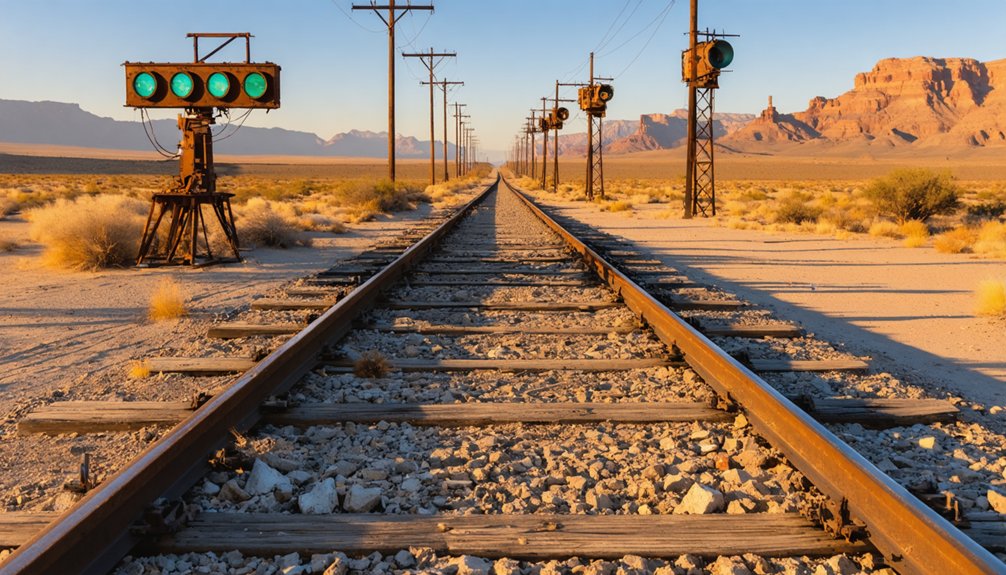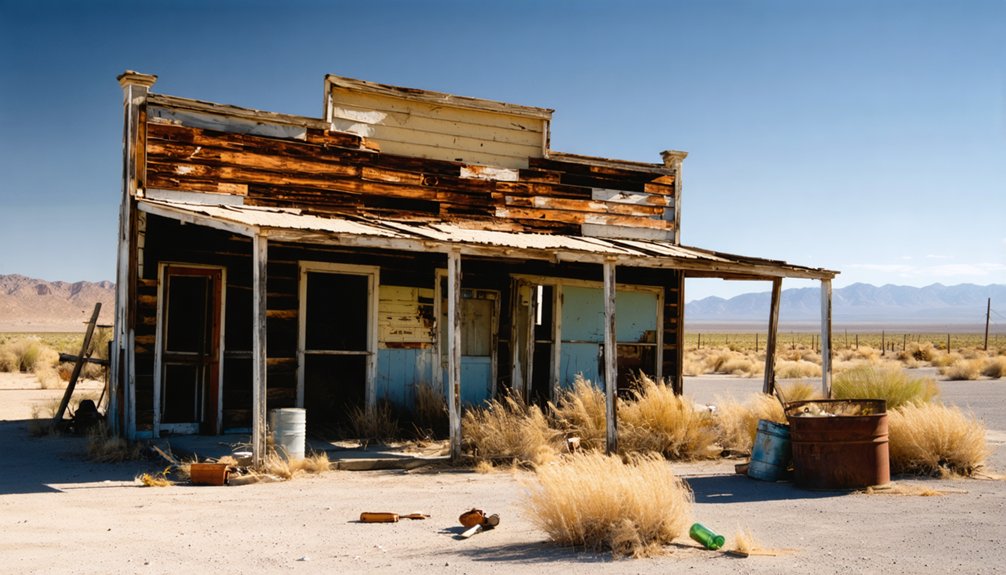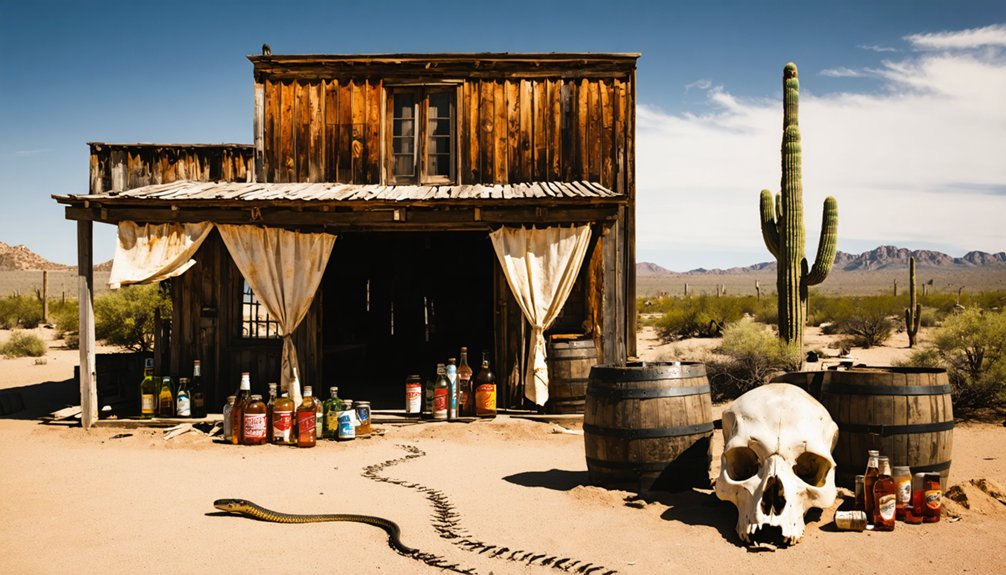
You’ll find Arizona’s ghost towns haunted by dark histories of bloodshed and tragedy. In Two Guns, an Apache massacre site turned failed tourist trap saw multiple fires and violent deaths. Tombstone’s streets ran red during the lawless silver rush, while Jerome earned its reputation as “America’s wickedest town.” Ruby’s abandoned mining camp holds tales of murder, and Oatman Hotel’s supernatural residents still lift glasses and move objects. These crumbling ruins hold countless untold secrets waiting to be unearthed.
Key Takeaways
- Jerome, once Arizona’s largest copper boomtown, features a sliding jail, underground tunnels, and reports of ghostly activity in its historic buildings.
- Two Guns holds dark history with the 1878 Apache massacre, failed tourist attractions, and mysterious fires fueling persistent paranormal tales.
- Vulture City showcases 18 original structures, including the infamous Hanging Tree where 18 miners were executed for gold theft.
- Ruby’s abandoned mining camp maintains over 20 historic structures, with ghostly encounters reported around its preserved schoolhouse and mining facilities.
- Oatman’s historic hotel harbors multiple spirits, including a murdered chambermaid and an Irish miner who moves objects and floats money.
The Dark History of Two Guns
While many ghost towns in Arizona have dark histories, few can match the haunting legacy of Two Guns and its infamous Apache Death Cave. In 1878, Navajo warriors massacred 42 Apache people hiding in the cave, using fire and bullets to trap them inside. The massacre legacy created a lasting local taboo, with neighboring tribes avoiding the site for generations.
You’ll find that historical accounts of the cave’s archaeological uncertainty are intertwined with tourist exploitation. In the 1920s, Harry E. Miller, who falsely claimed Apache heritage, built a zoo and tourist attraction around the site. He allegedly sold skeletal remains and faced violent conflicts with locals. Louise Cundiff and her husband rebuilt the town after Route 66 was rerouted nearby. The site’s dark energy seemed to follow Miller, who was later mauled by mountain lions at his own zoo.
The site’s cursed history continued through fire destruction in 1929 and 1971, spawning folklore myths that persist today.
Ruby’s Haunted Mining Camp Legacy
Deep in the heart of southern Arizona, where Montana Peak casts long shadows across the borderlands, you’ll find the remnants of Ruby – once the state’s most prosperous zinc and lead mining camp.
You’ll discover a place where violence and lawlessness once ruled, marked by brutal murders at the Ruby Mercantile and desperate bandits prowling the Mexican border.
During its heyday, miners crowded into hillside tents while the mine churned 24/7, creating a bustling town of 2,000 souls. The mine’s total ore revenue exceeded $10 million between 1909 and 1949.
Ruby’s resurgence as a preserved ghost town came in 1961 when Tucson families purchased the 362-acre property.
Today, caretakers maintain over 20 historic structures, including a schoolhouse museum.
While ghostly encounters are reported, the current caretaker insists there’s more to fear from the living than the spirits that linger among the adobe ruins. The town’s lone resident, Leslie Cherry, now watches over the property from the old Santa Cruz County courthouse.
The haunting history of Bodie ghost town adds a layer of intrigue to the arid landscape, drawing curious visitors eager to uncover its secrets. As they wander through the dilapidated buildings and eerie streets, tales of past residents and their untimely demises echo in the wind. For Leslie Cherry, the stories of those who once called Bodie home serve as a constant reminder of the town’s vibrant yet tragic past.
Blood-Stained Streets of Tombstone
Unlike Ruby’s remote outpost, Tombstone’s streets ran red in plain sight of civilization.
After silver’s discovery in 1877, the town exploded from nothing to 6,000 residents, bringing a blood soaked legacy that would define Arizona’s wildest chapter.
You’ll find Fremont Street’s violent confrontations immortalized by the infamous Gunfight at the O.K. Corral and subsequent vendetta killings between the Earps and Cowboys.
Local newspapers like the Epitaph and Nugget worked to downplay the violence to protect the town’s business interests.
- Bodies fell where they were shot, staining the dusty streets before being dragged to nearby buildings.
- Boothill Cemetery filled with “buried with boots on” victims, including the McLaurys and Billy Clanton.
- Newspaper wars between the Epitaph and Nugget sensationalized every bloody encounter, drawing more gunmen to town.
The town’s intense violence stemmed from deep divisions between northern mine owners and Confederate-aligned cowboys.
Those thirty seconds of gunfire in 1881 transformed Tombstone’s streets into a permanent monument to frontier justice.
Abandoned Mysteries of Vulture City
As prospector Henry Wickenburg’s pickaxe struck gold-bearing quartz in 1863, he couldn’t have imagined the dark legacy his discovery would spawn.
Within decades, Vulture City lore would include tales of up to 18 men swinging from the infamous Hanging Tree, bold gold shipment heists, and deadly mine collapses. The mine’s notorious reputation grew when high-grade theft by workers forced increased security measures.
You’ll find remnants of this lawless era in the 18 surviving structures, where prospectors once dreamed of striking it rich in a town that yielded 340,000 ounces of gold before World War II forced its closure. Today, visitors can explore these historic remains from October through May, when the site opens its gates to curious history seekers.
Ghost sightings now pepper local accounts, with visitors reporting spectral figures near the Hanging Tree and mysterious sounds echoing from the Glory Hole, where seven miners and their pack animals remain eternally entombed beneath 100 feet of rock.
Ghostly Echoes in Jerome’s Copper Mines
When miners first struck copper on Cleopatra Hill in 1876, they couldn’t have predicted that Jerome would become Arizona’s largest copper boomtown – or that its legacy would haunt the Verde Valley for generations to come.
From humble copper strike to haunted boomtown, Jerome’s story echoes through time in the cliffs of Cleopatra Hill.
You’ll find ghostly whispers echoing through abandoned tunnels where immigrant laborers once toiled, extracting over $800 million in precious metals from the earth’s depths. The mining shadows still linger in this precariously perched town, where massive underground explosions literally shook buildings off their foundations. After multiple devastating fires ravaged the town in the 1890s, Jerome earned its reputation as the “wickedest town” in America. The Phelps Dodge Corporation continued mining operations until 1952, leaving behind a billion-dollar legacy in extracted metals.
- The infamous “Sliding Jail” crept downhill from its original location, pushed by unstable ground beneath.
- Smelter fumes stripped the mountainside bare, leaving an eerily exposed landscape that persists today.
- Deep within the mountain, miles of dark tunnels still hold the memories of thousands who sought their fortunes here.
The Lost Souls of Boothill Graveyard
As you walk among Boothill’s weathered markers, you’ll find the final resting places of Tombstone’s most notorious characters – from gunfight victims like Billy Clanton to lynched outlaws like John Heath.
Roughly 100 unmarked graves hint at untold stories of frontier violence, disease, and poverty that claimed countless souls in this 1880s boomtown.
The cemetery’s mix of documented deaths and mysterious burials makes it a haunting reminder of how quickly life could end in the Old West, whether by bullet, rope, or misfortune.
Notorious Deaths and Burials
While Tombstone’s Boothill Graveyard stands today as a tourist attraction, it once served as the town’s grim necessity from 1879 to 1884, holding the remains of 256 souls who met their end in the untamed West.
Among the notable burials, you’ll find victims of the infamous Cowboys-Earps shootout and China Mary, the influential figure who controlled Hoptown’s vices.
Burial statistics reveal that 40% of deaths weren’t from old age – which started around 40 years in those harsh times.
- Gunshot wounds claimed the most lives among those who died in fights
- John Heath, lynched in 1884, represents both legal and vigilante justice
- The cemetery filled quickly with victims of disease, violence, and accidents, forcing its closure when the new Tombstone Cemetery opened
Boot Hill’s Outlaw Stories
Once a grim necessity for Tombstone’s dead, Boot Hill Graveyard earned its name from the countless souls who died with their boots on – a Western euphemism for violent death.
You’ll find outlaw legends scattered throughout these grounds, where more unmarked graves lie hidden than marked ones. The most notorious resident might be John Heath, lynched by an angry mob in 1884 for his connection to the Bisbee Massacre.
After 1881, Boot Hill became the final resting place for society’s outcasts – from unlucky gamblers to victims of frontier justice.
Even the casualties from the infamous Cowboys-Earps shootout on Fremont Street found their eternal rest here.
Today, visitors claim ghostly encounters among the stone-marked graves, where hasty burials and violent ends left their mark on this windswept hill.
Mystery Graves Still Exist
Despite decades of research and restoration, Boothill Graveyard harbors countless untold stories beneath its rocky soil.
You’ll find 93 unmarked graves among the 256 burial sites, each representing lost souls whose identities vanished with time. The separate Chinese and Jewish sections tell tales of forgotten pioneers, while excavations in the 1930s revealed surprising artifacts that deepened the mystery.
- China Mary’s 1905 burial stands as one of the last in the Chinese section, a rare documented story among many unknowns.
- A long-hidden Jewish section, enclosed by a crumbling adobe wall, went unnoticed for over a century.
- Souvenir hunters stripped away headstones and markers before protective fencing was installed, leaving many graves forever anonymous.
Tragic Tales From Fort Bowie
You’ll find Fort Bowie’s darkest chapter began with the 1861 Bascom Affair, when Lieutenant Bascom’s imprisonment of Chief Cochise‘s family ignited years of brutal warfare and Mail Station attacks.
After Cochise escaped and soldiers retaliated by hanging his brother, a fierce 16-day siege erupted around Apache Pass, with warriors firing down from the hills at terrified station occupants.
The aftermath transformed the peaceful mail route into a blood-soaked battleground, leading the Butterfield Overland Mail to abandon its operations just weeks later.
Apache Siege Aftermath
The tragic aftermath of Fort Bowie’s Apache conflicts left deep scars that would ripple through generations of Native Americans.
You’ll find that Apache retribution following the Bascom Affair transformed this strategic mountain pass into a battlefield drenched in blood and betrayal. What started as a hostage crisis spiraled into decades of warfare, ultimately leading to the forced removal of an entire people from their ancestral lands.
- You can still sense the weight of history at Fort Bowie, where Geronimo’s final surrender marked the end of Native freedom in the region.
- The Chiricahua Apache’s exile to Florida broke sacred connections to their mountain homeland that can never be restored.
- Families were torn apart as children were sent to distant boarding schools, while disease claimed countless lives in unfamiliar territories.
Mail Station Massacre History
While Fort Bowie’s most infamous chapter began as a simple ranch raid in January 1861, it quickly spiraled into one of the Southwest’s darkest episodes.
When Lt. Bascom imprisoned Cochise’s family members during peace talks, you’ll find the seeds of a bloody conflict that would last 25 years.
The massacre aftermath unfolded as Cochise, seeking leverage, captured stationmaster Wallace and sparked a deadly firefight at Apache Pass.
In a brutal display of Apache revenge, four station employees were executed, prompting U.S. soldiers to retaliate by hanging six Apache prisoners.
The bodies were left on display – a fateful decision that ignited Cochise’s fury.
This chain of violence transformed a peaceful mountain pass into a killing ground, where the Butterfield Stage Station’s ruins still whisper tales of treachery.
Supernatural Sightings in Oatman
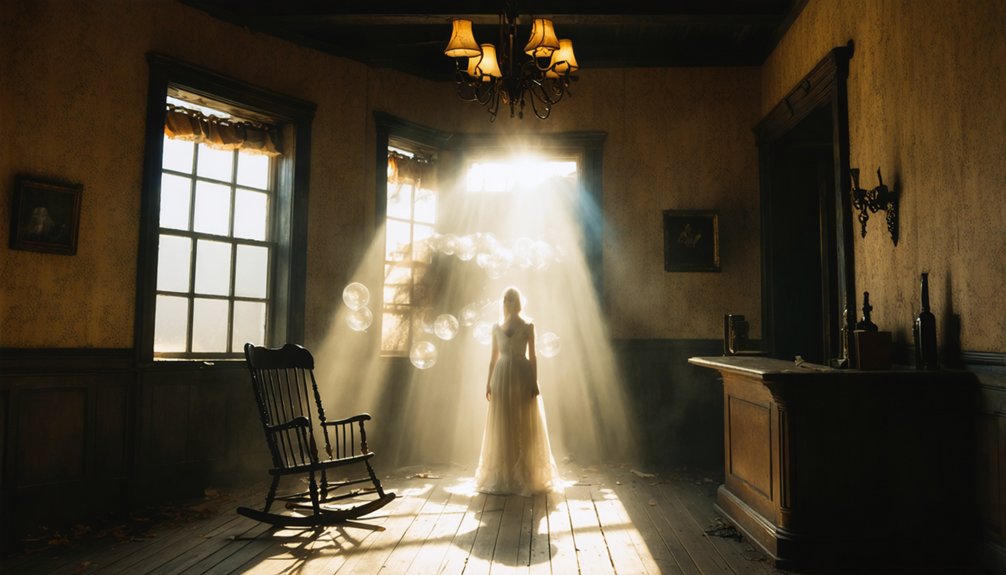
Among the countless haunted hotels dotting Route 66, Oatman Hotel’s supernatural residents have earned a particularly spine-tingling reputation.
You’ll find Oatie’s antics alive and well in this 1902 adobe structure, where the Irish miner’s spirit playfully lifts glasses and floats money through the air.
Beyond ghostly whispers and mysterious footsteps, you’ll encounter the haunting presence of a murdered chambermaid and the lingering spirits of Clark Gable and Carole Lombard from their honeymoon stay.
- Objects move on their own while lanterns sway inexplicably in Oatie’s former room
- A phantom chambermaid leaves body imprints in the dust of the second floor
- The protective spirit of Oatie once saved a clerk from plunging down the stairs
Eerie Remnants of Harshaw Cemetery
Deep in Arizona’s Coronado National Forest, Harshaw Cemetery stands as a haunting memorial to the region’s turbulent past.
Amid towering pines and desert scrub, this weathered graveyard echoes the raw history of Arizona’s untamed mining frontier.
You’ll find it nestled among collapsed adobe ruins and rusted tin-roofed shacks – remnants of what was once a bustling silver mining town of 2,000 souls. The cemetery’s architecture reflects the violent history of fire, Apache raids, and mining accidents that plagued this once-prosperous community.
Ghost town folklore tells of displaced residents who refused to leave even as the Forest Service tried relocating them in the 1960s. Some were descendants of families dispossessed by the Guadalupe Treaty.
Today, you can explore these eerie grounds where weathered headstones tell tales of frontier life amid the desert silence, surrounded by two million tons of abandoned mine waste that ASARCO left behind.
Death and Decay at Kentucky Camp
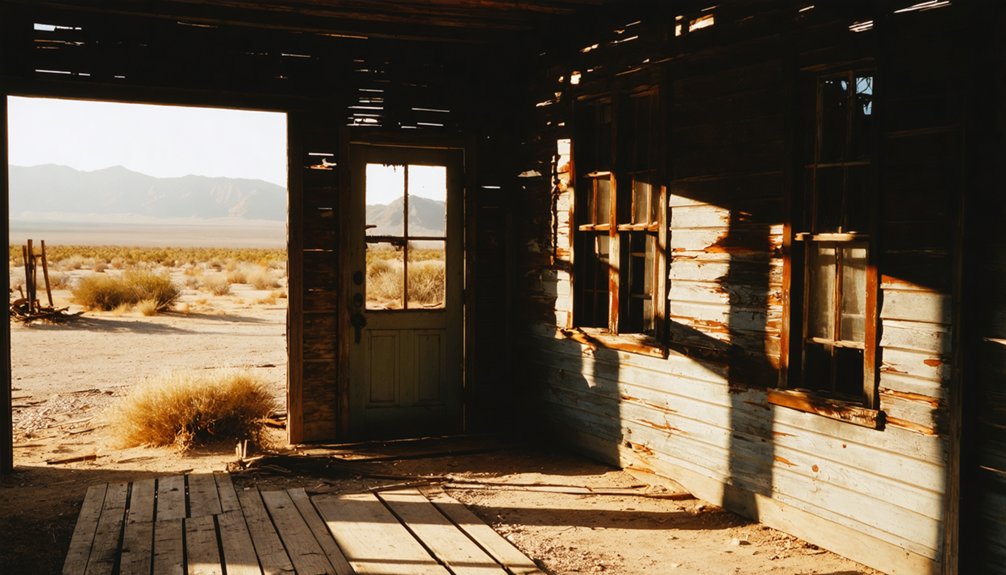
You’ll find more than dusty buildings at Kentucky Camp – this abandoned mining town holds the dark mystery of James Stetson’s suspicious death after falling from a Tucson hotel window in 1905.
His sudden demise triggered the collapse of the Santa Rita Water & Mining Company, leaving behind weathered adobe structures and rusting machinery from their failed hydraulic mining venture.
Today, as you walk among the five surviving buildings, you can still spot remnants of the operation’s ambitions, including the old assay office with its original furnace liners and the company headquarters where Stetson once planned his ill-fated gold extraction scheme.
Historic Murder Mystery
The mysterious death of mining engineer James Stetson in 1905 marked the beginning of Kentucky Camp’s decline into a ghost town.
After falling from his Tucson hotel window under suspicious circumstances, historic hauntings began to plague the once-thriving mining operation.
You’ll find ghostly legends still echoing through the adobe ruins, where some say Stetson’s restless spirit wanders the grounds he once managed.
- Witnesses report hearing phantom pickaxes and shovels in the dead of night
- A lone miner’s whistle pierces the darkness when no one’s around
- Company president McAneny claimed ghosts pursued him until his death in 1909
The truth behind Stetson’s death remains unsolved – was he pushed, drunk, or did he accidentally fall?
This dark mystery haunts Kentucky Camp’s legacy, drawing curious visitors to its preserved buildings deep in Arizona’s mining country.
Abandoned Mining Equipment
Rusted remnants of Kentucky Camp’s ambitious hydraulic mining operation still dot the landscape today, telling a story of technological innovation turned to dust.
You’ll find ghostly artifacts scattered across the gulches where massive monitors once blasted water 100 feet through the air, tearing earth apart in search of gold. The abandoned machinery includes a preserved hydraulic monitor on display, while eight miles of steel pipeline infrastructure stretches silently through the Santa Rita Mountains.
Walk the grounds, and you’ll discover the skeleton of what was once a cutting-edge water delivery system – 24-inch pipes crossing deep canyons, tunnels carved through Dead Horse Mesa, and the crumbling adobe buildings that housed the operation’s nerve center until its untimely demise in 1906.
Frequently Asked Questions
Which Arizona Ghost Towns Still Have Active Paranormal Investigation Teams?
You’ll find active ghost hunting techniques being used in Clifton, Globe, Jerome, and Goldfield, where professional teams regularly investigate active hauntings using specialized equipment and spirit communication methods.
Are There Guided Night Tours Available at Any Arizona Ghost Towns?
You’ll find tons of guided tours after dark – from Tombstone’s spooky O.K. Corral walks to Jerome’s haunted history treks. Don’t miss Bisbee’s ghost town experiences and Vulture City’s eerie flashlight explorations.
What Survival Gear Should You Bring When Exploring Remote Ghost Towns?
You’ll need sturdy boots, protective clothing, reliable lighting, first-aid supplies, navigation tools, and plenty of water. Don’t forget survival essentials like multi-tools, emergency shelter, and energy-rich snacks for safe exploration.
Which Ghost Towns Require Special Permits or Permission to Visit?
You’ll need permits for Ruby’s preserved buildings, Fairbank’s BLM-managed grounds, and Fort Bowie’s ruins. Vulture City requires admission but no special permit for regular self-guided tours.
Do Any Arizona Ghost Towns Completely Prohibit Photography or Video Recording?
You’ll find most ghost town photography restrictions are limited. Ruby’s totally off-limits now, but when open sites were photographable. Gold King Mine and Goldfield require permits for professional shoots, not personal photos.
References
- https://en.wikipedia.org/wiki/List_of_ghost_towns_in_Arizona
- https://kids.kiddle.co/List_of_ghost_towns_in_Arizona
- https://www.visitarizona.com/like-a-local/4-arizona-ghost-towns-you-may-have-never-heard-of
- https://www.visittucson.org/blog/post/8-ghost-towns-of-southern-arizona/
- https://www.ghosttowns.com/states/az/az.html
- https://www.atlasobscura.com/things-to-do/arizona/ghost-towns
- https://www.youtube.com/watch?v=l_ogVgvyw7Y
- https://www.arizonahighways.com/article/arizona-ghost-towns
- https://www.tripadvisor.com/Attractions-g28924-Activities-c47-t14-Arizona.html
- https://pinintheatlas.com/travel-blogs/ghost-towns/