Idaho’s ghost towns offer you a haunting glimpse into America’s mining past, with over 250 abandoned silver mines across War Eagle Mountain alone. You’ll find the historic Idaho Hotel, built in 1863, where spirits like “Screaming Alice” still roam Room 27. From Boot Hill’s 3,000 unmarked graves to Silver City’s well-preserved 1860s structures, these remote mountain settlements tell tales of fortune, tragedy, and mysterious disappearances that echo through time.
Key Takeaways
- Silver City contains 75 original structures from the 1860s, including the haunted Idaho Hotel where ghostly encounters are frequently reported.
- Boot Hill Cemetery holds over 3,000 unmarked graves with only 28 natural deaths, suggesting violent endings for many buried there.
- Burke Canyon features twisted railroad tracks and decaying mining equipment, remnants of its dark industrial past.
- Bayhorse’s preserved buildings tell stories of mining disasters and hardships, with structures frozen in time since abandonment.
- Gilmore’s abandoned mining structures and empty buildings create an eerie atmosphere, following a rapid population exodus after economic collapse.
The Rise and Fall of Idaho’s Mining Settlements
When gold was first discovered at Pierce in 1860, it launched a series of mining booms that would transform Idaho’s landscape and establish its early settlement patterns.
Pierce’s 1860 gold discovery sparked an unprecedented mining rush that shaped Idaho’s development and defined where people would settle.
You’ll find that subsequent discoveries in the Boise Basin and Owyhee Mountains triggered rapid town development, with places like Idaho City and Silver City rising from empty wilderness into bustling centers of commerce.
These mining boom settlements attracted a diverse mix of international migrants, with Chinese workers making up nearly half the population in some Boise Basin communities.
The Silver Valley region became particularly noteworthy, developing into one of the world’s most productive silver districts.
But the glory days wouldn’t last forever. When high-grade ore became scarce, metal prices collapsed, or expensive new mining technologies failed to produce profits, many towns faced rapid settlement decline.
From 1860 to 1866, Idaho produced 2.5 million ounces of gold, accounting for 19% of the United States’ total gold production.
Tales of the Haunted Idaho Hotel
Among Idaho’s most infamous haunted locations, the historic Idaho Hotel stands as a compelling evidence to Silver City’s wild frontier past.
Built in 1863 and relocated in 1866, this oldest hotel in Idaho has witnessed countless ghostly encounters. The most chilling tale involves Room 27, where former owner O.D. Broombaugh took his own life. The hotel was once part of a thriving community with over 300 homes during Silver City’s peak. You’ll find it perched at 6,200 feet in the Owyhee Mountains, where it’s survived while other buildings succumbed to flames.
During your stay, you might encounter Screaming Alice in her white dress, a gentleman in tux and tails, or children playing marbles in period clothing.
Paranormal investigations have documented mysterious light switches flicking, unexplained cold spots, and disembodied voices.
Two spirits from an 1800s shootout are said to roam the halls, while a mysterious man in a duster coat haunts the stairwell.
Exploring Abandoned Mining Structures
Throughout Idaho’s rugged terrain, abandoned mining structures stand as haunting monuments to the state’s rich mineral-extraction history.
You’ll discover weathered remnants across sites like Bayhorse, where preserved buildings tell tales of economic hardship and natural disasters. The area remains a semi-abandoned site with a small number of caretakers maintaining the grounds.
In Burke Canyon, you can explore twisted railroad tracks and decaying equipment while passing cave-like dwelling holes carved into hillsides.
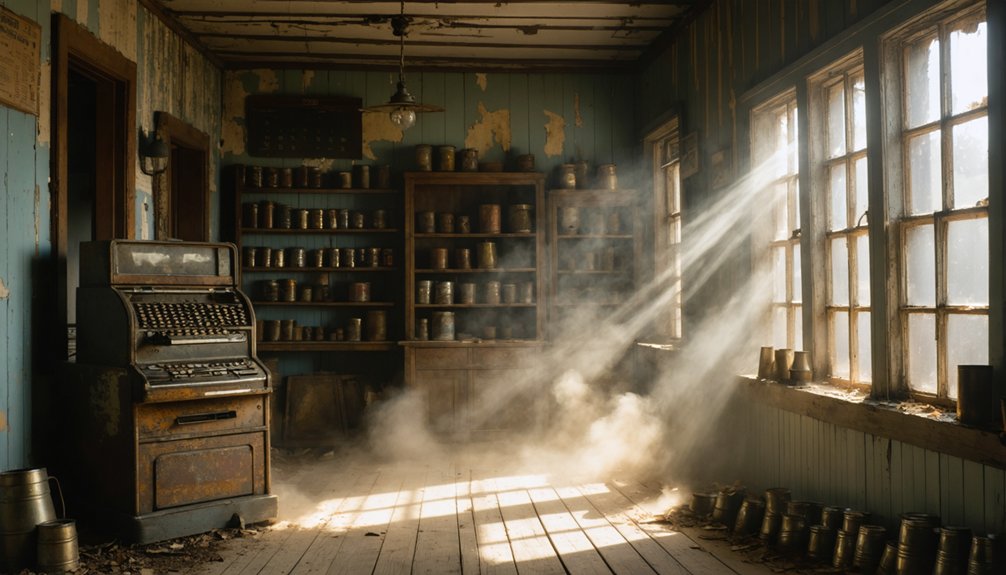
The mining relics at Gilmore reveal a once-thriving community with schools and stores before plummeting metal prices forced its abandonment.
Rocky Bar’s well-preserved structures offer an intimate glimpse into mining life, while Leesburg’s scattered log cabins and 120-year-old powerhouse showcase early electrical innovation.
These abandoned structures, from unmarked cemeteries to stamp mills, serve as stark reminders of Idaho’s boom-and-bust mining era.
The arid conditions in Idaho have helped preserve many historical structures, allowing visitors to experience authentic remnants of the past.
Hidden Treasures in the Boise Basin
The Boise Basin stands as one of America’s richest gold-producing regions, yielding over 3 million troy ounces since its 1862 discovery by the Grimes Party at Boston Bar.
Small streams and creeks drain through the basin’s rugged terrain, offering prime prospecting areas.
If you’re drawn to treasure hunting, you’ll find tales of hidden caches scattered throughout the area’s rugged landscape. Local legends speak of stagecoach robberies, including 300 pounds of stolen gold allegedly buried near Bannock County in 1865, and a mysterious $40,000 coin shipment concealed near Rye Flats.
You’ll discover prime hunting grounds in the gravels and arroyos northeast of Boise and around Idaho City. While dredging operations have altered much of the terrain, historical watercourses still hold potential riches. Gold coin shipments were frequently hidden in metal boxes by bandits who never returned to retrieve them.
Chinese mining sites offer another perspective, with artifacts and personal effects waiting to be uncovered in former camp locations.
Life and Death in Mountain Ghost Towns
If you’d visited an 1880s Idaho mining camp, you’d have faced brutal living conditions including crude housing, unreliable food supplies, and minimal medical care.
You would’ve witnessed frequent deaths from mining accidents, disease outbreaks, and harsh winter exposure, especially in high-elevation settlements where avalanches posed constant threats.
Your chances of survival would’ve decreased further due to the lawlessness, violence, and occupational health hazards that plagued these isolated mountain communities.
Settlers in Silver City endured life at over 6,000 feet elevation, making basic survival especially challenging during severe mountain winters.
Mining Camp Daily Struggles
Mining in Idaho’s remote mountain camps brought grueling daily routines and constant hardships for thousands of laborers who crowded into narrow valleys near mine entrances.
You’d find yourself waking at 5:30 AM, rushing through breakfast, and spending up to 14 hours away from your cramped shack between work and travel time. Underground shifts lasted 10 hours, with just one Sunday off every other week.
Labor disputes erupted frequently as miners fought for better wages and safer conditions. You’d earn between $3.50 to $7 per day depending on your skill level, but mine owners often cut wages or failed to pay entirely. The workforce consisted mainly of European immigrants, with only 25% native-born Americans working the mines.
When smelter trusts hiked their rates, tensions exploded into violent conflicts, with dynamitings and armed battles requiring military intervention to restore order.
Harsh Mountain Living Conditions
Beyond the grueling work shifts, daily survival in Idaho’s mountain ghost towns demanded extraordinary resilience against nature’s harshest elements.
You’d face snowy isolation at elevations over 6,000 feet, with communities like Silver City buried under six-foot snowdrifts that blocked access for weeks. Mountain passes and narrow canyons cut off escape routes, leaving you stranded during fierce winters.
Resource challenges meant adapting to bare essentials. You’d rely on propane for basic needs, while solar panels powered minimal appliances.
The harsh environment claimed both structures and lives – floods and fires destroyed Burke’s cemetery headstones, while Leesburg’s graves lie scattered among ruins.
When precious metal prices crashed, these hardships accelerated abandonment. Communities like Custer and Gilmore couldn’t sustain life against the combined assault of economic decline and mountain isolation.
Remnants of the Silver Rush Era
You’ll find over 250 abandoned silver mines scattered across War Eagle Mountain, where miners once extracted more than $60 million in precious metals during Silver City’s 70-year heyday.
The town’s well-preserved ruins include 75 original structures from the 1860s, offering you a rare glimpse into an authentic mining settlement that wasn’t destroyed or commercialized like many others.
Walking through Silver City’s silent streets today at 6,200 feet elevation, you’ll encounter historic buildings that have weathered harsh mountain winters without modern amenities like electricity or plumbing, standing as monuments to Idaho’s silver rush era.
Silver Mines Now Silent
Deep beneath Idaho’s rugged terrain, the once-bustling silver mines that defined the state’s mineral wealth now stand eerily silent.
Where ghostly echoes of the Coeur d’Alene District‘s billion-ounce legacy once rang out, you’ll find just 2 active mines among 90 historic sites. Silver whispers through abandoned shafts tell tales of an empire that produced 85% of Idaho’s silver and housed America’s largest underground operation.
The collapse hit hardest in the 1980s, when Bunker Hill’s closure drove away 6,000 residents – a third of Shoshone County’s population.
Today, you’re witnessing the aftermath of this decline: a 1,500-square-mile EPA Superfund site wrestling with heavy metal contamination.
The region’s silent mines stand as stark reminders of boom-turned-bust, while communities struggle with persistent unemployment and poverty.
Abandoned Buildings Tell Stories
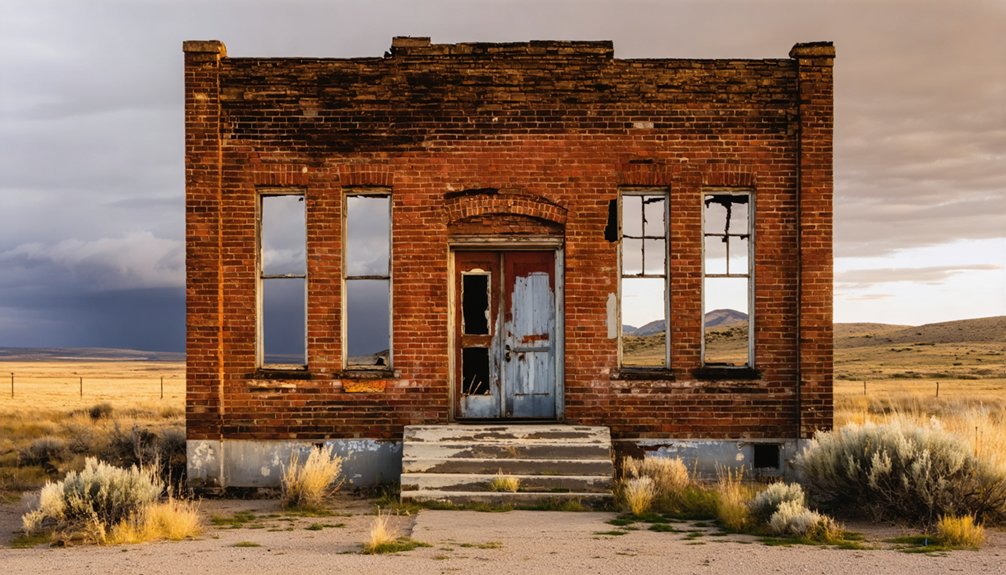
Time-weathered buildings scatter across Idaho’s ghost towns, revealing the rich architectural legacy of the silver rush era.
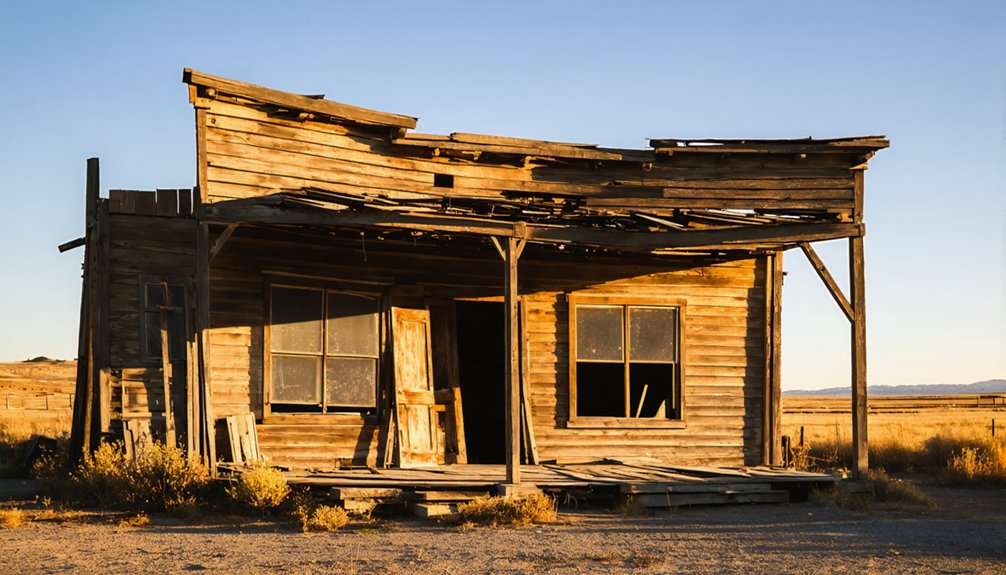
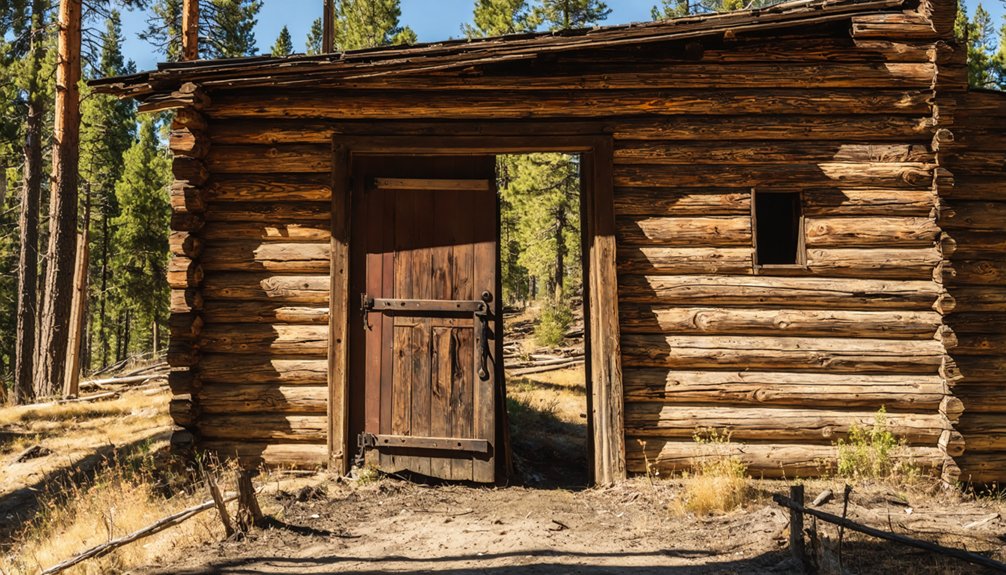
You’ll find wooden false-front storefronts that once housed bustling saloons and assay offices, their facades telling tales of 19th-century commerce. The abandoned architecture speaks through every detail – from saddle-notched log cabins to grand hotel ruins that housed up to 2,500 residents during the 1880s peak.
These historical narratives continue in the industrial remains: stamp-mill foundations, narrow-gauge rail beds, and water flume remnants map out the complex ore-to-market workflow.
Church foundations and cemetery plots reveal demographic stories, while schoolhouse ruins and courthouse remains show how mining camps evolved into structured towns.
Each deteriorating structure, from corrugated-metal foundations to newspaper offices, preserves a chapter of Idaho’s silver rush heritage.
Forgotten Cemetery Trails

Among Idaho’s most haunting remnants of its gold rush era, the forgotten cemetery trails weave through places like Boot Hill, Bonanza, and Leesburg, where thousands of unmarked graves tell stories of frontier hardship and loss.
Along Idaho’s dusty trails, silent graveyards mark the haunting footsteps of gold seekers who never found their way home.
You’ll find forgotten markers hidden beneath overgrown pine and sagebrush, with weathered inscriptions that barely hint at the lives they commemorate.
- Boot Hill Cemetery holds over 3,000 unmarked graves, with only 28 of its first 200 recorded deaths attributed to natural causes.
- Bonanza’s rundown cemetery grounds contain deteriorating wooden markers among abandoned cabins.
- Leesburg’s high-elevation burial grounds, once home to both pioneer and Chinese miners’ remains, now blend into the rugged mountain landscape.
Preserved Relics of the Old West
While Idaho’s mining towns largely faded into history, several remarkably intact settlements offer windows into the Old West’s golden age.
You’ll discover pristine historic architecture in Silver City, where 70 original buildings from the 1860s still stand at 6,200 feet in the Owyhee Mountains. The Idaho Hotel remains a reflection of this mining heritage.
In Custer and Yankee Fork, you can explore a restored gold dredge and period-accurate structures that showcase boomtown life.
Burke’s unique canyon setting forced miners to build directly into cliff faces, leaving behind fascinating industrial remains.
Don’t miss Placerville and Idaho City’s preserved commercial districts, where authentic saloons and public buildings transport you back to the era when fortune-seekers carved out communities in Idaho’s rugged wilderness.
Frequently Asked Questions
Are There Any Dangerous Wild Animals to Watch Out for in Ghost Towns?
You’ll need to watch for mountain lions, bears, wolves, and rattlesnakes during wild animal encounters. Take safety precautions like carrying bear spray and staying alert in abandoned structures.
What Survival Gear Should I Pack for Ghost Town Exploration?
Like a well-oiled machine, you’ll need survival essentials including protective gear, lighting, first-aid supplies, navigation tools, and exploration tools like multi-tools, duct tape, and route markers.
Which Ghost Towns Are Accessible During Winter Months?
You’ll find winter accessibility best at Silver City and Gilmore, where year-round residents maintain some access. You’ll need tracked vehicles or snowmobiles, as ghost town conditions become treacherous with heavy snowfall.
Do Any Ghost Towns Require Permits or Permission for Metal Detecting?
Like buried treasure waiting to be found, you’ll need permits for metal detecting in ghost towns. They’re protected by ARPA and state laws – contact land managers for required permissions and regulations.
Can Visitors Take Home Small Artifacts Found in Ghost Towns?
You can’t legally remove artifacts from ghost towns – it’s prohibited on public lands and requires owner permission on private property. For artifact preservation and to avoid legal implications, take photos instead.
References
- https://www.thegoldminehotel.com/ghost-towns-and-haunted-places-in-idaho
- https://history.idaho.gov/wp-content/uploads/2018/08/0064.pdf
- https://idaho-forged.com/idahos-ghost-towns-eerie-yet-approachable/
- https://visitidaho.org/things-to-do/ghost-towns-mining-history/
- https://westernmininghistory.com/state/idaho/
- https://en.wikipedia.org/wiki/History_of_Idaho
- https://isb.idaho.gov/wp-content/uploads/Idaho_History_Timeline_1977.pdf
- https://www.idahomuseum.org/chinese-mining/
- https://www.idahogeology.org/pub/Pamphlets/P-131.pdf
- https://uidaholib.github.io/hist404-group3/timeline/